🏛️ Masters of Mesopotamia: How Assyrian Soldiers Crossed the Tigris and Euphrates 🌊
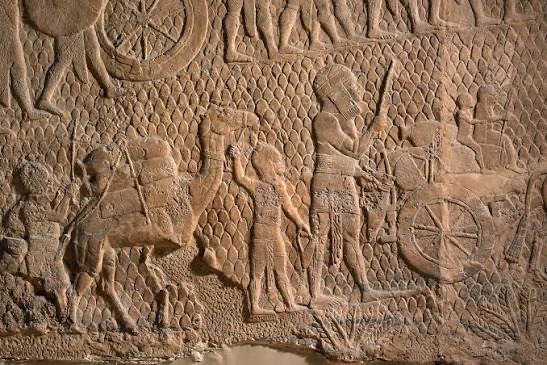
This extraordinary Assyrian relief, dating to 865–860 BC, preserves one of the earliest known visual representations of military swimmers in history. Carved nearly 2,900 years ago, it depicts Assyrian soldiers crossing one of the great rivers of Mesopotamia—the mighty Tigris or Euphrates—using an ingenious technique that helped build one of the ancient world's most powerful empires.
The soldiers are shown swimming while supported by inflated animal skins, usually goat or sheep skins, which served as portable flotation devices. These air-filled skins allowed warriors to cross deep and fast-flowing rivers while carrying weapons and equipment. Once ashore, the skins could be deflated, packed, and reused throughout the campaign.
⚔️ Why was this technique so important?
🔹 It allowed armies to cross rivers rapidly without bridges.
🔹 It enabled surprise attacks and swift military campaigns.
🔹 It facilitated the transport of soldiers, horses, weapons, and supplies.
🔹 It demonstrated advanced planning, engineering, and military organization.
Ancient sources indicate that these flotation skins were widely used throughout Mesopotamia for both military and civilian purposes, making them one of the most practical innovations of riverine life in the region.
Far more than a work of art, this relief offers a fascinating glimpse into the ingenuity of the Assyrians—masters of warfare, engineering, and adaptation. Long before modern military pontoon bridges and amphibious units, Assyrian soldiers were already mastering the waters of the Tigris and Euphrates, the lifelines of ancient Mesopotamia.
🌊🏹🐎 A timeless testament to the innovation and resilience of one of history's greatest civilizations.
#Assyria #AssyrianEmpire #Mesopotamia #AncientMesopotamia #Tigris #Euphrates #AncientHistory #MilitaryHistory #Archaeology #Nimrud #Kalhu #NeoAssyrianEmpire #AncientEngineering #RiverCrossing #AncientWarfare #NearEast #HistoryLovers #ArchaeologicalHeritage #Cuneiform #Civilization
Amid (modern-day Diyarbakır) was an Assyrian city. These 2 Assyrian monuments discovered in Amid are now displayed in the British Museum. Amid was also an important center of the Church of the East and I believe served as the patriarchal seat during certain periods of its history
@BasimHKH I had to make a correction
There is no Kurdish language that’s Indo Iranian and Arabic
Kurds are Sunnis from Iran who were deported to Iran under the ottomans
The Rise of Modern Assyria: The Scenario That Would Have Redrawn the Middle East in 1918
Introduction
History is written by the victors, but military reality is forged by the rifles on the ground. During World War I, the Assyrian people faced existential threats that led to
طرحت على ذكاء صناعي سؤال قلت لو الاشوريين في الحرب العالمية الاولى اعتمدوا على نفسهم ماذا كان سيحدث؟ طبعا كان نقاش متبادل، و انا اعطيته سيناريو تخيلي لما سيحدث.....
صعود آشور الحديثة: السيناريو الذي كان سيعيد رسم خريطة الشرق الأوسط عام 1918
🚨 𝗕𝗥𝗘𝗔𝗞𝗜𝗡𝗚: The Norwegian FA has officially filed a complaint against FIFA after Donald Trump received the FIFA Peace Prize during the 2025 World Cup draw.
They believe FIFA may have violated its political neutrality rules.
— @VI_nl
The Mar Mattai Monastery was founded in 363 AD.
It sits in the heart of Old Testament Nineveh, where Jonah preached to the Assyrians.
Miraculously, ISIS did not reach Mar Mattai. Otherwise, it would be lost forever—just like the tomb of Jonah which they blew up.
@MorAphremII
HDP eski Diyarbakır Milletvekili Altan Tan’dan Amedspor tepkisi:
“‘Amed’ kelimesi Süryanicedir.
Diyarbakır’daki Amed bölgesinin Kürtlerle ilgisi yoktur. Bölgede 1970’lere kadar Azerbaycan Türkçesi konuşuluyordu.
Amed ile Diyarbekir'i çarpıştırmayın.
Kimliklerle, tarihle oynamayın.
Bölgesel bir temsilse Diyarbekirspor olması lazım. İsimleri, kimlikleri doğru düzgün yerine koyalım.”
Their bodies laid in the street for hours because nobody dared to retrieve them.
Today, 19 years ago, Fr. Ragheed was martyred for refusing to close a church in Mosul.
19 years—no justice or recognition.
He finished delivering mass in Mosul & walked to his car with three deacons.
Islamic gunmen stopped them.
"We told you to close the church."
His last words will be remembered forever. He was martyred alongside three sub-deacons.
"How can I close the house of God?"
Fr Ragheed was born in Mosul in 1972, studying Theology in Rome & Computer Science in Dublin.
He served at the Chaldean Church of the Holy Spirit in Mosul, the heartland of Assyrian Christianity.
The Classical Syriac word for “pen” is qanyā (ܩܢܝܐ), a direct descendant of the Akkadian qanû (“reed”). However, in modern Assyrian, the more common word is qalama, which is cognate with Arabic qalam. Both ultimately derive from the Greek kalamos, meaning “reed” or “reed pen.”