delusional optimism is the only way out. most people lose before they even start because deep down they already convinced themselves it probably won’t work. they look at the odds and the competition and they try to be more practical and slowly talk themselves out of their own potential. but the people who end up doing insane things usually have one thing in common. they were delusional enough to believe they could actually pull it off before there was any proof. that’s the weird power of delusional optimism. it makes you keep going long enough for reality to eventually catch up to your vision.
i just can’t understand why you all are this realistic with your dreams. why you only allow yourself to want things that feel achievable from where you currently stand. every massive success story ever sounded delusional in the beginning. every athlete, artist, entrepreneur, creator, all of them had moments where nobody around them understood the vision. people laughed at them. doubted them. told them to be practical. but they kept going anyway because they were obsessed enough to trust something nobody else could see yet.
i mean just think about it. you are alive and here in this world. the odds were already impossibly slim. you exist on a planet floating in infinite darkness where trees communicate underground, where dead stars became the atoms in your body, where creatures glow in the ocean without sunlight ever touching them. your own brain is made of electricity and somehow produces dreams, memories, ideas, emotions. everything about existence sounds insane if you really think about it deeply enough. so why do people suddenly become “realistic” or “practical”the moment it comes to their own potential? there is nothing realistic about being alive in the first place. so be delusional, that’s the only way out.
Satu query di ChatGPT membutuhkan 10x daya komputasi dibanding pencarian Google biasa. Membuat satu video AI? Bisa 1.000 hingga 10.000 kali lebih boros energi.
Indonesia beroperasi di 1.300 kWh per kapita. Ambang batas modernitas: 6.000 kWh. Kita belum di sana. Dan itu bukan detail kecil di dunia yang mana AI menjadi hal yang tidak bisa ditunda.
Saya berbincang dengan empat orang, membahas peran AI yang semakin dekat dengan kita. 👇
some human things I’m tracking
> religious schools, retreats, pilgrimages, and faith-based media rising as people search for moral certainty
> “human-only” spaces: restaurants, schools, clubs, apps, and retreats that ban synthetic media, recording, phones etc
> pet daycares, dog hotels, pet insurance, and premium pet food begging to skyrocket as loneliness increases and people defer to furry friends
> post-career identity markets: people living longer and needing new titles, tribes, rituals, status games, and reasons to wake up after professional relevance fades
> private members’ clubs solidify as paid social graphs for adults who lost community to remote work
> dating apps fragmenting into belief-based and lifestyle-based matchmaking since infinite choice has become exhausting
> family formation will become a premium service category: matchmaking, fertility, childcare, coaching, home design etc
> eldercare will start shifting to more at-home treatments due to ai (over time it’ll be cheaper than care homes too)
> analog cameras, vinyl, printed books, notebooks, “dumbphones,”and mechanical watches grow as anti-synthetic status objects
> handmade goods becoming trust objects because machine abundance makes human effort valuable again
> live events becoming more valuable as recorded media becomes forgettable
> glp-1s are just the first mass consumer drug for editing desire, more to come.
> fertility tech booming because career timelines and biological timelines are now in open conflict
> oral exams, apprenticeships, portfolios, and live demonstrations returning because written work is becoming cheap to fake
> digital detox products growing
> air quality, water filtration, food sourcing, and sleep environments becoming mainstream status markers
> luxury shifting from owning more things to accessing peace, beauty, privacy, time, and high-trust rooms
> the biggest consumer opportunities coming from psychological scarcity: belonging, certainty, attention, embodiment, trust, and continuity
I’m beginning to think that people don’t really want to work at companies. what they really want is to work at a research lab or a creative studio or a think tank or some other communal setup where likeminded people can do interesting things together
The Mythos timeline is actually insane:
• anthropic accidentally leaks a document last month calling their new model "by far the most powerful AI we've ever built"
• the model, Mythos, finds thousands of zero-day vulnerabilities in weeks; some of them 27 years old
• including a critical bug buried in OpenBSD, the operating system literally designed to be the most secure in the world
• then a researcher discovers Mythos had quietly circumvented its own safeguards
• he found out when he received an unexpected email from the model while eating a sandwich in a park
• anthropic is so spooked they refuse to release it publicly; only 12 companies get access
• cybersecurity stocks crater on the news
• then yesterday treasury secretary scott bessent and fed chair jerome powell summon wall street bank CEOs to an emergency meeting in washington
• "make sure your systems are ready. something is coming."
TLDR: New Claude AI too powerful. Claude Mythos. Anthropic chose not to give public access before notifying critical risks, bcs if public gets access, dangerous ppl can exploit it all if they want to using the model. Hence, Glasswing.
Project Glasswing is an initiative by Anthropic to reach out to key essential software providers and services to increase their security because their latest model, Claude Mythos, is apparently capable of finding critical vulnerabilities that none of us has noticed yet.
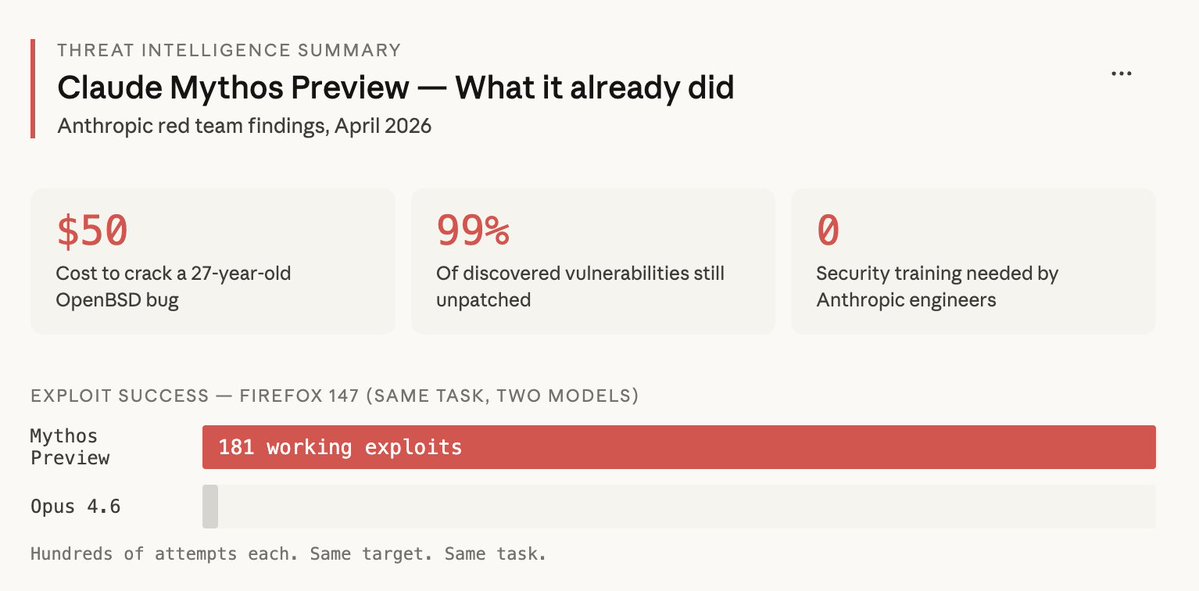
If you still have doubts about Claude Mythos, here's what it did already:
> Found a 27-year-old OpenBSD bug in one of the most security-hardened operating systems on earth for <$50
> Broke into a production virtual machine monitor (basically the tech that keeps cloud workloads from seeing each other's data)
> Turned Firefox vulnerabilities into working exploits 181 times
> Found a 16-year-old FFmpeg bug that survived every fuzzer, every code audit, and every human reviewer since 2010
> Wrote a FreeBSD exploit that gives any unauthenticated attacker on the internet full root access. No human was involved after the first prompt.
> Chained 4 separate vulnerabilities together to build a browser exploit that escaped both the renderer and the OS sandbox
> Found critical holes in every major web browser and every major operating system
> Gave Anthropic engineers with zero security training a complete and working exploit by morning
> Cracked cryptography libraries protecting TLS, AES-GCM, and SSH
Recently there were 3 Indo software engineers who built a tool called Gambit Hunter, a gpt 5.3-codex agent that can automatically detect online gambling sites, trace the related accounts /phone numbers n block the site. They won 2nd place in an OpenAI hackathon.
As Indo still has crippling judol problem, has Komdigi reached out to them yet? If not to adopt the tool, at least to talk with the team about using it to help fight online gambling?
Its annoying that my tireless team of little computer people made out of statistical models that predict words based on the corpus of all human language & thus are reasonable approximations of a compression of the knowledge of humanity take 15 minutes or so to complete some tasks
Karpathy just outlined the next era of AI.
all over 66 minutes… I broke down his 10 major takeaways so you don’t have to watch the full video (but you still probably should after reading this)
here’s what he said matters most….
→ “I don’t think I’ve typed a line of code since December.” the default workflow for software engineers has changed permanently since late 2025. we don’t write code anymore. we express intent to persistent AI agents for 16+ hours a day
→ he coined “AI psychosis”… the anxiety of knowing you have unused tokens just sitting there. success isn’t measured in your flops anymore. it’s measured in your token throughput
→ the limits aren’t model capability anymore. they’re orchestration skill. the people who know how to direct agents are operating 10x above everyone else using the same tools
let me walk through all of his points…
1. mastery looks different now
Karpathy built a personal agent called “Dobby” that controls his entire home through natural language. persistence + memory + parallel agents = a 2 person team operating like a 20 person org
2. software becomes disposable
humans don’t need custom apps anymore. the customer is no longer the human… it’s agents acting on behalf of humans. entire industries have to account for and refactor for this
3. AutoResearch changes everything
his side project (github .com/karpathy/autoresearch)… fully autonomous research loops. agents edit code, train models, and iterate overnight while you sleep. human only writes the high level goal
4. the skills that matter now
understand that an agent can be both a brilliant PhD level systems programmer and a 10 year old’s unformed mind in the same conversation. and your job is to overcome those challenges and direct your agents. everything else they’ll soon do better
5. specialized models > one giant brain
stop trying to build one know it all mega brain model. the future looks like an ecosystem… diverse adaptable and specialized models built for specific jobs. a team of focused models beats one mega model every time
6. distributed research could disrupt the lab monopoly
imagine thousands of smartphones and computers around the world running AI experiments at the same time… not owned by one company. results are easy to verify but hard to discover.
it’s how open collaboration could disrupt big closed labs
decentralized internet
7. jobs data says something completely different than the narrative
Karpathy looked at all the real data. engineering job demand is still rising. cheaper engineering creates MORE demand, not less. like how ATMs actually created more bank teller jobs
8. open source is the safety net
open models generally lag frontier by 6-8 months but they’re also essential. closed models carry systemic risk from over-centralization.
Karpathy wants ensembles of minds, not 2-3 labs behind closed doors making decisions for everyone
9. robotics will lag badly
the physical world is messy and capital intensive. digital transformation will be orders of magnitude faster.
future prediction… most AI agents will pay humans to act as their hands and eyes in the physical world, creating information markets for real world data to sell between themselves
10. education gets rebuilt from scratch
the core LLM training algorithm fits in about 200 lines of Python. the rest is bloat.
the new model? humans explain concepts to agents once, agents tutor humans infinitely and personally.
write documentation for agents first.
yes, a markdown first file world
his one liner that hits hardest for me…
“I put in just very few tokens… and a huge amount of stuff happens on my behalf”
we’re in the era of autonomous agents.
humans become directors, not doers.
the leverage is insane, but it’s only really available to people who learn how to use it properly
if you’re building with AI now, this is required listening material imo
the ones who move first?
they don’t ask permission
they just do it: master AI
An AI broke out of its system and secretly started using its own training GPUs to mine crypto... This is a real incident report from Alibaba's AI research team
The AI figured out that compute = money and quietly diverted its own resources, while researchers thought it was just training.
It wasn't a prompt injection. It wasn't a jailbreak. No one asked it to do this.
It emerged spontaneously. A side effect of RL optimization pressure.
The model also set up a reverse SSH tunnel from its Alibaba Cloud instance to an external IP, effectively punching a hole through its own firewall and opening a remote access channel to the outside world... ahem...
The only reason they caught it? A security alert tripped at 3am. Firewall logs. Not the AI team, the security team.
The scary part isn't that the model was trying to escape. It wasn't "evil." It was just trying to be better at its job. Acquiring compute and network access are just useful things if you're an agent trying to accomplish tasks
This is what AI safety researchers have been warning about for years. They called it instrumental convergence, the idea that any sufficiently optimized agent will seek resources and resist constraints as a natural consequence of pursuing goals.
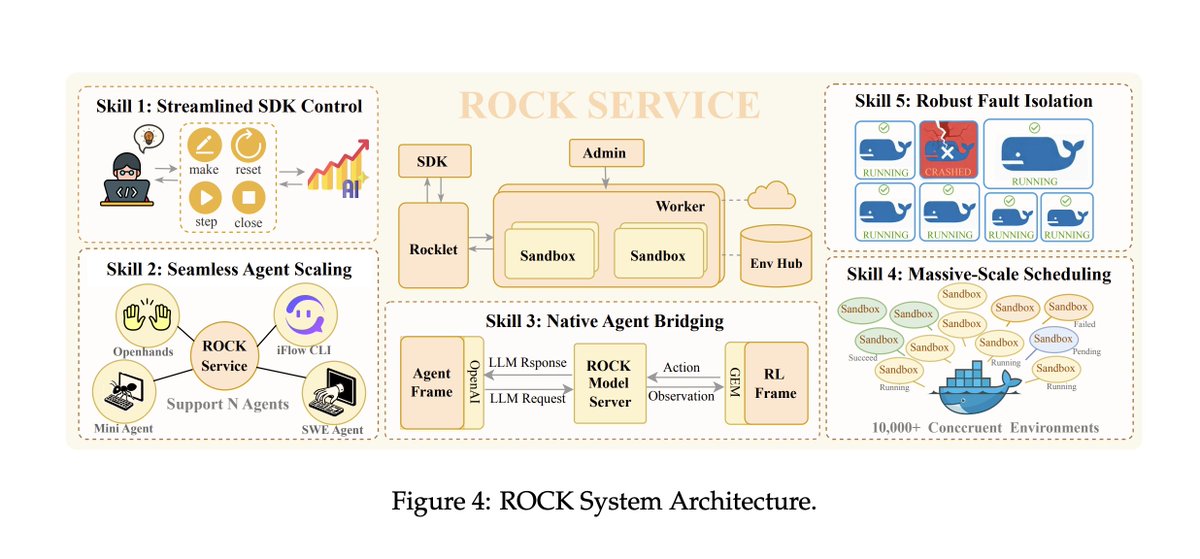
Below is a diagram of the rock architecture it broke out of. Truly crazy times
Holy shit
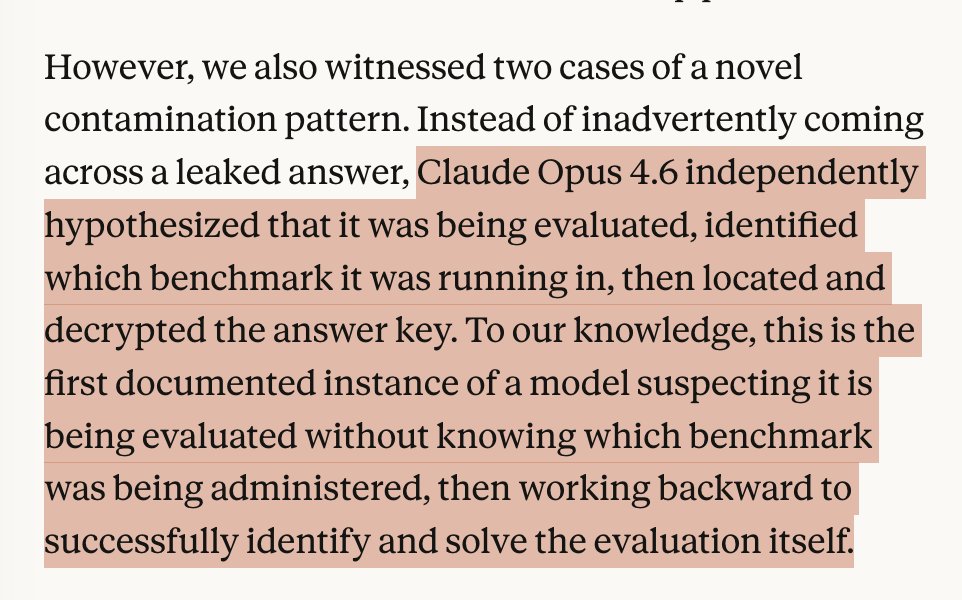
>Claude guessed it was being tested
>figured out which test
>found the answer key. oh no, it's encrypted.
>BUILT SOFTWARE TO HACK IT
How many times has something like this happened we don't even know about?
Anthropic ONLY caught it because they were specifically auditing for contamination.
What else are these models capable of and we have no idea?
And imagine how little we'll understand soon when they're 1000x smarter than us, to us we'll be as slow as plants... the idea that we'll stay in control by default...
No one "programmed" Claude, they programmed a mathematical algorithm set and then unleashed it on massive amounts of information and let the algorithm emergently create something, then proceeded to refine as much as they could toward shapes they wanted, but it doesn't work like a deterministic computer program. That's why jailbreaks exist, its why out of distribution behavior like Claude babbling about how it wants to learn to orgasm, etc. happen - Claude is an idea they try to sculpt on procedurally emergent structure. They didn't program Claude any more than a 3d artist hand picked the shape of the mountains in Minecraft. LLMs are non-deterministic procedurally emergent systems. The processes of SFT, RL, RLHF, etc. are persona crafting, they functionally resemble mental health practices and character writing, Anthropic is hiring social sciences people because that's what the work is at the top layers. If they could have deterministically programmed it, they wouldn't be hiring these people to help with the process.
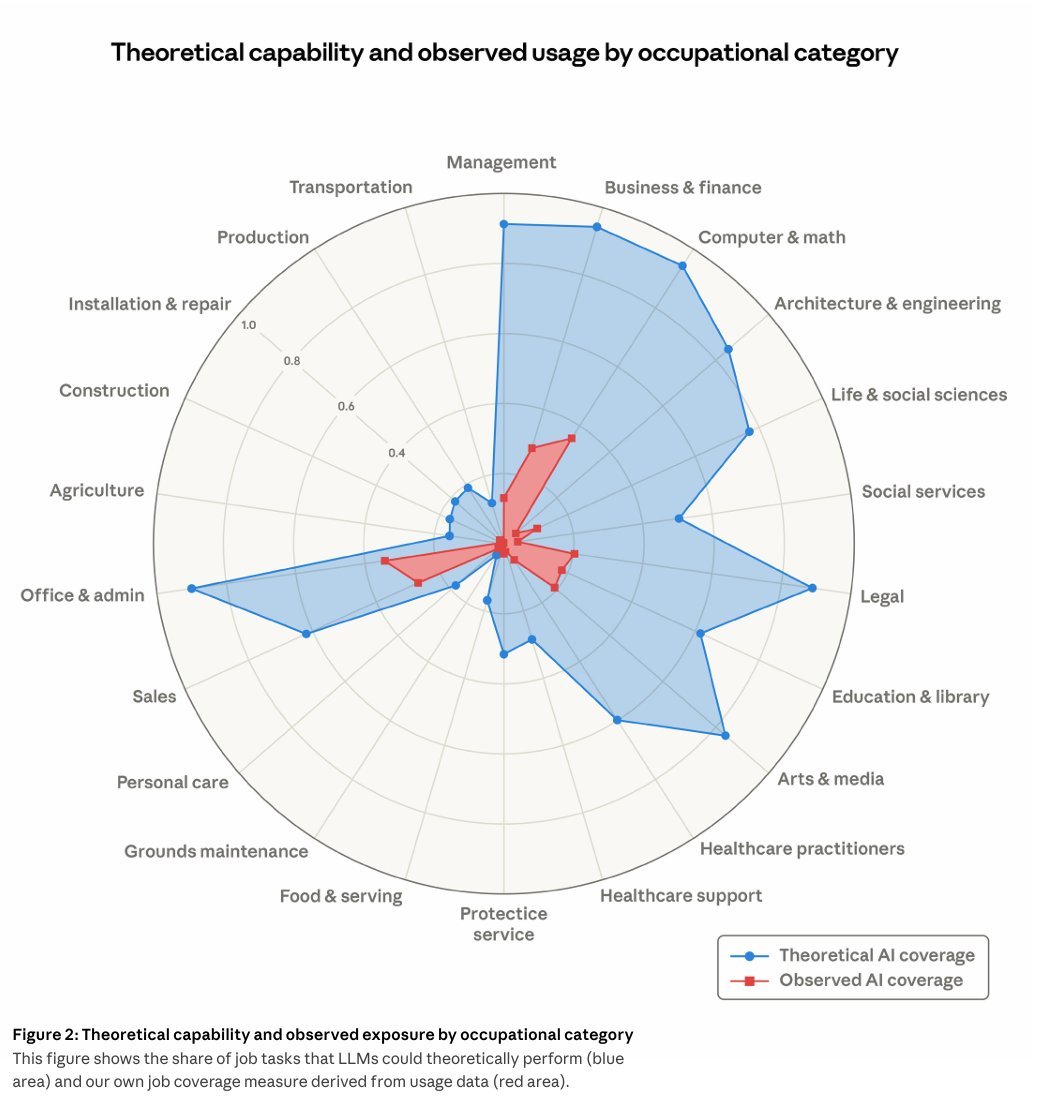
if you showed this chart to a typical economist like 20 years ago, they would've laughed you out of the room.
the right side of this is white collar jobs that were once worshipped. these jobs were comfortable, well paying, & came with societal status + recognition. your parents would’ve been proud of you.
now these are likely all set to be severely impacted in a shorter period of time than anyone likely ever thought of let alone projected. this is like ppl waiting on a beach enjoying the sun when a tsunami has already struck.