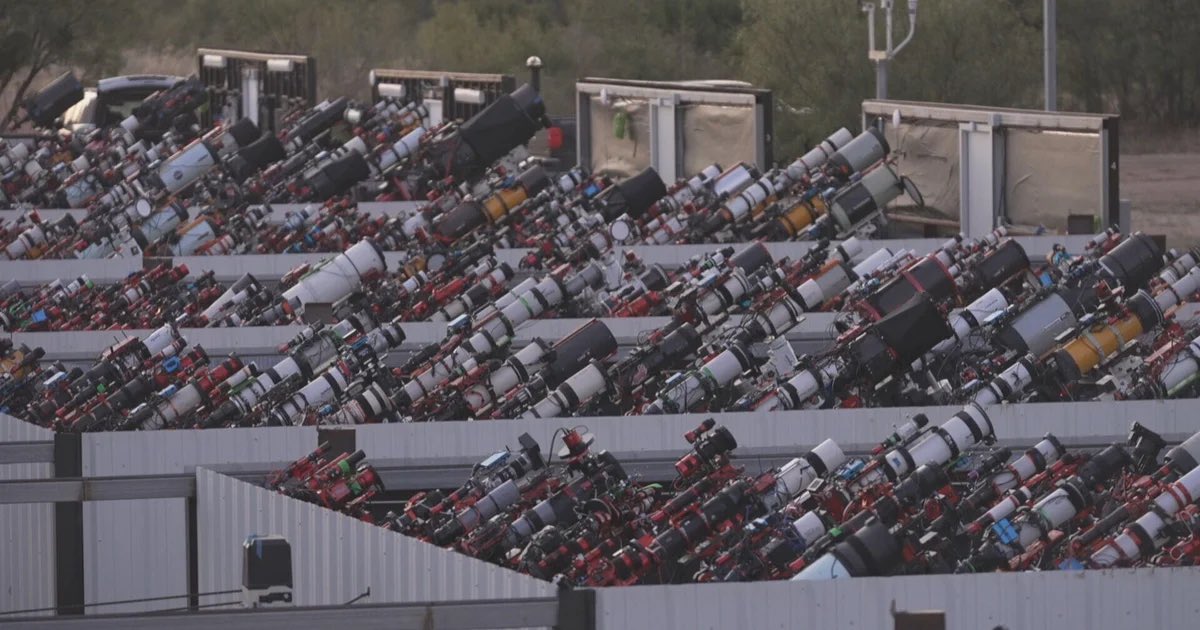
Just learned about the concept of a “telescope ranch” in Texas.
People pay to have their $10,000+ telescope rigs set up in the middle of TX to avoid light pollution.
Every night the roof rolls back off the warehouses.
Then you can remote in to your telescope and use it from anywhere in the world.
Leading British observatory hits out at plans to build 75 houses nearby amid claims it would make hi-tech equipment 'inoperable' https://t.co/XxUAdS8Rk6
This is Mars rotating on its axis. You can see the white ice cap at the top, dark surface regions, and its reddish color.
Captured by NASA’s Hubble Space Telescope.
🚨 BREAKING: TRUMP UFO DROP GOES DEEPER
New bombshell from the first batch of files: Apollo 17 footage that was buried for decades.
Astronauts captured bright particles and jagged, angular fragments tumbling past the spacecraft:
“There are big ones on my window… looks like the Fourth of July out of Ron’s window.”
“You see them… jagged, angular fragments tumbling.”
For years, NASA dismissed it as “floating insulation.”
Now the White House says: No consensus on what these objects actually were.
This release started after President Trump was directly asked about it back in February. He ordered the transparency — and it’s happening.
Happy Anniversary! 🎊
Hubble was launched #onthisday in 1990 and, every year since, it has been surprising us with its cosmic views 📸🌌
Check out the best images Hubble had to offer in its 36th year in our latest #SpaceSparks episode! 1/2
SpaceX is counting down to its 50th Falcon 9 launch of the year. Liftoff of the Starlink 17-16 mission from Vandenberg Space Force Base in California is scheduled for 7:37 a.m. PDT (10:37 a.m. EDT / 14:37 UTC). https://t.co/0uiZmXsNtJ
Behind the scenes of remote camera setup for tomorrow's Falcon Heavy launch of the ViaSat-3 F3 mission. It's been awhile and there will be a lot of lenses ready to catch the moment.
https://t.co/lIR57w4WqB for live views of Cape happenings
This mesmerizing view of NGC 1232 displays its sprawling 200,000-light-year-wide expanse, featuring a glowing reddish core, striking blue spiral arms, and a warped companion galaxy, all residing 60 million light-years away in the Eridanus constellation.
(Credit: ESO)
What's that green streak in front of the Andromeda galaxy? A meteor. While photographing the Andromeda galaxy in 2016, near the peak of the Perseid Meteor Shower, a small pebble from deep space crossed right in front of our Milky Way Galaxy's far-distant companion. The small meteor took only a fraction of a second to pass through this 10-degree field. The meteor flared several times while braking violently upon entering Earth's atmosphere. The green color was created, at least in part, by the meteor's gas glowing as it vaporized. Although the exposure was timed to catch a Perseid meteor, the orientation of the imaged streak seems a better match to a meteor from the Southern Delta Aquariids, a meteor shower that peaked a few weeks earlier. Not coincidentally, the Perseid Meteor Shower peaks next week, although this year the meteors will have to outshine a sky brightened by a nearly full moon.
Image Credit & Copyright: Fritz Helmut Hemmerich
China, with Russia's help, wants to build a base on the moon. If the Chinese regime succeeds in building the first facility there, it will try to deny to others the ability to land on the lunar surface. https://t.co/JQOH3ZWP7c
Comet Pons-Brooks in Northern Spring
As spring approaches for northern skygazers, Comet 12P/Pons-Brooks is growing brighter. Currently visible with small telescopes and binoculars, the Halley-type comet could reach naked eye visibility in the coming weeks. Seen despite a foggy atmosphere, the comet's green coma and long tail hover near the horizon in this well-composed deep night skyscape from Revuca, Slovakia recorded on March 5. In the sky above the comet, the Andromeda (right) and Triangulum galaxies flank bright star Mirach, beta star of the constellation Andromeda. The two spiral galaxies are members of our local galaxy group and over 2.5 million light-years distant. Comet Pons-Brooks is a periodic visitor to the inner Solar System and less than 14 light-minutes away. Reaching its perihelion on April 21, this comet should be visible in the sky during the April 8 total solar eclipse.
Image Credit & Copyright: Petr Horálek / Institute of Physics in Opava
A Full Plankton Moon
What glows in the night? This night featured a combination of usual and unusual glows. Perhaps the most usual glow was from the Moon, a potentially familiar object. The full Moon's nearly vertical descent results from the observer being near Earth's equator. As the Moon sets, air and aerosols in Earth's atmosphere preferentially scatter out blue light, making the Sun-reflecting satellite appear reddish when near the horizon. Perhaps the most unusual glow was from the bioluminescent plankton, likely less familiar objects. These microscopic creatures glow blue, it is thought, primarily to surprise and deter predators. In this case, the glow was caused primarily by plankton-containing waves crashing onto the beach. The image was taken on Soneva Fushi Island, Maldives just over one year ago.
Credit & Copyright: Petr Horálek / Institute of Physics in Opava
These are two colliding galaxies, not one galaxy with sweeping bangs. Arp 122 is made up of NGC 6040 (the hair), which is being warped as it begins to merge with LEDA 59642 (the face), as seen in this Hubble image. Credit: ESA/Hubble & NASA.
NGC 7635 - the Bubble Nebula, wonderfully processed by Janari Stserbina is a striking emission nebula in the constellation Cassiopeia. The image set that produced this is available on Starbase.
https://t.co/UsdFCicgv2
I’ll be revealing an epic photo 5 months in the making tomorrow. This was a collaboration between myself and legendary Milky Way/landscape photographer @DanielJStein and is a whopping 1.69 gigapixels. Here’s a timelapse of the event associated with the photo!
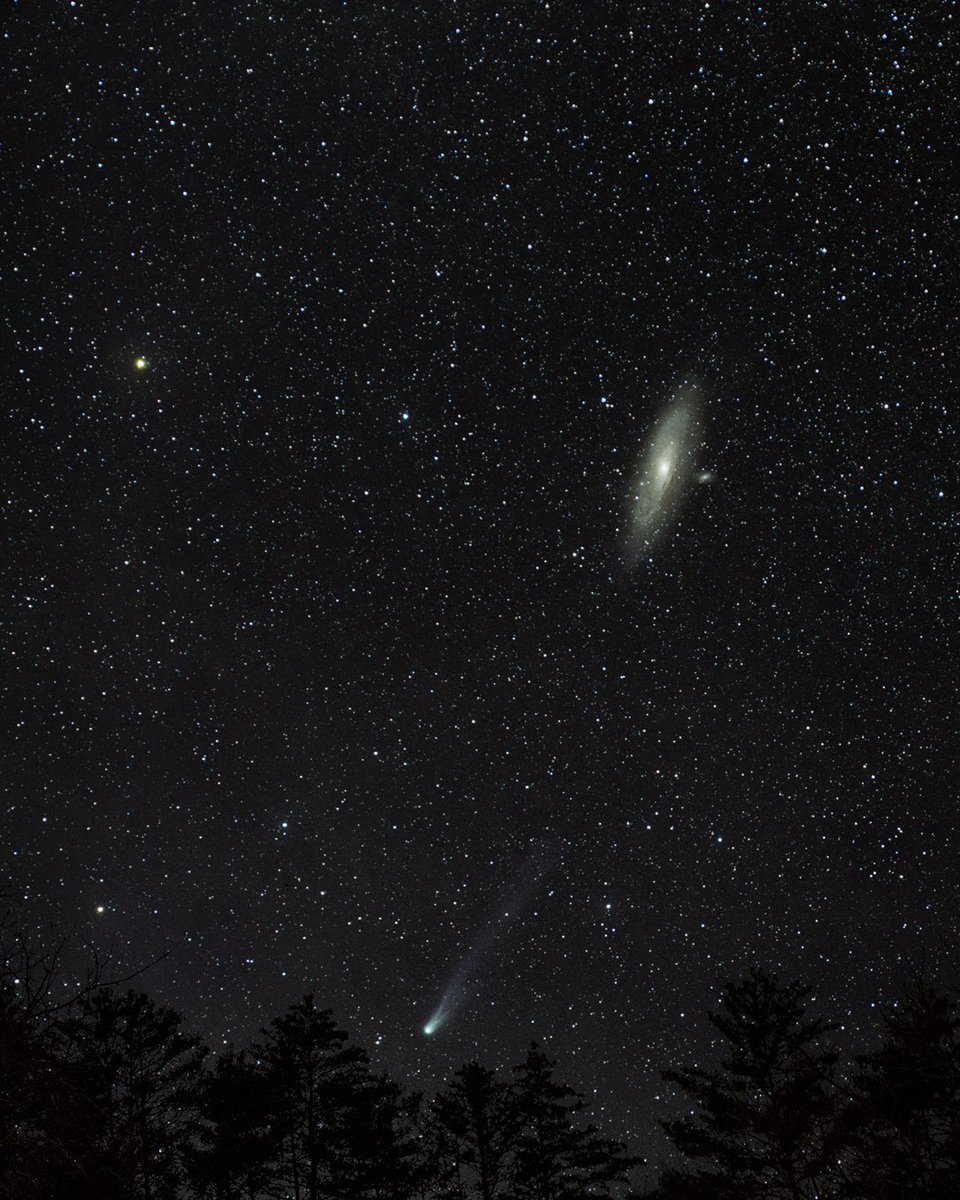
And here’s another snapshot of the comet I took at the same time as the closeup. You can see in this one the context of Andromeda, Mirach, and my tree line. #Astrophotography