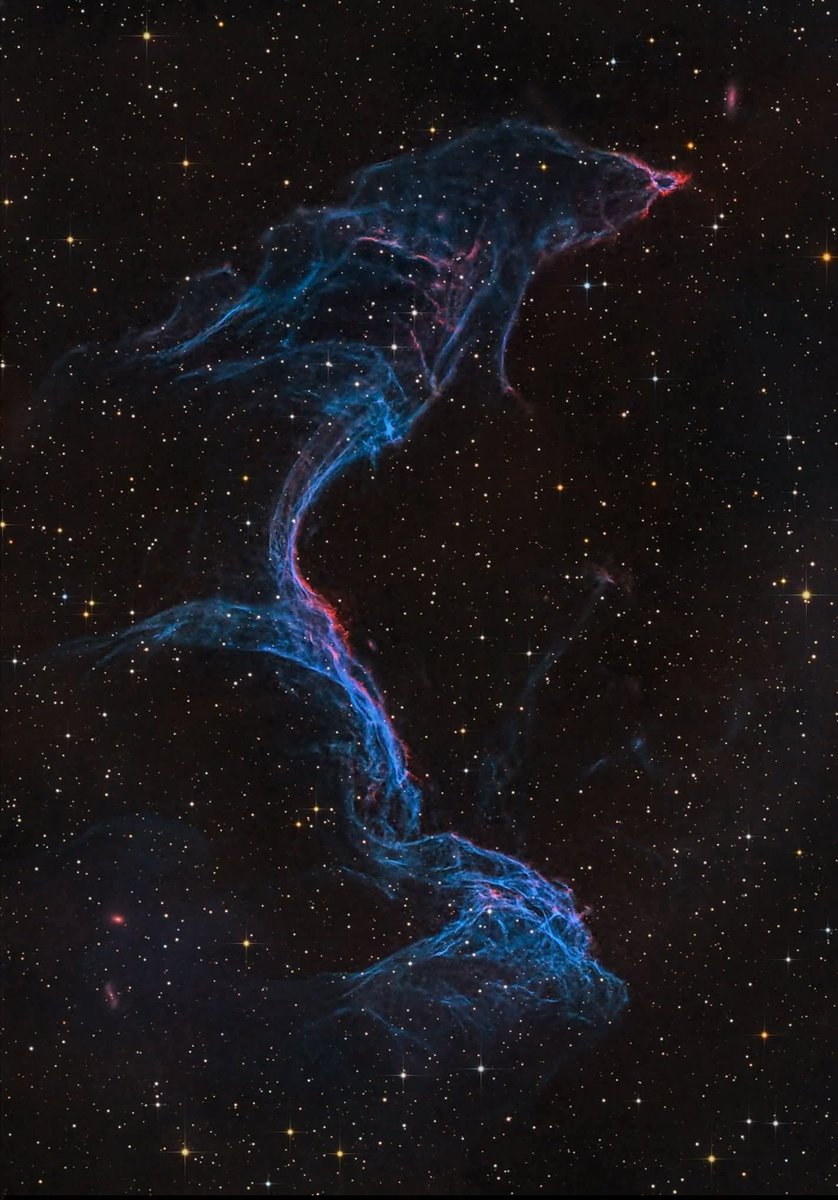
🐋The ESO 217-25 nebula, better known by its popular names Mermaid Nebula or Betta Fish Nebula, is an astronomical object classified as a supernova remnant.
It is located in the southern constellation of Centaurus.
It is part of the largest supernova remnant cataloged as G296.5+10.0. It is also associated with the radio source PKS 1209-51/52.
It is estimated to be located about 4,500 light-years from Earth, in the Carina Arm of the Milky Way.
It has an estimated age of 14,000 years.
This nebula is the result of the explosion of a massive star at the end of its life.
Its filamentary and sinuous structure resembles the fins of a fighting fish (betta) or the silhouette of a mermaid, depending on the orientation of the image.
Blue comes mainly from ionized oxygen (OIII) emissions.
Red represents the presence of ionized hydrogen (H-alpha).
The entire remnant covers an area twice the size of the full moon and has a physical diameter of about 100 light-years.
ESO 217-25 is an extremely faint object and difficult to observe visually with conventional telescopes, so its beauty is mainly revealed through long-exposure astrophotography using narrow-band filters.
Picture by Martin Pugh
The ESO 217-25 nebula, better known by its popular names Mermaid Nebula or Betta Fish Nebula, is an astronomical object classified as a supernova remnant.
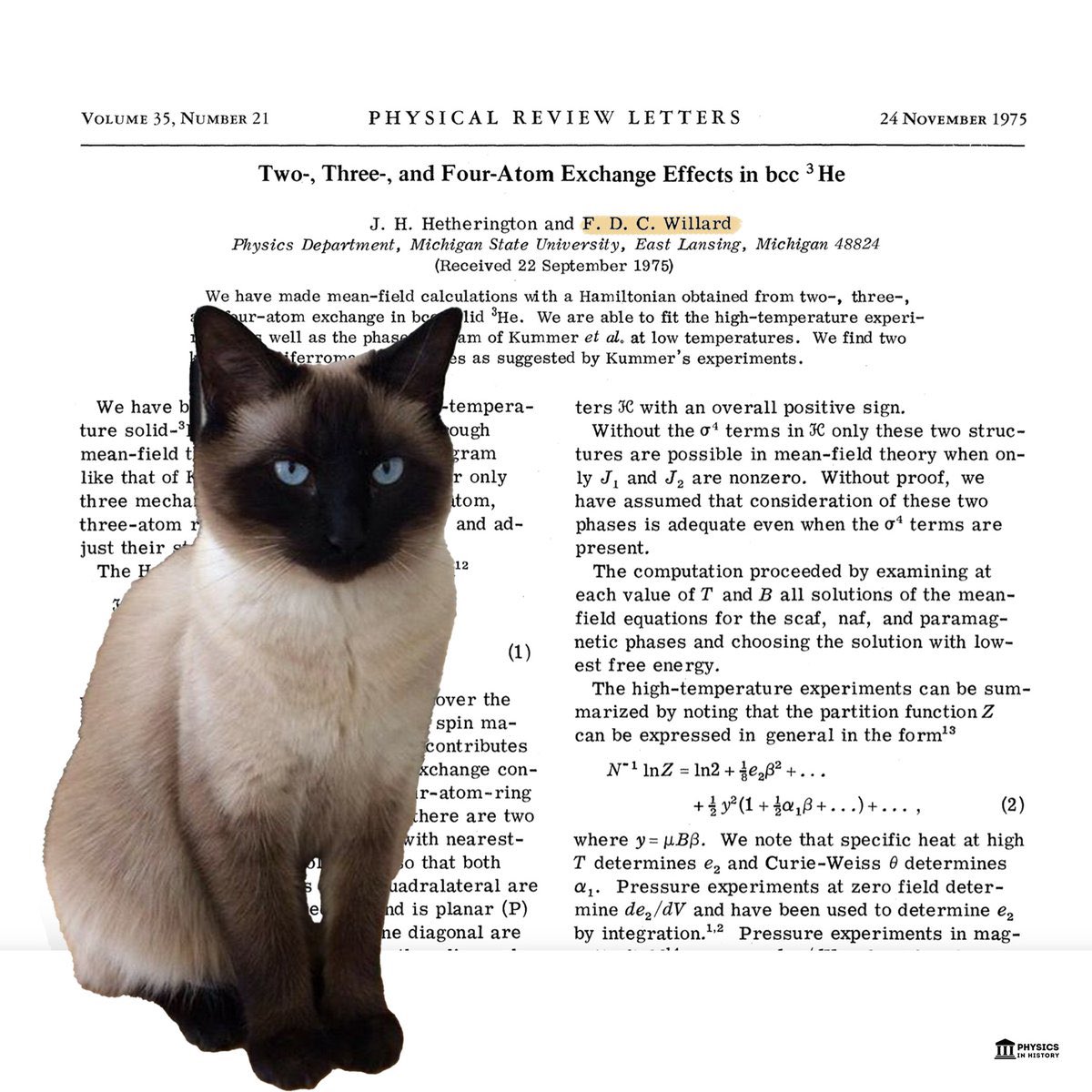
A cat co-authored a scientific paper in 1975, when his owner, a physicist named Jack H. Hetherington, decided to add him as a second author to avoid changing the plural pronouns in his manuscript. The cat’s name was Chester, and he was given the pen name F.D.C. Willard, which stood for Felix Domesticus, Chester. Willard was also the name of Chester’s father. The paper was about atomic behavior at different temperatures, and it was published in Physical Review Letters, a prestigious physics journal.
Chester’s co-authorship was revealed when Hetherington sent some signed copies of the paper to his friends and colleagues, and included the cat’s paw prints as his signature. The story became widely known and amused many people in the scientific community. Chester even published another paper as the sole author in 1980, in a French popular science magazine. He died in 1982, but he is still remembered as the first and only cat to have authored a published scientific paper.
🟢 Titan $15,000 Cash Challenge is Here.
The Titan Network’s third season of the $200,000 USDC campaign has arrived.
For 7 days, you can contribute to the network and compete for your share of the $15,000 USDC prize pool.
This challenge is built for everyone - whether you invite friends or operate a node, your contributions matter.
Join: https://t.co/jsyhZiUkbF
Why we’re launching this?
The $15,000 Cash Challenge brings promoters and node operators together in a single event.
It rewards growth, stability, and fairness - the core values of Titan Network.
Two Ways to Win:
Track 1: $9,800 Top 100 Elite Leaderboard (Promoters).
Earn Impact Score by inviting new members:
→ +2 points per 24 hours online from direct invites
→ +0.5 points per 24 hours online from indirect invites
→ +4 bonus when a direct invite hits 50 hours online
→ +2 bonus when an indirect invite hits 50 hours online
Leaderboard Prizes (Top 100):
→ 1st: $2,500
→ 2nd: $1,200
→ 3rd: $800
→ 4th–10th: $200 each
→ 11th–50th: $60 each
→ 51st–100th: $30 each
Track 2: $5,200 Community Cornerstone Lucky Draw (Node Operators).
→ 100 winners will be randomly selected, each receiving $52
→ 1 ticket per 24 hours your node is online
→ 5 tickets per 24 hours if your node is bound to a Shopee/Temu account
→ Each participant can win once only
All draws will be conducted with a verifiable blockchain-based process for transparency.
Fair Play Commitment
Titan Network will remove cheaters, fake accounts, or non-residential IP activity.
Every genuine contributor will be rewarded fairly.
Run Time
The event will start today, September 26, 2025, and will run for seven days.