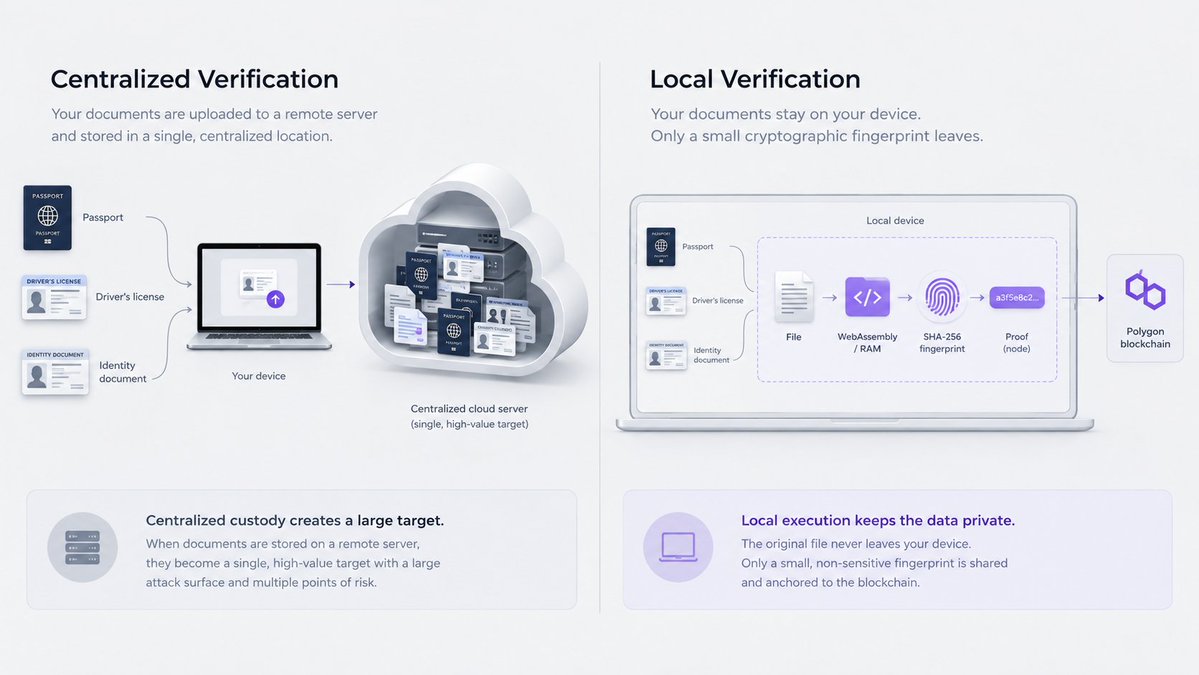
The recent IDScan cloud breach exposed over 153 million driver’s licenses and passports on the dark web. It’s a harsh reminder of a fundamental architectural flaw: centralized verification cloud servers are massive honeypots waiting to be exploited. When you upload a sensitive documents to a cloud platform to prove authenticity, you surrender custody of your data.
OpenSig fixes this at the execution layer.
Instead of routing files to a remote server, OpenSig runs local WebAssembly modules directly inside client RAM. Your sensitive files never cross a network socket. It calculates a 256-bit SHA-256 digest on-device, anchoring only the mathematical proof to the blockchain.
Zero cloud uploads, zero honeypots, and total document privacy.
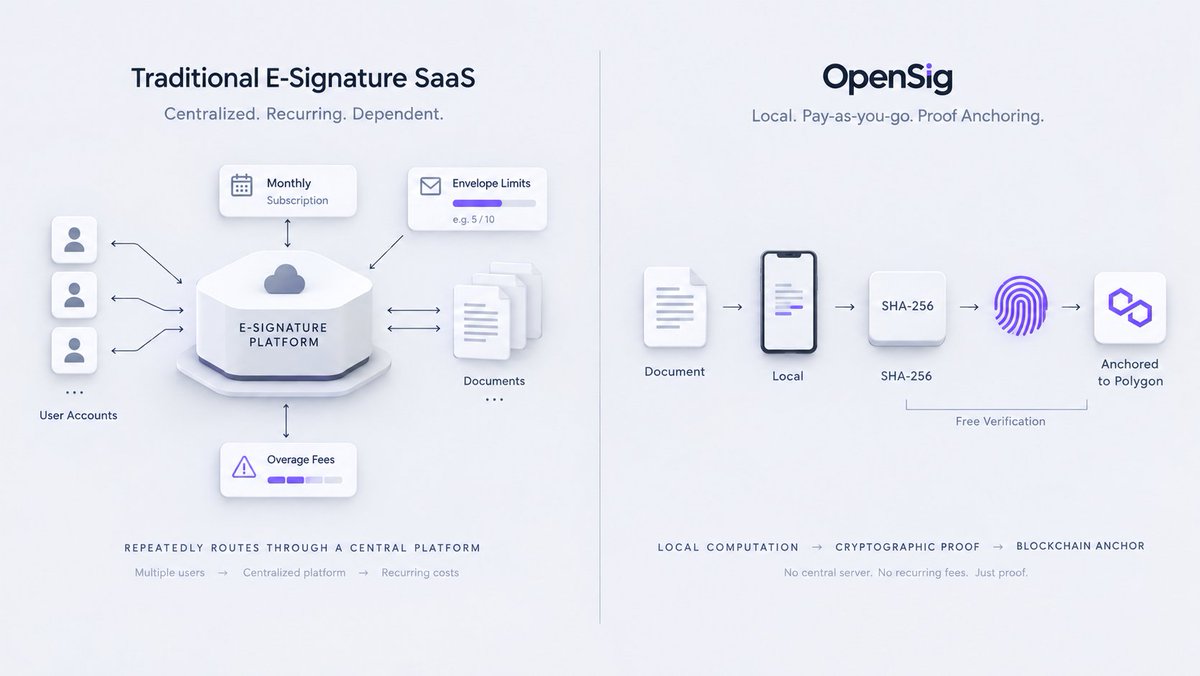
Traditional e-signature platforms have made a basic business necessity painfully expensive. Small teams now pay up to $45 per user monthly while being locked into strict annual envelope limits and surprise overage fees. This is one of the predatory OpenSig subscription model with on-device execution and pay-as-you-go proof anchoring.
When you sign or stamp a document in the OpenSig app, your device handles 100% of the computation locally. You generate a 256-bit hash, anchor the timestamp proof to the @0xPolygon blockchain.
No monthly retainers, no envelope caps, and zero central server vendor lock-in. Verification stays free for anyone, forever.
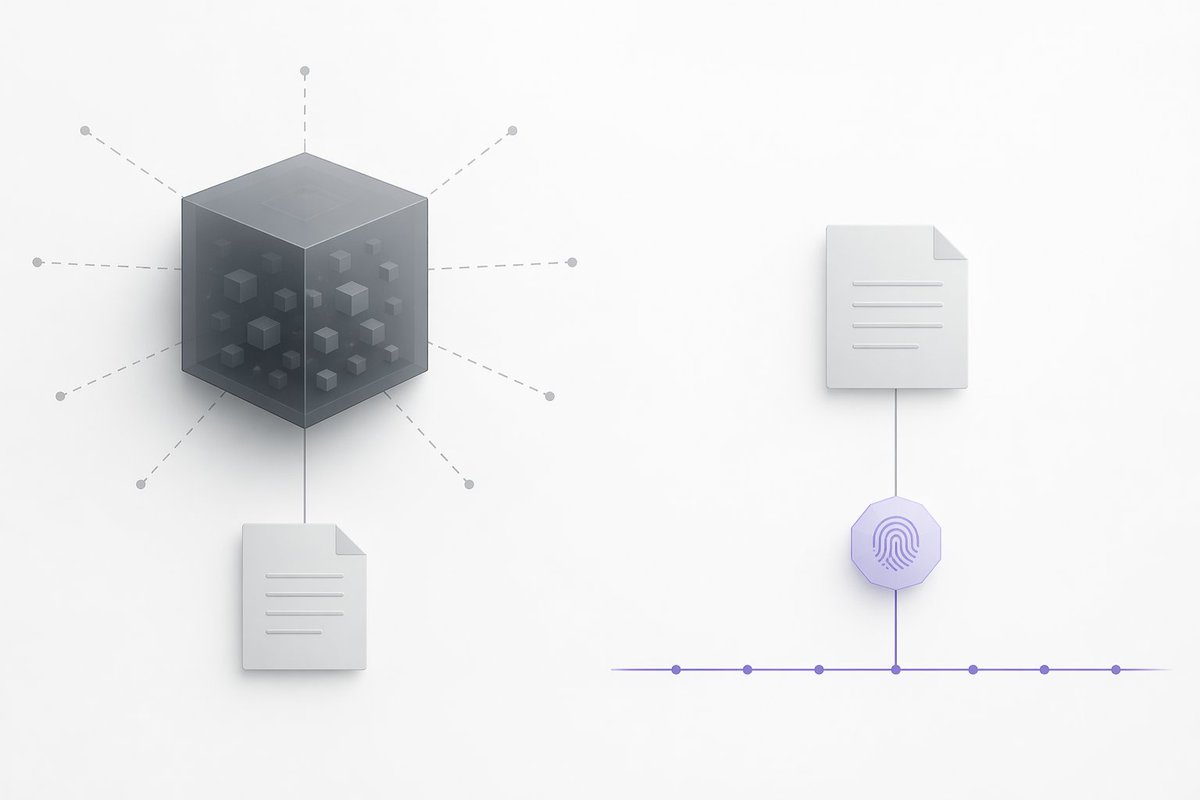
OpenSig hashes your file locally into Hd, builds a private chain hash Hc from that, then generates a deterministic sequence of signatures where each one locks to the last. You just publish the next free one on-chain.
And your file never leaves your device.
. @SkyEcosystem pulled in roughly $29m in fees and around $14m in protocol revenue in the last 30 days.
Most people earning yield on their stablecoins have never thought about where it comes from. It comes from here.
Sky is one of the largest yield engines in DeFi, around $6b sitting in it, its Savings Rate paying near 3.5% base on Ethereum right now according to @DefiLlama. And that rate is not invented. It's funded by real things underneath.
Interest from people borrowing against crypto collateral, AAA corporate debt, and mostly US Treasury Bills and other low-risk assets held by the protocol.
So when you earn yield on a stablecoin, you're often earning a small share of those underlying cash flows.
The interesting part is what products like @OseroHQ actually do. They aren't creating yield, they're only making it easier to access.
Instead of manually moving funds between protocols or watching rates every day, Osero routes deposits into Sky's Savings Rate and abstracts away the complexity. I think the value in what they are doing is routing. But how efficiently do they route?
That's one of the reasons I built an onchain dashboard for them.
If routing is the product, then routing is what should be measured.
Right now the dashboard tracks deposits, depositors and cross-chain activity.
Next, I want to track something even more interesting.
Something that can probably point whether the routing layer continues attracting capital as more users come onchain.
Because in the end, the question is not whether a protocol promises yield.
It's whether people keep trusting it with their money.
There is a quiet economy running underneath creative pitching. A client requests concepts from five studios. Four lose. The thinking of all five stays behind. Nobody calls it theft because nothing was signed, and the ideas were volunteered. Thousands of designers have signed petitions against free pitching for exactly this reason.
The industry knows the game. It plays anyway, because saying no to a pitch feels like saying no to the work.
We cannot fix pitching. We can offer one adjustment.
Timestamp the deck before it leaves your device. If your thinking shows up later wearing someone else's logo, the question of who had it first stops being your word against a company's.
We are building toward a world where every piece of original digital work carries an independent record of when it existed. Not because every creator is in danger of a dispute. Because creative and intellectual work drives everything products, research, culture, innovation and the people who produce it deserve infrastructure that treats what they make as something worth protecting.
Not after it is disputed. Not after it is stolen. Not after the window to prove anything has closed. From the moment it is made. That world does not exist yet. We are building one part of it.
The privacy property of cryptographic time-stamping is as important as the timestamp itself.
Most proof of creation tools require you to upload your file somewhere. The moment your file lives on someone else's server, they can read it, share it, lose or be compelled to hand it over.
For unpublished work, trade secrets, unreleased products, even sensitive research, the act of proving priority shouldn't require exposure.
A hash-based timestamp separates the proof from the content entirely.
You publish the fingerprint and the work stays yours.
Investigative journalism depends on source material integrity.
When stories break, questions about authenticity follow immediately.
Deepfake technology and AI-generated content have made visual and audio verification significantly more complex.
Traditional methods involve metadata analysis and platform records. Both can be challenged in ways that create doubt about authenticity.
Cryptographic timestamping of original source materials creates verifiable records independent of editorial systems.
Interview recordings, document photographs, and research materials timestamped at acquisition provide evidence that specific content existed before publication.
For journalists operating in hostile environments or covering sensitive topics, this represents protection beyond editorial backing.
The proof exists independently of news organization systems or platform cooperation. Source protection has traditionally meant protecting source identity.
Increasingly it also means protecting source material authenticity against manipulation claims.
Professional disputes average $15,000-$50,000 in legal fees.
Most stem from inadequate documentation of what was delivered, when it was approved, and what changes were agreed upon.
Cryptographic timestamps cost a few dollars per file.
The ROI calculation is straightforward.
Prevention remains cheaper than litigation.
Three things courts care about in IP disputes.
1. Did you create it?
2. When did you create it?
3. Can you prove both?
> Email helps with 1.
> Email tries to help with 2.
> Email fails at 3.
Cryptographic timestamp anchored to public blockchain nail all three.
The difference between IP protection and IP documentation isn’t that big. It’s mostly about stage and intent.
OpenSig helps with both.
Every project starts with an idea, but ideas don’t become products overnight.
And right now, that gap is shrinking fast because of AI.
Products ship faster than ever, yet most people only think about IP when it’s time to file a patent or copyright. By then, the real work has already happened, often with no clear record of how it came to be.
OpenSig is not here to replace legal protection. We’re here to scale it, by using advanced technology to prove ownership earlier and more clearly.
You can document creation as it happens from your desk.
- who created what
- when it existed
- how it evolved
So when you eventually need formal protection, or need to prove authorship, you’re not reconstructing history - you already have it.
Copying is now easier than ever, tamper-proof evidence is the advantage.