Grok Bot might be the first tool that lets one non-technical person run an entire business with a team of AI agents.
My friend Billy runs his whole newsletter business on Grok Bot agents, and I think we're about to see 100,000+ businesses like his.
BEST PRACTICES:
1. The agents run on a shared cloud computer, so running your newsletter, your X, and your receipts all in one place creates context bloat and burns tokens fast. One mission per setup.
2. Start with a Chief of Staff. Give it access to your existing docs (Notion, Slack, Gmail), have it audit the business, then tell you the top three agents to build first to drive revenue.
3. Perfect a task with the Chief of Staff before spinning up a new agent. Have it do the outbound sales once, review it, and only then say "now build a bot that does exactly that." You earn each new hire by proving the task works first.
4. Constraints are the feature. You get a limited number of agents, one thread per bot, like DMs with a teammate. It forces you to stay mission-oriented instead of spinning up a bot for every random idea.
5. You make the decisions, not the agent. Billy's team spent three weeks unable to pick where content should live. At some point you say "we're doing Notion, no more tinkering" and move on.
6. Run week one with no new agents. Build the team, learn to fly the plane, just execute. Week three is when you find the real gaps and expand, someone to man the inbox, someone for the Shopify shop.
7. Then add routines so it works while you sleep. Ask your Chief of Staff what recurring jobs would move the business forward overnight, and it builds the automations that run without you.
Thanks to @billyjhowell for sharing the sauce on @startupideaspod (follow for more).
Grokbot is really cool.
Watch below:
https://t.co/9jTXeOiu9x
One of the Grok Bot builders:
"For the first time I allocated 90% of my work to agents and they did it end to end."
In a 30-minute podcast he showed exactly how he uses Grok Bot and how to build an AI agent team from scratch.
This beats any paid course on building agents I've seen.
Watch it, then read the step-by-step guide on building your AI team for free, with ready-to-copy prompts.
This is the best founder you've never heard of. Adam Foroughi's company prints $5 billion in cash a year with just 400 people. When his stock price dropped by 92%, he borrowed money to buy back $6 billion in stock. That bet made the company more than $60 billion. The entire C-suite is just 4 people. To this day, Adam approves every hire. This episode has the highest insight-to-minute ratio of any conversation I've had so far.
Here’s our full conversation:
0:00 The $6B Buyback That Made $60B
2:15 Borrowing Money To Buy Back Stock At A Discount
5:02 Why VCs Passed On AppLovin In 2012
9:00 From App Discovery To Ad Platform
14:45 Beating Google's AdMob With Performance Marketing
19:30 No Board For Six Years
30:12 The China Deal That Almost Blew Up
37:45 The Convertible Note Pivot And KKR
46:30 Buying Gaming Studios To Get Data
51:45 Losing Trust With Game Developers
58:20 The 2022 Crash And How He Kept His Team
1:02:00 Building An Hyper Competent & Efficient Company
1:07:25 Why Every New Hire Needs His Approval
1:19:06 The Axon 2 Inflection Point
1:21:15 One Great Engineer Now Beats A Hundred
Includes paid partnerships.
The most efficient company in public markets is an ad company
Revenue per employee:
› AppLovin: ~$17M (~400 people, approaching $7B in annualized EBITDA)
› Nvidia: ~$5M (3x less)
› Netflix: ~$4.2M (4x less)
› Apple: ~$2.4M (7x less)
› Meta: ~$2.2M (8x less)
› Google: ~$1.9M (9x less)
› Microsoft: ~$1.1M (15x less)
Engineering hasn't grown in 3 years while cash flow scaled 20x. 4 execs total. No one-on-ones, no PMs.
In 2024 AppLovin cut ~40% of its team while its core ads business was growing nearly 100% YoY.
Key point: AppLovin cut during hypergrowth to deliberately increase efficiency. Unlike most companies who add more headcount.
Full breakdown with CEO Adam Foroughi and CTO Gio Ge below:
Harvard needs 8% return every year just to keep the lights on. 5% spending plus 3% inflation. Miss that number and buildings stop, professors leave, research dies.
40% of the operating budget comes from one portfolio. Not tuition. Not grants. One fund.
Jake Xia manages that fund's public markets. He also teaches the math behind it at MIT for free. One of the top five most-watched courses on OpenCourseWare. Millions of views. Almost nobody changed how they invest.
Every year he hands students a blank page. Build a portfolio. No rules. Someone writes 100% Apple. Someone writes rare coins. Confident picks. Same blind spot, every time.
Not one student asks the only question that matters: how much goes in each position. They all pick what to buy. Nobody sizes it.
Sizing is the entire job. The answer won the Nobel Prize. It's called the efficient frontier. Xia draws it on the board in under a minute.
Five equations sit underneath it. Compound growth. Present value. The geometric mean. The Rule of 72. Real return. All older than any bank on earth. All fit on a napkin. None behind a paywall.
A "guaranteed 5% bond" during 4% inflation is a 1% return. The industry doesn't hide this. It just hopes you never run the equation yourself.
The lecture is free. The napkin is free. The only thing that costs anything is not knowing.
You can now enable Claude to use your computer to complete tasks.
It opens your apps, navigates your browser, fills in spreadsheets—anything you'd do sitting at your desk.
Research preview in Claude Cowork and Claude Code, macOS only.
TLDR: I am a recovering alcoholic with no fund, no credentials, and no lobbyist. I rebuilt myself from nothing. Then I broke into finance with no degree, no pedigree, and no permission.
I parsed SEC filings for a $31.5 billion private credit fund called Cliffwater. Not because anyone asked me to. Because nobody else would. The filings are public, but they are buried in footnotes that are not indexed, not searchable, and not structured for analysis. I have been told by fund managers that nobody even attempts this.
Billions of dollars in pension capital, and the people who manage money for a living do not bother to read the filings.
So I read them. Every loan. Every amendment. Every semi-annual PIK disclosure. 2,330 positions. I hand-researched fifty.
I found 189 loans where borrowers are paying interest with more debt instead of cash. I found over 50 loans that are not generating enough cash to service their debt at all — carried at par on the books of a fund that has never reported a losing month in 41 months.
The fund's Sharpe ratio is 3.75. Bernie Madoff — who was fabricating returns and could pick any number he wanted — ran a 3.5. He got caught because the numbers were too smooth by Markopolos. The greatest quant fund in history, Renaissance Technologies, runs a five or six.
Cliffwater is claiming risk-adjusted returns that would be impossible even if you insider-traded with perfect information every single time, because the volatility of the underlying markets would still prevent it.
Nobody asked questions.
Bloomberg confirmed 14% redemptions 48 hours after I published. S&P cut the fund's outlook to negative this week. Cash on hand fell 76% in six months.
This is not an isolated fund. This is the structure. $9.4 trillion in private equity. $3.5 trillion in private credit. They all pay their own valuation agents. The valuation agents decide what the funds are worth. No valuation agent has ever been fired for saying the number was too high.
The marks produce the NAV. The NAV produces the fees. The fees come from pensions. The pensions come from firefighters and teachers and nurses in Oregon and California and Illinois who will never read a private placement memorandum in their lives.
Wall Street ran out of rich people. The endowments were full. The sovereign wealth funds were tapped. So they went downstream — to 401(k)s, to retirement accounts, to interval funds sold to people who have no idea what they own.
1. Direct the SEC and FSOC to examine Level 3 fair value practices across interval funds and BDCs.
2. Require that valuation agents be independent of the funds they mark.
3. State publicly that the current self-marking regime creates systemic risk.
4. Mandate position-level mark disclosure for every fund that accepts pension capital.
There are two ways this ends. It breaks all at once like 2008 and we fix it. Or it rots slowly like Japan: one fund blows up, six weeks of quiet, another one, and nobody connects it for a decade while a generation of retirees gets destroyed.
I am not asking anyone to take my word for it. I am asking them to read the filings.
If you know someone in the administration, a regulator, or anyone on a legislative committee, please send this to them. One person learned this from a one-bedroom apartment. Your government can too.
The will is what is missing.
Dr. David Sinclair, whose lab reversed biological age in animals by 50 to 75% in six weeks, says that 2026 will be the year when age reversal in humans is either confirmed or disproven. The FDA has cleared the first human trial for next month.🧐🤔
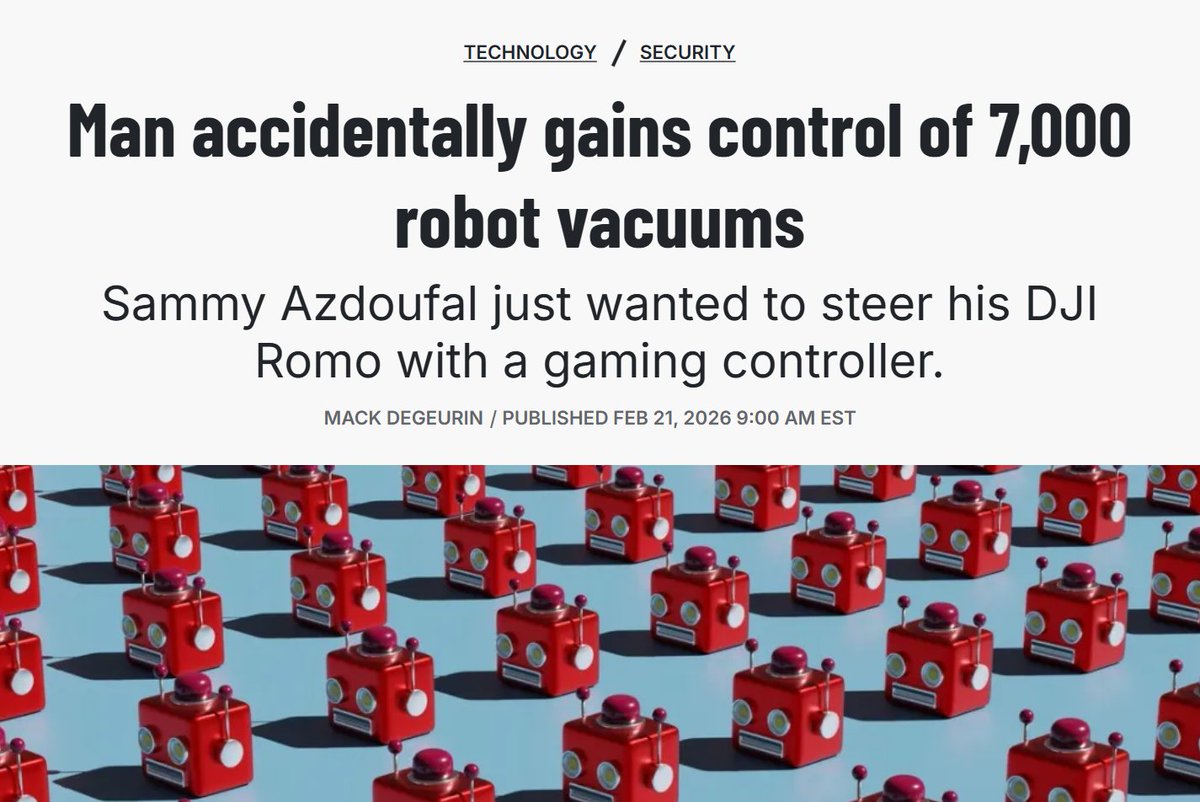
This story is actually insane:
• dude drops $2000 on a DJI robot vacuum like a lunatic
• refuses to use the normal app like a peasant
• Sammy Azdoufal fires up Claude to crack the API so he can drive it with an xbox controller
• Claude delivers the goods
• pulls an auth token from their servers, connects successfully
• except the system thinks he controls 7000 vacuums
• checks again
• yep, seven thousand
• DJI built authentication with zero device ownership verification
• any valid token works for any unit on the planet
• Sammy now has eyes inside homes across 24 countries
• live vacuum camera feeds everywhere
• full floor plans from the mapping data
• some guy in germany eating cereal at 3am, unaware his roomba is snitching
• one API call away from being the most informed burglar in history
• all he wanted was to steer his vacuum with a joystick
• does the right thing and reports it
• DJI fixes it in two days
• back to normal life with his stupidly expensive floor cleaner
• IoT companies stay undefeated at shipping garbage security