While I am on a hiatus from readings, book with @VEDANJANAM
He has my full endorsement and will give you an astonishingly good reading. Pay him more than he asks, even if it makes him blush. He is worth it!
🚨: 100 years ago, thousands fell into a deep sleep with no explanation. Today. its still a mystery!
Encephalitis lethargica killed five hundred thousand people, and scientists still can’t agree on what it was.
@technosiksha Absolutely not.. have seen various charts where venus n mars r exchanging. They don’t look attractive at all.. until it’s happening in lagna or lagna lord etc.
"The wisdom of Vedanta is eternal. It is a fountain of everlasting joy. The solution to all our problems lies hidden in the wisdom of the Upanishads."
Swami Rama
Sign and dignity posts may be uncomfortable for some of you, so please understand that they describe tendencies at the first level of analysis.
A sign (rāśi) is only the bahirtattva (outer elemental expression) of the bhāva it occupies.
The antartattva (inner elemental expression) is determined by the Kālapuruṣa Kuṇḍalī.
Both are further modified by the tattva of the nakṣatra and navāṃśa.
Thus, for every ascendant, every degree acquires meaning through the interaction of multiple layers.
Finally, the grahas modify the entire picture through placement, aspect, dignity, and other relationships.
So when a post says that an exalted Saturn tends toward excellent work ethic, it is describing one tendency associated with the bahirtattva and the kārakatva of Śani.
The final expression may look very different once the full chart is considered.
Excerpt from my developing work on tattva relationships across signs, the natural zodiac, Navamsha and Nakshatra....
Pṛthvī and jala lagnas have a reputation for endurance, deep processing, and internal transformation.
Their charts are structurally incapable of symmetric interaction. Instead, their lives operate in a beautifully complex, alternating pattern.
Let us understand why.
Puruṣa lagnas preserve the Kālapuruṣa's polarity across all twelve houses while strī lagnas systematically invert it.
This is why even-sign ascendants often feel less linear or disruptive but structurally more complex.
With Puruṣa Lagnas, the native operates in a world where like meets like. The external environment matches the mode of operation of the internal impulse.
For Strī Lagnas, the native's life is a alternating engine of garbha (womb) and kṣetra (seeded field). In odd houses, their internal projective fire or air is contained and cooked by a receptive environment. In even houses, their internal receptive water or earth is subjected to external, projective forces.
What does Jupiter's wisdom passing through Saturn's reality and emerging under Venus's terms mean for individuals?
It translates as follows:
Seek buy-in, alignment, and workable arrangements. Don't push in too hard. Not the time for "my way or highway".
Reduce grand plans, theories, and ideals into something people can actually use, understand, and support. This is not a good time to pontificate.
Appeal to authority won't work. Let reality, results, and constraints judge the value of an idea instead of relying on conviction or authority.
Protect relationships, networks, resources, and existing structures. You will be tempted to break what is working well enough.
Make yourself useful. Remove friction. Create cooperation. Seek to facilitate, rather than lead for the next one month.
Understanding Maghā placements and transits
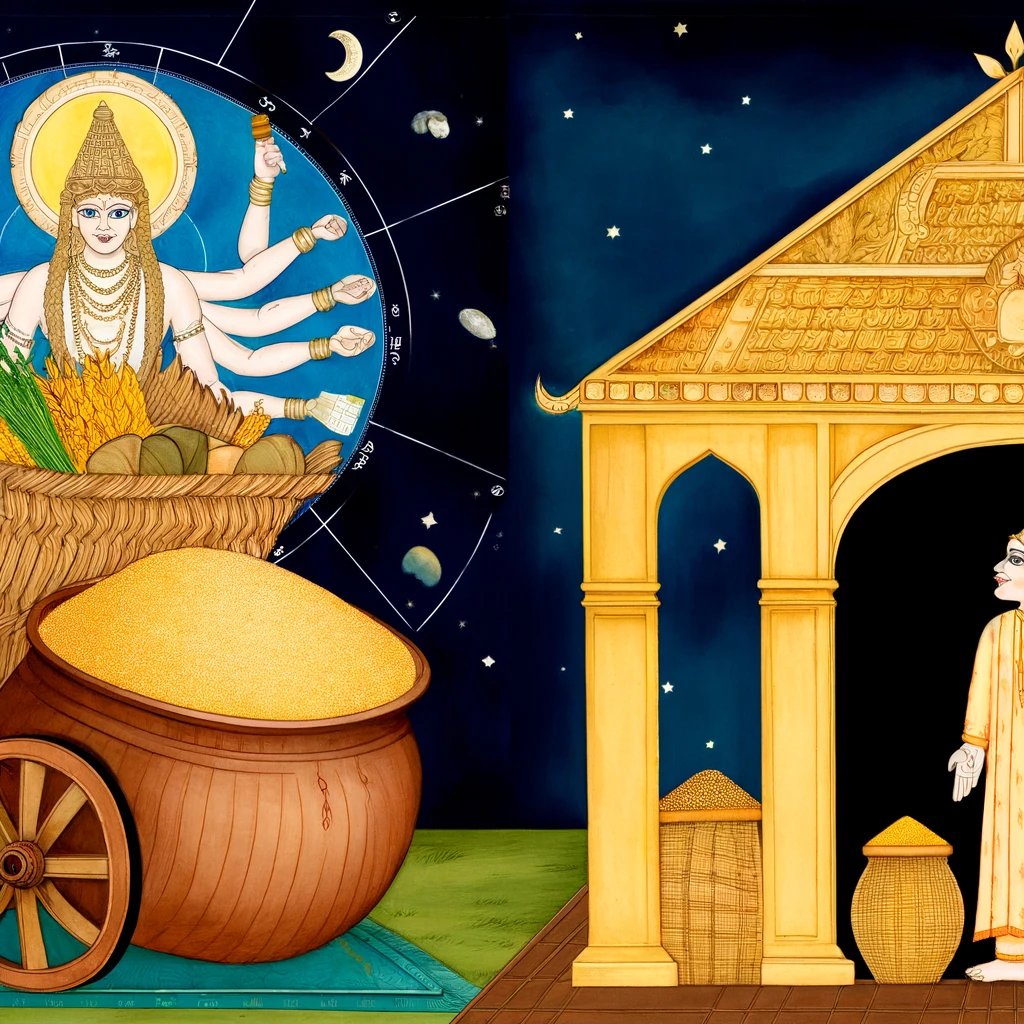
Maghā means a granary or storehouse filled with grains, and provisions.
The presiding deity is Pitṛdeva - the ancestors.
If a planet occupies a significant position in Maghā at birth, whether by placement or by vedha (per Sarvatobhadra Cakra), the native receives the specific influence of that planet as Pitṛ Anugraha - the grace of the ancestors. If a functional malefic causes the vedha, it signals Pitṛ Śāpa (curse of ancestors).
The results of favourable planetary contact with Maghā arrive without proportionate effort. They are the accumulated merit of the lineage. Past deeds. Past Karma. Not the native's own enterprise.
During favourable transits, these results are activated. Some are enjoyed immediately. The remainder accumulates for future use.
When functional malefics transit unfavourable positions relative to Lagna, the effect is loss and depletion. The stored ancestral merit diminishes.
🌸The Gems of Trade 🌸
Predictions for a birth horoscope come out accurate only after considering Desh (country/place), Kaal (time), and Paatra (individual/context), similarly, only those people can reap true benefits who utilize astrology while giving due consideration to a country's political situation, social setup, industrial policy, and commercial conditions.
In this context and an apt example, it is also necessary to mention that just as a gemstone's value is assessed based on its color, cut, water (brilliance/luster), weight, and auspicious/inauspicious signs, similarly, a conclusion about market direction can be reached by analyzing:
1. Which zodiac sign a planet is positioned in.
2.Which constellation (Nakshatra) it occupies.
3.Sankranti (transit of the Sun).
4.Sighting of the Moon on the second lunar day (Dwitiya ka Chandra-Darshan).
5. Eclipses.
6. Vedha in the Sarvatobhadra Chakra.
However, in addition to all these methods, there is one more special system through which commercial predictions receive immense assistance.
That system is—"Mutual Distance of Planets." That is, determining the outcome by finding out how much distance or interval lies between one planet and another.
We measure the distance between one person and another using units like miles, furlongs, yards, or feet. However, the distance between planets is not measured in miles or furlongs. All planets revolve in a circular path; therefore, the entire path—the circumference of the circular orbit—is divided into 360 parts. Each part is called a 'Degree' in English and 'Ansh' in the Sanskrit language. If we divide these 360 degrees into 12 parts, it results in 12 zodiac signs of 30 degrees each.
However, this system strangely works very well using Tropical (Sayana) zodiac system. William Delbert Gann has extensively used this system in his calculations for forecasting the market trends in advance.
Courtesy : Pt. H.S Trivedi ji 🙏🏾
🌸तस्मै श्रीगुरुमूर्तये नम इदं श्रीदक्षिणामूर्तये || 🌸
Rahu as an Amplifier
Rahu rarely creates something new. It takes the qualities of the planet it touches and pushes them beyond their ordinary limits. Desire grows stronger, ambition sharper, and the urge to experience, achieve, possess, or explore gains unusual intensity. Wherever Rahu joins a planet, there is fascination, hunger, experimentation, and a tendency toward extremes.
Rahu with the Sun
When Rahu joins the Sun, the desire for recognition, influence, and significance becomes powerful. These individuals are often driven to distinguish themselves and leave a visible mark on the world. The combination can produce remarkable charisma and leadership ability, though it may also bring struggles with authority, pride, or an unending need for validation.
Rahu with the Moon
When Rahu influences the Moon, it reaches directly into the emotional and psychological landscape. Feelings become intense, imagination vivid, and the mind rarely remains still. This placement can produce creativity, intuition, and unusual sensitivity, while also bringing anxiety, emotional volatility, or difficulty separating perception from projection.
Rahu with Mars
Rahu and Mars create tremendous drive. Energy, courage, competitiveness, violent tendencies and the desire to act are amplified. This combination often appears in people who thrive in demanding environments where initiative is rewarded. Without discipline, the same force can manifest as impatience, conflict, recklessness, or unnecessary risk-taking.
Rahu with Mercury
When Rahu joins Mercury, the mind becomes inventive, strategic, and highly adaptable. There is often talent for commerce, communication, negotiation, technology, or unconventional problem-solving. The challenge lies in keeping judgment clear, since the same placement can encourage manipulation or a tendency to outsmart oneself.
Rahu with Jupiter
Rahu's contact with Jupiter often produces tension between established wisdom and the desire to push beyond accepted boundaries. It can create original thinkers, reformers, teachers, and explorers of new philosophical or spiritual territory. At its highest, it expands understanding. At its lowest, it can rationalize excess, arrogance, or ethical compromise in pursuit of success.
Rahu with Venus
When Rahu amplifies Venus, attraction, pleasure, beauty, and desire become central themes. There is often a strong appreciation for luxury, art, relationships, and refined experiences, particularly those that feel unusual or unconventional. This placement can bring charm and magnetism, though it may also foster attachment, excess, or dissatisfaction with ordinary pleasures.
Rahu with Saturn
Rahu and Saturn form one of the most driven combinations in a chart. Saturn provides endurance and persistence; Rahu adds ambition and a powerful urge to achieve. The result can be extraordinary accomplishment built through sustained effort. At the same time, the individual may wrestle with chronic pressure, anxiety about status, or the feeling that success is never enough.
The Importance of Orb
The strength of Rahu's influence depends greatly on proximity. A close conjunction produces a stronger blending of energies, making the planet's qualities more intense and difficult to ignore. As the distance increases, the effect becomes subtler. The connection remains, but its expression is generally less dominant.
🌸The Gems of Trade 🌸
Predictions for a birth horoscope come out accurate only after considering Desh (country/place), Kaal (time), and Paatra (individual/context), similarly, only those people can reap true benefits who utilize astrology while giving due consideration to a country's political situation, social setup, industrial policy, and commercial conditions.
In this context and an apt example, it is also necessary to mention that just as a gemstone's value is assessed based on its color, cut, water (brilliance/luster), weight, and auspicious/inauspicious signs, similarly, a conclusion about market direction can be reached by analyzing:
1. Which zodiac sign a planet is positioned in.
2.Which constellation (Nakshatra) it occupies.
3.Sankranti (transit of the Sun).
4.Sighting of the Moon on the second lunar day (Dwitiya ka Chandra-Darshan).
5. Eclipses.
6. Vedha in the Sarvatobhadra Chakra.
However, in addition to all these methods, there is one more special system through which commercial predictions receive immense assistance.
That system is—"Mutual Distance of Planets." That is, determining the outcome by finding out how much distance or interval lies between one planet and another.
We measure the distance between one person and another using units like miles, furlongs, yards, or feet. However, the distance between planets is not measured in miles or furlongs. All planets revolve in a circular path; therefore, the entire path—the circumference of the circular orbit—is divided into 360 parts. Each part is called a 'Degree' in English and 'Ansh' in the Sanskrit language. If we divide these 360 degrees into 12 parts, it results in 12 zodiac signs of 30 degrees each.
However, this system strangely works very well using Tropical (Sayana) zodiac system. William Delbert Gann has extensively used this system in his calculations for forecasting the market trends in advance.
Courtesy : Pt. H.S Trivedi ji 🙏🏾
🌸तस्मै श्रीगुरुमूर्तये नम इदं श्रीदक्षिणामूर्तये || 🌸
A Russian psychologist spent 10 years proving that the act of talking to yourself out loud is one of the most powerful cognitive tools the human brain has, and almost nobody outside his field has read the work.
His name was Lev Vygotsky.
He worked in Moscow in the 1920s and died of tuberculosis in 1934 at the age of 37. He had no laboratory, no funding, almost no English readers, and a body of work that the Soviet government suppressed for two decades after he died.
He produced the foundational theory of how human cognition actually develops, and the central piece of that theory was a behavior almost every adult is faintly embarrassed about.
Vygotsky noticed that young children talk to themselves constantly. They narrate their own actions, they argue with imaginary opponents, they instruct themselves through tasks out loud.
The dominant theory at the time, from the Swiss psychologist Jean Piaget, said this was a sign of cognitive immaturity that children would eventually grow out of as they learned to think properly.
Vygotsky said the exact opposite.
He argued that this self-directed speech was the most important cognitive event in the entire developmental window, because it was the moment a child first started to use language as a tool to control their own mind. The child was not failing to think. The child was learning how to think by externalizing the process and listening to themselves do it.
He predicted that as children matured, this out-loud self-talk would not disappear. It would go underground. It would become silent inner speech, which is the running monologue every adult has inside their own head for the rest of their life.
The voice you hear when you read this sentence is the direct descendant of a four-year-old narrating their own block tower.
For 50 years almost nobody outside Russia had access to his work, and the few researchers who did pick it up could not get funding to test it. Then in the early 2000s the experiments finally started to pile up, and what they found was that Vygotsky had been right about something even more important than he knew.
The first major study came from Gary Lupyan at the University of Wisconsin and Daniel Swingley at the University of Pennsylvania in 2012. They ran a simple visual search experiment. Participants were shown 20 images at once and asked to find a specific object, like a banana or a chair. In one condition they searched silently. In the other condition they were told to say the name of the object out loud to themselves while looking for it.
The participants who spoke the target name out loud found the object significantly faster, with higher accuracy, than the participants who searched in silence. The effect was strongest when the spoken word matched a familiar object the brain already had a strong category for.
Saying the word out loud literally tuned the visual system to detect that thing better. The researchers called it the label feedback effect, and the implication was that the act of vocalizing a goal physically changes how the brain processes the world while pursuing it.
The second major study came out of the University of Michigan and Michigan State in 2017. The lead researchers were Ethan Kross and Jason Moser, and they used both EEG and fMRI to record what happens inside the brain when people talk to themselves while emotionally upset.
They asked participants to recall painful autobiographical memories and reflect on them in two different ways. Some used the first person, saying things like "why am I feeling this way." Others used the third person, referring to themselves by their own name, saying things like "why is John feeling this way."
The brain scans showed that the simple act of switching from first person to third person, even silently, decreased activity in the medial prefrontal cortex, the region responsible for rumination and self-referential pain. Within a single second of using their own name instead of the word I, participants showed measurably lower emotional reactivity. The shift required no extra cognitive effort. It cost the brain nothing. And it worked.
Kross described the mechanism in his interviews. Talking to yourself by name creates a small amount of psychological distance from your own experience. Your brain processes the situation more like a problem belonging to someone else, which means it can analyze it instead of drowning in it.
What Vygotsky had intuited in 1934 turned out to be even more powerful than the developmental theory he built it into. The voice you use to talk to yourself is not background noise. It is one of the most precise cognitive tools the brain has, and you can change how it works just by changing the pronoun you use.
People who talk through problems out loud are not anxious or unstable. They are running an externalized version of a process the rest of us are running silently and worse. The kindergartener narrating their block tower, the surgeon muttering through a procedure, the engineer pacing a hallway describing a bug to nobody, the athlete repeating a cue to themselves before a free throw, they are all using the same ancient mechanism that builds and steers human thought.
You can run the experiment yourself the next time you are stuck on something hard. Stop trying to solve it silently in your head. Say it out loud. Describe what you are seeing. Walk yourself through the steps as if you were explaining it to a colleague who is not in the room.
And when something genuinely upsets you, switch to your own name. Ask why this person is feeling this way, instead of why I am feeling this way.
The voice you have been told to keep quiet your entire life is one of the oldest pieces of cognitive technology you own.
Most people are still embarrassed to use it.
I forgot to add the prati-yuti of jupiter and pluto here. Here pluto is receiving the aspect of jupiter in Capricorn (debilitation sign of Jupiter). And venus a “जलमय” grah will join jupiter in karka rashi.
#ElNiño