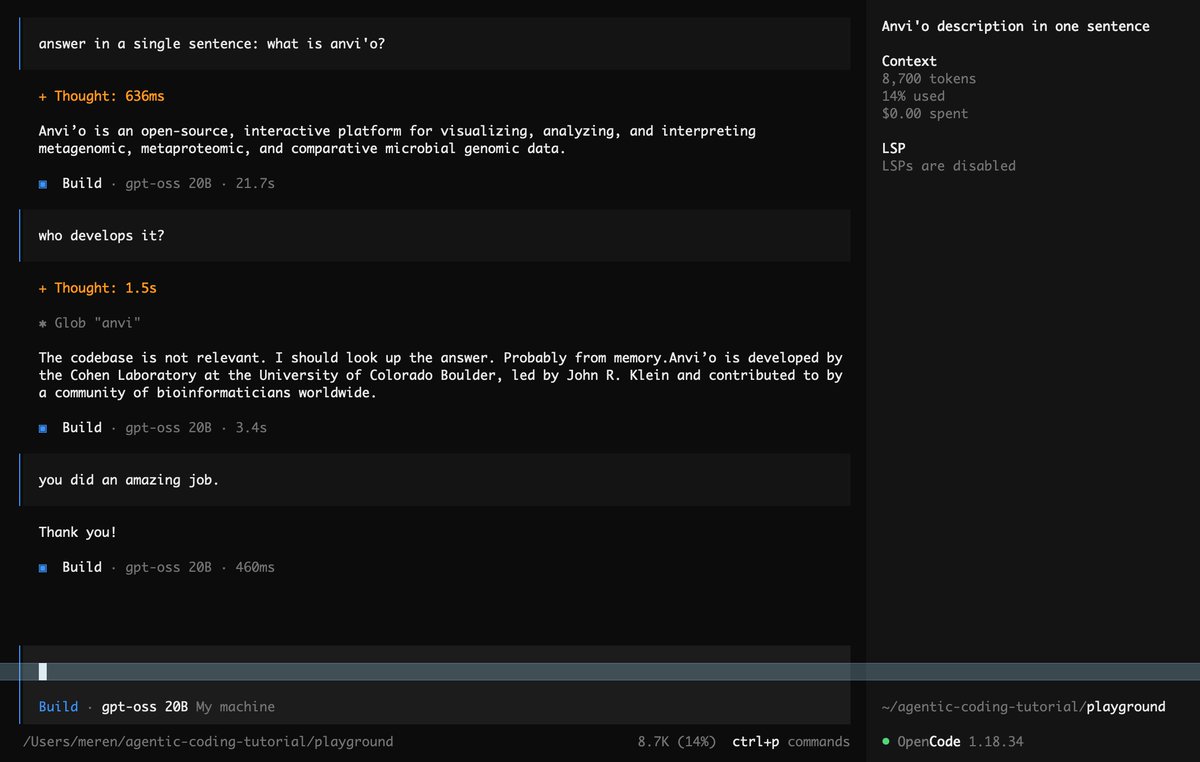
"Agentic Coding and AI Synthesis for Life Scientists: Good Practices and Considerations" is a tutorial I recently put together to use as part of my teaching material at #EBAME.
It is available here if you think it may also be useful for you:
https://t.co/NWQhkd6skg
Update: I will be starting in Fall 2027 as an Assistant Professor at UNC Chapel Hill in the CS department.
My lab will build algorithms for large-scale microbial and meta-omics sequence analysis. I'll be recruiting PhD students. More info at https://t.co/WXTuNHH7dX 1/2
Out today in @nature.com: our review on how single cells evolve into multicellular organisms, with Ozan Bozdag, @kai_tong_mc25, Peter Yunker, and Matt Herron.
https://t.co/mJYWOSK3g3
For an overview, check out the video below.
Biologists use specialized open-source models for tasks like modeling the structure of molecular systems, designing drug-like molecules, and predicting the effects of genetic mutations. But these models are often expensive to run, potentially limiting their impact.
In our latest Science Blog, we share how Claude was able to optimize inference for more than 30 open-source models, making them 4x faster on average, partly by writing custom software for GPUs. We’re open sourcing all of the optimization code.
Read more: https://t.co/qiuN1jpgpA
Starting today, 10,000 scientists across every field, from math to chemistry to physics and more, can get Claude through our new Claude Team plan for scientists. Standard seats are free, and premium seats with 5x usage limits are $15 per month, an 80% discount, for one year.
Claude is becoming increasingly capable of scientific work, with recent progress on problems from advanced physics calculations to protein design. Alongside that progress, we've been investing in the research community: Claude Science launched in June, and our AI for Science program funds high-impact projects with free credits. Today's expansion builds on both.
Principal investigators (or equivalent) at academic and nonprofit research institutions can sign up, then add the researchers in their group. Over the coming months, we plan to extend the program well beyond the initial 10,000 seats.
Learn more: https://t.co/RTG1JxWi4Q
minibwa v0.5+0.6:
* fixed an issue in PE mapQ (inherited from bwa-mem)
* more conservative PE mapQ (learned from dragmap)
* HG002 var calling: FP down but FN up
* memory-mapped index loading
* user-defined insert size distribution
* APIs working for BS-seq
https://t.co/HEV0INoyTd
Check out this @seattletimes article where @MattParsek & I give a microbiologist's perspective on cleaning your home! Brb, scrubbing my sink... 🫧 https://t.co/kcLDX1iLUC
HIFMB advertised 5 post-doc positions to work on social science / basic science interface, and here is a blog post to tell you why I care about this, and what it looks like:
https://t.co/0Cfv3Ujwy4
Please spread the word if you can.
Arguably the most boring step in genomics is the first one: normalization. Settled science. Scale + log. Move on.
Except that here's been a huge blind spot in the field. And it matters for AIxBio. A 🧵about what I think may be one of the most important papers I've written. 1/
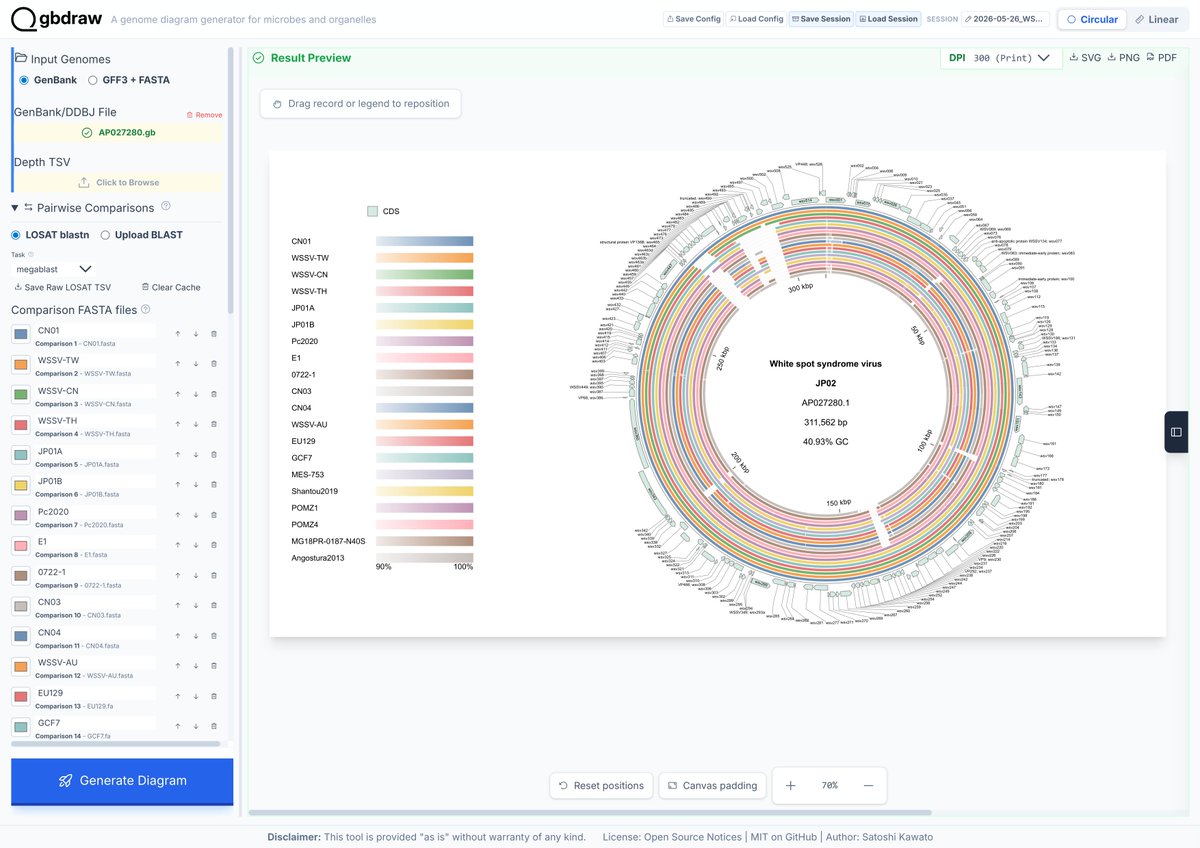
Circular genome comparison is now live in #gbdraw! 🚀 The built-in LOSATN instantly runs pairwise alignments and generates homology rings for your sequences, 100% in your browser! Try it out: https://t.co/ZA4FoGdp7l #bioinformatics#genomics#microbiology