@paraschopra 1. "Manual of Insight" and/or "Practical Insight Meditation" - by Mahāsi Sayadaw
2. "Principles of Economics" and "The Bitcoin Standard" - by Saifedean Ammous
3. "Safe Haven" and "The Dao of Capital" - Mark Spitznagel
University “scholars” of history have found a clean hack to perpetually produce papers and increase their credentials and fame. Keep posting some lies on any controversial topic in Indian history.
Hindus will outrage and do lafda on social media. Take screenshots and write sob stories based on their impulsive responses to journals like “Global Islamophobia”, “Current History”, “Religion News Service”, “Canopy Forum” etc…
Increase your scholarly indices, get called for conferences (which are basically paid trips), get fame both inside and outside academia, and also your victimhood credentials.
Audrey Turkshi paved the way. This guy will follow suit now.
Audrey: ISIS brought stability to a volatile region and provided the much needed administrative services of Syria post the colonial war of USA. They created roads, collected taxes and facilitated marriage to their soldiers so that women can have family life. Immigration was opened and open employment was provided to immigrants in the army giving an opportunity for glorious service to the nation.
For a century, it was considered reasonable for Western museums to keep ancient Indian artifacts in basements, to label Vedic astronomy as borrowed from the Greeks & to treat native oral histories as fairy tales. Their idea of a reasonable discussion is a 1 way lecture where they speak from a podium & the native population nods in silent agreement.
In the Anvikshiki (ancient Indian science of inquiry/logic), a debate is only considered complete through Purvapaksha (deeply studying the opponent's view) & Uttarapaksha (dismantling it with counter-evidence).
The pushback Miano is experiencing on X is Uttarapaksha in action. Regular citizens are tagging him with satellite imagery, excavation reports & genetic data from Rakhigarhi (which showed zero steppe pastoralist DNA in the Harappan individual, dealing a fatal blow to the Aryan invasion myth). He cannot counter the data, so he labels the platform "Low IQ" & retreats to a safer digital space.
Since Audrey has blocked, here is something what I want to share with media.
Unlike what she is telling, India still has thousands of sites which can be linked to SSC.
I have lat longed most!
Among the 7 largest cities of SSC, 4 are still in India.
There are 93 significant sites of which 77 are in current India.
I had shared this earlier. Resharing the map drawn for demonstrating trade.
https://t.co/9CmsjbiZWi
There is quite a large body of academics who believe that reading and recalling things written by others without critical analysis is “smart”. Typically these guys have good reading comprehension and memory and can do a qualitative “does this match what I read” analysis pretty quickly. In general they toe the establishment line and any writing that has jargon, reference to esoteric facts and polished narrative seems very impressive and authoritative to them. These guys typically are the ones who readily accept and defend mainstream narratives like AMT, 1200 BCE Rigveda, “genetic evidence” of language and a host of other narratives which require a carefully cultivated ignorance of facts and a lack of depth.
On the opposite end are people who have seen that “something is wrong” with the official narrative and will try to establish alternatives but have poor grasp of narrative formation, no school of thought and weak systems analysis to form a coherent alternative. remember that it does not matter how good your alternate hypothesis is if you don’t have the institutional support to create your own school of thought.
What is missing is combining good analysis with good narrative and this requires a school of thought and formal guidelines to create new research.
Great thread showing how great scholars essentially admit the vedic nature of IVC despite being ideologically opposed to it. Must be such a terrible mind fracture
I may not be a Yogini but at least I don’t have the IQ of a paramecium. You claimed there is only one IVC seal showing a figure seated in Yogic position. I showed you at least four officially documented ones which have been extensively analyzed by scholars. And there are more seals as well as sculptures.
Yet instead of admitting you were wrong the best you could come up was this pathetic attempt to deflect?
Better curl up with your pillow in a fetal position with your bottle of copium.
Archaeology is already becoming a de facto applied data science field: under the banner of “computational archaeology,” researchers use data modeling, statistical analysis, simulation, and GIS to infer past human behavior from fragmentary evidence.
Computer vision over drone and satellite imagery can automatically flag likely sites, stratigraphic patterns, and subtle landscape modifications, turning terabytes of raster data into prioritized dig targets.
I also mapped the SSC sites to show it is actually Saraswati Sindhu Civilization. When you place the sites on the map it becomes very evident. This was a just a weekend afternoon project!
There are even explicit attempts to formalize a “palaeoanalytics” stack: morphometrics of fossils, attributes of millions of stone tools, and environmental context, all integrated with ML methods to study human evolution.
The work looks very much like classical engineering: define feature spaces, build predictive or generative models, quantify uncertainty, and then iterate.
So, we have just got started. It is going to demolish lot of narratives built by conventional historians and archeologists who basically want to hang on to their "Expert fallacy".
Your work on IVC/SSC script is textbook application of Engineering to archeology. You have just got started. May your tribe swell!!
Most engineers are not impressed by name dropping, adhering to a particular school of thought or popularity of narrative, which are the pillars of the value system of humanities.
This is why they are shocked at data analysis as a counter to narrative/ dogma and why accusing an opponent as a member of the “Hindutva” school seems like a legitimate defense for them.
Empiricism, systems analysis, chronological coherence mean little to them because humanities is about “what we should believe” rather than facts or science.
A piece of analysis that used to take me weeks to complete in my free time can be done in a weekend now complete with charts, data and reproducible code.
And there are a million like me and we are an unstoppable force of nature at this point. Buckle up, it’s going to be a wild ride.
What Audrey is doing is standard manipulation pattern discussed in psychology literature.
Blocking critics or people with strong subject knowledge while keeping more impressionable or low‑information participants is one such technique discussed in books.
Keeping only weak or supportive replies and then beating the strawman argument is taught to any high schooler who takes class on logical fallacies.
Media‑literacy resources specifically warn that extraordinary or very confident claims without robust sourcing should be treated skeptically, especially if alternative views have been actively suppressed.
Here most of the media in India are failing to hold the maxim "extraordinary claims need extraordinary evidence"
It is futile to make Audrey understand how science works or how the data provides evidence. She is not as qualified in data or science.
Scholars can no longer gate keep historical narratives, and your dear Audrey cannot debate.
She blocks anyone who challenges her arguments because she cannot handle that someone may have the audacity to.
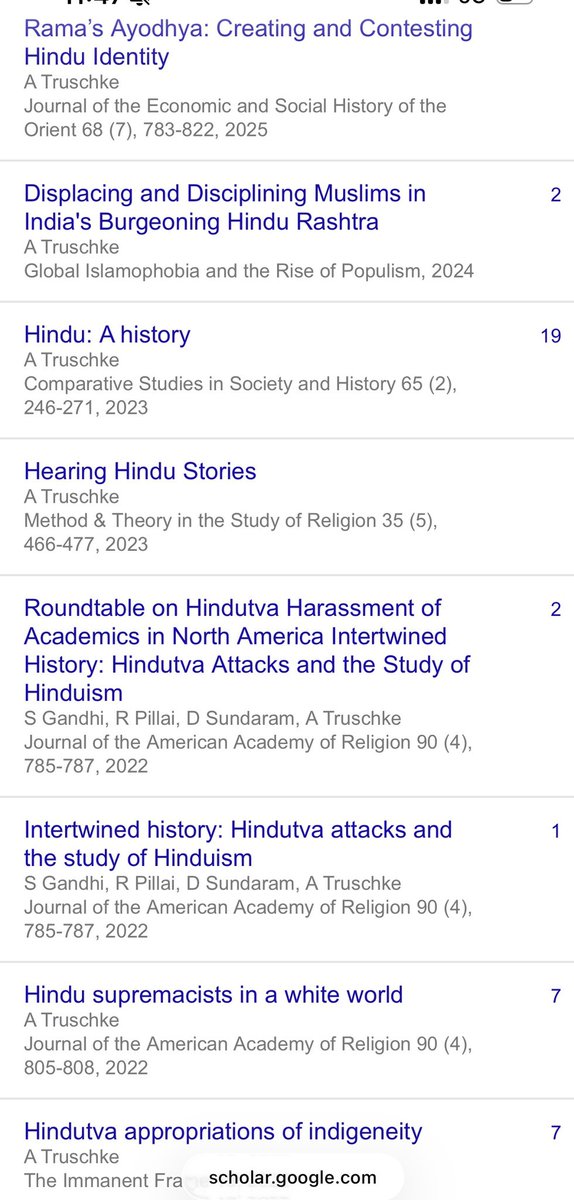
She then goes to outlets she likes to say this sort of stuff below.
Is disingenuous. People won’t stand for it. And they will bring receipts in terms of evidence to prove whatever they want to.
I bet you assume ‘Hindutva’ is also an insult. It’s not. The Supreme Court of India has also defined it way back in 1995 as a ‘way of life’ or a ‘state of mind’.
To throw around the term to think you’re making the case that people who challenge her or you are somehow bad is again a clear sign you hate the fact people are owning their histories with proof.
If a historian allows his/her personal feelings towards particular groups to shape shape their work, they are, by definition, failing at their craft. Historians are of course humans and inevitably carry emotions and biases, but when an entire field becomes systematically skewed, the stakeholders and people with "skin in the game" notice it.
The seeds of the distrust that exists among Hindus for Western academics (especially in humanities) has been sown by scholars like Audrey Truschke. This has unfortunately led even well meaning people to become overly(and sometimes unfairly) suspicious of all Western academics, which might have unfairly affected you too.
I haven’t followed your work closely beyond your videos on the Indus Valley Civilization. Correct me if I’m wrong, but since you focus primarily on prehistory and the ancient period, I assume you haven’t made any content on later periods of Indian history. If some Hindus have attacked you simply for presenting evidence on AMT, I apologize on their behalf.
On the specific issue of medieval and early modern Islamic rulers in India, the narrative promoted by scholars like Truschke is not refuted merely by “legends,” but by extensive primary historical evidence. The Mughal Empire belongs to the early modern period, its well within the era of written records, royal chronicles, and court histories. The problem is not the absence of evidence, but its selective treatment, these scholars often downplay or ignore the explicit statements of the kings and their own courtiers, who repeatedly describe the destruction of Hindu temples and idols as a religiously ordained duty. And yet some historians equate large scale, ideologically driven Islamic iconoclasm with occasional shifting of idols from one temple to another etc that might have occurred during conflicts between Hindu kings, and then conclude that all such violence by Islamic actors was purely political. This flattening of the record does a disservice to historical truth.
I remember this argument made by a Pakistani student from UT Austin at a private event. He said "My country is Islamic so it is fine if we do not treat non-Muslims as equal to us; it's the basis of the founding of our nation but India is secular according to its constitution, therefore it must treat all citizens equally." The shamelessness is unbelievable.
The Occidental hatred for India is because India refuses to move Hinduism to a museum. Everything else is a direct consequence of that. 1500 years of continued battering and what did they achieve? Chips at the edge. Substantial chips but still chips. If one looks at the achievement of Islam and christian expansion and evangelism, India is the only entity which stands out of a sore thumb. How can they even ignore that?
The essential mission for all anti-Indian history discourse is DECONSTRUCTION.
That Hinduism is not real, only sects and castes and tribal gods are.
That India is not real, only its 20th century linguistic states and random settlements in forests and ethno-caste enclaves are.
They believe that there is no whole, only parts as @samyak128 points out.
Almost all that is positive came from foreigners, the remainder from noble savage parochialists. All that is negative comes from those who dared to seek a united civilization and people, to be more than mud huts and tinpot kingdoms.
'Hinduism' should be left to be an exhibition in a museum. A smattering of disparate artifacts, untouched across a sterile floor. Now rendered untouchable. While 'India' is forged by an obtuse, overbearing set of legal documents stitched together by soulless Byzantine bureaucrats. Both should only be celebrated for their surface diversity, never their millennia-steeped depth and substance.
In each footstep of these adversaries of Indianism, there is deceit, as they seek to drape the subcontinent in a kaleidoscope of lies and obfuscation rendering it an amorphous, broken mass rather a sacred land between the mighty Himalayas and roaring Indian Ocean.
Here's What you need to know about Audrey Truschke:
1. Her father-in-law & Husband had a business of missionary conversion in India.
2. Her FIL formed an NGO bless India with the motto "Win India for Christ"
3. Indian Govt has destroyed their family business of conversion.
This is an unbelievable piece of work by Sarthak and something that requires amplification.
Let me explain what he found, in simple terms.
Sarthak is a Class 12 student from the 2025-26 batch, one of the 17 lakh students whose answer sheets went through CBSE's new On-Screen Marking system.
He spent days reading through CBSE's evaluation tenders, scraped all 576 tenders CBSE has issued, and tracked how the rules changed across three versions of the same tender.
The core finding is that the company that won the contract to scan and grade 17 lakh students' answer sheets is Coempt Eduteck.
Coempt used to be called Globarena Technologies. Globarena was the company behind the 2019 Telangana intermediate exam disaster, where software failures led to 3.8 lakh students getting wrong or missing marks, and 23 students died by suicide.
A government committee found systemic failure and negligence. Six months later, Globarena rebranded to Coempt Eduteck.
So a company with that track record won a contract to handle 17 lakh CBSE students. Sarthak's investigation is about how the rules were rewritten to let that happen.
The tender was issued three times.
> First tender, February 2025. It existed, then disappeared from the public GeM portal. Sarthak scraped all 576 CBSE tenders and this one was missing from the archive entirely.
> Second tender, May 2025. Four companies applied including TCS and Coempt. All four failed the technical evaluation. Cancelled.
> Third tender, August 2025. Coempt won. Between the second and third tender, a series of rule changes happened, and every single one made it easier for Coempt to qualify.
Here is what changed, one by one.
01. The old rules disqualified any company with a history of abandoning work, failing to complete contracts, or financial weakness. The new rules deleted this clause entirely. Coempt's Telangana history stopped being a barrier.
02. The old rules disqualified any company that was "blacklisted earlier." The new rules changed this to "currently blacklisted." Because Globarena rebranded after Telangana, removing the word "earlier" effectively erased their past.
03. The rules required Rs 50 crore average turnover over three years. Coempt's exact average came to Rs 50.86 crore. They cleared the bar by less than 1%. Earlier, a smaller company had asked CBSE to lower the bar to Rs 30 crore for fairer competition. CBSE refused. So the bar was kept high enough to block small players, but sat exactly low enough for Coempt to scrape through.
04. Software maturity is measured on the CMMI scale, 1 to 5. The old rules required Level 5. The new rules dropped it to Level 3. Coempt is a Level 3 company.
05. The cooling-off period for engaging retired CBSE officials was cut from two years to one. This makes it easier to use recently retired insiders to influence the process.
06. The old rules required experience with large projects of at least 5 lakh students each. The new rules removed the student count and counted cumulative answer-book volume across small projects instead. Coempt has many small fragmented university contracts. This helped Coempt and hurt TCS.
07. The old rules required bidders to own their own data centre and disaster recovery centre on Indian soil. The new rules allowed third-party MeitY-empanelled cloud hosting. Coempt runs on AWS and Azure. This helped Coempt and hurt TCS, which owns its own data centres. It also means student data is no longer on sovereign, Indian infrastructure.
08. The old rules required the bidder to own or control the complete source code of its software. The new rules deleted this. Coempt's platform runs on Microsoft's proprietary IIS, which they don't own.
09. A last-minute corrigendum, issued right before bid submission, removed CBSE's own power to blacklist the firm if its software failed catastrophically. So even a Telangana-scale failure couldn't get Coempt banned from future government tenders.
10. The penalty structure shifted from punishing mistakes to punishing delays. The old rules fined the vendor for wrong scanning, merged pages, and unscanned books. The new rules dropped those and instead levied Rs 50,000 per day for delays. This incentivises rushed scanning over accurate scanning.
11. The old rules had a hard accuracy threshold, error rate not to exceed 0.5%. The new rules removed this number entirely.
12. The old rules specified proper book and robotics scanners. The new rules just say "sufficient scanners." The definition was vague enough that, as Sarthak notes, the scanning could be done with a phone on a stand.
13. On the security side, the contract required a VAPT (vulnerability and penetration test) certified by CERT-In before go-live, and a restricted beta phase before launch. The system clearly wasn't restricted, because the other researcher, Nisarga, was able to access it and find vulnerabilities four days before go-live. So the mandatory security audit appears to have been bypassed.
These are more than a dozen rule changes, all between the failed tender and the winning tender, all pushing in the same direction, all benefiting the one company with the worst track record in the field.
The security holes Nisarga found last week now have an explanation. The system was built by a vendor that was specifically allowed to skip the security certification, the source code ownership, the data sovereignty, and the quality thresholds the original rules demanded.
Following things need to happen immediately;
1. An immediate CAG audit of the tender process.
2. A parliamentary debate on the topic.
3. An independent investigation into
> Why the first tender vanished?
> Why the disqualification clauses were deleted?
> Why the turnover bar was held exactly where it was?
> Why the security level was dropped?
> Why the blacklisting power was removed at the last moment?
Sarthak, this is genuinely exceptional investigative work. Far better than most journalists with full resources ever manage. Take a bow. :)
Whenever people South of Vindhyas speak Hindi and they forget any particular commonly used word, they will immediately find substitute Sanskrit equivalent word that they may know or is commonly used in their own mother tongue too
This is with assumption that a regular Hindi speaker should understand common Sanskrit words
This is especially true for Telugus, Kannadigas ans Malayalis as Sanskrit words are common in their vocabulary