UNDER THE HOOD: @QFEX #02
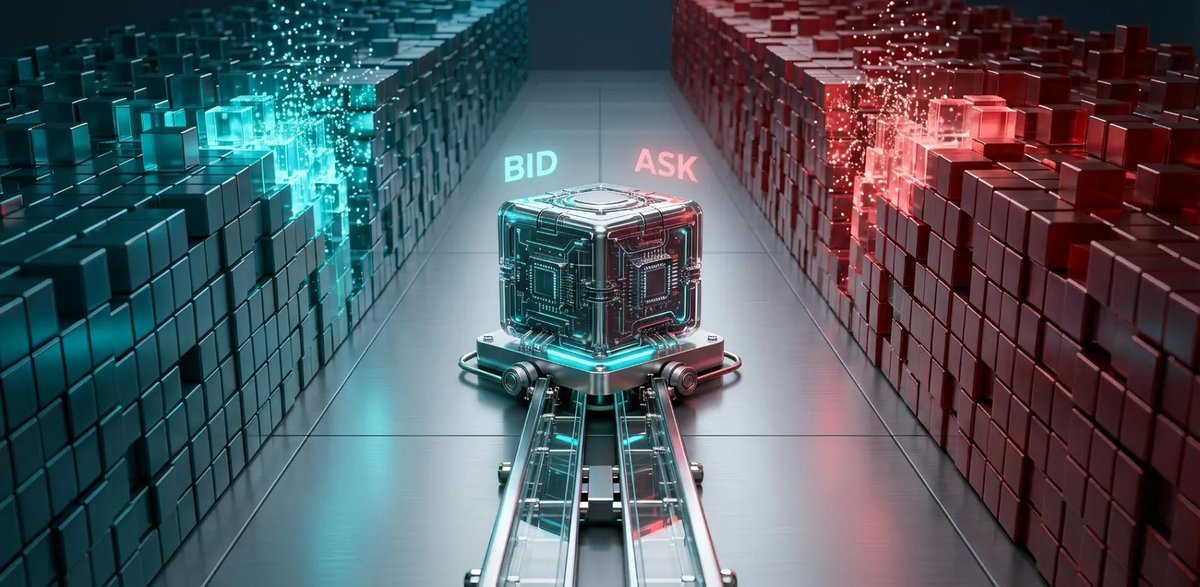
Market making isn't simply buying at $99.95 and selling at $100.05.
The real challenge is knowing when NOT to quote symmetrically.
Consider three mechanics:
1 - VOLATILITY
When the leader market becomes volatile or its data gets stale, the fair-value estimate becomes less reliable.
The solution? Widen both sides. Demand more compensation for uncertainty.
2 - INVENTORY
Already holding too much of an asset?
A market maker can skew its quotes:
→ Make selling more attractive.
→ Make buying less attractive.
This is inventory management through pricing, not just position limits.
3 - ORDER TRAINS
Instead of one bid, imagine:
$99.95
$99.90
$99.80
The closest order has a higher chance of execution but less edge. Deeper orders demand more edge but may never fill.
Here's the interesting part:
More orders don't automatically mean more liquidity. Poor spacing, excessive exposure and bad replacement logic can create problems of their own.
Market making is a continuous balance between price, risk and execution.
That's the engineering behind a functioning market.
What's more important for a market maker: tighter spreads or better inventory control?
Under the Hood: @QFEX - #01
A market maker can calculate the correct fair value and STILL lose money.
Here's why.
Imagine an asset has a fair value of $100.
A naive market maker quotes:
Bid: $99.95
Ask: $100.05
But what happens when volatility spikes?
What if the price feed is stale?
What if informed traders know something you don't?
What if your inventory is already heavily skewed?
QFEX 's market-making research breaks this down into three separate problems:
→ Fair value: What is the asset worth?
→ Quoting: How much uncertainty should the spread absorb?
→ Inventory: How aggressively should you buy or sell?
One particularly interesting detail: QFEX discusses widening spreads when volatility or stale data increases, while adjusting quotes asymmetrically when inventory becomes unbalanced.
This is the difference between calculating a price and actually running a market.
Would you rather trade against a tight spread with stale pricing or a wider spread with reliable fair value?
The best alpha doesn't always come from a chart.
Sometimes it comes from the people sitting around the table.
Bringing traders, builders and market thinkers together is how real ideas turn into opportunities.
@QFEX knows the value of a good conversation.
Next time i wanna be inside.
@QFEX CE runs the New York Stock Exchange, closes it every day at 4pm…
and now you can trade ICE itself at 3am on a Sunday.
The exchange became the asset. Respect @QFEX
@QFEX Scariest thing this Halloween:
Your stock gaps -15% after hours and you can’t do anything until 9:30am.
At this point I need Margot Robbie in a bathtub to explain why I’m still waiting for the market to open.
Or just trade it 24/7 on @QFEX
$6.3B gone from Binance’s hot wallet in about 20 minutes.
Withdrawals paused. Analytics firms point at North Korea.
Binance says it will cover user losses. Good. But the lesson for every trader is the same:
Lesson 1: don’t keep your whole stack on one exchange
Any centralized venue carries counterparty risk. Big or small, CEX or DEX.
Spread your trading across venues and withdraw what you’re not using.
Lesson 2: keep only margin on exchange
That’s how I run my own trading. Only the margin my strategies need sits on venue. The rest stays off.
Lesson 3: pick venues built by market-structure people
This is why @QFEX is in my rotation:
• Founders are quant traders from Tower Research & Flow Traders, with a Citadel background on the team, backed by YC
• One collateral: everything is USDC-margined. No zoo of tokens across 10 chains
• Fiat rails via bank transfer, plus stablecoins
• A public bug bounty program
• 24/7 equity, index, commodity and pre-IPO perps when you need to hedge, even while crypto is panicking
No exchange is risk-free. Diversify, size down, and keep your keys and your exposure in check.
If you’re rotating venues this week, QFEX is worth a look 👇
NFA · DYOR
The subtle detail is that a fair-value model must know when NOT to trust itself.
QFEX’s research highlights stale feeds, mismatched timestamps and thin order books as reasons a midpoint can mislead.
A price that looks precise isn't necessarily reliable.
The system must assess the quality of its inputs before using them to quote a market.
That’s the difference between displaying a number and building a robust pricing engine.
Most people look at @QFEX and see 24/7 equity perps.
The more interesting question is how you price an equity when its underlying market is closed.
QFEX’s research reveals some genuinely interesting mechanics.
I find out interesting features to explore :
The hard problem: funding when stocks are closed.
In crypto, the underlying trades 24/7. Equities don't.
QFEX says it suspends funding while the underlying market is closed rather than assuming every overnight price deviation will mean-revert.
Why does this matter?
A genuine overnight repricing can create a gap at the next open. Treating it as temporary mispricing can leave the exchange exposed to liquidations it cannot execute quickly enough.
QFEX also describes minimum and maximum price bounds based on the last known open price.
Markets don’t stop moving just because the stock exchange closes.
That’s what makes @QFEX interesting 👀
24/7 perpetuals on global equities, indices, and commodities - bringing crypto-style market access to traditional assets.
The real test? Liquidity, execution, and risk management.
Interesting infrastructure to watch as TradFi and crypto continue to converge. 📈