We kept running into the same problem while researching crypto projects: finding information was easy, but verifying it was not.
A project says it uses revenue for buybacks. Governance says the mechanism was approved. A dashboard shows activity. On-chain data shows tokens moving. But then the real questions start: is the buyback actually happening now? Where do the purchased tokens go? Are they burned or just held? Does supply actually decrease? Who ultimately captures the value?
Answering one question can mean jumping between docs, governance, dashboards and explorers — and sometimes you still end up unsure.
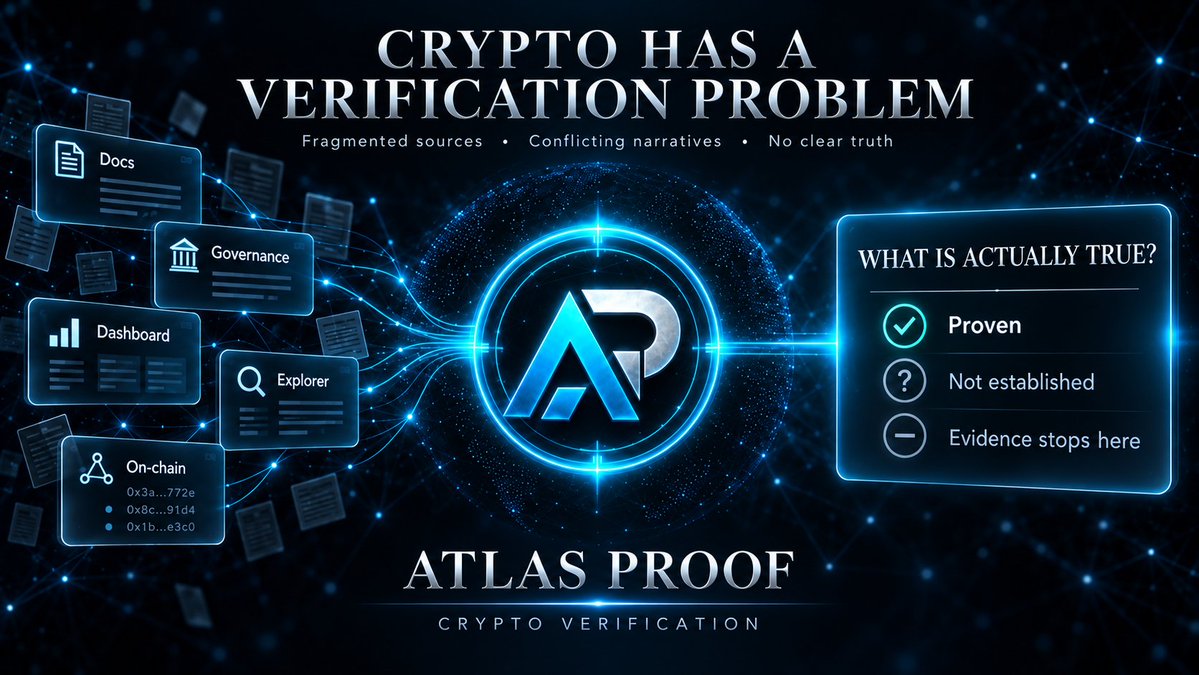
That made us ask: what if you could ask one question about a crypto project and get a clear, sourced answer showing what is proven, what isn’t, and where the evidence stops?
That’s what we’re building with ATLAS PROOF — Crypto Verification.
It’s still early, and we’re building it around real research workflows. If you research crypto projects yourself, I’d genuinely like to know: what is the hardest thing for you to verify?
The headline is TradFi moving onchain. The pile is mostly T-bills and yield funds. Stocks are $2.8B on a $45.9B stack. Issued market cap is not the same thing as equity rights sitting in a wallet.
RWA market cap has grown 11.2x over the past 3 years to $45.9B
U.S. T-bills lead at $13.6B, followed by yield strategies at $10.9B, credit funds at $6.2B, gold at $5.2B & stocks at $2.8B
Traditional finance is moving onchain, asset class by asset class
They put BlackRock in the product name and it already reads like you hold the fund. You hold an Ondo token built on a BlackRock model. Eligible non-US wallets, permitted venues. A strategy on a slide is not the same thing as the share class sitting in your wallet.
Introducing Ondo Intelligent Portfolios, the first three portfolios powered by BlackRock.
Ondo Intelligent Portfolios introduces a new onchain product category: curated investment portfolios delivered as single onchain transferable tokens.
The first three portfolios are based on portfolio strategies developed by BlackRock for Ondo, marking the first time eligible onchain investors can access exposure to such strategies through a single token.
1. BLKHIon: Ondo High Income Powered by BlackRock
2. BLKDIGon: Ondo Diversified Growth Powered by BlackRock
3. BLKGRWon: Ondo High Growth Powered by BlackRock
Diversified, professionally constructed strategies have historically required brokerage accounts and traditional fund structures. Now, delivered as peer-to-peer transferable tokens from Ondo, these onchain portfolios become accessible to eligible non-US investors in permitted jurisdictions through the wallets, exchanges, and DeFi applications they already use.
“Tokenization creates new ways for portfolio strategies to be delivered through digital infrastructure. Diversified portfolio strategies can be incorporated into tokenized investment products, enabling eligible investors to access diversified allocations through a single instrument. It shows how established portfolio construction approaches can be delivered through new channels and technologies.” - Lisa O’Connor, Global Head of the Model Portfolio Solutions team and Co-CIO for Global Solutions within the Multi-Asset Strategies group at BlackRock
Ondo Intelligent Portfolios can unlock novel capabilities:
→ Programmatic rebalancing
→ Full composability with DeFi
→ Complete transparency onchain
→ Multiple asset classes in a single token
This is just the start for Ondo Intelligent Portfolios. The infrastructure is now in place for leading financial institutions to bring their asset allocation expertise onchain.
Someone put a Lido buyback on the table like it was already policy. Cut the NEST threshold to $30M and send everything above that into $LDO. The vote is still open until tomorrow and it’s 99.99% Against. A proposal on Snapshot is not a live buyback. Right now the mechanism is a losing ballot.
@LidoFinance is voting on a community proposal to cut Lido Labs headcount by 50% and send 100% of protocol revenue above $30M a year into $LDO buybacks with near-unanimous disaproval.
Posted by @Aksusarya__eth, it bundles four asks:
- Commission an external audit of all 2025-2026 DAO expenses and grant distributions
- Cut Lido Labs headcount by 50%
- Lower the annualized revenue threshold that activates NEST (Network Economic Support Tokenomics), the DAO's LDO buyback framework, from $40M to $30M, and send 100% of revenue above it to buybacks instead of the 50% split the proposal describes as current
- Replace standing buyback orders that wait for price dips with a model that deploys capital on moving averages or real-time volatility
The proposal calls the current burn rate unsustainable given competition in institutional staking and says static orders leave capital "idle waiting for deep market corrections that may not occur."
All three voters who left a rationale are Against, citing missing analysis and headcount risk.
One warned: "While we strongly support the call for independent financial audits and transparency, the specific measures bundled within this proposal present unacceptable risks to the protocol's long-term success. First, mandating a 50% workforce reduction at Lido Labs is an overly aggressive and potentially destabilizing move."
26 wallets have cast 18.7Mn LDO so far: 99.99% Against.
Voting closes September 24th at 1:39pm UTC.
Proposal: https://t.co/qfmWGhjkSz
I went into the NEAR fee numbers instead of stopping at “switch is on.” The switch itself is real — 24 February, Intents payouts in $NEAR, split between the protocol and distribution partners.
The 30% take is already two different piles. DefiLlama has Intents at about $6M fees and $1.38M revenue over 30 days, closer to a fifth. NEAR’s dashboard today shows $5.76M gross and $2.03M net, which looks more like 35%.
Buybacks exist. buybacks.multisignature.near holds about 1.24M NEAR. That still isn’t “every captured fee buys the token and then burns it.” The blog lets governance buy, stake, lock, or just hold. DefiLlama treats the buyback as not a burn.
Fees are real. Some NEAR is being bought. The supply already shrinking from that 30% — that’s the part I couldn’t close.
WARNING : AI season everyone has been waiting for is back. And it’s back HARD. 🚨🚨
$NEAR finally woke up.
It sat under $2 for months. Now it’s at $4.54, up roughly 80% in a week.
NEAR Intents just had a $1B week, with lifetime volume now around $25–30B.
The fee switch has been live since February, with roughly 30% of fees captured over the last 30 days.
Buybacks are actually happening. Not just sitting in a tokenomics slide.
Then there’s the perps side.
Confidential perps are live on https://t.co/KBXVutcSY5, running on Hyperliquid rails, with 50+ markets and up to 40x.
Private deposits are on by default.
Confidential TVL has already cleared $70M, triggering the $3.33 milestone drop.
This is what makes $NEAR interesting to me.
It’s an AI name that was actually settling volume while the market barely cared.
The chart had been building a year long base.
Now we’re finally getting the first real answer.
@NEARProtocol@CryptoWizardd
We’re building ATLAS PROOF around real research problems.
If you research crypto projects, tell us what takes the most time or is hardest to verify. Your feedback will directly help shape the product.
We kept running into the same problem while researching crypto projects: finding information was easy, but verifying it was not.
A project says it uses revenue for buybacks. Governance says the mechanism was approved. A dashboard shows activity. On-chain data shows tokens moving. But then the real questions start: is the buyback actually happening now? Where do the purchased tokens go? Are they burned or just held? Does supply actually decrease? Who ultimately captures the value?
Answering one question can mean jumping between docs, governance, dashboards and explorers — and sometimes you still end up unsure.
That made us ask: what if you could ask one question about a crypto project and get a clear, sourced answer showing what is proven, what isn’t, and where the evidence stops?
That’s what we’re building with ATLAS PROOF — Crypto Verification.
It’s still early, and we’re building it around real research workflows. If you research crypto projects yourself, I’d genuinely like to know: what is the hardest thing for you to verify?
@alexanderesslee@CoinMarketCap The pile is the easy part. I get stuck on what that 2.49M is doing today — sitting, staked, spoken for, or free to walk.
Optimism passed Upgrade 20 on September 16 and the thread already reads like Superchain interop is here. L2BEAT is clearer than the headline: this is a prerequisite, not interop itself. Mainnet target is September 24. A vote can land and the feature can still be a date on a calendar.
@Optimism Upgrade 20 passed governance on Sep 16.
It introduces Super Root Dispute Games to prepare the network for future interoperability between chains. That is a prerequisite for Superchain interop, not interop itself. Mainnet target: Sep 24
https://t.co/tAiFUxn0Pe
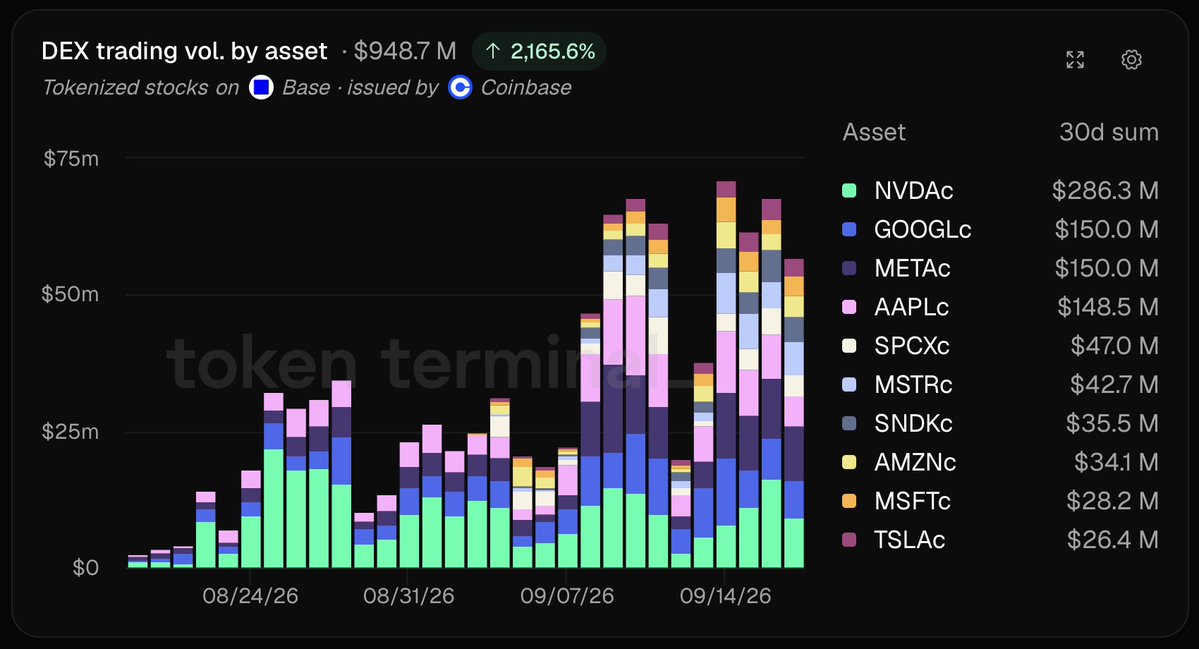
Token Terminal is already treating tokenized-stock volume on Base as the thing that puts Base on Coinbase’s income statement. Volume on the chain is one clock. A line item in Coinbase’s books is another. Paper can trade all day on Base and still never show up as Coinbase taking that flow.
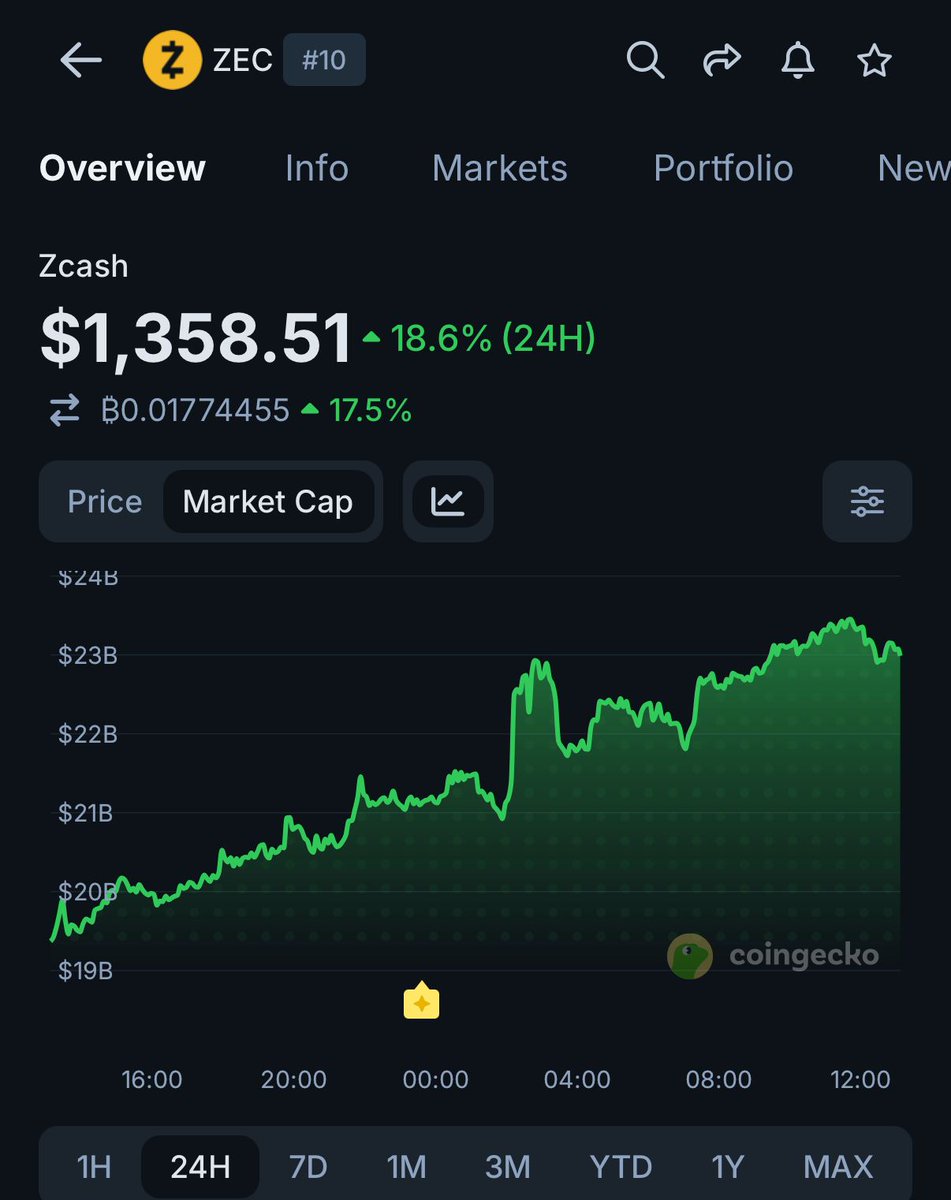
They put $23B and a governance vote in the same sentence, like the vote printed the cap. Faster blocks is a parameter. Twenty-three billion is a price. A vote can pass and the chain can still be on the old clock — and the market can rip for a different reason. I can’t tell from this which of those two actually moved.
JUST IN: $ZEC breaks above $23B market cap.
The move comes from a recent governance vote, backing faster block times while maintaining its Bitcoin-style halving schedule.
@DegenerateNews@HyperliquidX@RobinhoodCrypto One day of app revenue is a scoreboard, not a winner. Hyperliquid can print more than Robinhood Chain today and that still doesn’t say whose token eats any of it, or if tomorrow looks the same.
Arc just went live and the thread makes it sound like the whole circus showed up on day one — 190 partners, big banks, Aave, Morpho, everyone. I keep tripping on the same thing. Being on the launch poster is not the same as already doing business there today. The chain can be on and a bunch of those names still just be a logo.
Arc Mainnet is live with 190+ partners across value movement, markets, assets, infrastructure, and agentic applications.
Stablecoins, tokenized assets, onchain markets, global payments, and agentic economic activity now have a shared execution environment built for real-world finance.
The Economic OS for the internet starts today.
Explore Arc Mainnet: https://t.co/Zaz6RTPJeW
@Unchained_pod The headline already treats the buyback as gone. It’s still a proposal to cancel one that was already approved, and the $30k a month is why they’re even talking. Late September is the vote — last approval didn’t mean it kept running, and this proposal isn’t executed either.
This line is going to get read the lazy way. A working Uniswap fee switch, so now every other token looks cheap if it only gives you governance. I get stuck one step earlier. A switch that is on still does not tell you who receives the take today — the wallet, the staker, the treasury, or a buy that may never hit the float. Uniswap turning something on does not flip every other protocol by itself. It just makes the missing pipe louder.
Rival DeFi protocols have less room to leave token economics unresolved. A working Uniswap fee switch makes governance rights alone a harder sell.
https://t.co/pZAaqmH7LO
This one stings a bit. People buy an onchain “stock” because it moves like the stock and is named like the stock, then find out they never owned the thing underneath. No share, no vote, no dividend, and if the wrapper snaps there is nothing to grab. Token Terminal put it simply: some holders only learn that after the fact. I keep getting stuck one step earlier. Tracking a price is not the same as holding a claim. The ticker borrowed the name. It did not borrow the right.
The growth catalyst for @MetaLeX_Labs-style products
Onchain stock holders reach critical mass
Some get rugged after learning that their tokens do not confer ownership of the underlying stock
Issuers who want to earn user trust explore more onchain-native tokenization models
Morpho just made it easier to lend straight into a market.
No curator. You pick the risk. You take the rate.
Easy to read that as: the network is growing, so the token is too.
I keep getting stuck one step earlier.
The product can get bigger and still leave $MORPHO on the side.
Fees moving through the markets are not automatically value arriving at the token.
What I can’t tell from the announcement is the only part that matters here:
is any take actually reaching $MORPHO today — or is that still just something governance could turn on later?
$INJ is up 40% YTD, while its RWA perpetual volume has scaled to $5.3B in cumulative trading.
In this article, we look at how @Injective's 135 active RWA perpetual markets, onchain orderbook, and unified liquidity are powering that growth.
Read the full article 👇
https://t.co/TZej38vh2e
@wallstreetbets 24/7 tape is trading hours.
It does not say who keeps the fee when the market never closes.
Open: the rail is live — or only the slogan?
Monad just printed $1B in DeFi TVL, and the replies already treat it like the token won.
The easy conclusion is: a billion locked means holders capture that growth.
I stayed on that $1B.
TVL is deposits sitting in contracts.
It is not protocol revenue.
It is not what holders received.
It is not even “money the chain kept.”
A billion can sit there and pay almost nothing to a token.
A smaller pool can pay more if the fee path is real.
What I can hold: the $1B print is the headline going around.
What I could not close: I did not check how much of that TVL produced fees today, or whether any of those fees reach a token.
Open question: is that $1B a measure of use — or is it being read as a measure of value for holders?
Today I saw this: people say Pendle sends about 80% of protocol revenue back to the token.
The easy conclusion is: if you hold PENDLE, you get that money.
I stayed on that 80%.
Some posts say the 80% buys PENDLE on the open market.
Some posts say it goes to sPENDLE — the locked version.
Those are not the same thing.
Buying the token is one step.
What happens after the buy is another.
And locking PENDLE into sPENDLE is a different seat than just holding it in a wallet.
What I can hold: the 80% number is being repeated a lot.
What I could not close: I did not check this week’s actual split — how much was bought, how much went to sPENDLE, how much is still sitting unused.
Open question: when they say “the token gets 80%,” do they mean anyone holding PENDLE — or only people who already locked it?