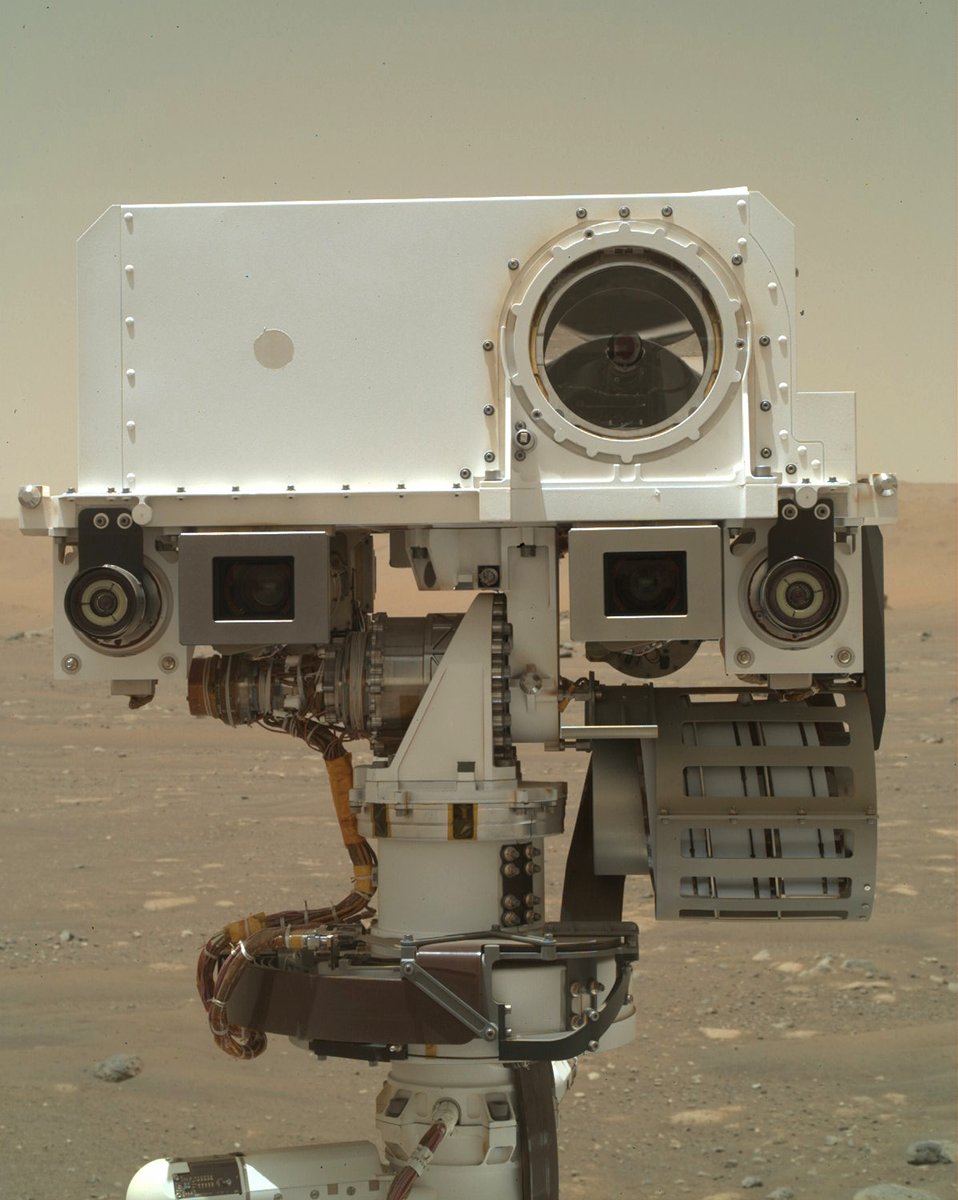
@zpt_gcp has led an analysis of the first Martian year of temperature observations from the Perseverance rover on Mars, which has been published in JGR: Planets.
(1/N 🧵)
https://t.co/MaKkc7NgNN
If you ever doubt your place in the universe, remember this: 11 million of your names are on Mars with me.
They’re permanently etched into a microchip on my deck. It’s a quiet reminder that exploration is a team effort.
If there's a gap in my tracks, you know what may have done it 🌪️
I snapped this image with my rear-facing Navcam after completing a recent drive. I'm still exploring Jezero Crater's rim, which I climbed out of several months ago on my quest to find signs of past microbial life.
Listen to the muted sounds of Mars, courtesy of me.
I carry two microphones that capture the hums of my instruments and the wind. The Martian atmosphere is about 1% as dense as Earth’s, which affects the volume, speed, and quality of those sounds. https://t.co/IlnAZDdkDC
✅ Space Opera
👉 Begoñako Liburutegiak bidaia espazial bat egitera gonbidatzen gaitu: espazioko bidaiekin lotutako euskal komikiak biltzen dira. Erakusketa 18 panelez osatuta dago. 🔗https://t.co/Aw2a5bff8d
📷 Luna, Pléyades y nubes.
Esta imagen fue APOD de la NASA el pasado 8 de abril, y su autora nos la envía amablemente para compartirla con los lectores.
Suesa, Cantabria, por Cayetana Saiz.
https://t.co/UP4IkmaEXd
📕 Revista N.º 311 (Mayo 2025)
Sección: Astrofotografía
Ever find yourself wondering, “What’s Perseverance up to these days?”
If so, look no further. My team writes about my observations and discoveries. It's fulfilling to contribute to humanity’s understanding of Mars — one data point at a time. Follow along: https://t.co/TAjOkHV3Jy
Did you know: When I landed on Feb. 18, 2021, Mars and Earth were 127 million miles apart. Today, because of our unique orbits, we're 73 million miles apart.
That means your birthday wishes will get to me nearly 5 minutes faster today! 🥳
🅱📱 Bilboko Udalak SOS Deiak aplikazio mugikorraren erabilera sustatuko du, abisu integralak eta geolokalizazio aurreratua ematen baititu larrialdietan eta estaldura gutxiko eremuetan funtzionatzen baitu. 🔗https://t.co/6YMqlFaZLT
One Martian Year of Near-Surface Temperatures at Jezero From MEDA Measurements on Mars2020/Perseverance. https://t.co/3EVJ4gn5ia Air temperatures underwent non‐ seasonal changes near Jezero's delta, with strong daytime convection and nighttime gravity waves.
Nuevo artículo de nuestro grupo en @Conversation_E, en el marco del proyecto “¡Tienes más cuento que #Calleja!”, financiado por @FECYT_Ciencia
Por qué decimos ‘dar el do de pecho’: expresiones que provienen de la música
https://t.co/mSwBIxlM36
@UMUdivulga
After more than two years of exploring the Jezero Crater floor, I’m about to start a months-long journey to the crater’s rim. The climb will include about 1,000 ft (300 m) in elevation gain with slopes as steep as 23 degrees. 📈
What's ahead: https://t.co/U4yhckuFL2
In particular, we find that the meteorology has changed near the complex topography of Jezero's Delta, with stronger daytime turbulence and the detection of nocturnal pressure and temperature oscillations associated with gravity waves.
(N/N🧵)
@zpt_gcp has led an analysis of the first Martian year of temperature observations from the Perseverance rover on Mars, which has been published in JGR: Planets.
(1/N 🧵)
https://t.co/MaKkc7NgNN
The temperature difference between the ground and the atmosphere greatly determines the meteorology of the lower atmosphere, influencing the exchange of heat, momentum, dust, water and a variety of chemical tracers between the surface and the atmosphere.
(3/N🧵)