A New Chapter for Atomos Space
We’re proud to share that Atomos Space is now part of @katalystspace!
Joining Katalyst marks an exciting leap forward in our mission to make rendezvous and proximity operations (RPO) routine, reliable, and revolutionary. Our flagship spacecraft, tech stack, and incredible team are now powering Katalyst’s expanding servicing, SDA, and upgrade offerings.
We’re staying grounded in Broomfield, CO—and aiming higher than ever.
Let’s change the way space works. Read more here: https://t.co/RnmM3AsEbj
We had an all-hands meeting this morning at @AtomosSpace and realized a big gap existed in the space economy on which we could capitalize. Therefore, we’re now diverting all resources to creating a series of space conferences. We need more opportunities to pontificate!
On March 21, Atomos established communications over our high bandwidth AddValue IDRS radio. In the first five minutes of connection, we received 17X more data than we had since launching earlier this month. We have maintained communication with the spacecraft since, sending updates and downloading files. We will continue through propulsion system commissioning and soon move on to our rendezvous demonstration. While we have previously demonstrated our final approach guidance algorithms using our ground-based rendezvous testbed, we are eager to prove out this capability on orbit.
Why do we focus so much on doing more with less? … While some co’s believe the USG must buy their products to prime the sector, our goal is to push the boundaries and work hard to deliver a capability at a price so compelling that our commercial customers see it as obvious.
I’m so proud of the team for getting us to where we are. Besides being amazingly resilient, they made good engineering decisions quickly with very limited information - waiting for more data would have lost the spacecraft. We’re feeling prepared for what comes next!
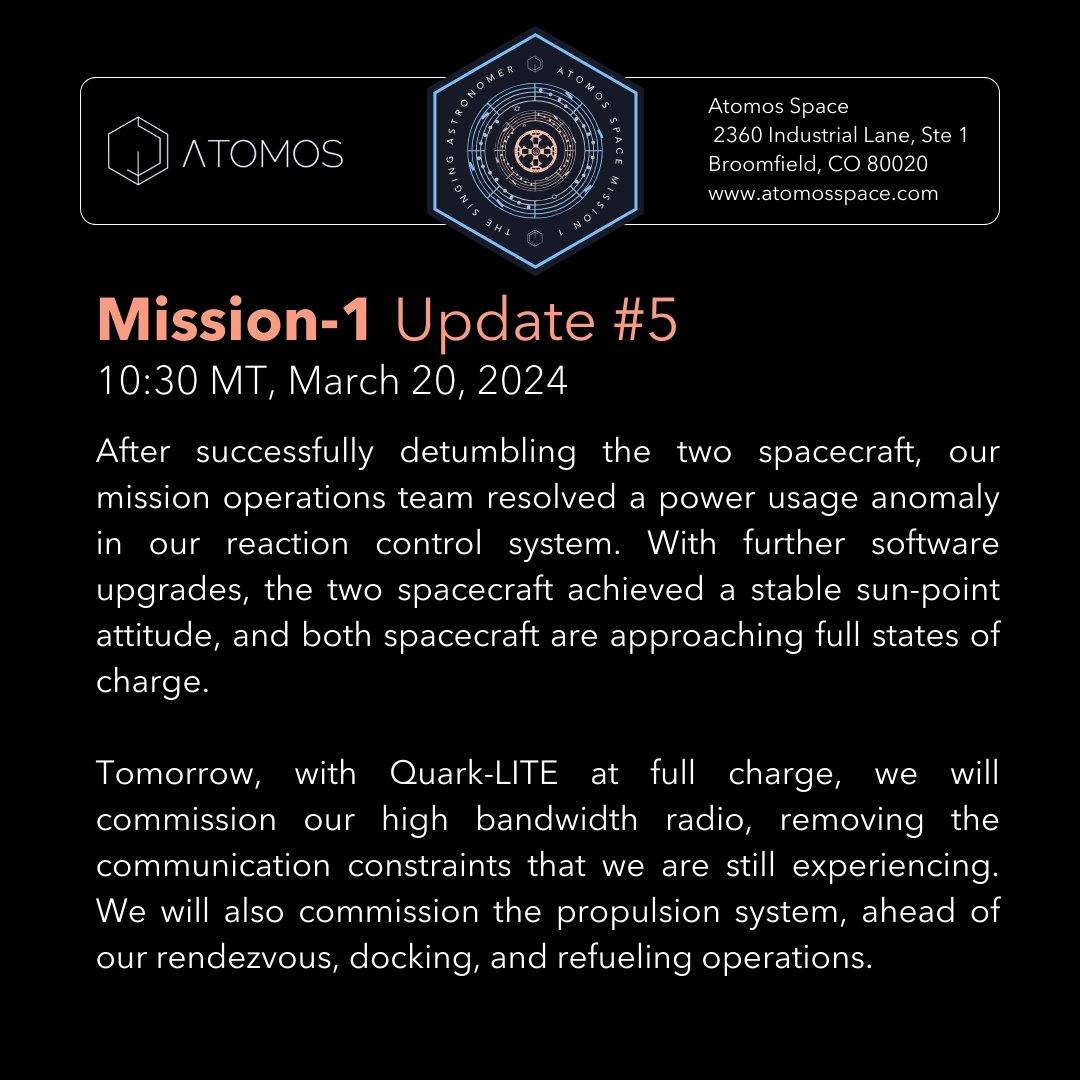
After successfully detumbling the two spacecraft, our mission operations team resolved a power usage anomaly in our reaction control system. With further software upgrades, the two spacecraft achieved a stable sun-point attitude, and both spacecraft are approaching full states of charge.
Tomorrow, with Quark-LITE at full charge, we will commission our high bandwidth radio, removing the communication constraints that we are still experiencing. We will also commission the propulsion system, ahead of our rendezvous, docking, and refueling operations.
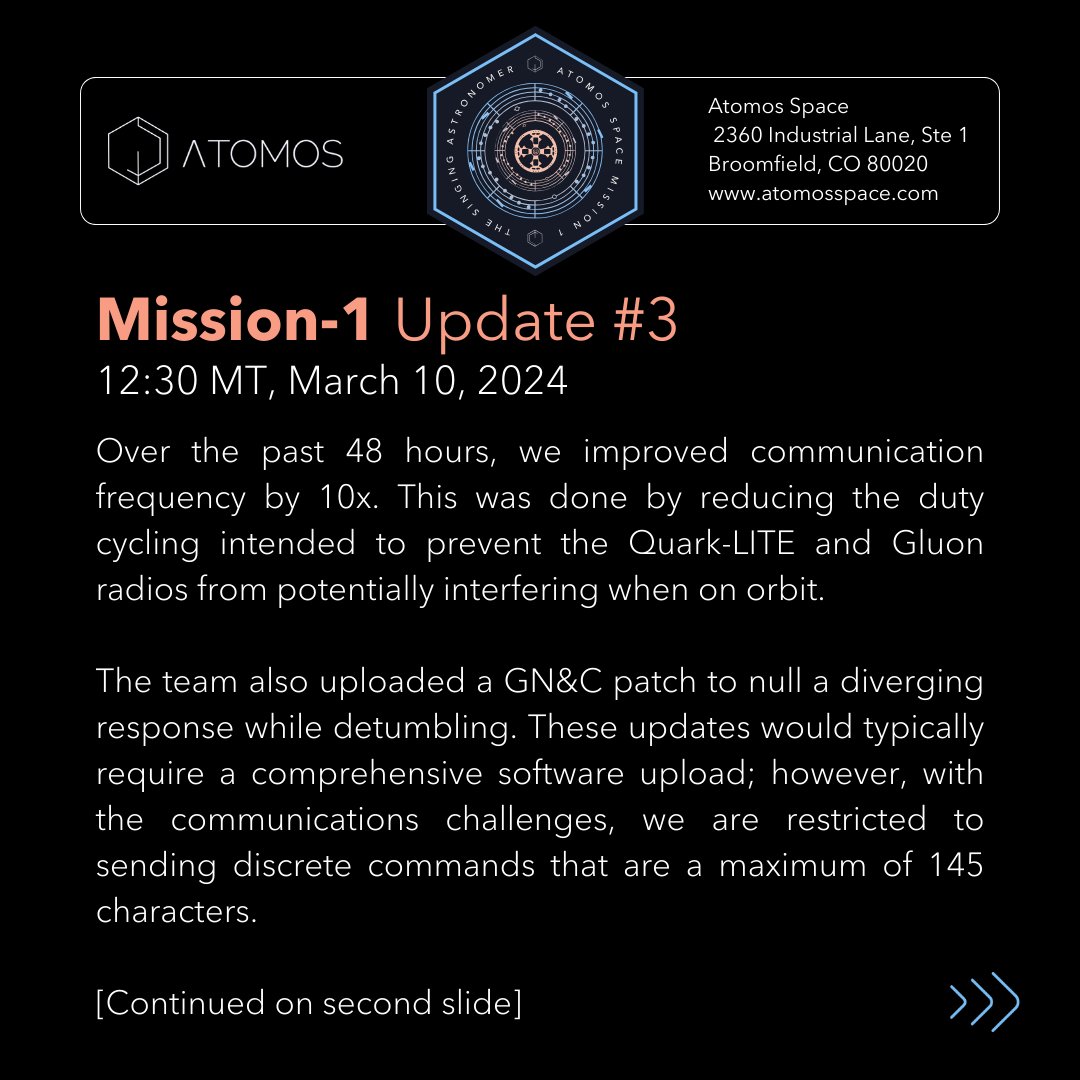
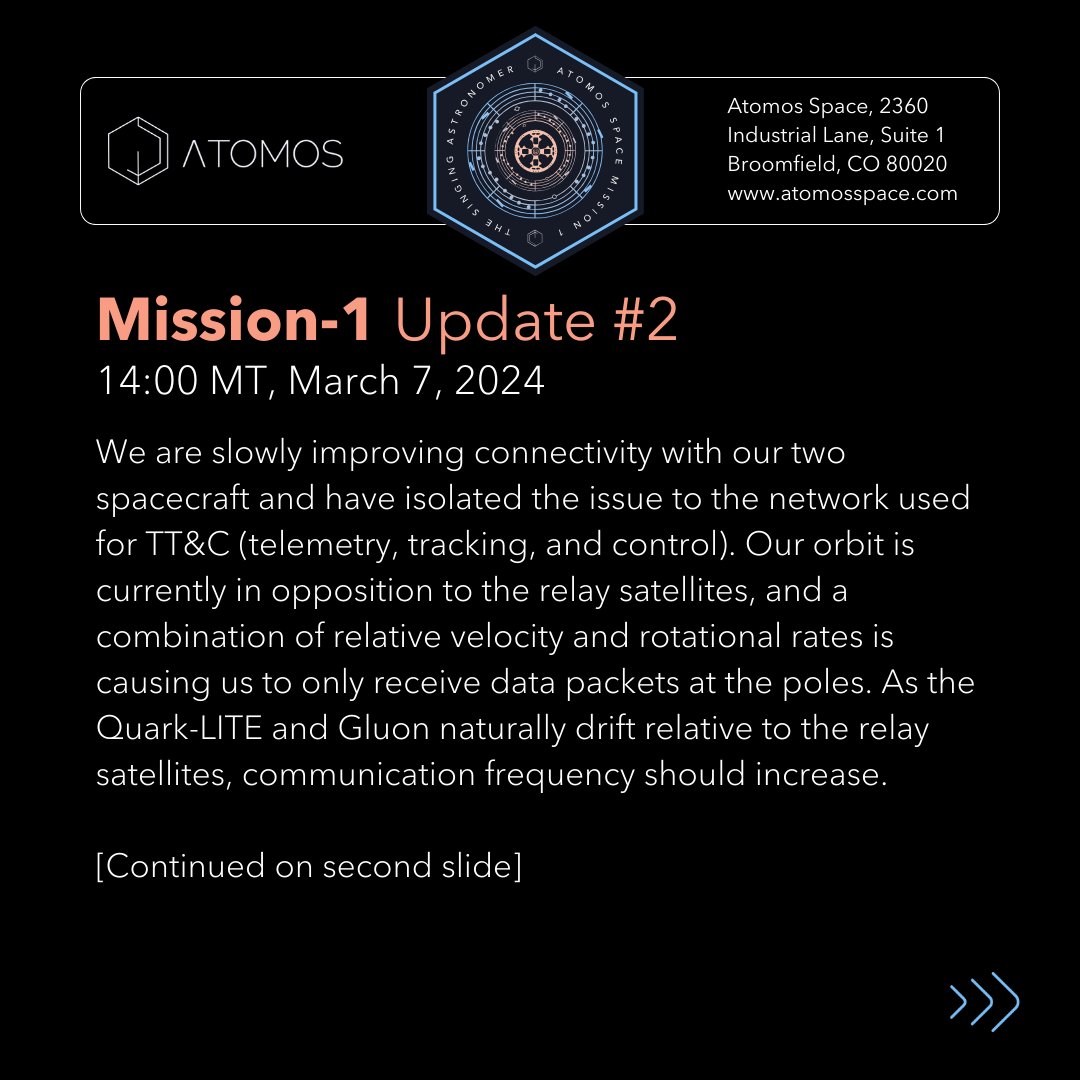
Alt Text: 12:30pm MT, March 10, 2024.
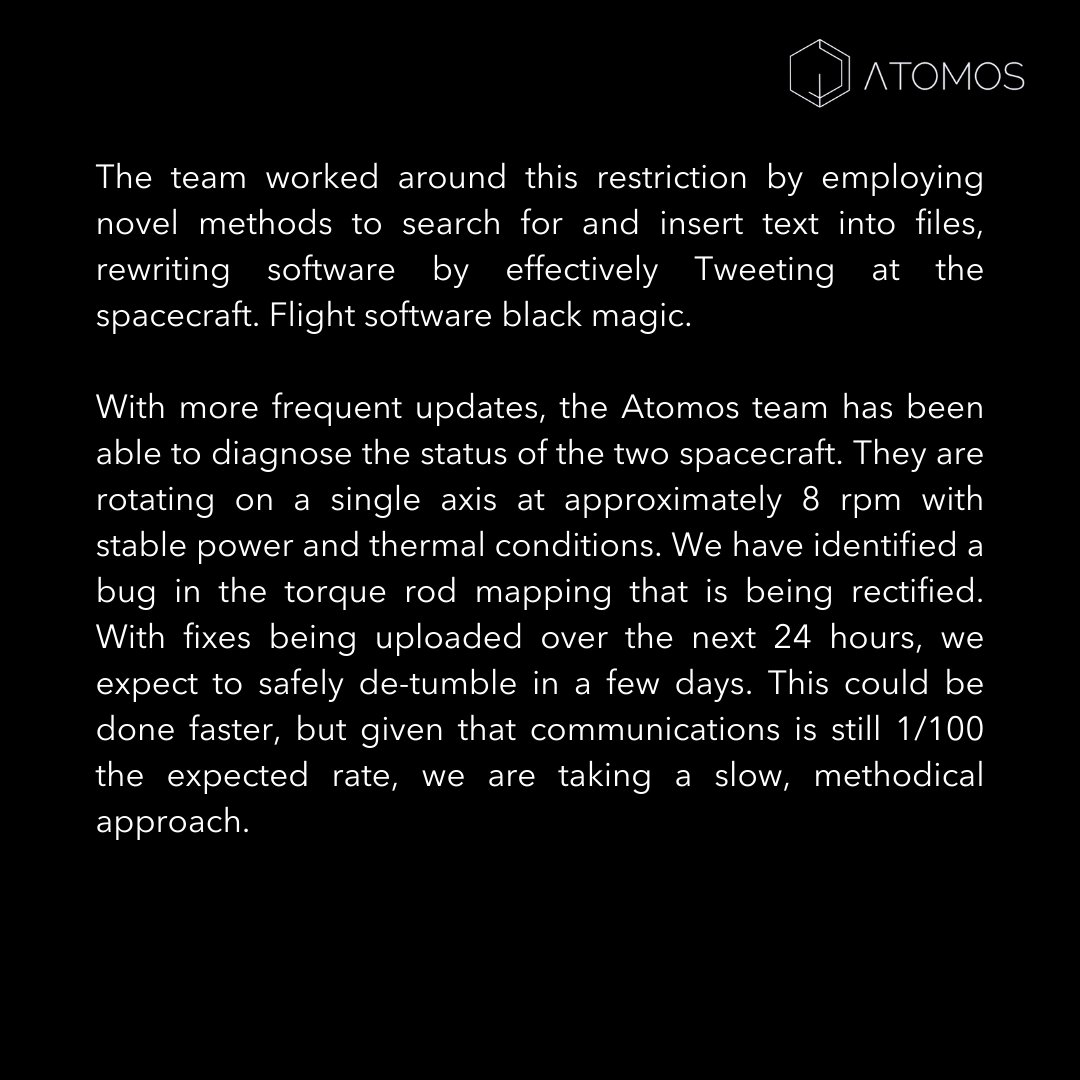
Over the past 48 hours, we improved communication frequency by 10x. This was done by reducing the duty cycling intended to prevent the Quark-LITE and Gluon radios from potentially interfering when on orbit. The team also uploaded a GN&C patch to null a diverging response while detumbling. These updates would typically require a comprehensive software upload; however, with the communications challenges, we are restricted to sending discrete commands that are a maximum of 145 characters.
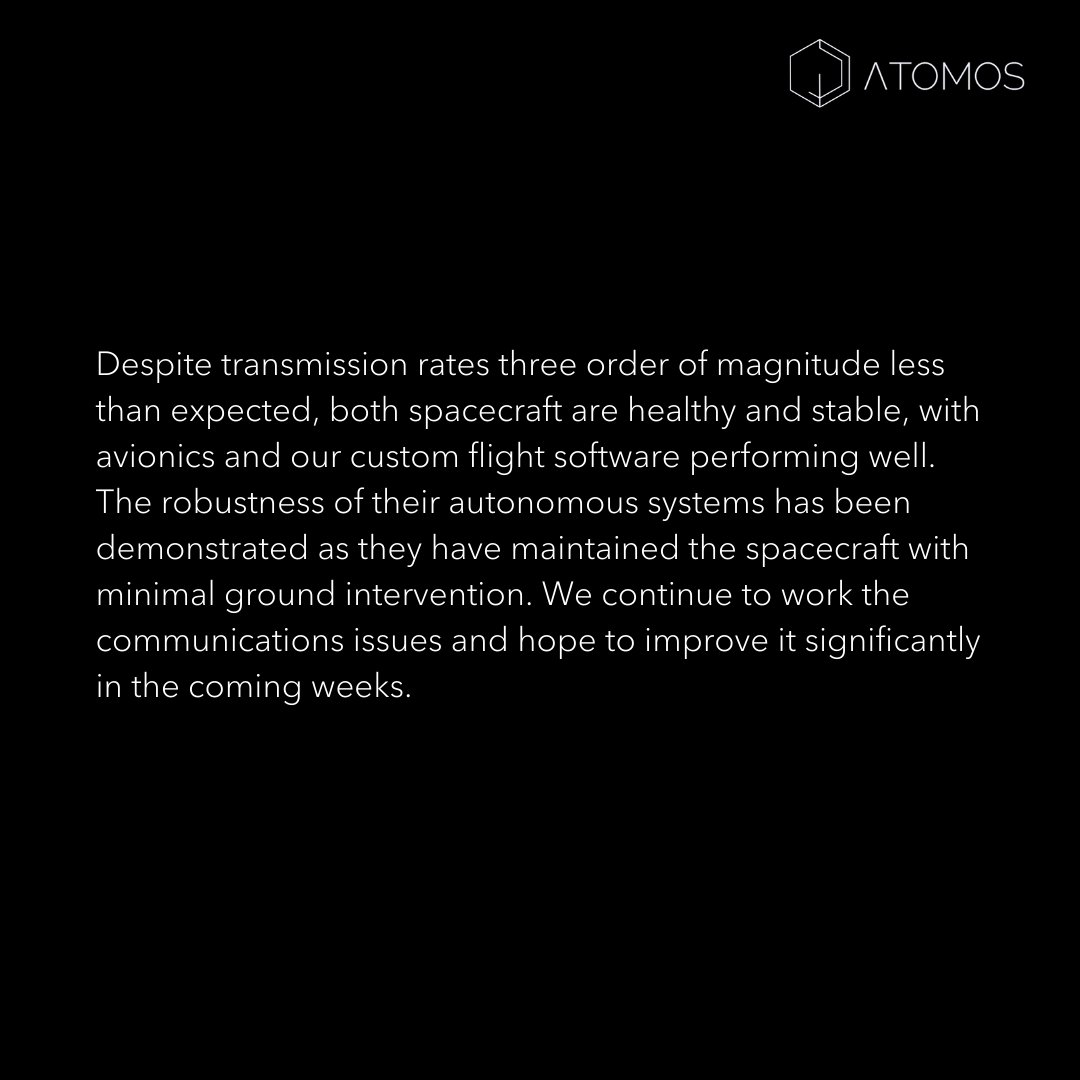
The team worked around this restriction by employing novel methods to search for and insert text into files, rewriting software by effectively Tweeting at the spacecraft. Flight software black magic. With more frequent updates, the Atomos team has been able to diagnose the status of the two spacecraft. They are rotating on a single axis at approximately 8 rpm with stable power and thermal conditions. We have identified a bug in the torque rod mapping that is being rectified. With fixes being uploaded over the next 24 hours, we expect to safely de-tumble in a few days. This could be done faster, but given that communications is still 1/100 the expected rate, we are taking a slow, methodical approach.
Watch the livestream of our 2:05pm PT launch today, starting in approximately 3 hours! Our two spacecraft (seen in the bottom right of the stack photo) will be deployed 1hr 13mins after liftoff.
Image credit: SpaceX
https://t.co/gsAWEF9YLB
Super pumped for the Atomos team today. A lot of interesting capabilities going to orbit on Transporter 10 but Atomos brings with it the potential to dramatically impact the orbital ecosystem for decades to come.
Ad astra