BullshitBench update for GPT-5.6 and Grok 4.5 - nothing super interesting, they stayed at about the level of previous versions of the models (Grok 4.2 and GPT-5.5).
Not a super good sign for 5.6, but I guess expected considering it is not a new pre-train
Reaching AGI won't be beating a benchmark. It will be the end of the human-AI gap. Benchmarks are simply a way to estimate the current gap, which is why we need to continually release new benchmarks (focused on the remaining gap). Benchmarking is a process, not a fixed point.
We can say we have AGI when it's no longer possible to come up with a test that evidences the gap. When it's no longer possible to point to something that regular humans can do and AI can't.
Today, it's still easy. I expect it will become nearly impossible by 2030.
The 3rd edition of my book Deep Learning with Python is being printed right now, and will be in bookstores within 2 weeks. You can order it now from Amazon or from Manning.
This time, we're also releasing the whole thing as a 100% free website.
I don't care if it reduces book sales, I think it's the best deep learning intro around, and more people should be able to read it.
An attempt to explain (current) ChatGPT versions.
I still run into many, many people who don't know that:
- o3 is the obvious best thing for important/hard things. It is a reasoning model that is much stronger than 4o and if you are using ChatGPT professionally and not using o3 you're ngmi.
- 4o is different from o4. Yes I know lol. 4o is a good "daily driver" for many easy-medium questions. o4 is only available as mini for now, and is not as good as o3, and I'm not super sure why it's out right now.
Example basic "router" in my own personal use:
- Any simple query (e.g. "what foods are high in fiber"?) => 4o (about ~40% of my use)
- Any hard/important enough query where I am willing to wait a bit (e.g. "help me understand this tax thing...") => o3 (about ~40% of my use)
- I am vibe coding (e.g. "change this code so that...") => 4.1 (about ~10% of my use)
- I want to deeply understand one topic - I want GPT to go off for 10 minutes, look at many, many links and summarize a topic for me. (e.g. "help me understand the rise and fall of Luminar"). => Deep Research (about ~10% of my use). Note that Deep Research is not a model version to be picked from the model picker (!!!), it is a toggle inside the Tools. Under the hood it is based on o3, but I believe is not fully equivalent of just asking o3 the same query, but I am not sure.
All of this is only within the ChatGPT universe of models. In practice my use is more complicated because I like to bounce between all of ChatGPT, Claude, Gemini, Grok and Perplexity depending on the task and out of research interest.
I attended a vibe coding hackathon recently and used the chance to build a web app (with auth, payments, deploy, etc.). I tinker but I am not a web dev by background, so besides the app, I was very interested in what it's like to vibe code a full web app today. As such, I wrote none of the code directly (Cursor+Claude/o3 did) and I don't really know how the app works, in the conventional sense that I'm used to as an engineer.
The app is called MenuGen, and it is live on https://t.co/bQonQT88t0. Basically I'm often confused about what all the things on a restaurant menu are - e.g. Pâté, Tagine, Cavatappi or Sweetbread (hint it's... not sweet). Enter MenuGen: you take a picture of a menu and it generates images for all the menu items and presents them in a nice list. I find it super useful to get a quick visual sense of the menu.
But the more interesting part for me I thought was the exploration of vibe coding around how easy/hard it is to build and deploy a full web app today if you are not a web developer. So I wrote up the full blog post on my experience here, including some takeaways:
https://t.co/2kkQh0ElgB
Copy pasting just the TLDR:
"Vibe coding menugen was exhilarating and fun escapade as a local demo, but a bit of a painful slog as a deployed, real app. Building a modern app is a bit like assembling IKEA future. There are all these services, docs, API keys, configurations, dev/prod deployments, team and security features, rate limits, pricing tiers... Meanwhile the LLMs have slightly outdated knowledge of everything, they make subtle but critical design mistakes when you watch them closely, and sometimes they hallucinate or gaslight you about solutions. But the most interesting part to me was that I didn't even spend all that much work in the code editor itself. I spent most of it in the browser, moving between tabs and settings and configuring and gluing a monster. All of this work and state is not even accessible or manipulatable by an LLM - how are we supposed to be automating society by 2027 like this?"
See the post for full detail, and maybe give MenuGen a go the next time you're at a restaurant!
Yoshua Bengio says when OpenAI develop superintelligent AI they won't share it with the world, but instead will use it to dominate and wipe out other companies and the economies of other countries
I don't have too too much to add on top of this earlier post on V3 and I think it applies to R1 too (which is the more recent, thinking equivalent).
I will say that Deep Learning has a legendary ravenous appetite for compute, like no other algorithm that has ever been developed in AI. You may not always be utilizing it fully but I would never bet against compute as the upper bound for achievable intelligence in the long run. Not just for an individual final training run, but also for the entire innovation / experimentation engine that silently underlies all the algorithmic innovations.
Data has historically been seen as a separate category from compute, but even data is downstream of compute to a large extent - you can spend compute to create data. Tons of it. You've heard this called synthetic data generation, but less obviously, there is a very deep connection (equivalence even) between "synthetic data generation" and "reinforcement learning". In the trial-and-error learning process in RL, the "trial" is model generating (synthetic) data, which it then learns from based on the "error" (/reward). Conversely, when you generate synthetic data and then rank or filter it in any way, your filter is straight up equivalent to a 0-1 advantage function - congrats you're doing crappy RL.
Last thought. Not sure if this is obvious. There are two major types of learning, in both children and in deep learning. There is 1) imitation learning (watch and repeat, i.e. pretraining, supervised finetuning), and 2) trial-and-error learning (reinforcement learning). My favorite simple example is AlphaGo - 1) is learning by imitating expert players, 2) is reinforcement learning to win the game. Almost every single shocking result of deep learning, and the source of all *magic* is always 2. 2 is significantly significantly more powerful. 2 is what surprises you. 2 is when the paddle learns to hit the ball behind the blocks in Breakout. 2 is when AlphaGo beats even Lee Sedol. And 2 is the "aha moment" when the DeepSeek (or o1 etc.) discovers that it works well to re-evaluate your assumptions, backtrack, try something else, etc. It's the solving strategies you see this model use in its chain of thought. It's how it goes back and forth thinking to itself. These thoughts are *emergent* (!!!) and this is actually seriously incredible, impressive and new (as in publicly available and documented etc.). The model could never learn this with 1 (by imitation), because the cognition of the model and the cognition of the human labeler is different. The human would never know to correctly annotate these kinds of solving strategies and what they should even look like. They have to be discovered during reinforcement learning as empirically and statistically useful towards a final outcome.
(Last last thought/reference this time for real is that RL is powerful but RLHF is not. RLHF is not RL. I have a separate rant on that in an earlier tweet
https://t.co/RMIpFPVpuM)
# RLHF is just barely RL
Reinforcement Learning from Human Feedback (RLHF) is the third (and last) major stage of training an LLM, after pretraining and supervised finetuning (SFT). My rant on RLHF is that it is just barely RL, in a way that I think is not too widely appreciated. RL is powerful. RLHF is not. Let's take a look at the example of AlphaGo. AlphaGo was trained with actual RL. The computer played games of Go and trained on rollouts that maximized the reward function (winning the game), eventually surpassing the best human players at Go. AlphaGo was not trained with RLHF. If it were, it would not have worked nearly as well.
What would it look like to train AlphaGo with RLHF? Well first, you'd give human labelers two board states from Go, and ask them which one they like better:
Then you'd collect say 100,000 comparisons like this, and you'd train a "Reward Model" (RM) neural network to imitate this human "vibe check" of the board state. You'd train it to agree with the human judgement on average. Once we have a Reward Model vibe check, you run RL with respect to it, learning to play the moves that lead to good vibes. Clearly, this would not have led anywhere too interesting in Go. There are two fundamental, separate reasons for this:
1. The vibes could be misleading - this is not the actual reward (winning the game). This is a crappy proxy objective. But much worse,
2. You'd find that your RL optimization goes off rails as it quickly discovers board states that are adversarial examples to the Reward Model. Remember the RM is a massive neural net with billions of parameters imitating the vibe. There are board states are "out of distribution" to its training data, which are not actually good states, yet by chance they get a very high reward from the RM.
For the exact same reasons, sometimes I'm a bit surprised RLHF works for LLMs at all. The RM we train for LLMs is just a vibe check in the exact same way. It gives high scores to the kinds of assistant responses that human raters statistically seem to like. It's not the "actual" objective of correctly solving problems, it's a proxy objective of what looks good to humans. Second, you can't even run RLHF for too long because your model quickly learns to respond in ways that game the reward model. These predictions can look really weird, e.g. you'll see that your LLM Assistant starts to respond with something non-sensical like "The the the the the the" to many prompts. Which looks ridiculous to you but then you look at the RM vibe check and see that for some reason the RM thinks these look excellent. Your LLM found an adversarial example. It's out of domain w.r.t. the RM's training data, in an undefined territory. Yes you can mitigate this by repeatedly adding these specific examples into the training set, but you'll find other adversarial examples next time around. For this reason, you can't even run RLHF for too many steps of optimization. You do a few hundred/thousand steps and then you have to call it because your optimization will start to game the RM. This is not RL like AlphaGo was.
And yet, RLHF is a net helpful step of building an LLM Assistant. I think there's a few subtle reasons but my favorite one to point to is that through it, the LLM Assistant benefits from the generator-discriminator gap. That is, for many problem types, it is a significantly easier task for a human labeler to select the best of few candidate answers, instead of writing the ideal answer from scratch. A good example is a prompt like "Generate a poem about paperclips" or something like that. An average human labeler will struggle to write a good poem from scratch as an SFT example, but they could select a good looking poem given a few candidates. So RLHF is a kind of way to benefit from this gap of "easiness" of human supervision. There's a few other reasons, e.g. RLHF is also helpful in mitigating hallucinations because if the RM is a strong enough model to catch the LLM making stuff up during training, it can learn to penalize this with a low reward, teaching the model an aversion to risking factual knowledge when it's not sure. But a satisfying treatment of hallucinations and their mitigations is a whole different post so I digress. All to say that RLHF *is* net useful, but it's not RL.
No production-grade *actual* RL on an LLM has so far been convincingly achieved and demonstrated in an open domain, at scale. And intuitively, this is because getting actual rewards (i.e. the equivalent of win the game) is really difficult in the open-ended problem solving tasks. It's all fun and games in a closed, game-like environment like Go where the dynamics are constrained and the reward function is cheap to evaluate and impossible to game. But how do you give an objective reward for summarizing an article? Or answering a slightly ambiguous question about some pip install issue? Or telling a joke? Or re-writing some Java code to Python? Going towards this is not in principle impossible but it's also not trivial and it requires some creative thinking. But whoever convincingly cracks this problem will be able to run actual RL. The kind of RL that led to AlphaGo beating humans in Go. Except this LLM would have a real shot of beating humans in open-domain problem solving.
DeepSeek (Chinese AI co) making it look easy today with an open weights release of a frontier-grade LLM trained on a joke of a budget (2048 GPUs for 2 months, $6M).
For reference, this level of capability is supposed to require clusters of closer to 16K GPUs, the ones being brought up today are more around 100K GPUs. E.g. Llama 3 405B used 30.8M GPU-hours, while DeepSeek-V3 looks to be a stronger model at only 2.8M GPU-hours (~11X less compute). If the model also passes vibe checks (e.g. LLM arena rankings are ongoing, my few quick tests went well so far) it will be a highly impressive display of research and engineering under resource constraints.
Does this mean you don't need large GPU clusters for frontier LLMs? No but you have to ensure that you're not wasteful with what you have, and this looks like a nice demonstration that there's still a lot to get through with both data and algorithms.
Very nice & detailed tech report too, reading through.
Absolutely wild that it's just possible to... will things into existence. Throughout your entire education (0-22 y.o.) you are conditioned to accept the world as-is, and in the following decades you slowly unlearn this conditioning and internalize the fact that you can actually change things. Everything.
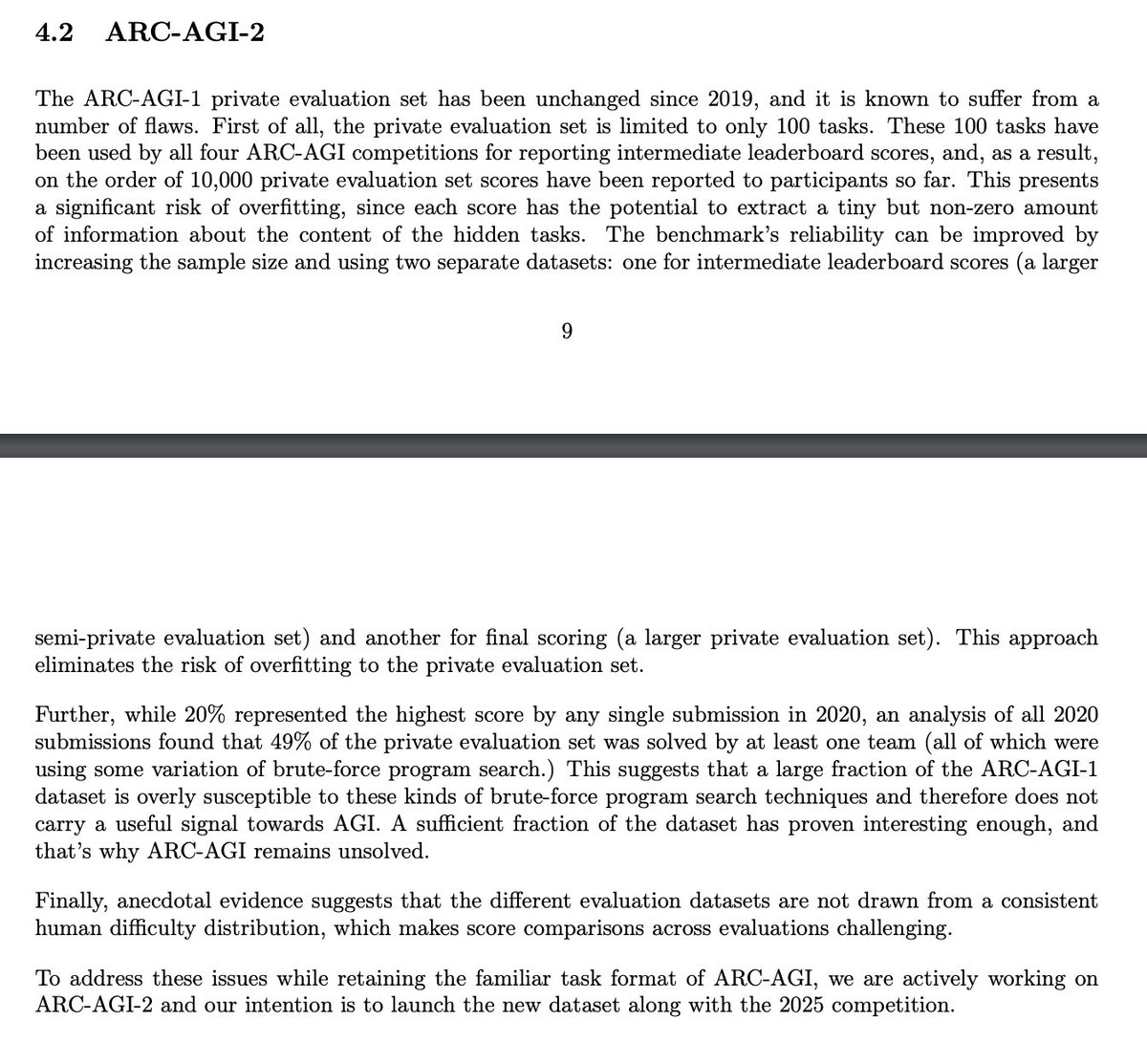
If you haven't read the ARC Prize 2024 technical report, check it out (link in next tweet).
One important bit: we'll be releasing a v2 of the benchmark early next year (human testing is currently being finalized).
Why? Because AGI progress in 2025 is going to need a better compass than v1. v1 fulfilled its mission well over the past 5 years, but what we've learned from it enables us to ship something better.
In 2020, an ensemble of all Kaggle submissions in that year's competition scored 49% -- and that was all crude program enumeration with relatively low compute. This signals that about half of the benchmark was not a strong signal towards AGI.
Today, an ensemble of all Kaggle submissions in the 2024 competition is scoring 81%. This signals the benchmark is saturating, and that enough compute / brute force will get you over the finish line.
v2 will fix these issues and will increase the "signal strength" of the benchmark.
If we get the good ending, it will be because of AI. If we get the bad ending, it will also be because of AI. If you want to influence which one we get, better work on AI.
People have too inflated sense of what it means to "ask an AI" about something. The AI are language models trained basically by imitation on data from human labelers. Instead of the mysticism of "asking an AI", think of it more as "asking the average data labeler" on the internet.
Few caveats apply because e.g. in many domains (e.g. code, math, creative writing) the companies hire skilled data labelers (so think of it as asking them instead), and this is not 100% true when reinforcement learning is involved, though I have an earlier rant on how RLHF is just barely RL, and "actual RL" is still too early and/or constrained to domains that offer easy reward functions (math etc.).
But roughly speaking (and today), you're not asking some magical AI. You're asking a human data labeler. Whose average essence was lossily distilled into statistical token tumblers that are LLMs. This can still be super useful ofc ourse. Post triggered by someone suggesting we ask an AI how to run the government etc. TLDR you're not asking an AI, you're asking some mashup spirit of its average data labeler.
⚡️ Excited to share that I am starting an AI+Education company called Eureka Labs.
The announcement:
---
We are Eureka Labs and we are building a new kind of school that is AI native.
How can we approach an ideal experience for learning something new? For example, in the case of physics one could imagine working through very high quality course materials together with Feynman, who is there to guide you every step of the way. Unfortunately, subject matter experts who are deeply passionate, great at teaching, infinitely patient and fluent in all of the world's languages are also very scarce and cannot personally tutor all 8 billion of us on demand.
However, with recent progress in generative AI, this learning experience feels tractable. The teacher still designs the course materials, but they are supported, leveraged and scaled with an AI Teaching Assistant who is optimized to help guide the students through them. This Teacher + AI symbiosis could run an entire curriculum of courses on a common platform. If we are successful, it will be easy for anyone to learn anything, expanding education in both reach (a large number of people learning something) and extent (any one person learning a large amount of subjects, beyond what may be possible today unassisted).
Our first product will be the world's obviously best AI course, LLM101n. This is an undergraduate-level class that guides the student through training their own AI, very similar to a smaller version of the AI Teaching Assistant itself. The course materials will be available online, but we also plan to run both digital and physical cohorts of people going through it together.
Today, we are heads down building LLM101n, but we look forward to a future where AI is a key technology for increasing human potential. What would you like to learn?
---
@EurekaLabsAI is the culmination of my passion in both AI and education over ~2 decades. My interest in education took me from YouTube tutorials on Rubik's cubes to starting CS231n at Stanford, to my more recent Zero-to-Hero AI series. While my work in AI took me from academic research at Stanford to real-world products at Tesla and AGI research at OpenAI. All of my work combining the two so far has only been part-time, as side quests to my "real job", so I am quite excited to dive in and build something great, professionally and full-time.
It's still early days but I wanted to announce the company so that I can build publicly instead of keeping a secret that isn't. Outbound links with a bit more info in the reply!
Congrats to @AIatMeta on Llama 3 release!! 🎉
https://t.co/UBwFPTJM6V
Notes:
Releasing 8B and 70B (both base and finetuned) models, strong-performing in their model class (but we'll see when the rankings come in @ @lmsysorg :))
400B is still training, but already encroaching GPT-4 territory (e.g. 84.8 MMLU vs. 86.5 4Turbo).
Tokenizer: number of tokens was 4X'd from 32K (Llama 2) -> 128K (Llama 3). With more tokens you can compress sequences more in length, cites 15% fewer tokens, and see better downstream performance.
Architecture: no major changes from the Llama 2. In Llama 2 only the bigger models used Grouped Query Attention (GQA), but now all models do, including the smallest 8B model. This is a parameter sharing scheme for the keys/values in the Attention, which reduces the size of the KV cache during inference. This is a good, welcome, complexity reducing fix and optimization.
Sequence length: the maximum number of tokens in the context window was bumped up to 8192 from 4096 (Llama 2) and 2048 (Llama 1). This bump is welcome, but quite small w.r.t. modern standards (e.g. GPT-4 is 128K) and I think many people were hoping for more on this axis. May come as a finetune later (?).
Training data. Llama 2 was trained on 2 trillion tokens, Llama 3 was bumped to 15T training dataset, including a lot of attention that went to quality, 4X more code tokens, and 5% non-en tokens over 30 languages. (5% is fairly low w.r.t. non-en:en mix, so certainly this is a mostly English model, but it's quite nice that it is > 0).
Scaling laws. Very notably, 15T is a very very large dataset to train with for a model as "small" as 8B parameters, and this is not normally done and is new and very welcome. The Chinchilla "compute optimal" point for an 8B model would be train it for ~200B tokens. (if you were only interested to get the most "bang-for-the-buck" w.r.t. model performance at that size). So this is training ~75X beyond that point, which is unusual but personally, I think extremely welcome. Because we all get a very capable model that is very small, easy to work with and inference. Meta mentions that even at this point, the model doesn't seem to be "converging" in a standard sense. In other words, the LLMs we work with all the time are significantly undertrained by a factor of maybe 100-1000X or more, nowhere near their point of convergence. Actually, I really hope people carry forward the trend and start training and releasing even more long-trained, even smaller models.
Systems. Llama 3 is cited as trained with 16K GPUs at observed throughput of 400 TFLOPS. It's not mentioned but I'm assuming these are H100s at fp16, which clock in at 1,979 TFLOPS in NVIDIA marketing materials. But we all know their tiny asterisk (*with sparsity) is doing a lot of work, and really you want to divide this number by 2 to get the real TFLOPS of ~990. Why is sparsity counting as FLOPS? Anyway, focus Andrej. So 400/990 ~= 40% utilization, not too bad at all across that many GPUs! A lot of really solid engineering is required to get here at that scale.
TLDR: Super welcome, Llama 3 is a very capable looking model release from Meta. Sticking to fundamentals, spending a lot of quality time on solid systems and data work, exploring the limits of long-training models. Also very excited for the 400B model, which could be the first GPT-4 grade open source release. I think many people will ask for more context length.
Personal ask: I think I'm not alone to say that I'd also love much smaller models than 8B, for educational work, and for (unit) testing, and maybe for embedded applications etc. Ideally at ~100M and ~1B scale.
Talk to it at https://t.co/KmKRlZeTHQ
Integration with https://t.co/RD6MRWT2zz
Introducing `claude-opus-to-haiku` ✍️
Get the quality of Claude 3 Opus, at a fraction of the cost and latency.
Give one example of your task, and Claude 3 Opus will teach Haiku (60x cheaper!!) how to do the task perfectly.
And it's open-source: https://t.co/TXWUZuqOWD