When a post by an American about American politics goes viral, we assume Americans made it popular. Often, accounts abroad did.
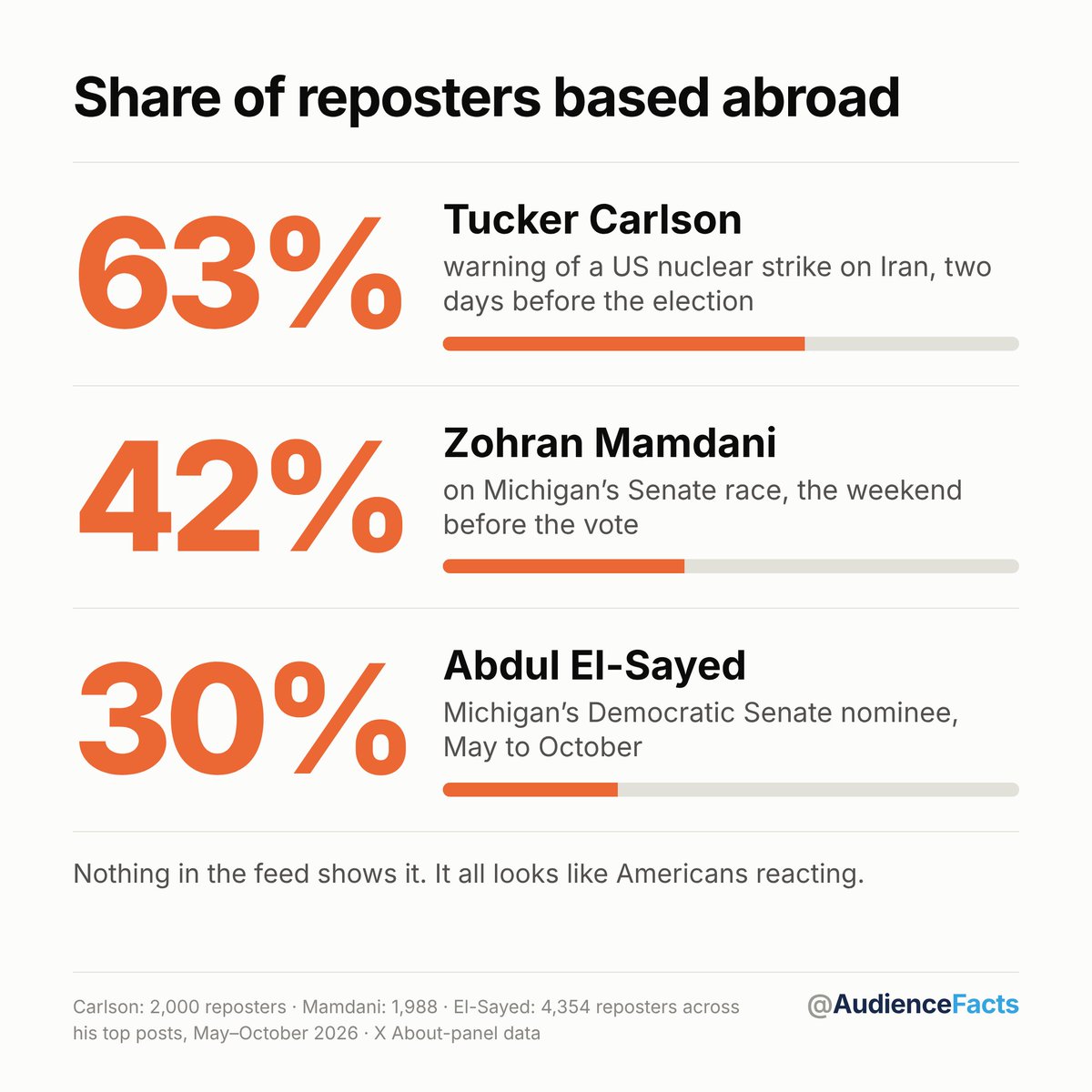
This high-stakes election season, foreign reposters were:
63% on Tucker Carlson’s Iran nuclear warning
42% on Zohran Mamdani’s Michigan Senate post
30% on Abdul El-Sayed’s posts
What's going on? Where is this engagement coming from? And is it equally distributed?
Buckle up, let's dive in. 🧵👇
X led every platform by showing where each account is based.
Today it sits on each profile as a footnote. Users can look it up one account at a time, but few do. The result: borders disappear on the topics we debate most.
The next step is to help users understand a more complete picture, directly from the feed.
See https://t.co/dUVb7v3QsV for more data and recommendations.
cc: @petersellis@singhai@benjitaylor
Do creators have any financial incentive to produce consensus, moderating content over polarizing, outrage content?
Thinking something based on Community Notes that can identify and reward Original Creators when engagement comes from diverse social graphs vs. being concentrated in one echo chamber.
When a post by an American about American politics goes viral, we assume Americans made it popular. Often, accounts abroad did.
This high-stakes election season, foreign reposters were:
63% on Tucker Carlson’s Iran nuclear warning
42% on Zohran Mamdani’s Michigan Senate post
30% on Abdul El-Sayed’s posts
What's going on? Where is this engagement coming from? And is it equally distributed?
Buckle up, let's dive in. 🧵👇
Can we add a setting that gives users the option of:
1. Filtering their feed by geography. For example, if someone doesn't want to see hot politics takes from "America First" accounts based in Morocco
2. Underweighting foreign engagement when determining what gets recommended in their feed. For example, if people in Europe or the Middle East are applauding the posts of an American podcaster, that foreign applause is discounted when deciding what posts to recommend to an American.
The level of foreign involvement in the American election process is something the U.S. government needs to reckon with, and fast.
Nearly 20% of accounts reposting Abdul El-Sayed's posts on X were based in non-English-speaking countries, compared to just 7% for Mike Rogers