Congratulations to Yi Fei Cheng on his successful presentation of "First or Third-Person Hearing?" in which we explore the effect of spatial audio on avatar embodiment in VR.
In *First or Third-Person Hearing?*, led by Yi Fei Cheng, we explore where audio should come from when we embody an avatar in VR. We show that audio source position influences embodiment and immersion.
https://t.co/TKG6jDMQlR
@CyLab@CarnegieMellon This project was possible thanks to Hafsa OUAJDI, Oussama Hadder, @ModanTailleur, and Mathieu Lagrange from École Centrale Nantes, participants in the 2023 DCASE synthesis challenge (Task 7) who shared their sounds, and research assistants Anjelica Ferguson and Justine Sullivan.
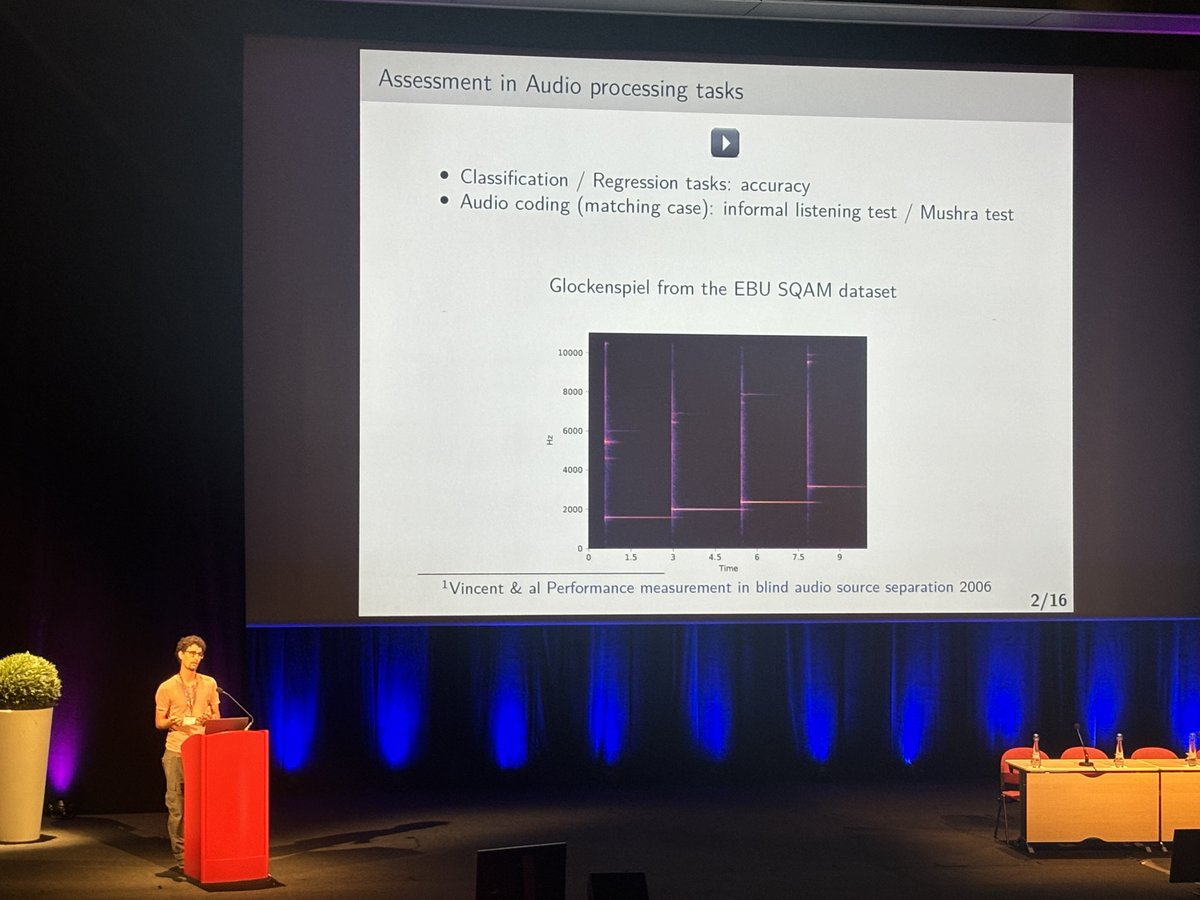
"Correlation of Frechet Audio Distance with Human Perception of Environmental Audio is Embedding Dependent” was led by graduate students Modan Tailleur and Junwon Lee, followed by M Lagrange (presenter), K Choi, LM Heller, K Imoto; Y Okamoto.
https://t.co/gYNx6509uL
🚨 Call for #APCAM2024 submissions!
Share your research on music cognition, speech perception, and more by Sept. 15! 🎶 Don’t miss out on travel awards and mentorship meetups—apply today!
🔗 https://t.co/heket8Q3RL
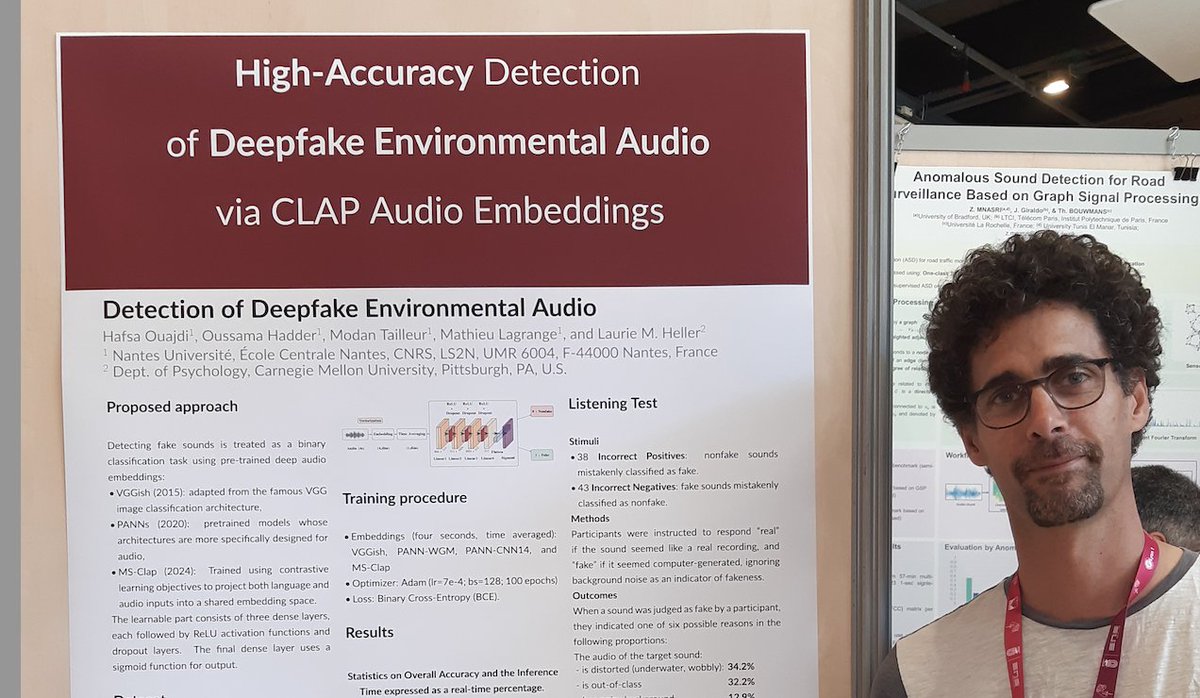
The conference paper is “Detection of Deepfake Environmental Audio,” by H Ouajdi, H Oussama, M Tailleur, M Lagrange, LM Heller. https://t.co/HQRR3CSyiJ
Would you like to discriminate fake from real sounds? 👂Today, at #EUSIPCO2024, Prof. Lagrange presented an accurate system for detecting fake (ai-generated) everyday sounds, led by students Ouajdi & Oussama. We also showed human performance and strategies for detection.
Congratulations Dr. Hassan Azad (U of Florida) on a great presentation today about the effects of noise on school children at Internoise 2024! He's first author on our conference paper, ASSESSMENT OF ANNOYANCE FROM TRAFFIC NOISE INSIDE AND OUTSIDE A SCHOOL. @internoise2024
🔊 Hi folks!
Looking forward to exploring the latest in auditory science and sharing updates about #APCAM2024 and the Auditory Perception & Cognition Society with you along the way!
Did you know that louder sounds 📢are easier to recognize, but more unpleasant? So, is it valid to "equalize" sound levels in the lab to test sound recognition and pleasantness? See our new paper in @ASA_JASAEL, funded by @misophoniafund, to find out.
https://t.co/2trOeL1FAI
Great job today by graduate student Urszula Oszczapinska! She presented our research on misophonia, funded by @misophoniafund: Altering the Perceived Cause of Unpleasant and Misophonic Sounds with Videos and Words at #AROMWM2024.
https://t.co/UD9ijsD1vs
#APCAM2023 is today in San Francisco! There are presentations on: auditory scene analysis, cross-model perception, music perception, speech perception, language processing, and healthy/disordered hearing. Our lab is presenting on misophonic sounds. https://t.co/ikYiWdCjg6
Just came back from a meeting filled with talks about ongoing research on ways to understand, diagnose and treat misophonia! #MRFannualmeeting. I presented my lab's research funded by https://t.co/05CGWUQjRf and got to hear about all the fascinating progress being made.
The call for abstracts is open for the 22nd annual Auditory Perception, Cognition, and Action Meeting (APCAM) on Nov 16th in San Francisco, CA. Deadline 09/17/23 for abstract submission and travel award applications. Visit https://t.co/ikYiWdBLqy .
@acousticsorg@AuditoryAPCAM
Our lab at @CarnegieMellon is recruiting 18+ #misophonics in the Pittsburgh area for an in-person study on #misophonia!
🔊 1.5-2hrs at $12/hr
🔊 Listen to everyday sounds while being monitored by our team
Please share with your networks! More info below