Economist in MMT & ecological macro, completing a M. Economics of Sustainability. On a crusade for economic enlightenment, even experts can’t resist my wit.
Richard Murphy’s rejection of the Job Guarantee is a profound category error.
By stripping the JG out of MMT, we allow the establishment to extract the "fiscal space" while leaving the NAIRU intact.
We cannot let MMT be strip-mined. Here is why: 👇
https://t.co/LAuZlDB15D
@HenricCont By definition, yes: Inflation is a rise in money prices, so a barter economy can't have it.
That says where it shows up, not what drives it.
Which cost is rising, and why, is what this thread is about.
@EconMacro Venezuela, Turkey, Sri Lanka and Argentina each ran into foreign-currency debt, a currency peg, or a collapse in what they could produce or import.
Those are the channels that bit.
The Commonwealth borrows in its own currency, and the dollar floats. 3/3
Which makes raising rates until people lose their jobs a remarkably blunt instrument.
We've normalised holding hundreds of thousands of Australians out of work as the price anchor. #MMT
Unemployment at that scale isn't a fact of nature.
@EconMacro Nor does Canberra borrow anyone's savings to spend.
It spends by crediting accounts, and bonds swap settlement balances for a term asset.
Their rate can be a policy choice too:
The RBA held the three-year yield at its target from March 2020 to November 2021. 2/3
@adamlje No.
Care, maintenance, bushcare and community services, as I said here: https://t.co/3Ui2C6nbLY
Postwar Australia's implicit version ran through roads, railways, housing and local councils: https://t.co/i7ayCVvSo0
@gogreen1908 That doesn't mean no worthwhile work.
Care, maintenance, bushcare and community services lean heavily on labour.
Where a project needs scarce inputs, it joins the queue like any other buyer, or waits until industrial policy has built the capacity. 2/3
There's another anchor available. #MMT A Job Guarantee offers a job at a fixed wage to anyone who wants one.
It expands in a downturn and shrinks in a boom, automatically. The wage is fixed and the quantity floats — which is precisely what makes it a price anchor.
@NickHionas The Commonwealth, the way it pays for anything:
By crediting bank accounts.
No tax has to be raised first.
The real cost is the time and materials, and the JG uses time that unemployment wastes anyway.
The wage bill shrinks as private hiring picks up.
@HenricCont Agreed: A financial deficit means net financial assets fall, not necessarily wealth.
That fits my 18 Nov point: Financial claims aren't real wealth.
But the financial side still matters.
Run private deficits for years and private debt piles up, as Australian households found.
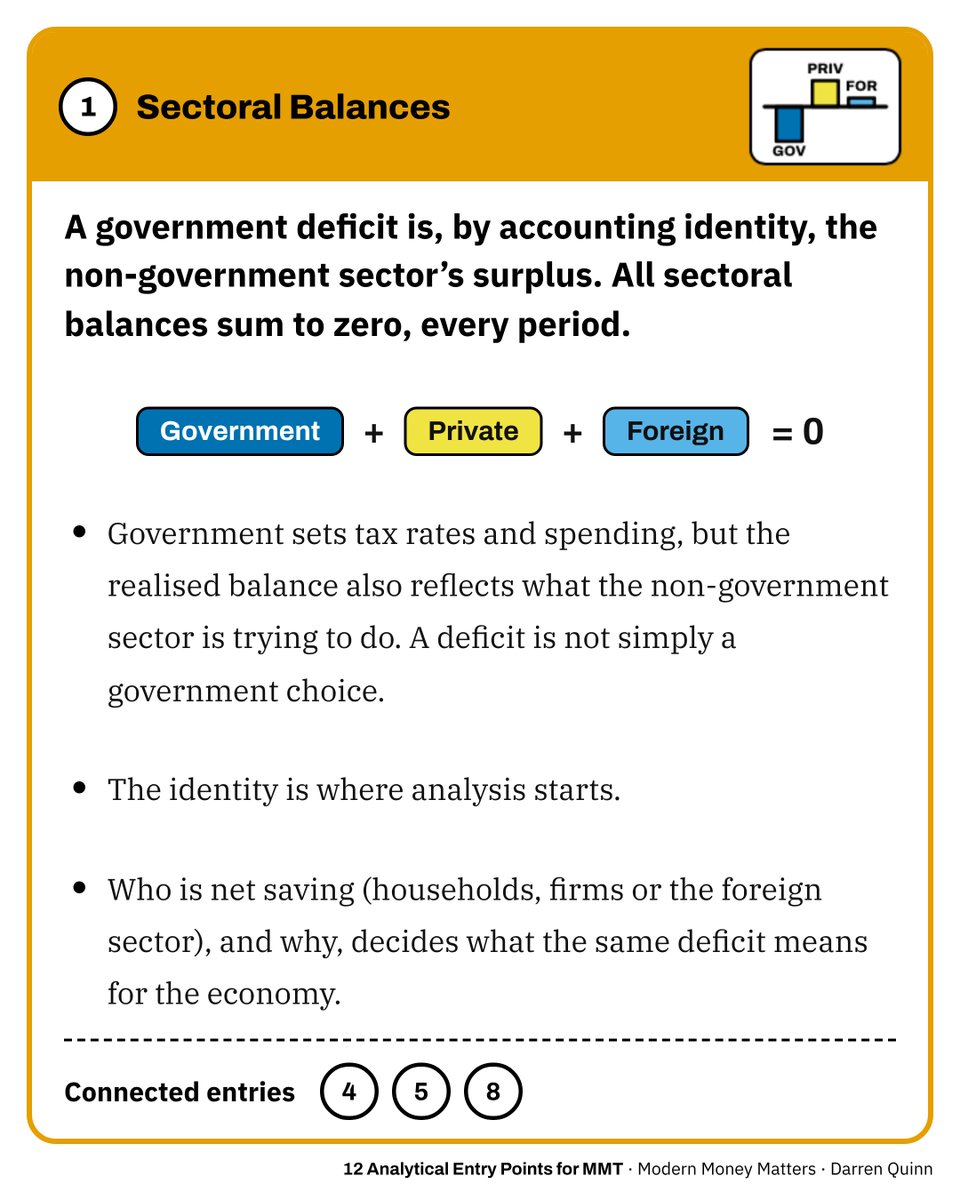
#MMT Card 1 of 12, Sectoral Balances. A government deficit is, by accounting identity, the non-government sector's surplus. All sectoral balances sum to zero, every period. A coloured equation reads: Government + Private + Foreign = 0.
@gestalt_j Agreed: Real wealth is what matters, and comparative advantage is a big part of where trade's gains come from.
You take those gains as imports.
A fund holds the part you don't take, and as a nation you only acquire net claims abroad by exporting more than you import.
"We must live within our means."
Whose means?
A currency issuer's means are the real resources available: idle workers, unused plant, energy, materials.
If people want work and there is work worth doing, living within our means would mean doing it.
@gestalt_j Fair: The fund is a currency hedge. A fall lifts its assets' value in your currency.
But it hedges the price, not the supply.
Higher yields draw capital in, but pay foreign holders too and squeeze borrowers at home.
Neither taxes nor bonds fund a currency issuer's spending.
It isn't superior across the board.
A fund cushions a price shock by paying the dearer import bill.
Capacity covers a cutoff, when nobody will sell to you at any price. Different risks.
I stop at necessities because only there is a cutoff catastrophic enough to justify the cost.
@gogreen1908 Agreed, and I'd go further:
JG projects do bid for inputs.
Only the wage is fixed. So the claim is narrow.
The JG doesn't bid up the price of labour, and its work can be chosen to lean on idle labour rather than scarce equipment. 1/3
@pr1234321 Housing shows private borrowing can inflate assets. That's bank lending, limited by borrowers, capital and collateral.
Deficits can feed asset prices too, depending on who holds the surplus.
But a government can't run short of its own currency: https://t.co/KpqnbF62t1
What Limits Bank Lending
The money multiplier says banks need reserves before they can lend.
They don't, and the idea props up another myth: That banks lend out your deposits.
Here's what actually limits how much banks lend. 1/7 1/7
Australia has run a current account deficit for most of its modern history.
Put that into the identity and the result is blunt: if the Commonwealth runs a surplus, the Australian private sector must be going backwards, or borrowing from banks to stay afloat. #MMT
@cezarybaginski Fair test, and "fully employed" has a check:
Is that input actually used up?
Where it is, more spending bids its price up.
Where it isn't, it needn't.
Capacity use, vacancies and prices are all measurable, and they can show I'm wrong.
So is there no constraint? There is, and it's the real one. #MMT
If government spending bids for workers, steel, concrete and energy that are already fully employed, you get inflation. Inflation isn't a rival to the real-resource story.
It's how a real limit announces itself.
@adamlje Agreed on the resources:
Taxes cut private spending and release real resources for government to use.
What they don't do is supply the dollars government spends, because spending credits accounts first.
The limit is the resources, not the dollars.
@AynRand_is_Dead Glad it helped.
Possible, yes: The bank buys the notes from the central bank with settlement balances, so its balance falls when it buys them.
Paid out as bonuses, they leave the vault and cut shareholders' funds as before.
Briefcase or transfer, the accounting is the same.
"Government debt" is a column in an account.
Flip to the other side, and it's private wealth: superannuation holdings, bank assets, savings.
Every dollar of the debt is someone's asset.
You can't pay it all down without taking that wealth off someone. #MMT
@HenricCont The post doesn't say inflation was absent, and the buffer it describes was implicit.
The anchor claim is narrower:
A fixed-wage offer fixes the price of labour at the bottom.
It doesn't reach import costs or market power. Those need other tools: https://t.co/U4rWamdkcC
We Already Had a Job Guarantee. We Just Never Called It One
1940s railway gang. AI-GeneratedWhoever Defines "Full Employment" Decides Who PaysEconomics is a struggle over meaning.
https://t.co/bJrmWEFE9f
@HenricCont Not quite.
The identity sizes each sector's net saving.
It can't say which households hold it, or what gets produced.
Those are the questions on top: Real resources, jobs, prices and who holds the surplus.
The distribution half: https://t.co/y40e2vfdMj
@gestalt_j One fix to my earlier 2/2:
A currency fall lifts import prices across the board, not in one place.
Higher taxes would answer it only by squeezing everyone, so which imports bind still decides the remedy. 3/3
@gestalt_j The $ saved through trade comes from exporting more than you import, which is real output you don't get to use.
And a fund holds financial claims on assets abroad, so in a crisis the question is whether anyone will sell you the good at all. 2/3