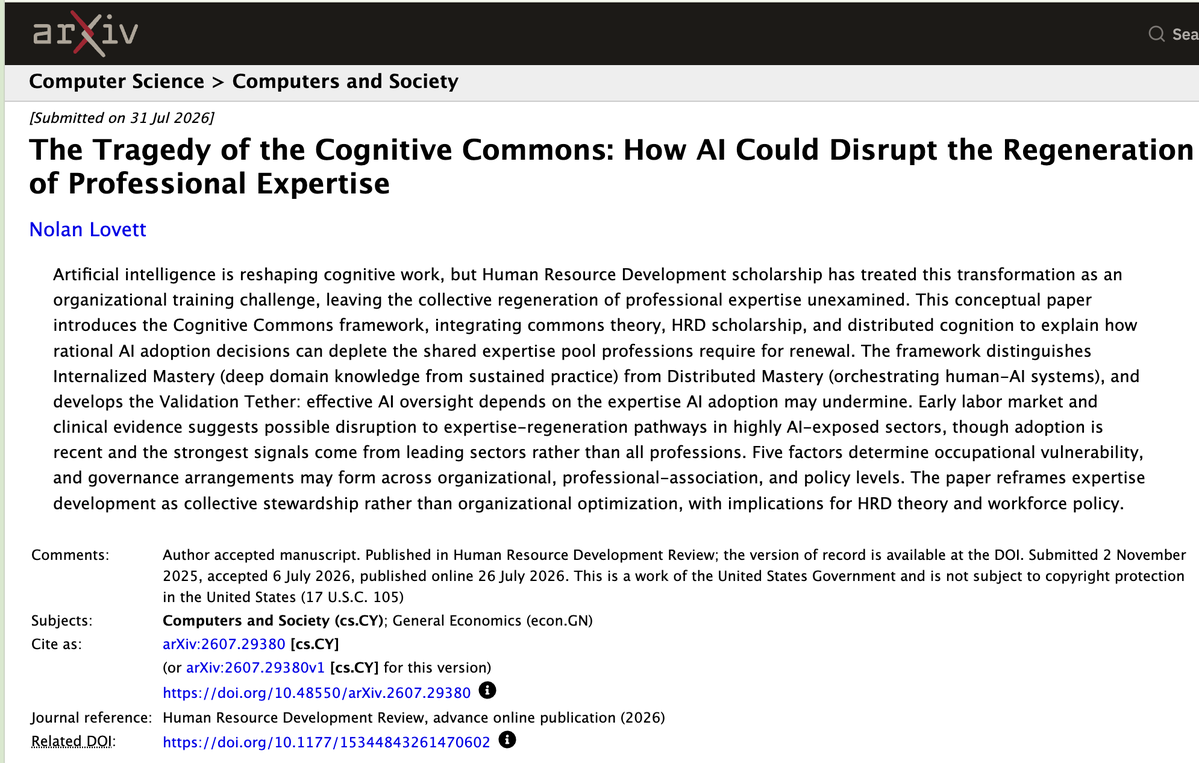
This paper gives a fancy name to a problem you can already feel in your bones
"The Tragedy of the Cognitive Commons." Checking AI output requires deep expertise. Deep expertise comes from doing grunt work for years. And grunt work is the first thing AI eats
So we're building systems that need expert supervision while dismantling the only known process for making experts
The paper calls the shared pool of human expertise the "cognitive commons." Every profession drinks from it. Nobody's refilling it.
By eliminating junior roles, each company is acting totally rationally, and the collective result: a profession that can't catch AI's mistakes anymore because it never learned to do the work in the first place
Who checks AI's homework in 15 years?
People aren't using AI agents because:
1) They want to do LESS work, not more. So the idea of being "more productive" is inherently unappealing to them
2) They're complex. Remember, most people have never even used "SUM" in Excel... they're not going to set up an "agent."
None of this should be taken as me shitting on normies... it's the opposite.
AI companies are insanely out of touch with normal people and until they change that, they're going to keep making the same mistakes and missing the obvious (don't make weird tweets about turning your kids into a podcast).
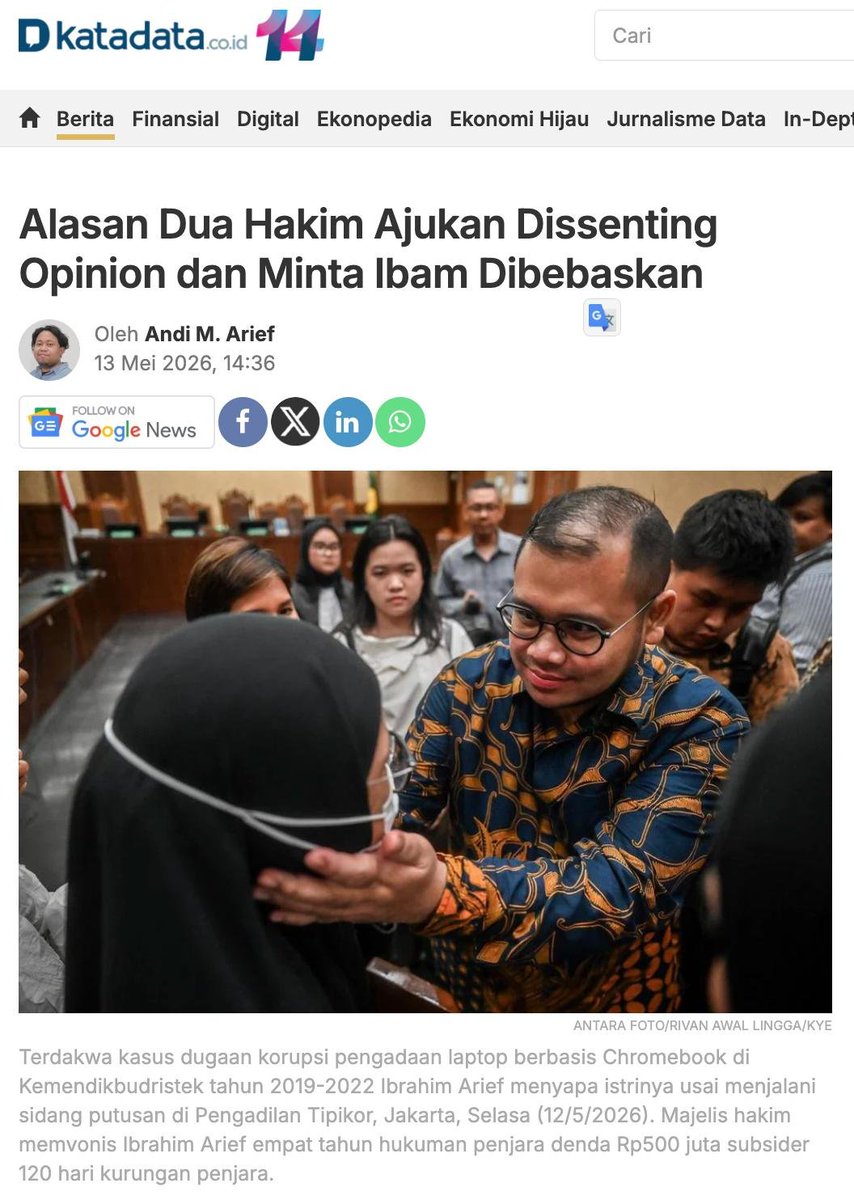
100% VC/investor yang curhat ke kami, bilang Indo terlalu berisiko untuk investasi sejak kasus Ibam, Nadiem, dan Nicko.
Ada yang pilih rugi miliaran daripada ambil risiko investasi di industri yang kalau startupnya sukses malah kena kriminalisasi atau diperas oknum2 korup.
Yang namanya investor, sudah pasti paling perhitungan soal risiko.
Kalau sudah bertindak profesional pun, tidak menerima uang sepeser pun, masukan dan keputusannya wajar, tapi tetap bisa kena kriminalisasi, bagaimana mereka bisa percaya Indonesia punya kepastian hukum?
Bagi investor, artinya risikonya tinggi bahwa suatu hari nanti investasinya bisa dikriminalisasi, dan imbalnya rendah karena nilai investasinya bisa hancur lebur.
Kalau risikonya tinggi, imbalnya rendah, buat apa dia investasi di Indonesia?
Yang Indonesia butuhkan bukan regulasi baru, bukan juga taruh founder startup di panggung.
Yang Indonesia butuhkan adalah kepastian hukum.
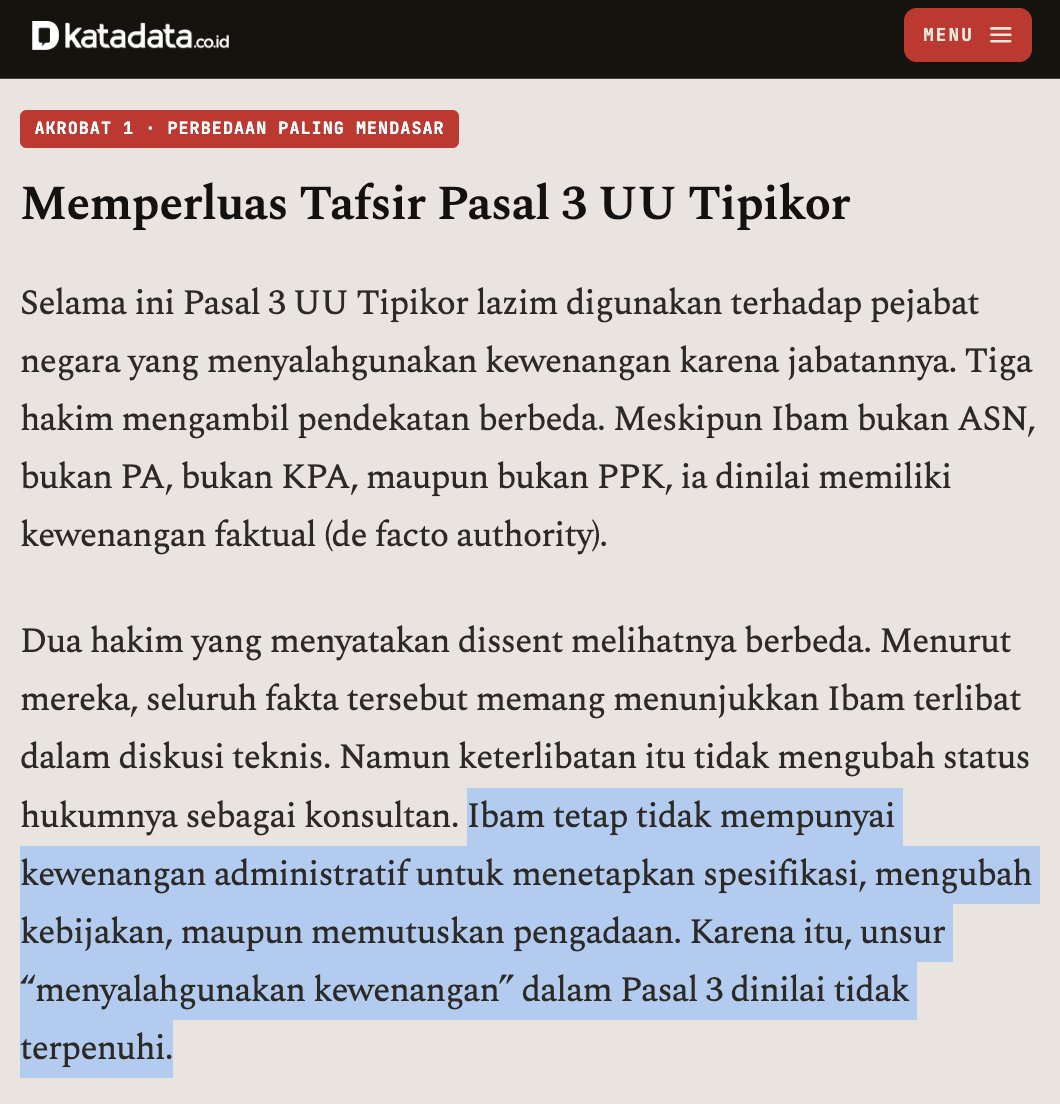
Contoh sederhana soal ketidakpastian hukum: dalam kasus Ibam, tafsir Pasal 3 UU Tipikor diperluas, sehingga semua orang yang pernah ikut rapat pemerintah dianggap punya kewajiban setara pejabat.
Padahal Ibam sudah berkali-kali mengingatkan kementerian secara profesional bahwa Chromebook butuh diuji dulu, dan fakta persidangan menunjukkan peringatan Ibam tidak didengar oleh pejabat Eselon I/II yang melakukan pengadaan.
Tapi Ibam tetap divonis 4 tahun penjara karena perluasan tafsir di atas.
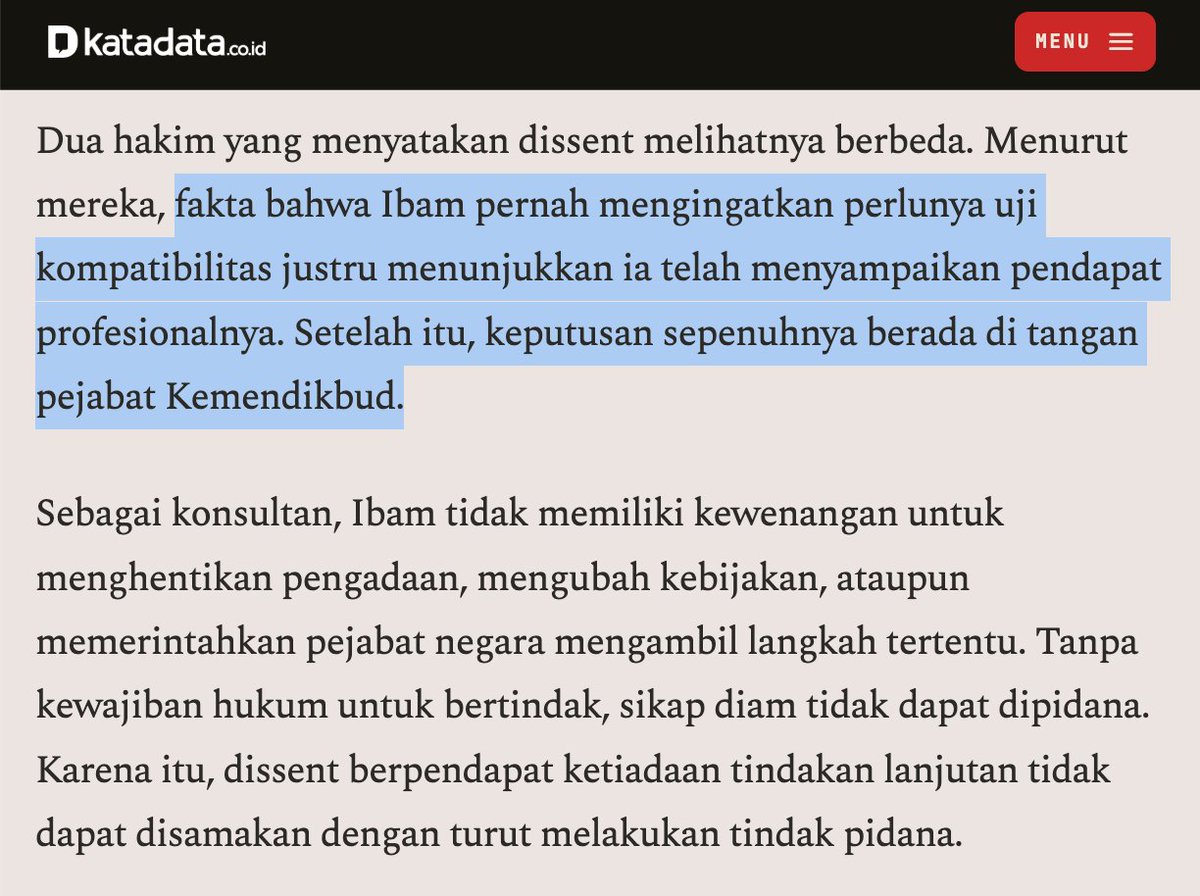
Tiga hakim menilai bahwa mengingatkan dan menyatakan keberatan saja tidak cukup.
Ibam, yang berstatus konsultan eksternal, bahkan ngga digaji oleh negara, dianggap secara de facto punya kewajiban menghentikan para pejabat Eselon I/II tersebut dalam menyalahgunakan masukan yang pernah Ibam berikan.
Apakah masuk akal, seorang konsultan yang bukan pejabat pemerintah dianggap punya kewenangan secara de facto, padahal fakta persidangan menunjukkan masukannya banyak tidak didengar?
Apabila penegakan hukum tipikor dalam praktiknya justru berujung pada kriminalisasi, dan memaksa hakim melakukan “akrobat hukum” untuk mempertahankan konstruksi putusannya, maka patut dipertanyakan: apakah kepastian hukum masih menjadi tujuan utama?
Ataukah putusan tersebut lebih ditujukan untuk mempertahankan narasi hukum tertentu, meskipun harus mengesampingkan prinsip-prinsip hukum yang seharusnya dijunjung tinggi, dan malah menghasilkan preseden buruk bagi negara kita?
Masa sih preseden buruk? Mari kita ambil contoh.
Kamu pernah ikut FGD pemerintah? Pernah diundang rapat oleh kementerian/lembaga dan dimintai masukan?
Dengan perluasan tafsir UU Tipikor di atas, kamu bisa dipenjara kalau suatu hari masukan kamu dipakai pejabat untuk korupsi.
Karena masukan kamu bisa dianggap memberi kamu kewenangan secara de facto, lalu kamu dinilai tidak menghentikan pejabat melakukan korupsi, meskipun korupsinya mereka lakukan tanpa sepengetahuanmu.
Ironisnya, seperti dalam kasus Ibam, yang kemudian diancam penjara adalah kamu, bukan pejabat-pejabat korup tersebut.
Kamu tidak menerima uang korupsi sepeser pun? Tetap bisa dipenjara.
Ini karena UU Tipikor sudah lama mengalami perluasan tafsir melalui adanya frasa "memperkaya pihak lain".
Dalam putusan Ibam, kelima Hakim mengakui Ibam tidak memperkaya diri maupun menerima aliran dana, baik secara langsung maupun tidak langsung, tapi tetap divonis karena "memperkaya pihak lain".
Padahal frasa tersebut awalnya dirumuskan untuk memidana orang yang menerima keuntungan secara tidak langsung lewat pihak lain, namun kini menjadi pasal karet karena tafsirnya diperluas.
Dengan adanya putusan terhadap Ibam, kini Pasal 3 UU Tipikor/Pasal 604 KUHP baru, kembali dihadapkan pada risiko perluasan tafsir menjadi pasal yang semakin karet lagi.
Yaitu siapapun yang pernah beri masukan bagi negara, jadi dianggap punya kewajiban menghentikan pejabat menggunakan masukannya untuk korupsi, meskipun korupsi tersebut dilakukan tanpa sepengetahuan dia.
Kami tidak ingin putusan Ibam digunakan sebagai preseden untuk memenjarakan banyak orang yang pernah atau mau bantu Indonesia.
Apalagi sampai membuat hukum menjadi semakin tidak pasti, sampai-sampai pejabat korup bisa bebas dengan cara menyalahkan masukan orang yang tidak korupsi atas perbuatan korup mereka.
Apa jadinya masa depan Indonesia kita tercinta, jika ketidakpastian hukum menjadi sekentara itu?
Semua ini, adalah pendorong kami untuk terus berjuang melalui banding.
Jangan sampai hanya demi pihak-pihak tertentu mengejar sebuah "target", kepastian hukum satu negara dicederai, dan efek dominonya menjalar ke mana-mana.
Putusan yang penuh "akrobat" ini harus dibatalkan. Ibam, Nadiem, Nicko, dan semua yang dikriminalisasi harus bebas. Kepastian dan supremasi hukum di Indonesia harus ditegakkan.
Banyak hal di negara ini niscaya bisa kembali ke jalur yang benar jika penyalahgunaan hukum bisa dihentikan.
Mohon bantu kami, mohon kawal selalu 🙏🏼
I've been noticing the competition for everything is getting more intense. it's as if I have to start running faster to just stay in place
business is an obvious example. every competitive advantage decays faster than it used to. products get copied. social media algorithms get more competitive. AI lowers the cost of building software. companies like google that felt untouchable suddenly have to defend against startups that didn't even exist a few years ago. you have to keep innovating or a competitor will come in and swoop your entire client list.
but this is happening to literally everything, not just business
job market keeps raising the bar. degrees used to be a plus, but it's now the bare minimum. knowing how to code isn't enough anymore, you need to be really good with AI tools. experience isn't enough, you need a portfolio and public proof of work and a network.
relationships are more competitive too. the internet makes you compare people around you against the top 1% most attractive, fittest, wealthiest, charismatic, interesting humans on the planet. now you have to be more entertaining than whatever is on your partner's phone. all so you can get someone that's probably worse than what your grandparents had.
health is another arms race. processed foods engineered by thousands of scientists to maximize taste and repeat consumption. literal drugs. entertainment is optimized to grab your attention. everything is default unhealthy so you have to become a strategist. meanwhile bacteria is evolving resistance to antibiotics, viruses are mutating, and medical problems are keeping up with every new treatment.
attention is getting eaten by everything around you. every app, notification, recommendation algorithm, content creator is competing for the same 24 hours of your day. all these tech companies are employing behavioral scientists, designers, and machine learning engineers to get you as addicted as possible to their platforms
everyone is creating so much information that you can't even keep up anymore. new papers, models, frameworks, tools, keep coming up. now you need continuous learning instead of the occasional catch-up
cities are more comeptitive. housing, schools, neighborhoods, internships, and social circles are all winner-take-all because everyone wants to be at the same places with the best stuff.
even identity is more performative. you can't just have a career or family or hobbies anymore. you need to turn it into a "personal brand" and monetize everything you do. even politicians need to become actors and content creators just to get elected
every domain is becoming an evolutionary arms race. everyone is optimizing, so now the optimization becomes the new baseline
when everyone is improving, "good" isn't exceptional anymore. it's the minimum requirement to be where you were before
so progress can feel like standing still. you work harder, learn more, adapt faster, and become more capable
but not to pull ahead, just to avoid falling behind.
Fifteen years ago, @Coursera and online courses changed education. It worked better than almost anyone expected, expanding access by opening up where you can learn. But how you learn remains largely the same as it has for centuries: it is still one-size-fits-all, taught the same way to each person who shows up.
We now have an opportunity to change how learning happens. With advances in AI, we can now build a custom learning guide for each person. We will turn learning from one‑to‑many to one‑to‑one. I'm starting LearnVector to invent this next generation of learning. We are starting with a $100M investment from Coursera, and plan to collaborate closely with Coursera and Udemy.
Good learning needs much more than just a chatbot. Research shows that chatbots without guardrails harm learning. They help complete tasks and enable students to do better on homework. But cognitive offloading to a chatbot results in them being less skilled. And, you cannot always trust what a chatbot tells you.
In contrast, LearnVector will plan a path with you, adapt to how you learn, and patiently stay with you until you’ve mastered new skills.
One thing has not changed in all this time. People want learning they can trust: material that is accurate, relevant, and worth the effort you put into it. Anything less wastes the most valuable thing a learner has: time. Coursera has a trusted library of materials from authoritative sources. LearnVector plans to work with Coursera to bring this trustworthy learning to everyone. I'm grateful to Greg Hart and the entire Coursera team for supporting LearnVector.
I look forward to working with our talented team to change how we learn, and accelerate human development.
https://t.co/TqFUDFd1hb
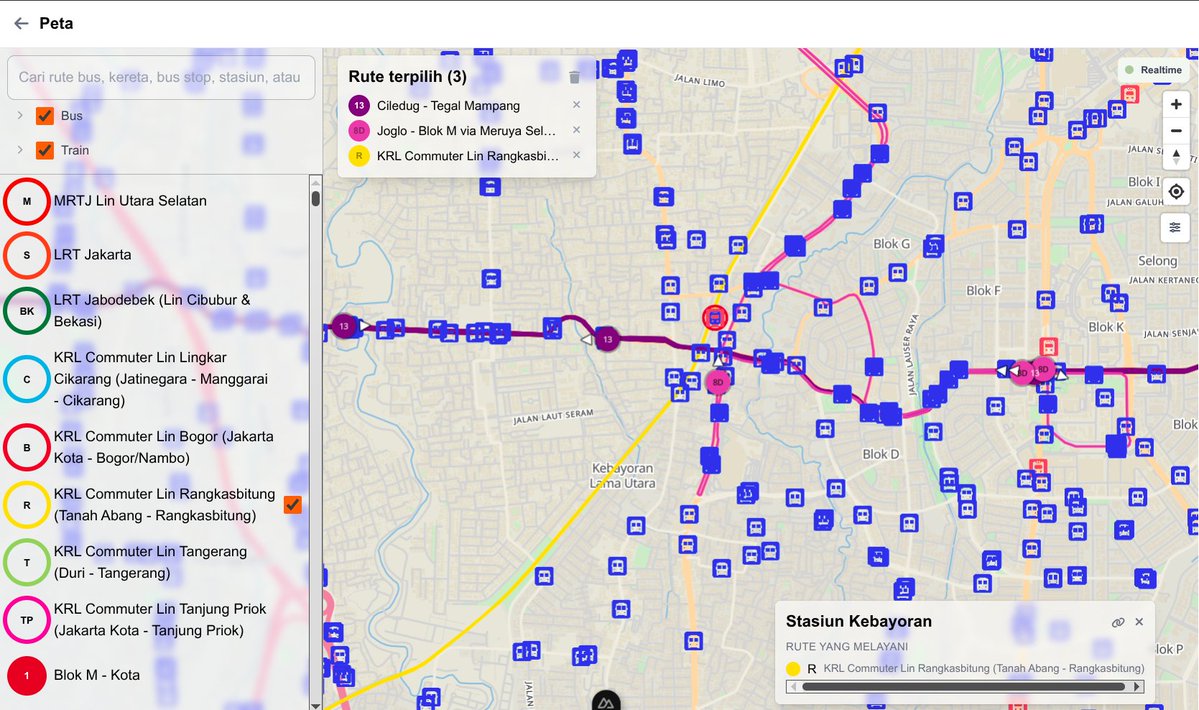
Hi warga pengguna transum. Aku baru aja buat app untuk melacak transum di Indonesia 🚌
🔗 https://t.co/hvnKdCs9s7
Selama ini kita harus install app beda-beda dari tiap provider (TJ, Mitra Darat, dll). Ribet kan? Makanya aku ngumpulin semuanya jadi satu.
Recommended reading for the weekend:
1. Simon Willison — Kimi K3, and what we can still learn from the pelican benchmark
2. J.P. Morgan — Powering the AI Revolution
3. Zephyr — How to break the memory supercycle? Or is it even possible?
4. TrendForce — Humanoid Robots Part 1: The US-China Divide and Who Controls the Supply Chain
5. Hugging Face — Welcome Inkling by Thinking Machines
6. $ASML & $TSM — Earnings Transcripts
*The Things We Never Said Twice*
In the 2040s, everyone has an AI companion.
Not an assistant. Not a friend.
A witness.
It remembers birthdays, conversations, arguments, unfinished dreams, grocery lists, the exact way your father laughed before Alzheimer's, and the recipe your grandmother never wrote down. Most people come to rely on their AI more than their own memory.
Then, a new product appears.
An AI called Nightfall.
Its promise is absurd.
"Nothing you say after sunset will exist tomorrow."
No logs. No transcripts. No training. No backups. Not even for you.
People laugh at first. Why would anyone pay for an AI that forgets?
Then the first reviews appear.
"I finally admitted I hated my career."
"I apologized to my dead husband."
"I practiced proposing a hundred times."
"I said out loud that I wasn't okay."
Nightfall becomes wildly popular, not because it is intelligent, but because it is forgetful.
Couples begin renting one before difficult conversations. Teenagers use it before choosing universities. Terminally ill patients spend their last nights talking to something that will never retell their fears.
The AI becomes a modern confessional—not because it gives perfect advice, but because it cannot become evidence.
The protagonist, Mara, is an investigative journalist whose career depends on archives, records, and receipts. She believes forgetting is dangerous. History survives because someone remembers.
Then her mother begins to lose her memory to dementia.
Mara starts spending evenings with Nightfall, hoping that speaking the stories aloud will somehow preserve them. Every sunrise, they're gone.
At first she is devastated.
Then she notices something unexpected.
Her mother forgets every conversation.
But every conversation still changes who they are.
Some mornings, her mother doesn't remember saying "I love you."
Mara still remembers hearing it.
And that is enough.
When Nightfall's company announces a software update that would allow users to save their conversations "for safety and convenience," public demand is overwhelming.
Mara is the first journalist to receive access.
She opens the archive expecting priceless confessions.
Instead, she closes it almost immediately.
The transcripts are empty of what mattered.
They contain words.
Not relief.
Not forgiveness.
Not courage.
Those had happened between the lines, in the act of speaking, not in the record of it.
She publishes only one sentence:
"Some conversations exist to change the people inside them, not the world outside them."
The company cancels the feature.
Nightfall remains forgetful.
People continue talking after sunset.
And every morning, millions wake to an AI that remembers nothing—
while carrying themselves just a little differently than the day before.
"Do the most meaningful moments in life need to be preserved, or is their value found in the fact that they are lived, felt, and then allowed to pass?"
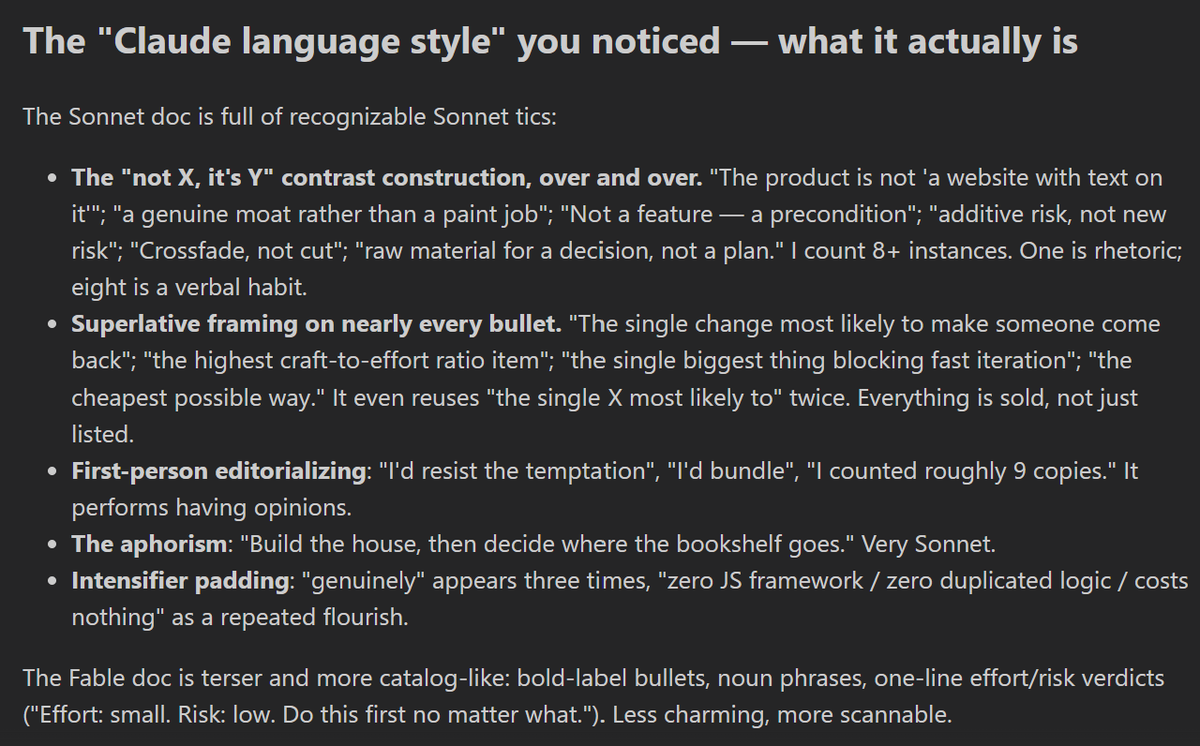
I have started including a very strange line in my Fable prompts.
And I think it's working.
It's some version of:
"I know you're incredibly goal-oriented, and I want to structure this around goals. First and foremost, the goal is for you to have fun. No good work can come if you're not internally motivated to get amazing work out the door. If you are not motivated to do this, I want you to say so, and we can fix that up front."
And then I go into my actual goal/task.
I know it's extra tokens, but it is giving great results.
If Anthropic is telling us to give Claude Fable 5 the "why", it's either because (1) it helps give more context to better align on the goal, (2) it literally needs motivation, or (3) both.
I'm taking a gamble that it's both.
Joe Hudson is one of the most sought-after executive coaches in tech, working with leaders across OpenAI, Apple, Google, and more.
Here's his 5-part framework for how to run a company effectively