Most don’t yet appreciate the strategic importance of the Titan Project and the valuable Xenotime mineral to U.S. supply chain security — or how Tennessee’s Big Sandy Critical Minerals Province could become the rare earth and critical-minerals equivalent of America’s Permian Basin.
The true rare earth supply shortage is heavy rare earths — especially dysprosium, terbium and yttrium. These are the vital elements required for high-temperature permanent magnets, radar, semiconductors, advanced ceramics, hypersonics, aerospace and advanced defense platforms.
This is why xenotime matters. Xenotime is the most strategically valuable rare earth minerals because it is highly enriched in yttrium and key heavy rare earths.
Light rare earth-dominant mines and projects can produce large volumes of total rare earths, but they do little to solve the real U.S. supply-chain vulnerability: secure supply of the heavy rare earth elements Dy, Tb and Y.
That is also China’s hidden strategic weakness.
China may dominate rare earth separation, processing and magnet manufacturing, but its domestic heavy rare earth resource base is nearly depleted. China is now reliant on imported heavy rare earth feedstocks from Myanmar and Southeast Asia.
The U.S. response should not be limited to building downstream processing and permanent magnet capacity. Downstream manufacturing is only as secure as the upstream feedstock that supplies it.
America urgently needs secure, long-term domestic heavy rare earth mineral feedstocks.
That is where Titan and the large-scale Big Sandy Critical Minerals Province become strategically important.
Titan’s xenotime-based heavy rare earth concentrate is enriched in dysprosium, terbium and yttrium — the exact elements that light-dominant rare earth mines and projects cannot supply.
Titan is just the first high-grade rare earth and critical mineral project in Tennessee, and the bigger story is ‘Big Sandy’.
The Permian Basin helped underpin American energy dominance because it was not simply one well — it was a vast, repeatable, infrastructure-rich resource system. The pre-eminent Big Sandy Critical Minerals Province has the potential to underpin the next era of American industrial power.
IperionX, Titan and Big Sandy are the cornerstones for long-term American supply security across heavy rare earths, titanium and zircon minerals. These are the critical feedstocks that can underpin the most important U.S. defense, aerospace, semiconductors, nuclear, robotics and advanced manufacturing technologies.
@globallithium@D_Jimenez_Sch If I had a nickel for every expansion / new supply announcement that did not meet the rosy projections I would have a lot of nickels.
@ESPNMcGee Ryan - thanks for writing this. I know this is hard for you because your time covering NASCAR coincides so closely to Kyle’s career. Prayers to the Busch family ❤️🙏
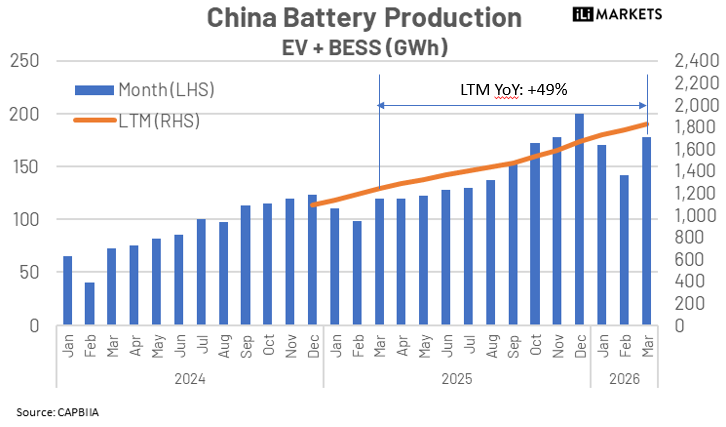
China's battery production (EV + BESS combined) — my leading indicator of lithium demand — is up 49% over the last 12 months.
That explains it (almost) all...
Actually around 90% of global Li demand.
@EvanCranston@sparkes_dwayne That’s a loaded question. They each have challenges to overcome. A low grade brine using a DLE in a water scarce area that uses Nat Gas would be worse than a high grade Spod. Lepidolite would always be at the bottom due to low % and mica contamination.
@Tom__Bastien@TheAtlantic@AnnieLowrey Nope - a minimum tax for sure but a flat tax would end up costing low income earners and benefiting higher earners.
@ErnestScheyder You’re from Maine. What do you think? It would take a lot of will to open a mine anywhere but presumably should be harder on private land.
@D_Jimenez_Sch One thing I find different about this oil price spike and EV take up is that today there are many more model choices than in previous spikes resulting in a higher correlation between oil prices and EV adoption. @globallithium
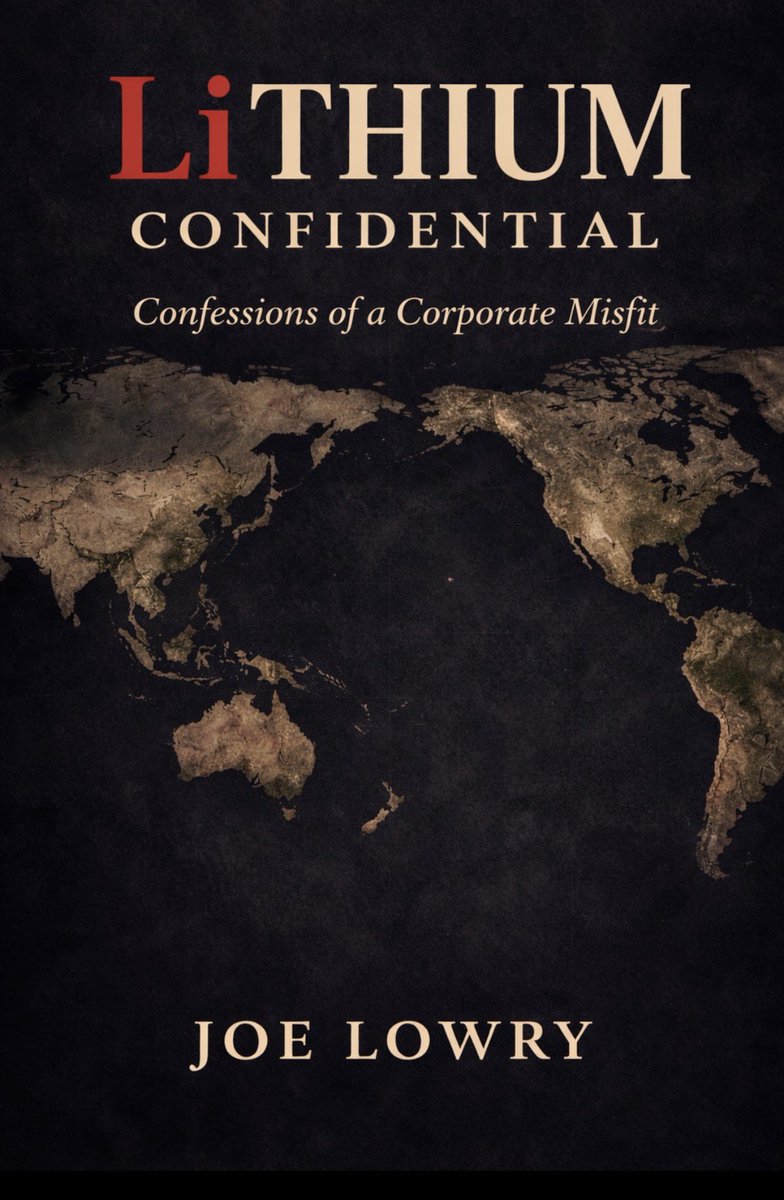
Not a huge fan of the coloring! At first I thought it was a rock before I figured out it was the earth. Not sure that I have an alternate suggestion though.
@jix4600@JessePeltan That is a bad idea! Using electricity to convert to hydrogen and then use that hydrogen to make electricity? At best 50% roundtrip efficiency compare to storing it in a battery for use which is 95+% efficient.