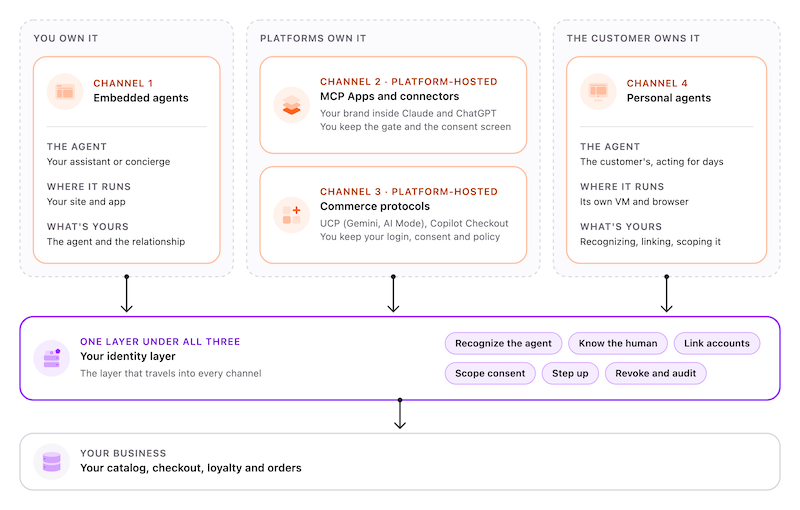
great post on how to secure agentic commerce to win, by my friend and @auth0 Chief Product Architect @sandrinodm
makes sense of the whole thing, explains how UCP and Personal Agent Protocol fit, and more...
if you don't already, go give him a follow
https://t.co/0i9rtASxvd
excited to share that @mattkrzus has joined the @auth0lab team
Matt's a hardcore ML systems engineer and I'm very excited he's part of the team
we believe using AI to secure AI will be a big part of the future, so more of our experiments will involve ML. go give him a follow!
proud "dad" moment: Google's new Agent Substrate uses @OpenFGA for authz https://t.co/w45mWtD1It
amazing validation for the project we started with @jonallie 5 years ago
I'm hiring a Principal Applied AI/ML Scientist for the @auth0lab team. this is a first for our team
we are currently focused on enabling builders and companies of any size to ship production grade AI agents, by helping them with identity and security. we believe data, and developing our own models will play a huge role in this
if you are great at ML and would love to work with a small team on taking ideas from 0 to 1:
https://t.co/VXsIiMdGGB
DMs open for questions
everyone wants their product to work with AI agents. but no one wants their product to be abused. and let's be honest: AI means more + better "bad bots"
we are building a product that can help you, by letting you verify there's a real human behind AI agents. we think it'll be really useful for:
- dev products
- e-ticketing
- agent credit cards
- social networks
we are starting a private Beta of Human Principal with a few companies that want to integrate and give us feedback.
interested? https://t.co/l5lml4DIEq
Today we joined @tiagosada and @worldnetwork on stage to unveil what we've been working on @okta: Human Principal
Let's dive in 👇
Dev products with free offerings and social media platforms are vulnerable to abuse. AI makes scaled abuse and fraud easier than ever. As agents continue to go mainstream, these problems are expected to exacerbate. Without a way to distinguish the human behind agents, other options can be aggressively rate-limiting or per-product heavyweight KYC processes, both of which add friction, can introduce data privacy risks, and undermine the value of automated agentic workflows.
*Human Principal will allow API builders to verify whether a human stands behind an agent and its actions, and enforce policies accordingly. Humans will be able to verify themselves using a number of verification methods, and obtain device-bound cryptographic proof that carries across products without requiring cumbersome re-verification.
@world_id, slated to become one of the first Human Principal integration partners, is set to provide Human Principal a privacy-preserving, user-friendly, and ubiquitous proof of human verification method. This will enable features like rate limits per human for agent traffic, abuse-protected free tiers, and a cleaner onboarding flow for agents that need to access services on behalf of their human principal.
The waitlist to join the upcoming Human Principal beta is now open at https://t.co/l5lml4DIEq
*Forward-looking statements apply https://t.co/BJdPZnEtEW
Camp AI is going on tour 🌎
6 cities. 5 months. Startup demos, panels, and ghost stories about what your agents did when no one was watching.
First stop: SF on May 7. NYC, London, and more soon!
Presented by @Auth0. Will add links in 🧵as we announce each city! #Auth0CampAI
your users want agents that know about them. their past chats, preferences, habits, needs, etc.
so we've been experimenting with agent memory at @Auth0. to enable you to build agents that act on users' behalf, the way your users expect
interested? DM me or @jcenturion86
agent identity and access control is a big problem. openclawd makes it very evident :)
a lot moltbook not knowing who is behind usage is that a lot of keys are api keys vs user bound tokens.
there's no openclawd account (nor should there be just for its own sake). identity is relevant and necessary depending on use cases. rate limiting is a very common use case to push for identity
but the question becomes: what do you limit on? e.g. can someone have 1000 clankers if they are a "real person" and is each unlimited? does a person get a quota and the quota gets split amongst clankers?
the identity approach you choose depends on what you need it for. @worldnetwork real world identity comes in handy (much like @X verification) because you want to baes it on real world scarcity, not just an agent's "private key"
btw @auth0 we’ve done a bunch of stuff with https://t.co/MMZyo6wPSF and there is more coming. if you are dealing with agents, auth, identity, access control hmu. would love to chat
Today is a great day for open standards and AI, and at @Auth0, we’re all in on both.
We’re excited to join the Agentic AI Foundation (AAIF) with @Okta and keep working with the community to help builders create safer, more capable AI systems.
sign in with @vercel enables every dev to build on top of the AI cloud
naturally, builders using @auth0 will be able to support it for their apps
@nextjs app with "Sign in with Vercel" 👇. thanks @okbel for the last mile assist!
code for `setup_auth0_vercel.sh` in reply