Mimir 3.0 changes the Kafka question for observability teams.
With Grafana Mimir's ingest storage architecture, Kafka is no longer just a side dependency. It becomes the write-path commit boundary: distributors write samples to Kafka, Mimir acknowledges writes after Kafka durability, and ingesters consume from Kafka partitions.
That means self-hosted Mimir teams need to evaluate more than Kafka API connectivity.
1️⃣ If Kafka sits on the ingest path, broker-local disks can turn scaling into partition data movement.
2️⃣ In high-throughput metrics ingest, inter-broker replication and cross-AZ reads/writes can become a steady cost driver.
3️⃣ If Mimir already uses object storage for long-term blocks, keeping Kafka durability tied to broker disks creates another stateful storage lifecycle to operate.
AutoMQ fits this architecture by keeping the Kafka interface Mimir expects while moving persistent Kafka data into shared object storage. Distributors and ingesters still use Kafka semantics; the storage and scaling model becomes Diskless.
👉 Read the full blog: https://t.co/iDihtkjwde
For more Kafka and AutoMQ engineering insights, please join the AutoMQ Slack community:
📷https://t.co/W9DeB86RZp
#GrafanaMimir #Kafka #AutoMQ #DisklessKafka #Observability #Kubernetes #SRE
Diskless Kafka only becomes production-ready if teams can keep the Kafka ecosystem they already trust.
The architecture is attractive for a clear reason: moving durability away from broker-local disks can reduce replica-heavy storage overhead, make scaling lighter, and avoid large data movement during recovery or reassignment. But those gains only matter if existing clients, tools, operators, and Kafka semantics keep working.
That is why compatibility is the real production gate for Diskless Kafka:
1️⃣ Moving durable data to shared object storage can make brokers more stateless, but that value disappears if applications, SDKs, operators, or tooling need to change.
2️⃣ Rewriting the Kafka API means chasing the fastest-changing layer of Kafka: protocols, coordinators, transactions, Consumer groups, Admin APIs, KRaft behavior, and edge-case fixes.
3️⃣ AutoMQ narrows the change to Kafka's Log/Segment storage boundary: S3Stream replaces local log storage, while the Kafka compute layer continues to run APIs, coordinators, transactions, Consumer groups, and KRaft behavior.
This is why #AutoMQ treats Kafka compatibility as an architecture principle, not a feature checkbox: 𝐀𝐮𝐭𝐨𝐌𝐐 𝐤𝐞𝐞𝐩𝐬 𝐊𝐚𝐟𝐤𝐚 𝐩𝐫𝐨𝐭𝐨𝐜𝐨𝐥𝐬 𝐚𝐧𝐝 𝐬𝐞𝐦𝐚𝐧𝐭𝐢𝐜𝐬 𝐢𝐧 𝐭𝐡𝐞 𝐜𝐨𝐦𝐩𝐮𝐭𝐞 𝐥𝐚𝐲𝐞𝐫 𝐰𝐡𝐢𝐥𝐞 𝐫𝐞𝐩𝐥𝐚𝐜𝐢𝐧𝐠 𝐥𝐨𝐜𝐚𝐥 𝐥𝐨𝐠 𝐬𝐭𝐨𝐫𝐚𝐠𝐞 𝐰𝐢𝐭𝐡 𝐒𝟑𝐒𝐭𝐫𝐞𝐚𝐦.
👉 Read the full blog: https://t.co/d7VeicToUq
For more Kafka and AutoMQ engineering insights, follow AutoMQ on LinkedIn or join the AutoMQ Slack community:https://t.co/W9DeB86RZp
#Kafka #ApacheKafka #DisklessKafka #DataInfrastructure #CloudNative #AutoMQ
@tobiaslins@alex_holovach It depends on how many vms you will use. On AWS, a minimum three-node cluster with 2C8G instances can deliver a throughput of over 120MB/s.
Kafka availability is not just a replica-count question.
Coinbase’s May 2026 MSK outage is a useful reminder for Kafka platform teams: even a multi-AZ, multi-replica deployment can fail to recover cleanly if the full recovery path does not hold.
The deeper lesson is that Kafka availability has to be designed as an end-to-end recovery path, not a parameter checklist:
1️⃣ Inside one cluster, recovery depends on leader takeover, client reconnects, ISR health, and whether the remaining brokers can absorb shifted traffic.
2️⃣ Because traditional Kafka ties compute to local persistence, post-failure replica recovery, scaling, and partition reassignment can still involve heavy data movement.
3️⃣ Once recovery crosses regions, data replication is not enough unless offsets, downstream state, and failover routing line up.
#AutoMQ approaches this by reducing the broker-data binding through Shared Storage, restoring capacity with stateless brokers and fast scale-out, and using Async Kafka Linking DR with Metadata-only Proxy to combine offset-aligned recovery with seconds-level RTO.
👉 Read the full blog: https://t.co/dcyNzqg9YH
➡️ Follow AutoMQ on https://t.co/3Pe0l0Lfw5, or join our Slack community for the latest Kafka and AutoMQ engineering insights.
📚 Join the AutoMQ's Slack Community: https://t.co/gDJjhG0225
#Kafka #ApacheKafka #DataInfrastructure #SRE #DisasterRecovery https://t.co/drVucsX6lV
𝐊𝐚𝐟𝐤𝐚 𝐦𝐢𝐠𝐫𝐚𝐭𝐢𝐨𝐧 𝐢𝐬 𝐧𝐨𝐭 𝐣𝐮𝐬𝐭 𝐫𝐞𝐩𝐥𝐢𝐜𝐚𝐭𝐢𝐨𝐧.
#MirrorMaker2 can copy data across clusters. But when a Kafka cluster becomes part of production-critical infrastructure, the hardest part is usually not moving bytes. It is moving traffic.
The cutover is where risk concentrates:
1️⃣ Producers may move in batches, creating split-write risk if the migration path is not coordinated.
2️⃣ Consumers need a safe resume point, and offset translation becomes especially fragile for Flink, Spark Streaming, or Kafka Streams.
3️⃣ Rollback is no longer simple once new writes land on the target cluster.
That is why treating migration as “replicate first, stop writes later, then switch clients” often turns into a maintenance-window plan.
This article compares MirrorMaker2 and #𝐀𝐮𝐭𝐨𝐌𝐐 Linking from a migration perspective: data path, producer cutover, consumer coordination, offset continuity, stateful workloads, and rollback boundaries.
AutoMQ Linking is built around that cutover plane. It keeps offsets aligned, supports rolling producer migration, coordinates consumer groups, and helps teams move Kafka workloads without turning cutover into the riskiest part of the project.
👉 Read the full analysis: https://t.co/glTeYiz0FL
#Kafka #ApacheKafka #KafkaMigration #MirrorMaker #StreamingData #DataEngineering #AutoMQ
OpenAI’s Kafka journey is a signal for the AI era.
As ChatGPT traffic grew, OpenAI scaled Kafka throughput 20x in one year, but also had to build Prism, Photon, UForwarder, and HA Cluster Groups around Kafka.
The article traces what that architecture reveals:
1⃣Proxy layers can make Kafka usable at massive scale, but they move complexity above the engine.
2⃣The trade-off was real: many workloads moved away from ordering, transactions, and partition-based processing.
3⃣The deeper direction is Diskless Kafka / storage-compute separation: less data movement, lower storage overhead, and lighter recovery.
Building heavy proxies is how teams survive scaling traditional Kafka. Redesigning the engine around storage-compute separation is how they avoid that architectural complexity in the first place.
That is where AutoMQ’s direction fits: not another layer around Kafka, but a Kafka-compatible engine built for the cloud-native Kafka path.
👉 Read the full analysis: https://t.co/R6BgcDLflE
#Kafka #DataEngineering #CloudNative #AIInfrastructure #SRE #AutoMQ
🪣 AWS S3 Files brings sub-millisecond reads to S3. Can Kafka finally go diskless with S3 Files? Not so fast.
This blog tells the real story — S3 Files is not a good idea for Diskless Kafka:
📉 P99 latency spikes to 700 ms+ — a 140x jump from P95
💸 ~$106,000/month for just 100 MB/s write throughput
⚠️ Durability gap — broker crashes lose unflushed data with replica=1
S3 Files optimizes for read-heavy, small-file workloads. Kafka is the opposite: sustained, high-throughput writes.
AutoMQ has already solved this. Its WAL (Write-Ahead Log) abstraction layer decouples storage from compute, letting users plug in different cloud storage backends — from EBS to S3 — and balance cost against performance for their workload.
The direction is right. The shortcut isn't.
👉 Read the full story: https://t.co/ywr1OvnBxW
🌐 More about AutoMQ: https://t.co/67YHQQm5AX
#ApacheKafka #Kafka #S3 #CloudNative #DataStreaming #CostOptimization #AutoMQ
💸 Check your AWS bill right now. Cross-AZ traffic easily consumes 50% of your Kafka budget.
🏗 Broker-to-broker replication made sense in data centers (free traffic). On clouds, it's an expensive architectural relic.
☁️ AutoMQ uses S3 as the durability layer. No cross-AZ replication. No multi-GB fanout. Cross-AZ traffic cost → near zero.
👉 Read the full breakdown: https://t.co/3fLzVIQc16
🌐 More about AutoMQ: https://t.co/67YHQQm5AX
#Kafka #ApacheKafka #AutoMQ #CloudNative #CloudCost #DataEngineering #BestPracticez
💥Kafka's high availability isn’t just about replicas—it’s about RTO you can actually rely on.
🔧 In this deep dive, AutoMQ shows how a single-line config can cut your Apache Kafka RTO in half, and why large clusters still hit a hard ceiling without a cloud-native, disaggregated storage-compute architecture.
👉Dive into the full breakdown : https://t.co/luEtShjy9F
#Kafka #ApacheKafka #AutoMQ #CloudNative #PerformanceTuning #BestPractice #Streaming #DataEngineering
AutoMQ continues to earn top-tier industry recognition, now powering mission-critical Kafka workloads at iQIYI.
From private‑cloud Kafka to hybrid cloud and now cloud‑native AutoMQ, iQIYI cut real‑time streaming infra cost by 70%+ while gaining second‑level elasticity.
Read the full technical blog👉https://t.co/CnmeYB7I6i
#Kafka #ApacheKafka #AutoMQ #CloudNative #Streaming #DataEngineering #BestPractice #CostOptimization
🤝 Thrilled to announce! AutoMQ × Aklivity = Unlocking Cloud-Native Real-Time Data.
🎉 AutoMQ × Aklivity brings a stateless, cloud-native Kafka stack with a multi‑protocol gateway—so your Web, mobile, and IoT apps (HTTP, MQTT, gRPC, SSE) can talk to Kafka in real time, securely, and at scale.
⚙️ Think 10x cost efficiency on S3 + AsyncAPI‑driven governance at the edge.
👉 Read the full announcement:https://t.co/GI2bNQ5QGm
🌐 AutoMQ: https://t.co/67YHQQm5AX
🌐 Aklivity: https://t.co/A3D4koVGhF
#AutoMQ #Aklivity #CloudNative #ApacheKafka #RealTimeData #StreamingInfrastructure
⚙️Kafka in the cloud doesn’t have to choose between low latency and low cost.
AutoMQ x AWS FSxN pushes Diskless Kafka to sub‑10ms end-to-end latency at 300 MiB/s write / 1.2 GiB/s read, while keeping ~90% lower TCO vs traditional Kafka.
Want to see how a next‑generation Kafka actually performs under real benchmarks?
Read the full performance report 👇
🔗 https://t.co/MoWd4UfZ1W
#Kafka #ApacheKafka #AutoMQ #PerformanceTuning #CloudNative #Streaming #DataEngineering #CostOptimization
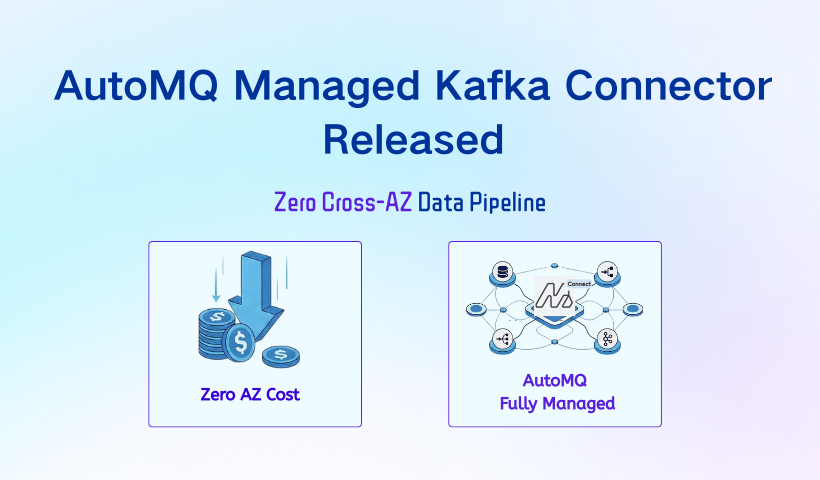
🚀Kafka Connect x AutoMQ, now fully managed with Zero Cross-AZ data pipelines.
We just released AutoMQ Managed Kafka Connector in BYOC, so you can spin up production-grade CDC pipelines on AWS without self-managing Connect clusters or paying the cross-AZ “tax”.
Debezium, S3 Sink, unified control plane, and observability are all built in.
👇See the full breakdown:🔗https://t.co/yxQg0YrepS
#Kafka #ApacheKafka #KafkaConnect #AutoMQ #CloudNative #Streaming #DataEngineering #CostOptimization