$SPY $QQQ - JPMORGAN DROPS BULLISH STOCK OUTLOOK, WARNS RALLY MAY NOT LAST
JPMorgan's trading desk, led by Andrew Tyler, has shifted from tactically bullish to cautious following last week's sharp market correction.
Tyler expects a near-term rebound but doubts it will develop into a sustainable rally.
The bank cites Fed rate uncertainty, Nvidia-related risks and questions over AI earnings growth in 2027–2028.
JPMorgan wants to see lower volatility, stronger cyclical stocks and a potential Fed rate-hike delay before turning bullish again.
"We do think a bounce is coming," Tyler wrote, but a durable market bottom remains uncertain.
South Korea announced phased measures to calm markets amid rising volatility, including ensuring a stock stabilization fund is in place to respond when needed, top financial officials said after an emergency meeting on Sunday https://t.co/sDDGSqA8EN
JUST IN: Joe Biden accuses Nancy Pelosi of undermining his 2024 reelection bid by “working furiously behind the scenes” to get elected officials & delegates to defect.
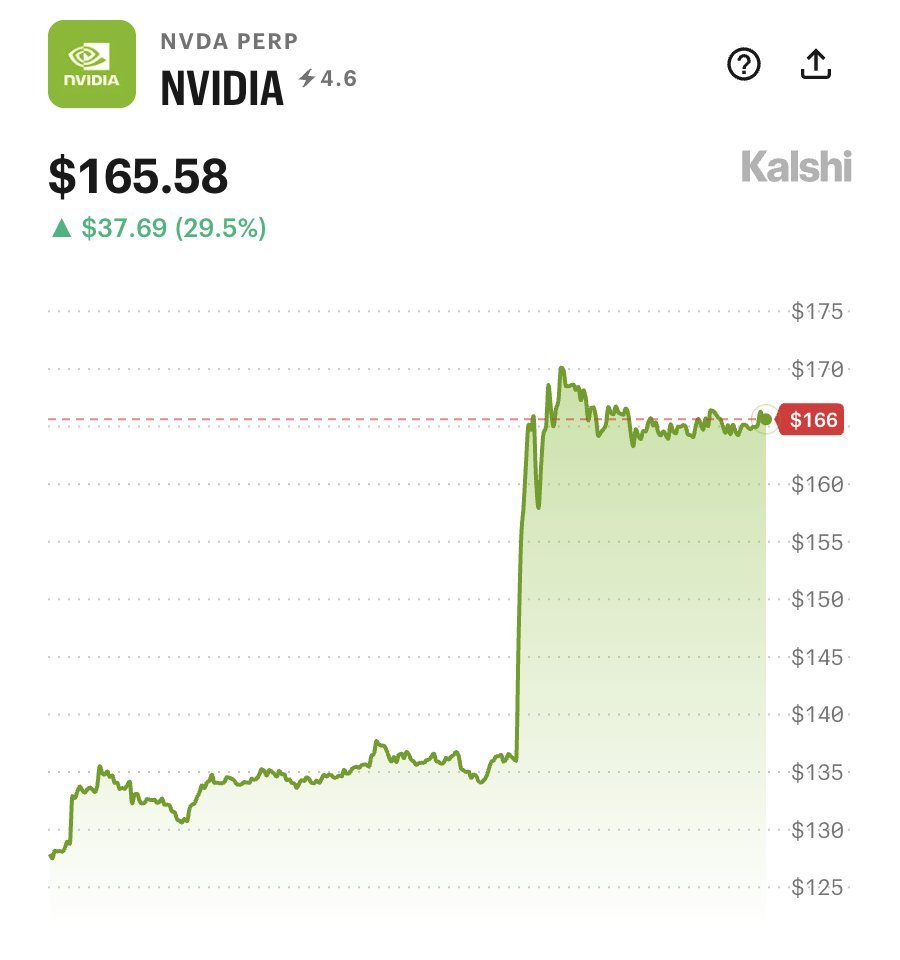
NVIDIA futures (XNVDA / SNVDA) volume topped 10K contracts ($71.8M notional) on Nov. 12, with nearly 40% traded overnight ahead of the U.S. cash open.
The power of single stock futures on full display ahead of $NVDA’s earnings next week. https://t.co/VQTtLuMwJy
Institutional investors are extremely bullish on the US equity market:
Long non-dealer positioning in US equity futures is up to +$330 billion, its 2nd-highest on record.
This metric covers asset managers, hedge funds, Commodity Trading Advisors (CTAs), and other institutional investors.
Over the last 6 months, net long positioning in US equity futures has risen by +$100 billion.
This figure is now just $10 billion below its all-time high set in 2024.
By comparison, between 2010 and 2023, institutional positioning never exceeded $150 billion.
Institutional investors are heavily exposed to US equities.
WHY I THINK $NVDA IS STILL ON ITS WAY TO $10 TRILLION
First and foremost, I believe Nvidia will become a $10T company. Now, as with anything of that nature, it’s quite easy to keep investor fear going of losing so much value over the past two weeks.
But, to separate fact from fiction here, Jensen Huang was the founder, architect of strategy, the culture at Nvidia and major customer relationships. It’s huge news but in no way should this impact near term earnings power of the company he’s built.
Big difference. Leader leaves but Founder built massive earnings power. In fact, stock has fallen some 30% and yet infrastructure demand isn’t decreasing in any meaningful way. CUDA, networking, Rubin (production ramping), relationships w/ nearly all major AI infrastructure customers in the world and all this remains. Colette Kress (CFO) has been part of senior leadership since 2013 so massive uncertainty regarding who will permanently replace Jensen but in no way does that impact near term in my opinion.
To be clear, I’m not counting on a return to Nvidia dominance in AI compute. As I said, there’s increasingly serious competition from multiple companies including $AMD in its Helios designs, and from $GOOGL scaling up its own TPU compute silicon and building out its ecosystem of TPU clusters.
The growing AI compute industry will likely support the growth of multiple architectures, all capturing share of an exploding total opportunity. What I’m counting on is that the growing AI compute opportunity will be large enough that, despite increasing competition, Nvidia will keep growing.
This competition is very real, but it doesn’t mean the AI compute industry is stopping but that it’s becoming more normal and multidimensional. And in terms of valuation, it’s pretty clear that the recent Nvidia selloff created a purchasing opportunity at roughly 11x projected FY2028 earnings of $15.50 per share. Management has been guiding to roughly 70% revenue growth for that year, which would result in earnings of roughly 30% per year over the two years following, or 20x earnings in FY2029, or approximately $10T in market cap. That number (which again, isn’t a price target, and investors will undoubtedly assign a discount for uncertainty) is roughly where the fundamental growth in earnings of a leading AI compute company is tracking.
To be clear, we are evaluating a stock that has fallen nearly 30% in a relatively short period of time and is now trading at 11x projected FY2028 earnings of $15.50 per share for a company that management has outlined for investors to expect to grow greater than 70% in revenue for the year.
The forecasts for the company’s earnings growth have not deteriorated, they simply have not received the credit that they deserve given the significant change in leadership that is occurring. Therefore, if we assume that Nvidia’s earnings for FY2028 of $15.50 per share were to increase by 30% in the following year, or approximately $20.15 per share in earnings, then at 20x earnings the company would have a market capitalization of $10T.
Again, this is not to say that investors are suddenly going to price the stock at an extraordinary premium to where it currently trades. Rather, the earnings of the company will grow to a number where the market capitalization of the company will approach $10T in value as the scale of the infrastructure required to support AI computing grows exponentially.
I am extremely interested in how the company will execute on its earnings guidance for Q4 as well as its initial FY2028 growth projections for Rubin based off Jensen’s departure after 33 years.
Colette Kress, who has sat on the board of directors for 14 years and served as Senior Vice President of Sales, Service and Marketing for 14 years has apparently been earmarked by the board as Jensen’s permanent replacement for CEO.
While I recognize that Jensen built an enormous amount of value during his time as CEO of the company, it is possible that the company will maintain execution at the levels required to become a $10T company and indeed go on to become a $10T company provided that sufficient time is afforded to the new leadership to allow them to become familiar with all aspects of the business.
In the meantime, increased political resistance to construction of data centers, higher interest rates to service its increased debt and custom silicon designed to compete with the company’s GPUs all provide investors with excellent rationale for assigning a greater margin of safety to the stock than is currently embodied in the current stock price.
I continue to believe that the world is in the very, very early stages of building out the AI compute infrastructure required to support an immense number of end uses, and that accordingly, I believe that Nvidia remains one of the best positioned companies to profit from this amazing and enormous opportunity.
BREAKING: An estimated 12.5 million US gamers plan to take time off or change their schedules for the Grand Theft Auto VI launch on Nov 19, according to a PCMag/YouGov survey.
That’s about 8% of American adult gamers, rising to 13% among Gen Z. Men are slightly more likely than women to plan around the launch, 9% versus 7%. More than half of US adult gamers also plan to upgrade their console this season, with GTA VI a top reason.
Spot Bitcoin ETFs have traded for almost three years. Over that period, it's estimated that the average Bitcoin cost basis for investors is $77,000. Given the current price of $68,500, that's an 11% loss. What happens when fed up investors decide to cut their losses and move on?
BREAKING: Banned Nvidia chips ended up in a Shanghai AI data center linked to Alice Huang, per Bloomberg
A company Huang founded, now majority-owned by her sister, listed 52 Super Micro units with Nvidia H100 or H200 chips, which can’t be sold to China without US approval. Separately, a Singapore Nvidia cloud partner bought 22 Dell servers with Nvidia H800 chips. The chips went to a Shanghai facility run by Huang’s husband, Kang Wei.
US officials suspect Alice Huang was recruited by Chinese intelligence to target Jensen Huang, who resigned as Nvidia CEO this week.
US Treasury secretary Scott Bessent has blamed Howard Lutnick’s commerce department for failing to ban exports of Nvidia’s chips to Megaspeed, the Singapore-based company linked to an alleged Chinese spy, per FT
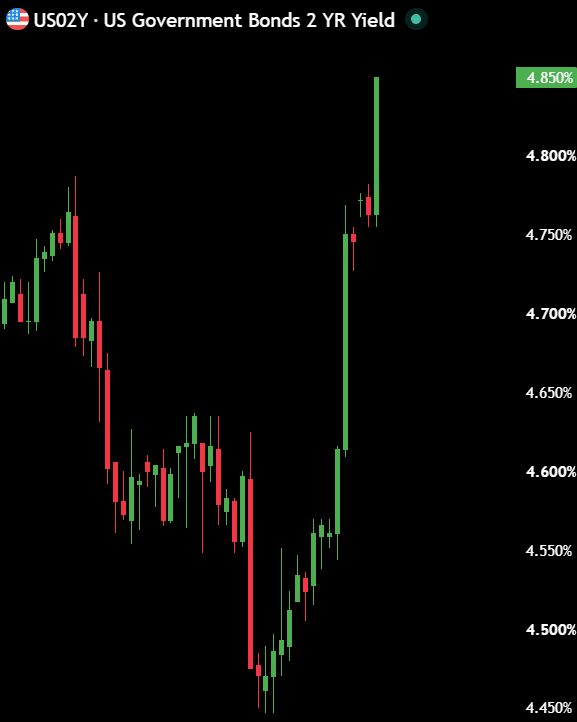
Insane pump in US bond yields.
US 2Y yield just hit 4.85%, its highest level in 4 weeks.
It's now up 40 bps in last 4 trading days as rate hike odds are surging.