Now in @ChemicalScience: Our theoretical investigation, together with @TheBlanchardLab, of Baird-aromatic triplet state quenchers for self-healing fluorophores with up to 4x10^6 faster kISC than COT. https://t.co/eJI8ZakfAr
Key findings from hours-long spectral dynamics of a series of phenoxazine dyes, influenced by microsolvation @AvikPati@bitspilaniindia
https://t.co/2qb6O9e35M
Recovering true FRET efficiencies from smFRET investigations requires triplet state mitigation https://t.co/AItNfGYoJM
Grateful for the rigorous and tireless efforts from all authors of this work. Thankful to the Editor and Referees for helping us refine the take home messages!
Out today from the Blanchard lab! An important paper showing that the accuracy of smFRET measurements depends on excitation strength, and how to correct for these issues or bypass them with self-healing dyes. https://t.co/2dpO9NU5lE
@TheBlanchardLab address a decades-long problem in single-molecule fluorescence resonance energy transfer (smFRET). Researchers created “self-healing” fluorophores, paving the way for more accurate experiments.
https://t.co/ACL21VlMEq
Must-read work from @TheBlanchardLab in @naturemethods today!
#FRET efficiencies from commonly used fluorophores decrease at high illumination intensities, due to the accumulation of "dark" triplet states.
#open
https://t.co/DXYfWXLOMy
Continuing on the theme of dyes being tricksters! This paper is a must-read for those doing smFRET with cyanine dyes. @TheBlanchardLab shows how dye photophysics, specifically excursions to the triplet state, can confound smFRET measurements. And how to fix it.
A true privilege to be a part of such an inspired interdisciplinary team. CFTR Function, Pathology and Pharmacology at Single-Molecule Resolution: https://t.co/1ceVwDb0VF
From @TheBlanchardLab and @ChenLabRU out @Nature:
integrating #singlemolecule#FRET#ephys reveals how CFTR gating is regulated by NBD dimerization and ATP hydrolysis, and mechanistic insights into potentiators and disease mutations
https://t.co/dQLmidb3IZ
Happy to share our recent article in Nat. Commun.😊 Here we used femtosecond Raman spectroscopies to capture ultrafast motion in a unidirectional molecular car. @UEA_Chemistry@iitbbs#femtosecondRamanSpectroscopy
https://t.co/ZgSUSyCyYC
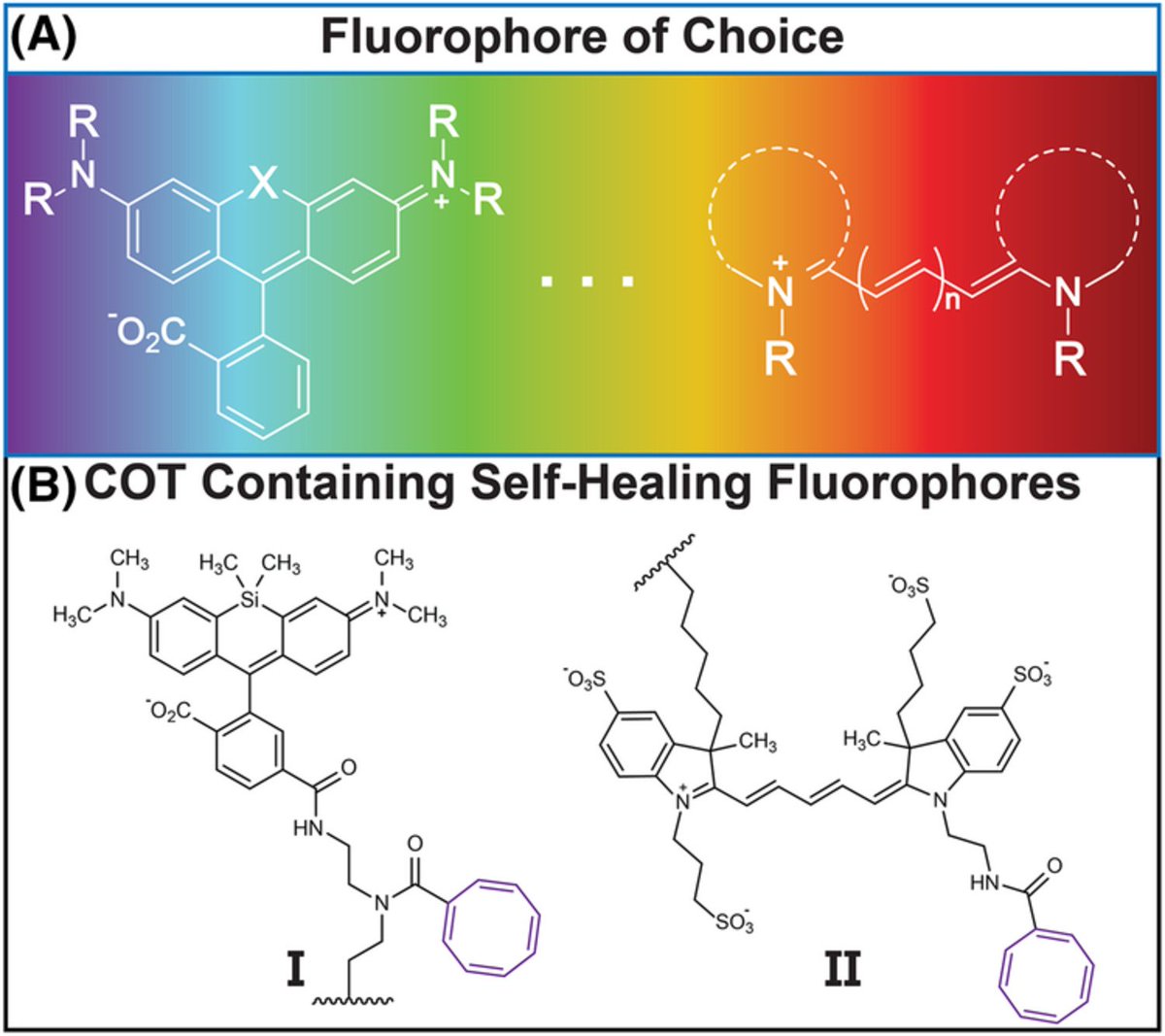
Today in the special ES(A)A issue of JPOC, a Perspective paper by Scott Blanchard and co-workers (@TheBlanchardLab) on the use of T1 state Baird-aromatic moieties to improve fluorophore performance in microscopy and imaging applications. https://t.co/nDPv9COjHt
The first set of snapshots of mRNA-tRNA translocation on the bacterial ribosome, animated to give a sense of the wonderous nature of this process. So much more to learn!
Available for download here: https://t.co/umz3pnq1jh
Animation By: Zhaowen Luo
An amazing group of extraordinarily talented and interdisciplinary scientists made this collaborative work possible! Congrats to everyone involved for their efforts to complete this remarkable achievement!
Now in @naturemethods: detecting and tracking GPCRs on the surface of live cells with smFRET. A long-standing collaboration between @TheBlanchardLab and the Javitch lab @ColumbiaPsych, congratulations to all!
https://t.co/VIfhniObkB
Check out the tour de force achievement of single-molecule FRET imaging of GPCR dimers in living cells out today from the Javitch lab and with @TheBlanchardLab. https://t.co/Xkl5dJZN0X and the accompanying N&V from @EmmanuelMargeat https://t.co/vAynulNEi0
Amazing how technology is pushing the boundaries of what we can see happening in living cells! smFRET is revealing new biology. (Yes twitter, I read this article before posting it).