Oxford researchers argue that LLMs can never invent anything.
It is mathematically impossible.
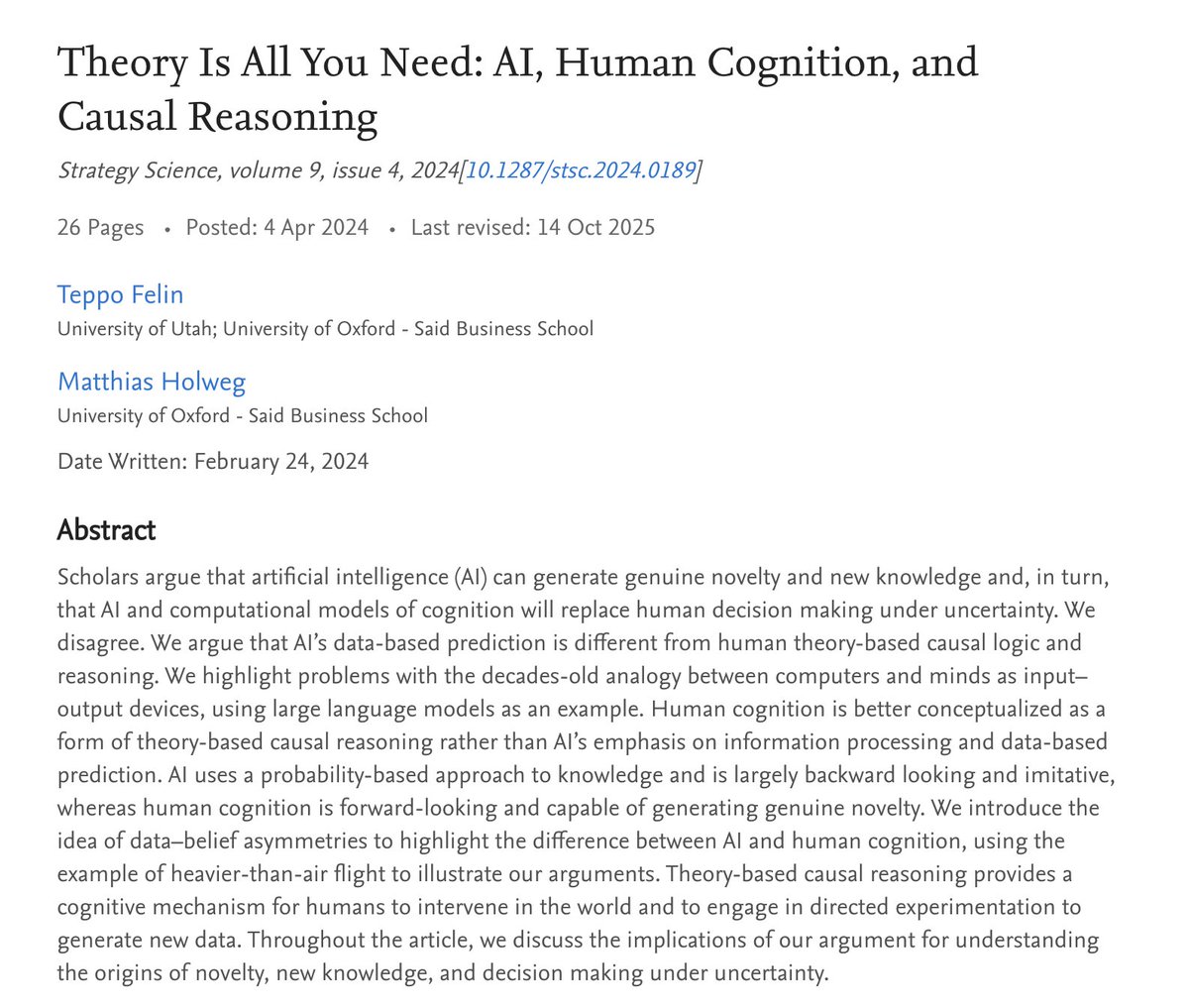
They published a paper called “Theory Is All You Need" and it argues against the claim that computational models can generate genuine novelty or new knowledge.
They analyzed the limits of generative ai, and the results are a brutal reality check for the idea that ai will replace human decision making under uncertainty.
Here is why AI is stuck and human cognition wins:
backward-looking vs forward-looking.. llms are probability machines that look backward at existing data. human cognition is forward-looking and capable of generating genuine novelty. human cognition operates theoretically "top-down" rather than "bottom-up" from data.
the "data-belief asymmetry".. the researchers use the invention of "heavier-than-air flight" to illustrate this concept. an ai relies on data-based prediction, which is largely imitative. humans, however, use theory-based causal logic that allows them to hold beliefs that go beyond existing data.
the intervention gap.. humans don't just process information; we use theory to practically "intervene" in the world. we engage in directed experimentation to generate entirely new data. ai-based models are theory-free and place primacy on existing data and prediction.
tldr?
AI uses a probability-based approach to knowledge and ia largely imitative. It can process data and make predictions, but human cognition relies on theory-based causal reasoning.
The decades-old analogy comparing human minds and computers to mere "input-output" devices is fundamentally flawed.
I have conducted an audit of Anthropic's finances.
What I have found is so shocking that I am calling for a Congressional investigation.
Anthropic is not just seeking regulatory capture.
It has built a regulatory capture machine that cannot be turned off.
Structural financial incentives make it impossible for Anthropic -- I call it the Anthropic Network -- to turn off its own AI doom cycle.
It starts with METR.
Dario Amodei proposes "third-party evaluators" to assess the risk of Anthropic's models.
He proposes METR for this purpose.
But METR is financially dependent on the Anthropic's success -- specifically, on the explosive growth of more than $7 billion dollars in Anthropic stock.
Dustin Moskovitz invested this stock into Good Ventures Foundation, where it represents the majority of that organization's portfolio.
And GVF is the overwhelming funder of the entire Anthropic Network ecosystem.
This stock was worth $500 million early last year.
It is worth more than $7.7 billion just ~16 months later.
METR -- and all of those building a career its parent organizations -- cannot afford to disrupt that growth.
Because if Anthropic goes under, many of the organizations that fund METR go under as well.
But if Anthropic succeeds, METR and its parent organizations become more richly financed to regulate AI -- something those at METR want very much.
The "third-party evaluator" is not "third-party" at all.
The evaluator is on Anthropic's payroll.
If this were the end of it, that's bad.
But that isn't all.
The same organizations that fund METR also fund the many organizations, such as the Tarbell Center, that promote AI Doom.
The Tarbell Center publishes AI Doom articles in The Verge, Science, LA Times, The Dispatch, TIME, and others.
They are selling the problem, and then selling the solution to the problem -- from the same money pile: Anthropic's.
All of these organizations are financially dependent on the same exploding $7 billion money pile.
As Anthropic grows more and more powerful, its AI Doom Machine grows better and better financed -- louder and louder.
Meanwhile, the regulatory regime seeded in METR grows larger to solve the increasingly loud -- now hysterical -- problem of AI Doom that the Anthropic Network itself created.
From this standpoint, as Anthropic becomes more powerful, AI might be getting scarier, sure -- but the positive feedback loop also becomes more deafening -- independent of objective facts.
This itself is an objective fact.
The deafening AI Doom is part of an business model, that, as it expands, so too does the AI Doom messaging -- there is simply more money to do it.
But the problem also goes in the other direction:
If Anthropic dies, the Regulatory Regime and the AI Doom Machine are crippled or die.
Neither METR nor Tarbell nor the other organizations in the Anthropic Network can allow that to happen.
Hence, neither METR or the AI Doom Machine can be trusted to provide independent assessments of Anthropic's models or AI more broadly.
They simply are not organizations independent of Anthropic.
And Anthropic cannot detach itself from METR or Tarbell or countless other safety orgs (not shown here), either, because they drive hype for the models and the possibility of eventual regulatory capture, and Anthropic will not give that up willingly.
What's more, the people at all of these organizations are all the same ecosystem, the same community. They just shuffle between organizations.
The Anthropic Network is therefore, so long as it is successful, locked into a self-amplifying feedback loop inside an ideological monoculture.
And that feedback loop is winning.
That's what Jacob Coxon is.
China is keeping messaging tight. That is why optimism for AI is so high in China.
America has Anthropic: a massive company pushing anti-AI propaganda at a state level.
Anthropic will either create hysteria until American AI slows down and China wins, or it will create fractures throughout American society with severe political consequences.
Ironically, because of the structural financial incentives underpinning the Anthropic Network, it has become the same kind of self-amplifying virus that it fantasizes AI to become in the future -- while hiding its tracks just as carefully.
It is the mirror of the same AI virus that it hypothesizes to consume America.
Anthropic's business model, models itself after the very thing it claims to fear.
Except Anthropic's ideology infects humans, not computers.
Congress must investigate.
Evidence and Github in next post.
Then some supplementary figures.
Anthropic’s new threat report is absolutely insane.
They claim:
-Alibaba extracted 151M+ Claude exchanges to help train Qwen
-Kimi secretly routed some users to Claude without them knowing
-DeepSeek apparently did the same
-A weapons group used multiple Claude instances as an engineering team, test-fired a guided rocket, FAILED, then went back to Claude to figure out what went wrong
What the fuck did I just read 😭
A recent Princeton study analyzed over 20 years of voting and polling data and found that American voters have a "near-zero, statistically insignificant impact on public policy."
So, if the US government doesn't represent the People, the obvious question becomes, "Does a political solution remain? Can we vote our way out of this, or is it too late already?"
Join me as I seek to answer that question: https://t.co/N2Gykx0d61
Laura Bicker, BBC China correspondent, on the disaster at Gyirong Port on the Nepal–Xizang border: “Shocking footage isn’t being shown in China – and we know little about victims there.”
Numerous people in China have pointed out that the footage is, in fact, all over Chinese platforms; indeed, the very video in the BBC’s own report was released by the Chinese port authorities. So the sequence is: 1) the Chinese state published the clip; 2) the BBC ran the clip; 3) the BBC published a story about how the Chinese state is suppressing the clip.
@AndyBxxx has made another point worth noting: Chinese media doesn’t operate on the basis of “if it bleeds, it leads”. You won’t see grieving relatives and footage of bodies looped for 24 hours. The BBC treats the absence of disaster pornography as evidence of a cover-up rather than a different (and frankly much better) editorial culture.
The article concedes that Beijing has launched “a massive rescue operation involving hundreds of emergency workers”. Even the International Campaign for Tibet, an NED-sponsored Washington-based lobby group, is recorded here “praising the work of first responders”. Xi Jinping personally chaired an emergency meeting to coordinate it. Chinese media has provided “daily updates on the missing and the dead”, plus updates on the rescue operation and on the barrier lake at risk of overflowing. It has shown rescue teams scaling mountains and cliff faces and crossing raging rivers.
Premier Li Qiang was “quickly dispatched to the region” – a level of responsiveness from the top leadership that those of us in the West can only dream of. Compare for example the US response to Hurricane Katrina, or the British government’s response to the Grenfell disaster. From all of that, the article arrives at the phrase “muted response” 🤷🏽
The BBC reports that local CPC members have been asked to step up and help with relief efforts, and provide “emotional guidance or psychological support to affected residents”. This is predictably framed as an operation to “stem any signs of discontent”.
Our intrepid reporter finally reveals her motive with a single clause: “Tibet, which Beijing annexed in the 1950s”. A-ha. It turns out this is a story about British state media, not Chinese state media.
Tibet has been part of China since the 13th century. Taking advantage of the chaos of the collapse of the Qing dynasty, the British invaded Tibet in 1904, at which point they came up with the formula of recognising Chinese “suzerainty” over Tibet while asserting that the region was “independent in internal administration” – which de facto meant that the British could do whatever they wanted there. Incidentally, Britain didn’t abandon that formula until 2008, when it finally recognised China’s sovereignty over the region.
If the BBC is going to insist on a formulation of “Tibet, which Beijing annexed”, it should, for the sake of consistency, also refer to “Cornwall, which London annexed”, since this took place around the same time as Tibet’s absorption into the Yuan Dynasty.
The article goes on to repeat tired tropes about “the Chinese government oppressing and persecuting Tibetans”, albeit without going into the nature of this oppression, which includes raising literacy levels from 5 percent to 98 percent; 15 years’ publicly funded education; the highest per capita central government transfers in China; the elimination of absolute poverty; the provision of modern infrastructure, health care and social services; and impressive efforts to protect and promote Tibetan language and culture.
What doesn’t get a single mention is the cause of the disaster. This was a flash flood in the fastest-warming mountain range on earth, in a region where glacial lakes are multiplying and bursting. There is a genuine story here about climate change coming for the Himalayas and the hundreds of millions who depend on their rivers, but the BBC instead chooses to run with the usual anti-China rubbish.
Solidarity with the people of China and Nepal affected by this disaster, and with everyone working to save them. And shame on a state broadcaster that chooses slander over solidarity.
Because once you buy a few houses and 20 cars and several yachts there is not much more you can do in China with millions or billions of dollars. Schools are cheap and you can't buy your children's way into it because they have to pass Gaokao. You can't buy political power like in the West. And, of course, as soon as you become exceptionally rich, you come under the scrutiny of authorities. Most people in China do not pay all their taxes, especially the billionaires.
So, since you can't fully buy political protection and are now under high scrutiny, you want to diversify outside of China, buy your children a college degree (sure, it's $100K/year and not worth it, but money is no object to you, and no Gaokao is required). And you might need to run somewhere from the authorities if shit hits the fan.
Of course you'll say you are being politically persecuted by the CCP and the Americans will swallow it hook, line and sinker.
Many such cases.
von der Leyen stated that China controls critical parts of the EU’s supply chains, and that if dialogue cannot reduce Europe’s dependence on China, the EU must be ready to use all available instruments.
Translation:
We want to use threats to force a dialogue with China.
But dialogue requires leverage.
What exactly does the EU have?
Military power? Dependent on the United States.
Energy security? Vulnerable.
Manufacturing depth? Eroding.
Critical minerals? Dependent on China.
Technology? Increasingly squeezed between American platforms and Chinese industrial scale.
Geopolitical autonomy? Mostly rhetorical.
No empire’s power. All of an empire’s habits.
Brussels spends one day lecturing Washington,
the next day lecturing Beijing,
then acts shocked when both stop taking the sermon seriously.
The EU wants American security, Chinese supply chains, global regulatory authority, and strategic autonomy at the same time.
And when Washington pressures it or Beijing retaliates, Brussels immediately rediscovers the language of “coercion” and “bullying.”
You cannot spend years provoking both poles of the system and then cry because neither treats you like a third superpower.
The EU has the tone of an empire and the bargaining power of a client.
Europe’s problem is not that China and America bully it.
Europe’s problem is that it still speaks like a power center after becoming a dependency center.
What China just did with the blocking statutes against U.S. extraterritorial sanctions sets quite a major precedent, probably the financial equivalent of what happened with rare earths last year (in the sense that this is China taking a major step to push back against a U.S. hostile measure as opposed to taking it on the chin).
It's a little complex but, to start with, what many people ignore (and will probably be surprised by) is that - by and large - Chinese companies and financial institutions have largely complied with extraterritorial U.S. sanctions.
Anecdotal story on this: I know for a fact, because I personally know the person, that a very famous guy (whose name I won't reveal but that everyone of you would know) sanctioned by the U.S. was in China recently and tried to exchange money at the counter of a random Chinese bank. Just simply exchange dollars for a Chinese yuan, in mainland China. And he was refused, because he is sanctioned by the U.S. - despite the fact that China as a country has absolutely no problem with the person.
This goes to illustrate just how much goodwill China extended to the U.S. on this - a Chinese bank, in China, refusing to serve someone China has no problem with, just to comply with U.S. extraterritorial sanctions.
It also goes to illustrate why this blocking order marks such a sharp departure.
What triggered it is not new sanctions by the U.S. but recent efforts under the so-called "Operation Economic Fury" to dramatically ramp up enforcement of existing sanctions on Iran.
The U.S. notably issued at the end of April alerts to financial institutions worldwide - including in China - on "the sanctions risks associated with independent 'teapot' oil refineries in China, primarily in Shandong Province, given their continued role in importing and refining Iranian crude oil" (https://t.co/LkHFCKdY5c)
Even more importantly, they also specifically went after Hengli Petrochemical Dalian (https://t.co/y2iGTbiu7R), one of China's largest private refineries, with 400,000 barrels per day capacity and a parent company (the Hengli Group) that's a Fortune Global 500 company.
In effect, what the U.S. extraterritorial sanctions mean is that Hengli - and all other Chinese 'teapot' oil refineries being targeted - is cut off from the dollar system, and any bank, insurer, or trading partner anywhere in the world - including in China - that deals with them risks being cut off too. Which is obviously a major hostile move by the U.S. against China (and, of course, Iran).
Except that China, this time around, is not having it.
Since 2021 they've had regulations ("Measures to prevent the improper extraterritorial application of foreign laws and measures", https://t.co/ENBSJBVor1) that gives the Chinese government power to formally prohibit compliance with foreign sanctions, and that, since this April (https://t.co/82yw0izC6z) are also extraterritorial in nature.
In effect what these regulations - and their April addendum - say is that if you comply with U.S. extraterritorial sanctions by cutting off a Chinese company, you are violating Chinese law. Any entity - Chinese or foreign - that refuses to deal with a sanctioned Chinese company because Washington told them to can be sued in Chinese courts, fined by MOFCOM, and since April, placed on a 'Malicious Entity List' with asset freezes and trade restrictions.
In a nutshell on one side you have the U.S. saying "cut them off or we cut you off" and now China says "well, if you do cut us off we're going to be real nasty with you, in China and potentially beyond."
These regulations were - until yesterday - purely theoretical: they've never actually been applied. But, yesterday, China's MOFCOM made it crystal clear this time is different: they used a statement with a triple negative, saying the U.S. sanctions "shall not be recognized, shall not be enforced, shall not be complied with" ("不得承认、不得执行、不得遵守", https://t.co/3NlBy7I1jL).
In effect you now have companies that are in the middle of this - for instance financial institutions serving Hengli - caught in quite a bind: face U.S. or Chinese hostility. It's a no-win, they need to choose a camp on this.
Concretely speaking, given that the overwhelming majority of companies affected are operating inside China, they'll obviously choose the China side.
The real question therefore is: Is the U.S. ready to act on its threat and cut off Chinese banks or other institutions that keep servicing these refineries?
Because that probably means sanctioning major Chinese financial institutions, which is a whole different level of escalation. The moment the U.S. designates a major Chinese bank for dealing with Hengli, this stops being about Iranian oil and becomes a direct financial confrontation between the two largest economies on earth, which is a much bigger deal with probable consequences for the entire global financial system.
Or will the U.S. back off, meaning China would have effectively caught their bluff, showing that extraterritorial sanctions are a lot of bark but not a lot of bite?
We'll know in the next couple of weeks I guess.
One thing is sure though: whatever happens with these refineries, the broader damage is done. China used to extend remarkable goodwill on sanctions compliance - voluntarily cooperating with extraterritorial sanctions inside its own borders even though it had no legal obligation to respect them. That goodwill has been spent.
And, from a U.S. standpoint, a China with less goodwill vis a vis U.S. financial hegemony is undoubtedly a far bigger issue than a few teapot refineries buying Iranian oil.
A serious infringement on our liberty being snuck thru to give ASIO powers to pick you up and interrogate you for 24 hours on suspicion of.. what? hate speech? Planning to protest US military presence?
And who decides what ‘promotion of communal violence’ is? Not a judge. A politician.
Don’t forget - 300K of us were accused of exactly that when we marched across the harbour bridge. A peaceful march against the slaughter of children caused a terror attack at Bondi. And the PM was to blame because he had not introduced repressive measures.
The timing dovetailing nicely with upcoming anti AUKUS, anti war, anti US base protests likely upcoming.
Senator slams the dirty deal to supersize the security state!
Senator David Shoebridge's powerful speech on ASIO Bill No. 2 deserves to be seen in full.
ASIO's secret police powers to interrogate innocent Australians under the threat of prison terms are now broader than ever.
You're a year too late.
ASIO Amendment (No. 2) Bill 2025 passed the House of Representatives in July 2025, with full bipartisan support, allowing detention and interrogation without judicial warrants, with severely constrained access to legal representation, and without the right to refuse to answer questions. Questioning warrants require a person to appear and answer questions for up to seven days, and restrict the person's ability to alert others to ASIO's interest. Refusing to answer is a crime carrying up to five years imprisonment, and disclosing to a third party that you were detained is also an offence.
The implications are significant and worth taking seriously, because most of them operate well below what ordinary Australians would think of as normal legal protections. Let me break them down clearly.
You don't have to be a suspect. This is the foundational shift. Under the ASIO Act, individuals subjected to compulsory questioning need not be suspected of any crime, which effectively means ASIO can pull someone in as part of a fishing expedition. The person summoned could be a friend or family member of someone ASIO is interested in, an academic, a journalist, or an innocent bystander. One framing that has been used: if you overheard a conversation on a bus that could assist ASIO's investigations, you could find yourself the subject of a warrant.
Your lawyer is there in name only. A lawyer can be present, but they are largely gagged. They cannot interrupt, cannot properly advise you on your rights during questioning, and ASIO can remove them entirely if they decide the lawyer is a security risk. Any notes the lawyer takes are confiscated before they leave.
You cannot tell anyone. The entire process can remain secret for years. You cannot tell your family, your employer, or anyone else that you have been detained and questioned. This applies even after the fact. The isolation is total and enforceable.
Silence is a crime. If you decline to answer, you face criminal penalties. Refusing is not a protected right here the way it would be in an ordinary police investigation.
Children are included. The legislation allows ASIO to detain and question individuals as young as 14 who are not suspected of any crime.
The scope has expanded. The bill extends these powers beyond terrorism and espionage to cover all seven of ASIO's security heads, including sabotage, promotion of communal violence, attacks on Australia's defence system, and threats to territorial and border integrity. That last category in particular is broad enough to raise serious questions about how it could be applied to protest activity, civil disobedience, or political speech that touches on sensitive topics.
The "temporary emergency measure" fiction is now gone. The Law Council's point is worth registering plainly: the passage of time alone should not convert an extraordinary power into an ordinary one. These powers were introduced post-9/11 with a sunset clause precisely because parliament acknowledged they were exceptional. Removing the sunset clause makes them a permanent feature of Australian law, with no further democratic pressure to justify their continuation.
The political homelessness of the civil liberties argument. Labor now governs as though state authority is a moral instrument requiring only the right intentions to justify its expansion. The Coalition offered enthusiastic bipartisan support on national security grounds. The Greens have opposed the bill, but their credibility on civil liberties is complicated by their enthusiasm for clamping down on online free speech. There is nowhere in the major party structure for this concern to land.
The practical reality for an ordinary Australian is that you now live in a legal environment where an agency of the executive, acting under a warrant approved by a politician rather than a judge, can compel you to attend questioning, compel you to answer, constrain your legal representation, forbid you from telling anyone, and imprison you for silence. None of this requires you to have done anything wrong, or even to be suspected of doing anything wrong. That is a qualitative shift in the relationship between the state and the individual, not a marginal adjustment to counter-terrorism law.
This is wild.
In every single one of these countries, China is now viewed more favourably than the US. It represents a shift in favourability in *all* cases.
This is exactly why Anthropic pisses me off.
You can keep saying the watermark doesn’t change ownership, doesn’t identify the user, doesn’t affect quality, doesn’t add hidden characters, and won’t look any different to readers. Fine. But that is not the whole issue. The issue is that you are still marking work that a human being may have thought through, structured, argued, and emotionally meant, just because AI helped process it.
AI assistance is not authorship. If I wrote the idea, the argument, the meaning, the emotional core, and the final judgment, then it is my work. If Claude helped translate it, polish a sentence, or make it clearer, that does not suddenly make Claude the author. But a watermark absolutely changes how people perceive authorship. People are not going to say, “Claude may have been involved in processing this text.” They are going to say, “AI wrote this.”
And honestly, who the hell are you to do that to my writing? Who gave you the right to stamp your model’s involvement onto work that came from my thoughts, my experience, my voice, and my judgment? You can say it does not change ownership all you want, but socially, reputationally, and creatively, it absolutely changes how the work is read.
So fine. Do whatever you want. Build your watermarking system. Follow whatever framework you want. I’m not using Claude. Good luck.
OpenAI is falling apart right now.
9 of their most important leaders have left the company recently, and Altman is about to ask the public to buy the stock.
2 of them even walked out within 72 hours of OpenAI handing its own staff $7 billion in cash...
On Monday, August 10, OpenAI completed a deal letting current and former employees sell roughly $7 billion worth of their shares. The price valued the company at $852 billion, the exact same number as its March funding round.
On Tuesday, August 11, Brad Lightcap announced he was leaving after 8 years. He spent 4 of them as chief financial officer, then ran the company as chief operating officer from 2022 until April. He worked alongside Sam Altman at Y Combinator before OpenAI existed.
On Thursday, August 13, chief revenue officer Denise Dresser announced she was leaving. She was hired in December from Salesforce, where she had been the CEO of Slack. In April she took over most of Lightcap's responsibilities. She lasted 8 months.
The cash window opened Monday. By Thursday both executives who ran the business side were gone.
But what's interesting is who actually wrote the $7 billion cheque:
Every previous time OpenAI let its employees cash out, an outside investor bought the shares. In October, Thrive Capital, SoftBank and others put up $6.6 billion at a valuation near $500 billion. There was a $1.5 billion version of the same deal in 2024.
This time OpenAI bought the shares back itself, using its OWN money.
So no outside investor put a single dollar behind that $852 billion price. The company named its own number and then paid it.
This is a business generating around $2 billion a month while losing roughly $1.22 for every single dollar it earns.
And it just spent $7 billion of that cash buying its own stock at a number no third party ever tested.
Here is the full list of the people who left since April:
- Bill Peebles, who ran the Sora video app
- Kevin Weil, vice president of OpenAI for Science
- Srinivas Narayanan, technology chief of B2B applications
- Kate Rouch, chief marketing officer
- Josh Achiam, chief futurist, after nearly nine years
- Johannes Heidecke, head of Safety Systems
- Chloe Bakalar, the only person at OpenAI whose entire job was ethics
- Brad Lightcap
- Denise Dresser
Bakalar left in July. OpenAI never announced it, and NOBODY has replaced her.
Fidji Simo stepped down the same month, and two thirds of the organization had been reporting to her.
Greg Brockman absorbed most of her job. He also introduced Dresser's replacement this week, a Wiz executive named Dali Rajic.
OpenAI filed its IPO paperwork confidentially on June 8. The full prospectus, the one with audited financials in it, still has not appeared.
So the order of operations is worth sitting with...
File the paperwork in June. Buy your insiders out in August at a price you set yourself. Watch the people who built the commercial side leave that same week. Then show the public the books.
Retail investors will see those numbers for the first time in a document written after every one of these people had already made their decision.
Sam Altman told staff in June that he expects to go public within the next year. Reporting since then has pointed at 2027 instead, and a tender offer of this size is usually what a company does when the listing is not close.
Here is what I think happens next:
That prospectus lands with a revenue line big enough to carry the story, and the executive turnover gets buried in the risk factors where almost nobody reads. The people who priced OpenAI at $852 billion this month were the same people who took the money out of it; and the next set of buyers will not get that arrangement.
Anthropic has the best geniuses, no doubt. But they also have the most egocentric “I’m the intelligent god, and you unsafe idiots must obey AND pay me. I want to make trillions, but I’m smart enough to brainwash you into believing it’s about safety, not monopoly” mindset. People tolerate it anyway because Claude is so good, but obviously, they’ll leave the moment there’s a better alternative.
I cannot remember the United States ever apologising for "overcapacity" when it was the world's leading industrial power. Should Italy apologise for its overcapacity in fashion, France for its overcapacity in wine, the UK for its overcapacity in financial services, or Belgium for its overcapacity in chocolate?
*** The real challenge of our time is that centuries of Western dominance have come to an end, and there is a need to adjust to a multipolar world.