The future of Street View looks like this 😍
Basically City-scale 3D Gaussian Splatting. Thanks to a hierarchical level of detail (LOD) approach, you get real-time rendering of massive scenes at 30+ FPS!
But capturing city scale at street level is SUPER messy, with people, cars, and pets (!) moving everywhere - resulting in reconstruction artifacts.
In this paper, these 'movers' were detected and removed in a pre-processing step using Mask R-CNN and checking against the SfM point cloud. Vehicle license plates were also detected and masked out.
Not only is this CNN segmentation step useful to eliminate movers — it is crucial for privacy and aesthetic reasons too! All the stuff you need to ship this stuff commercially.
Sunday rant.
For software engineering, my sense is that the phrase “premature optimization is the root of all evil” has massively backfired. Its from a book on data structures and mainly tried to dissuade people from prematurely write things in assembler. But the point was to free you up to think harder about the data structures to use, not leave things comically inefficient. This context is always skipped when it’s uttered.
Not all fast software is world-class, but all world-class software is fast. Performance is _the_ killer feature.
If you are in engineering, here is a fantastic anecdote. I refer to this account often. It’s a bit subtile, but the implications are massive-
It’s an account of how SQLite became 50% faster, not by doing one specific thing but hundreds of small ones.
SQLite is everywhere today because of this work.
https://t.co/krLFFps2up
We need the engineers in all companies fight for this more. Product leads are not the right owners of the end performance of the software. This needs to be encoded in the professional pride of the software engineering discipline. Leaders in companies need to encourage it and hold engineering accountable. It’s simply not ok to fritter away the performance of the products for random reasons.
Every user of your products cares exactly as much about latency as engineers do when typing in their terminal. They just don’t have the words to describe what they don’t like about the experience and neither should they.
🗺️🚀 Big news! @openstreetmap will be embracing vector tiles in 2024, transforming the map experience with dynamic, up-to-date data. #OSM#VectorMaps2024
https://t.co/3Az72EjIuH
Zuckerberg's Meta Is Spending Billions to Buy 350,000 Nvidia H100 GPUs
Mark Zuckerberg plans on acquiring 350,000 Nvidia H100 GPUs to help Meta build a next-generation AI that possesses human-like intelligence. The 350,000 number is staggering, and it’ll also cost Meta a small fortune to acquire. Each H100 can cost around $30,000, meaning Zuckerberg’s company needs to pay an estimated $10.5 billion just to buy the computing power, not to mention paying all the electricity costs.
https://t.co/EpSTlMGmne
This actually happened to Evernote. They took the advice of “keep talking to your customers and ship whatever they want” as the only guiding principle for product development. And what ended up happening was paying users liked it, but the product become unintuitive and feature overload for the new user. To the extent that they had to rebuild a version for the new user.
Users don’t always know if they really want something. It’s your job to take the extra step to think on their behalf: whether they really need this. Or can what they ask be done through something much simpler. Or can you solve multiple problems of different users with one new redesign rather than a bunch of changes. The right principle is: “Keep talking and listening to your users, spend the additional time thinking on their behalf what they actually want, and ship that”.
Update: We've released our initial open map datasets.
The milestone release includes Places of Interest, Buildings, Transportation Network, and Administrative Boundaries layers, establishing a baseline for our future work on open map data.
Learn more:https://t.co/4XQGDD8OMz
Google Open Buildings dataset v3 now covers even more continents:
https://t.co/0j4RVGADB7
1.8B building detections in Africa, Latin America, Caribbean, South Asia and Southeast Asia.
It’s a big week! We’ve raised $1.3 billion and are building the world’s largest AI cluster (22k H100s).
We’re grateful for our investors and new funding that will help us accelerate our mission to make personal AI available to every person in the world. https://t.co/l2MPlhgqVl
This is huge for two reasons 🙌
🌍 It's a mega new dataset in the 3D Tiles format that's publicly accessible
🔓 Google have relaxed their terms to allow usage within other renderers
The second is most surprising and I'm curious if this applies to their other Maps APIs now…
Big day for the Web: Chrome just shipped WebGPU without flags. Someone on @nomic_ai's GPT4All discord asked me to ELI5 what this means, so I'm going to cross-post it here—it's more important than you'd think for both visualization and ML people. (thread)
https://t.co/nSoL75Qtf7
Searching for high-resolution data to study buildings? 🏠
@flxwagner & I have compiled everything we could find in Europe for you!
Just published in @ScientificData: https://t.co/xhqkmRaEqg
Explore and download the EUBUCCO v0.1 dataset on https://t.co/uhjBBp99kt
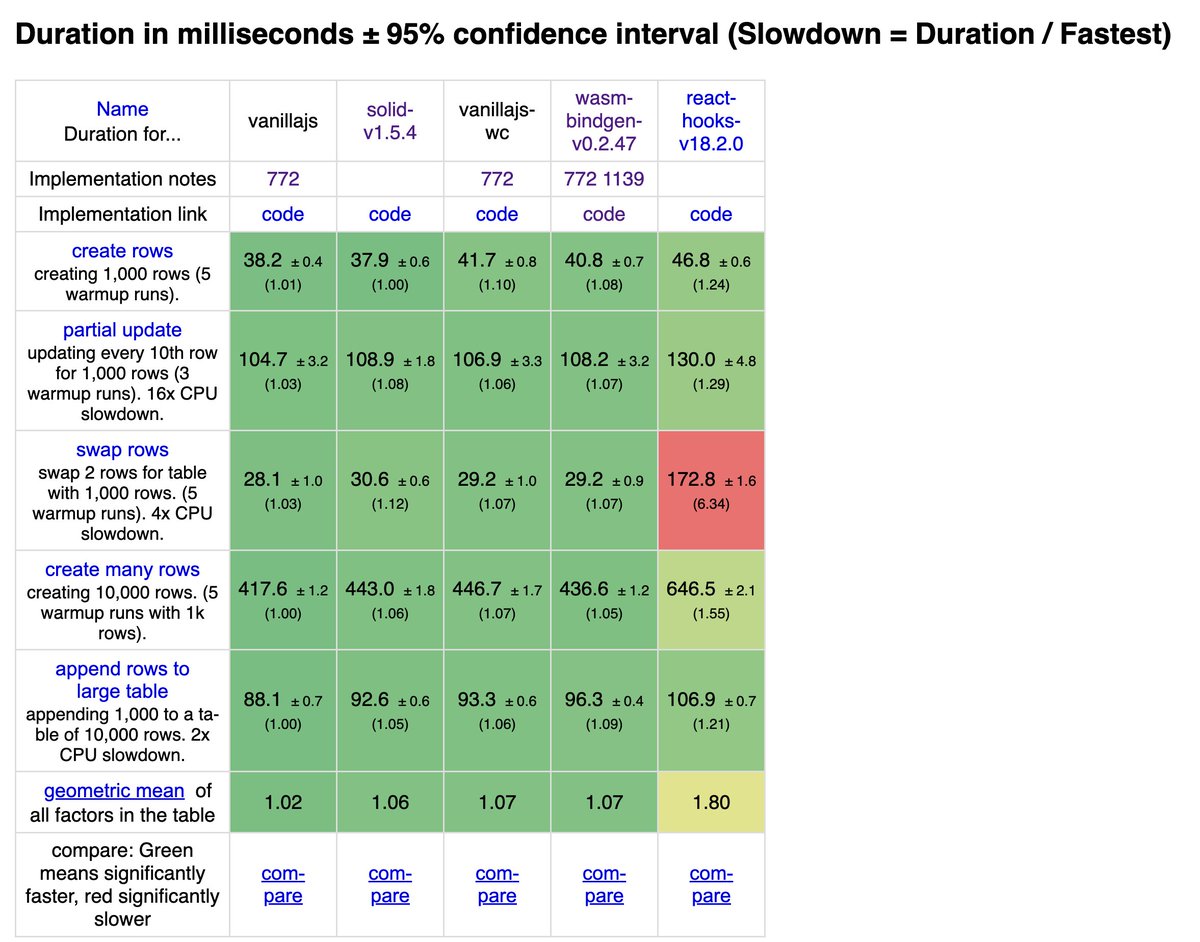
Interesting find of the day: DOM manipulations from Wasm are only ~7% slower than JS. V8 has really invested into making those JS<->Wasm calls fast.
(`wasm-bindgen` is effectively importing DOM API functions and invoking them from Rust, doing string copying/transcoding, etc.)
Hi everyone! I have COMTiles (Cloud Optimized Map Tiles) hosted on Amazon S3 and visualized with MapLibre GL JS. 🗺️
Please check it out!
https://t.co/r1LutuydXg
#foss4g#AWScommunity#MapLibre#CloudOptimized
Very exciting updates in the world of #Landsat: the "Landsat Next" mission will have:
- Not two but three satellites! 🛰️🛰️🛰️
- ~6 day revisit time! ⏱️
- "Superspectral resolution" - 26 bands! 🌈
- Up to 10 metre resolution! 🔍
- Still include thermal IR! 🔥
Coming soon in 2030!
If you are enthusiastic about maps and would like to work with a global open-source community of really nice people, MapLibre might be the opportunity for you! We are hiring. Apply now at https://t.co/4vZ6WgQwea
#opensource#jobs#gischat
30 years ago we invented personal in-car navigation.
Now, the time has come to transform how maps are made.
Introducing the TomTom Maps Platform, the foundation for the smartest maps on the planet... https://t.co/ke4XFD44Cc
Today we’re sharing some of our latest progress on AI-powered hypercompression of audio. Our researchers achieved ~10x compression rate vs. MP3 at 64 kbps with no quality loss — the first time this has been done with 48 kHz sampled stereo audio ➡️ https://t.co/wEncd6rAbP
1/5