If you happen to be in Taipei in early November, we're holding a conference on the psycholinguistics and neurolinguistics of under-researched languages of Taiwan and around!
Confs: 2025 Conference on the Mosaic of East Asian Language Processing: This international event brings together researchers interested in how the under-represented languages of East and Southeast Asia—such as Formosan, Philippine, Hakka, Ryukyuan, and… https://t.co/XhNuBefLC0
The informal poll results are in, & as I feared, most people are running ANOVAs in #R with functions that can give highly misleading (or flat out wrong) results. Follow along to see why using anova() and aov() is usually inadvisable & why you should be using car::Anova() 🧵
By measuring the brain’s electrical signals, the Cognition and Brain Lab explores how the brain links sensory information to meaning and memory.
⚡️🧠🤔
Learn more from lab leader Kara Federmeier ▶️ https://t.co/TMwgXbYvTo
@PsychIllinois 🔶🔷
Calls: The 5th International Conference on Theoretical East Asian Psycholinguistics: 2nd Call for Papers: ICTEAP-5 will feature both oral and poster sessions. The abstract submission form allows you to specify whether you would prefer an oral or poster… https://t.co/cXAZphWIx6
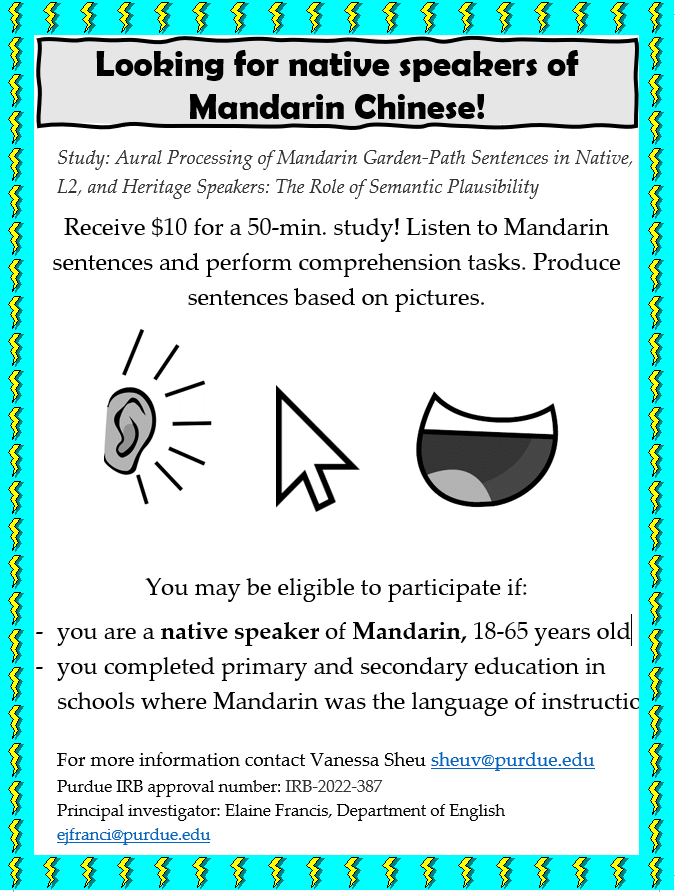
Looking for advanced L1 English L2 #Mandarin speakers for online dissertation research! $15/80 min.
The experiment involves computer-based tasks and takes place over Zoom. Participants are compensated via an major electronic payment app of their choice
https://t.co/5oTqXiasjT
Our editorial on a critical reassessment of syntax, the brain, and linguistic theory: https://t.co/U6P13AkSfD
w/@ManciniSim@e_zaccarella@jixingli
A great collection of articles - thanks to all who participated!
@fernandaedi @glossapsycholx I also must thank all the team of Glossa Psycholinguistics — supportive editors, reviewers with genuinely helpful comments, the whole process has been so pleasant and joyful!
I am so happy to have this manuscript published in @glossapsycholx !
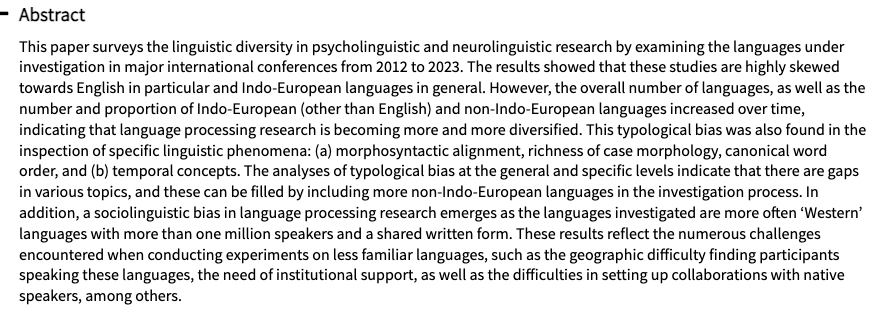
I still remember myself looking at all these posters at AMLaP or HSP, wondering which languages were represented and what this may (or may not) reflect. This curiosity resulted in a manuscript!
We are proud to announce the latest article published in @glossapsycholx:
“A decade of language processing research: Which place for linguistic diversity”, by @AymericCollart: https://t.co/Os10FaN6t6
Anything you’d like to share about languages and Taiwan, and you’d like to visit Academia Sinica for a great conference about a wide range of many other topics as well? Here’s your opportunity!
Calls: The 5th World Congress of Taiwan Studies: Call for Papers and Panels: WCTS-5 – 2025 The 5th World Congress of Taiwan Studies (WCTS-5) will be held at Academia Sinica in Taipei, Taiwan, May 23-25, 2025. The general theme of the WCTS-5 is Taiwan in… https://t.co/e4YxFVAN75
Today, I’ve experienced the best of #openscience. When your computer suddenly crashes and refuses to work, all your old datasets and R codes are still stored somewhere.
I am thrilled to see this work come to life!
In the book, I combine interviews with former genocide perpetrators with cutting-edge neuroscience research to delve deeper into the roots of harmful obedience.
#Obedience#Psychology#Neuroscience#genocide#academia#wars#rescuers
On the top of that, add gradient acceptability ratings and individual differences, and you obtain a construction getting more and more mysterious and fascinating!
📣 New article in Journal of Psycholinguistic Research!
It's all about Taiwan Mandarin, comprehension of time reference with the auxiliary verbs 'you' (have) and 'hui' (I dare you to translate it!), and acceptability judgments.
https://t.co/XFpQfJMhTy
BUT digging into the acceptability ratings actually revealed other patterns... yes, 'you' can be acceptable with future time adverbs depending on the meaning of the verb!