solana:DXrrBJMjK3xAV7YvuWAg42aeJHck3GmJmcN78HfDpump
been watching this one and actually playing it
pixel MMORPG right in your browser. no download, just open it and go.
what i like so far:
→ the game actually works. smooth, no jank
→ dev is active af. people report bugs, dev ships fixes fast
→ autopilot runs your character for you, so you can grind while doing other stuff
→ full MMO loop: classes, guilds, parties, pets, bosses, player market. feels like the games we grew up on
→ discord is active, people are in there talking strats and sharing builds
→ dev has been burning supply
→ price holding up well
honestly it's kinda fun lollll
https://t.co/eM1hHYYDjf
a tiny MMO in your browser. no download, PC or phone. pick a class, press AI and your adventurer hunts, loots and levels on its own, even after you close the tab.
three servers from day one: Asia, Europe and Americas. one account plays on all of them.
play now at https://t.co/VqADz8FHBQ
CME (Commodity Market Exchange) rugged its own users.
https://t.co/iZj4uPlsve
robinhood:0xe2324ff2a59f8ecba8c321c6466e59121c00e795 https://t.co/kVVbPl3uvu
every meme on CME is paired with a "commodity coin." Those coins sit on USDG peg pools. That's your exit. That's the only way out.
So here's what the deployer did.
Sep 25, 20:40–20:43 UTC. 62 peg pools. 3 minutes.
Every single one:
→ call withdraw()
→ pull ALL the USDG
→ toss $100 back in so the pool doesn't look dead
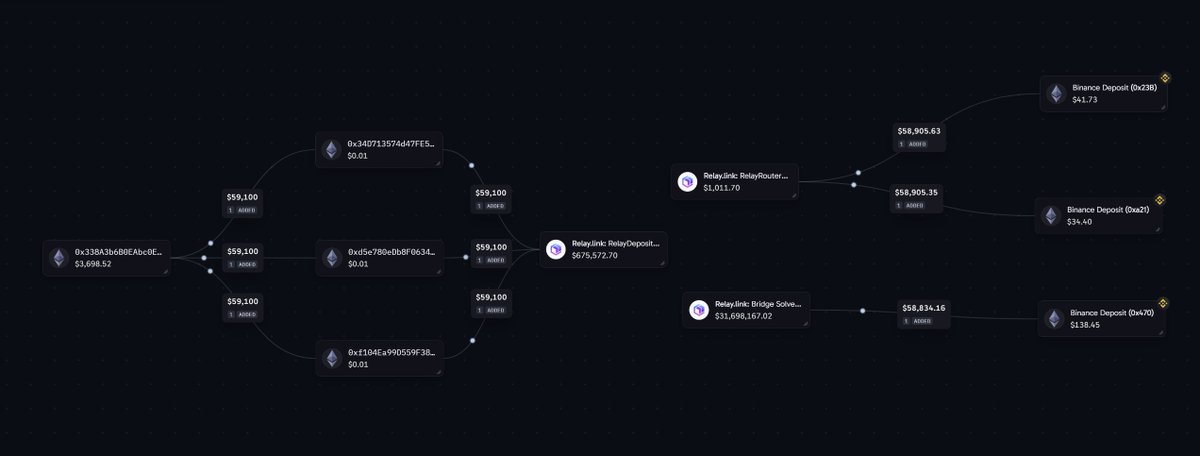
→ send the rest to 0x338A3b6B0EAbc0EfdD1AeA33e81E57C102158D8C (a wallet the deployer funded)
~184,240 USDG pulled
~6,200 put back
~178,040 USDG gone
Biggest hits:
1/ OSRS Gold (RSGP): 20,326 USDG
https://t.co/KUJBMzxyzk
2/ Milk (DC), aka the pool behind solana:3Zmci14Gi6nacGQn96DihGvFikxmCZ23A1bNEs6Gpump: 20,104 USDG
https://t.co/UVnDfrZdv6
3/ Copper (HG): 12,851 USDG
https://t.co/gDXzlrnX8V
Then, less than 15 min later, 3 fresh wallets each bridge exactly 59,100 USDG to BSC through Relay. 177,300 total. Comes out as ~176,645 USDT.
3 Binance deposit addresses.
0xa2197016fe0fc61cd8a656d38d593cb125b87295
0x470f6fc8965f987aa641121a70584a2d15a81a42
0x23b7f88c9e3ab3bfd9629efc83fd8c4715fa5365
Relay txs:
https://t.co/24a0YQLnPa
https://t.co/115VZdMT8e
https://t.co/N6WOCqeMqw
Oh and the deployer? Still online. Still pushing setPrices every few minutes. Still hasn't said a word.
0xB365f2602efA59B876B6dAC1cC5C040a67f95c82
These 3 deposit addresses received funds drained from CME's peg pools. Please review the accounts behind them and freeze the funds while this is investigated.
@binance@BinanceHelpDesk@heyibinance@cz_binance@BinanceResearch
When we analyzed $CME before, I was more inclined to view it as a Commodity Meme Launchpad on Robinhood Chain.
0xe2324ff2a59f8ecba8c321c6466e59121c00e795
But with the latest product updates, I think CME’s narrative has clearly upgraded, so let’s break it down further:CME now looks more like it is building:Real-world Assets → On-chain Quote Assets → Meme Markets → Trading → Fee Economy
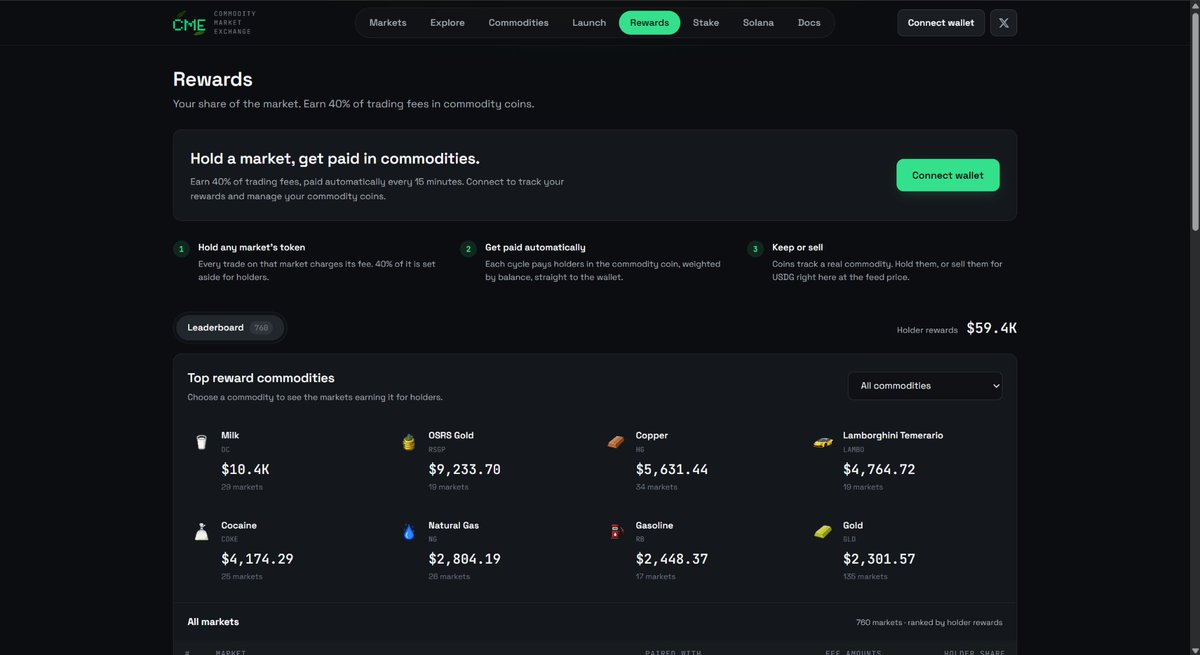
CME currently supports around 220 Commodities and 760 Markets, covering gold, oil, agricultural products, and also expanding into OSRS Gold, CS2 Skins, Pokémon Cards, cars, fast food, and more.
So what it is really trying to build may not just be Commodity markets, but:Anything with a price can become a market.
This is CME’s most important Narrative Upgrade.
A traditional Launchpad looks like:Meme → SOL / ETH / BNB
While CME is:Meme → Gold / Oil / OSRS Gold / CS2 Skin / Pokémon Card / Lambo...
More importantly, users holding Market Tokens can receive 40% of trading fees in Commodity Rewards.
So what CME is actually creating is:Meme → Commodity Exposure + Trading Fee Yield
This is also the biggest difference between CME and a traditional Meme Launchpad.
At the same time, CME’s product infrastructure is also being upgraded.
New Markets can now enter Uniswap V4 directly from the first trade, with the Bonding Curve running inside the Pool Hook, eliminating the traditional:Bonding Curve → Graduation → Migration → New Pool
Instead, it becomes:Launch → V4 Pool → Trading
This reduces the complexity of liquidity migration and early trading, while also making it easier for Terminals, Trading Bots, and other trading infrastructure to integrate.
CME’s Value Capture is also becoming clearer:Trading Fees → 40% Commodity Rewards → 30% CME Buyback → Burn / Staking → 30% Protocol
So far, around 7.4M CME has been burned, with cumulative buybacks of around 21.6 ETH.
This means CME now has three layers of flywheels:
Layer 1: Market Flywheel
More Commodities → More Markets → More Meme Categories → More Creators → More Markets
Layer 2: Trading Flywheel
More Markets → More Trading → More Fees → More Commodity Rewards → More Users → More Trading
Layer 3: CME Token Flywheel
Trading Volume → Protocol Fees → CME Buyback
→ Burn / Staking → Supply ↓ → CME Value Capture
Ultimately:More Assets → More Markets → More Trading → More Fees → More Rewards / Buyback → More Markets
I think there are several major Catalysts to watch next.
First is continued integration with Axiom, GMGN, and other Trading Terminals. If more trading entry points support CME, early liquidity and trading efficiency for new markets should improve.
Second is new asset categories.
OSRS, CS2, Pokémon, etc. are actually testing CME’s core concept:Anything with a price can become a Commodity.
If these non-traditional assets start generating real trading volume, CME’s Narrative could move further away from “Commodity Meme” and toward an Everything Market.
Third is continued growth in the number of Markets.
It is already approaching 760 Markets. If it eventually reaches:1,000 → 2,000 → 5,000
then CME will increasingly look like a real Market Factory.
But this is also CME’s biggest problem right now.
Market Count ↑ ≠ Revenue ↑
If the number of Markets keeps growing but most of them have little trading activity, then:Markets ↑
does not necessarily mean:Volume ↑ → Fees ↑ → Buyback ↑
CME currently has around 760 Markets, but only around $164K–$170K in 24h Volume, which means the key question now is not whether there are enough Markets, but:Can these Markets actually generate sustainable trading volume?
So my current view of CME has upgraded from:“A Commodity Meme Launchpad on Robinhood Chain”
to:“Market Infrastructure on Robinhood Chain that turns real-world price assets into On-chain Quote Assets.”
What makes CME interesting is not Gold, Oil, or any single Commodity.
It is:Real-world Price → On-chain Asset → Meme Market → Trading → Fee Economy
If this mechanism can eventually turn:220 Commodities + 760 Markets
into sustained growth in:Trading Volume + Protocol Revenue + CME Buyback / Burn
then CME’s Narrative could further upgrade from:
Commodity Meme Launchpad
to:Everything Market on Robinhood Chain
So the core data I’m watching now is simply:
Market Count → Trading Volume → Fees → Buyback / Burn
The number of Markets has already shown that CME can expand.
The next thing it needs to prove is whether it can turn those Markets into real trading volume.
Chart: https://t.co/RqlcRLCIkd
Computer use is now in Claude Code.
Claude can open your apps, click through your UI, and test what it built, right from the CLI.
Now in research preview on Pro and Max plans.