Economics is, at its core, a discipline of uncomfortable truths. It requires explicit comparison between feasible alternatives under real constraints, rather than reliance on idealized outcomes that reflect what is socially desirable or rhetorically appealing but often unattainable in practice.
Paul Ehrlich has died. He was 93.
He is survived by 8,300,678,394 people (134% increase from 1968), with a daily worldwide average calorie intake of 2,800 kcal (a 22% increase).
To most economists this is just obvious common sense. Good to see more evidence confirming it. The answer is just build more housing. Squeezing total supply in name of more “affordable housing” is just counterproductive.
Populists across the spectrum, left and right, hate economists. I joked its some puzzle but I think there's a simple reason. It's not about liking capitalism or something.
And the disagreement is almost always about how to reason about problems, not about values.
Populists want solutions. Economists offer trade-offs. I'm not the first to point this out but its a huge distinction.
A carbon tax doesn't solve climate change. It prices carbon so people make better decisions at the margin. To the populist, that sounds like accepting the problem.
Same with manufacturing. A tariff doesn't create jobs. It shifts them, from the millions of workers in industries that buy steel to the 160,000 who make it. To the populist, "protect American workers" sounds like a solution. To the economist, the question is: which American workers?
We can go down the list. Rent control intends to help renters. It produces housing shortages. The populist sees the economist opposing rent control and concludes: you don't care about poor people.
As Sowell put it: "The first lesson of economics is scarcity: there is never enough of anything to fully satisfy all those who want it. The first lesson of politics is to disregard the first lesson of economics."
I think, not surprising, the economists are right.
It's more than just two different approaches. Thinking in trade-offs forces you to trace each step: who actually bears the cost of a tariff, what happens to housing supply when you cap rents, how a carbon tax changes behavior at every margin.
You can't skip ahead to the answer. You have to follow the chain. This is why economists spend careers doing exactly this and still argue about the answers. That's what it looks like when you take the problems seriously.
The populist skips all of this based on some intuition pump. Think of the person on a group project who's so confident in the answer that they never bother learning the material. That's populist economic reasoning from inside the discipline. The confidence comes from not having looked at the trade-offs closely enough to see how hard they are.
Stewart is the populist left. Oren Cass is the populist right, and he's more dangerous because he sounds like an economist, and plays one on TV, without putting in the work of thinking about trade-offs.
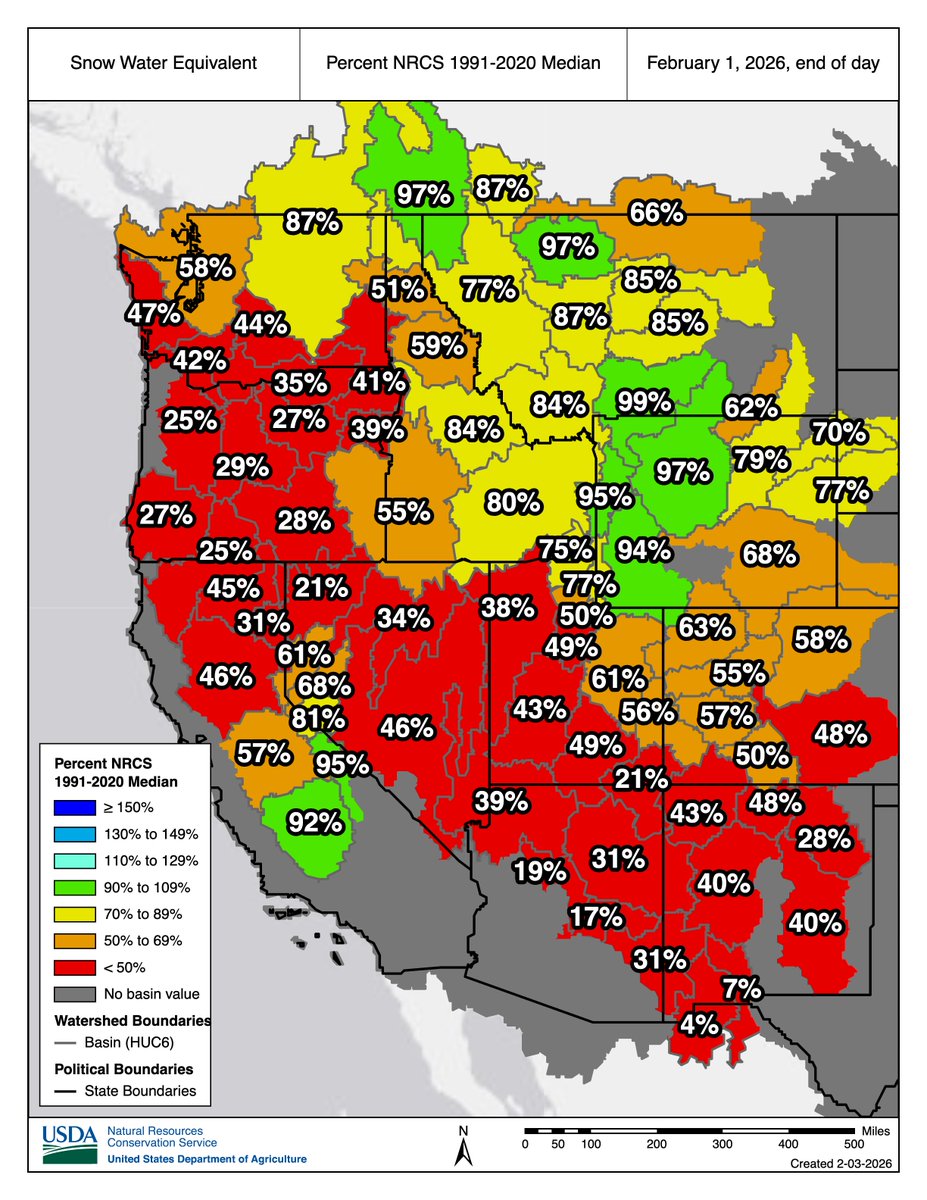
February 2026 Snow Drought Update
A Dry, Warm January Leaves the West With the Worst Snowpack in Decades
Economic impacts are occurring, especially for winter recreation and the communities that rely on it. Water supply concerns are increasing. https://t.co/WTDuSNEJBu @NOAA
This footage from inside the eye of Category 5 Hurricane Melissa might be the most jaw-dropping video ever captured of a hurricane’s eye, showcasing the infamous “stadium effect."
Dust is already an issue in the San Joaquin Valley - and as more land comes out of production, dust emissions will rise.
What can be done? A great piece from @ValleyAgVoice looks at recent research, with quotes from our own @Ayres225. #cawater#SJV https://t.co/XSXCNKNU3d
@dfkodsi@besttrousers@xwanyex I think we can make progress by exploring extent to which occu choice is influenced by discrimination, and we do. But that's a hard question, and often proposing an equation that controls for occu is met with a knee-jerk "can't do that", while other analyses are given a pass.
I think actually we have a pretty good handle on institutions that promote long-run growth, and a little bit on the stability of democratic institutions. Large scale and somewhat arbitrary government confiscation of hard-earned wealth, to satisfy the passions of envious masses, and sky high marginal tax rates, are not among them. Property rights, rule of law, reasonable taxation of investment returns, impartial justice, opportunity, and all the boring things we've known about for 250 years.
CA farmers are divided over a bill that would loosen rules protecting agricultural land. The goal of a bill proposed by Assembly Democrat Buffy Wicks is to seed solar farms on fallowed fields. #cawater
w/quotes from @Ayres225, via @RA_Becks@CalMatters
https://t.co/1MBTkOZemL