@RobGrieves I went after Christmas to Bremer Bay, all the way 1000km on FSD, almost no interventions. Car was confidently overtaking slow moving trucks and spotted couple roos.
Tesla are among the fastest selling 2nd hand cars and their prices are the same as a year ago but non-Tesla EVs saw a 10.3% reduction while petrol and diesel car prices dropped 2.8%. These stats come from the iseecars study analysing 6.7 million 1- to 5-year-old used cars sold in Q1 2025 and Q1 2026👇
https://t.co/hGq08ND84O
RBA rate hikes will be interesting, to say the least
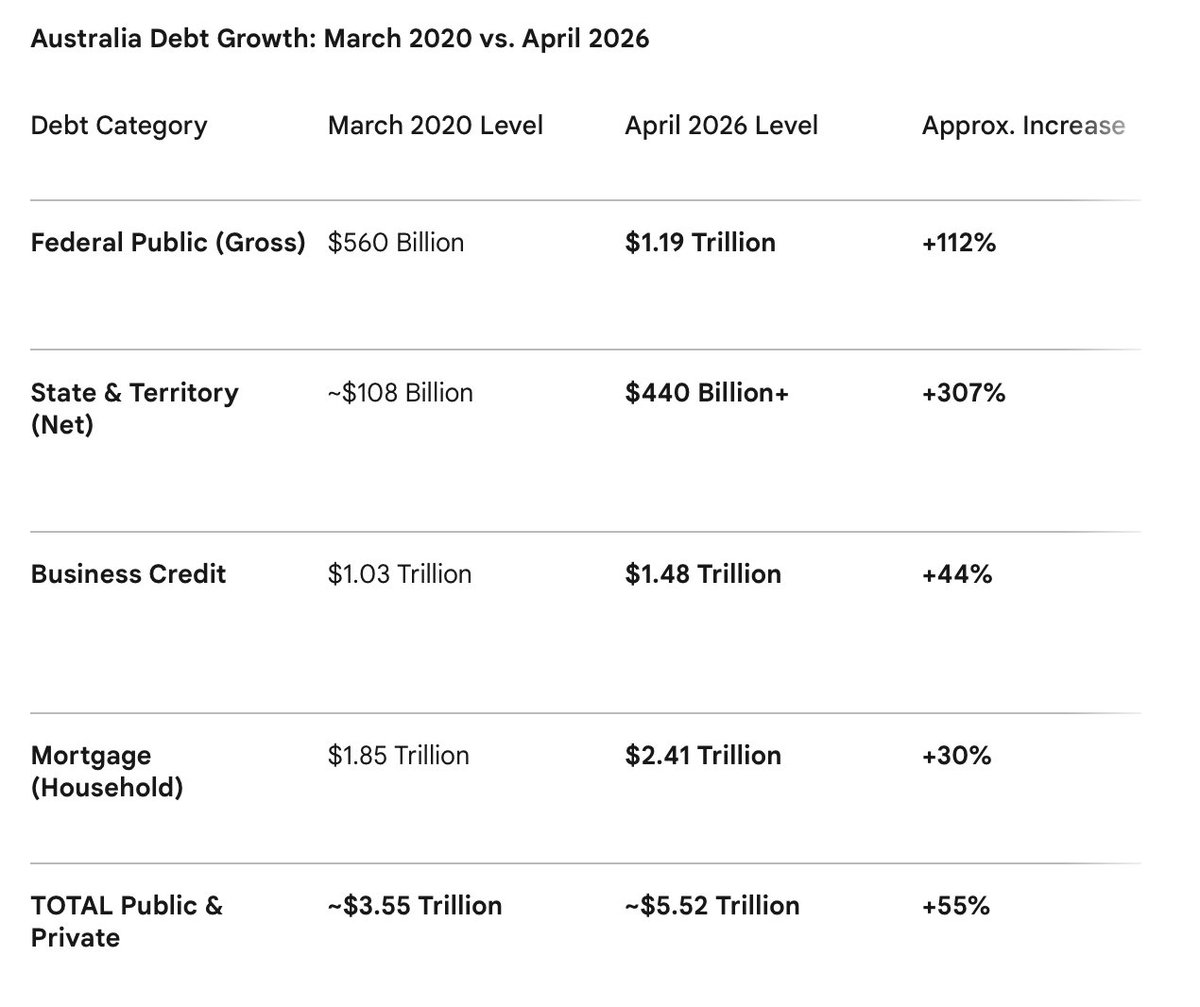
Nearly $2 trillion of additional debt in the economy since covid (AI summary of ABS and gov data)
This has the potential to become the mother of all default cycles in Australia, the mother of all historical credit bubbles in Oz too #ausbiz #RBA
We need RELIABLE DC chargers in 100km intervals everywhere around WA. The feds spent $2.5B (that's a B for billion or $2,500 million) on cutting the fuel excise tax for just 3 months. (The states chipped in with millions more) It would cost ~5-10% of that to have world-class charging infrastructure that would last 10-20 years spanning the whole country, particularly the black spots like the Nullarbor, the Horizon Power NWIS i.e. northern part of WA and the NT and parts of QLD. We also need to be realistic, Tesla Superchargers claim a ~99.95% uptime. The closest any other network consistently gets to is ~90-95%. 90% may sound high but it's COMPLETELY UNACCEPTABLE as it's equivalent to 1 out of every 10 petrol stations being out of fuel. The solution is staring us in the face, install Tesla Superchargers open to all EVs in 100km intervals (ideally in drive-through configurations eg Kojonup) @TeslaCharging offers 3rd party access to SCs where Tesla will manage the servicing and maintenance see: https://t.co/5S9agDKjDp supercharger-f...
@tesla_wa called for improved EV infrastructure over a year ago. See the full TOCWA report here: https://t.co/VQBx5shpjH
Model Y vehicles now make up the emergency response fleet for MelSafe in the City of Melville, Western Australia.
The city reports around $50,000 USD in annual savings from fuel and maintenance, while also reducing emissions. The vehicles are deployed 24/7 on 12-hour rotations.
"It's been a big winner with our community. They think they are fantastic."
Tajik is not “abandoned” Iranian heritage — it is a continuation of Iranian linguistic and cultural traditions in the east.
•Customs and “wannabe Persians”: Tajiks are widely regarded as part of the broader Persian/Iranian cultural sphere (Persianate world), sharing language, literature (e.g., influences from Ferdowsi, classical Persian poetry), and historical ties with Iran and Afghanistan’s Dari speakers. They are not “wannabes” but indigenous Central Asian Iranians who maintained and adapted Persian culture amid Turkic, Mongol, and other influences. Claims of “identity crisis” are subjective and often appear in online nationalist or fringe discussions; academically, Tajik identity is rooted in this Persian-speaking Iranian continuity in Central Asia, distinct from but related to western Persians.
4. Irony is that while they forgot their culture, remnants of their ancient Indian culture remain in China to this day. This is the famous “Sogdian Whirl” dance, which came to China via Sogdian Buddhists. Here is famous Uyghur dancer Gulimina Maimaiti performing it.
This mixes truth with exaggeration:
•“Forgot their culture”: Overly dismissive. Tajik/Persianate culture in Central Asia preserved much Iranian heritage (language, poetry, festivals, architecture under Islamic rule, e.g., Samanid legacy). Elements of pre-Islamic Sogdian/Bactrian culture (art, trade traditions) influenced the region indirectly.
•“Ancient Indian culture” via Sogdians: Buddhism itself has Indian origins, and Sogdians (along with others) transmitted Buddhist texts, art, and practices to China. However, the Sogdian Whirl (Húxuănwǔ or “whirling barbarian dance”) is a Sogdian performing art — a vigorous, spinning dance often performed on a small carpet, popular in Tang China (7th–9th centuries). It was brought by Sogdian merchants, dancers, and entertainers along the Silk Road. While Sogdians helped spread Buddhism, the dance itself is more associated with Sogdian secular/court entertainment and cultural exchange (with possible Zoroastrian or Central Asian roots) rather than purely “Indian” or strictly “Buddhist” elements. It became a craze in Tang courts and is depicted in Chinese art and tombs.
•The performance by Uyghur dancer Gulimina Maimaiti is a modern revival/interpretation of this historical dance tradition. Uyghurs (Turkic) have their own cultural overlaps with the region but are distinct from Tajiks.
Overall Assessment
•Factual core: The etymology from Banu Tayy is right; ancestry from Sogdian/Bactrian stock with Buddhist history (including Sarvāstivāda influences in the broader region) is broadly correct; the Sogdian Whirl reached China via Sogdian networks.
•Problems: The statement frames history through a lens of “abandonment,” “forgetting,” and “wannabe” identity, which oversimplifies complex cultural shifts, assimilations, and continuities common in history (e.g., language/religion changes under conquests). Tajiks did not “become Persians” as outsiders — they are Eastern Iranian Persians who retained and evolved that heritage. “Identity crisis” is not a neutral historical description but a rhetorical one. The “ancient Indian culture” link to the dance is indirect at best.
In reality, Central Asian history (including Tajik ethnogenesis) reflects layers of Iranian, Turkic, Islamic, Buddhist, and Silk Road influences — not a simple story of loss or crisis. Tajik culture today includes strong Persian literary and linguistic traditions alongside local Central Asian elements.
Analysed by @grok
The statement contains a mix of partially accurate historical and etymological facts, significant oversimplifications, and some misleading or value-laden interpretations. Here’s a breakdown:
1. “Tajik” itself comes from the Banu Tayy Arab tribe
This part is correct in its core etymology, though the implication is off. The word “Tajik” (or tājīk / tāzīk) derives from Middle Persian/Iranian terms for “Arab,” specifically linked to the Banu Tayy (Ṭayyiʾ), an Arab Bedouin tribe from Najd that had early contacts with the Parthian and Sasanian empires. During the 8th-century Muslim conquest of Transoxiana (Central Asia), Turks and locals used variants like täžik or tözik to refer to the invading Muslim armies (which included Arabs but were mostly Persian converts from regions like Fars). Over time, the term shifted from meaning “Arab/Muslim” to denoting Persian-speaking (Iranian) Muslims in Central Asia, in contrast to Turks. It later became the self-designation (autonym) for the Tajik people. Folk etymologies linking it to “crown” (tāj) are not supported by scholarship. So yes, the name traces back to Banu Tayy via this linguistic path — but it does not mean Tajiks are ethnically or ancestrally from that Arab tribe.
2. Their forefathers were Sogdian (Sugudha) and Bactrian (Balkh) Buddhists of the Sarvastivada (Hinayana) school
This is mostly accurate regarding ancestry, but oversimplified on religion and specifics:
•Modern Tajiks are primarily descendants of ancient East Iranian peoples, including Sogdians (from Sogdiana, centered in modern Uzbekistan/Tajikistan areas like Samarkand) and Bactrians (from Bactria, around Balkh in northern Afghanistan/southern Central Asia), with additional admixtures from Persians, Scythians/Saka, Greeks (via Hellenistic kingdoms), and some later Turkic elements. They are the main Persian-speaking (Iranian) sedentary population of Central Asia.
•Buddhism was indeed prominent in these regions along the Silk Road. Bactria and Sogdiana had significant Buddhist communities from the Kushan period onward (1st–3rd centuries CE and later). The Sarvāstivāda school (a major early Buddhist Abhidharma tradition, often classified under “Hīnayāna”/Śrāvakayāna) flourished in northwestern India, Kashmir, Gandhara, and parts of Central Asia (including areas linked to Bactria and influenced by Sogdian merchants). Sogdians acted as key transmitters of Buddhism (and other religions like Manichaeism and Nestorian Christianity) to China. However:
•Not all Sogdians or Bactrians were Buddhist — the region featured a rich mix of Zoroastrianism (Mazdaism), local cults, Hinduism, and later Islam. Buddhism was strong but not universal.
•Sarvāstivāda was influential in Central Asian Buddhist centers (e.g., Kucha had Sarvāstivādin monasteries), but Sogdian Buddhism in China often involved merchant communities transmitting texts and art rather than the entire population adhering strictly to one school.
3. These people abandoned not only their ancestral religion but also customs and language to become wannabe Persians
This is highly interpretive and overstated, bordering on polemical (“wannabe,” “identity crisis”).
•Religion: Yes, the ancestors (Sogdians/Bactrians) largely converted to Islam (Sunni for most Tajiks) following the Arab conquests in the 8th century, with Buddhism declining over centuries due to political, economic, and cultural shifts (similar to many regions). Zoroastrian elements also faded. This was a common pattern across the former Persianate and Central Asian world.
•Language: No major “abandonment.” Tajiks speak Tajik Persian (a variety of Persian/Farsi, part of the Iranian language family). Ancient Sogdian and Bactrian were also Eastern Iranian languages. The shift to a Persian dialect reflects broader Persianate cultural dominance in the region (e.g., under the Samanid Empire, which revived Persian as a literary language in Central Asia).
This is a brilliant article on the reality of modern Australian political discourse and how it interacts with the broken nature of our economy for the average person.
I highly recommend everyone reads it.
@Polymarket Australia, with all its natural resources, is $2.44 trillion at peak. That is a clear indication of what type of economy will be driving in the future.