Welcome to the most asymmetric trade in modern financial history.
The thread below lays out why. The opportunity exists because capital has chased the AI trade while ignoring the physical assets AI requires to run — assets that have quietly become the best-performing asset class of the decade. Since October 2020 when we first called for the commodity super cycle: QCI Total Return +217%, GSCI Total Return +205%, Gold +140%. NASDAQ trails at +130%. S&P 500 at +85%. The top three are all commodities. Yet oil cannot get out of its own way while copper and the broader atom complex prints fresh highs . That is the dislocation. That is the trade.
Get long. Buckle in. Hang on for the ride.
Forgive the longer posts in this thread — attempting to mimic my old 10-bullet commodity takes. On to it.
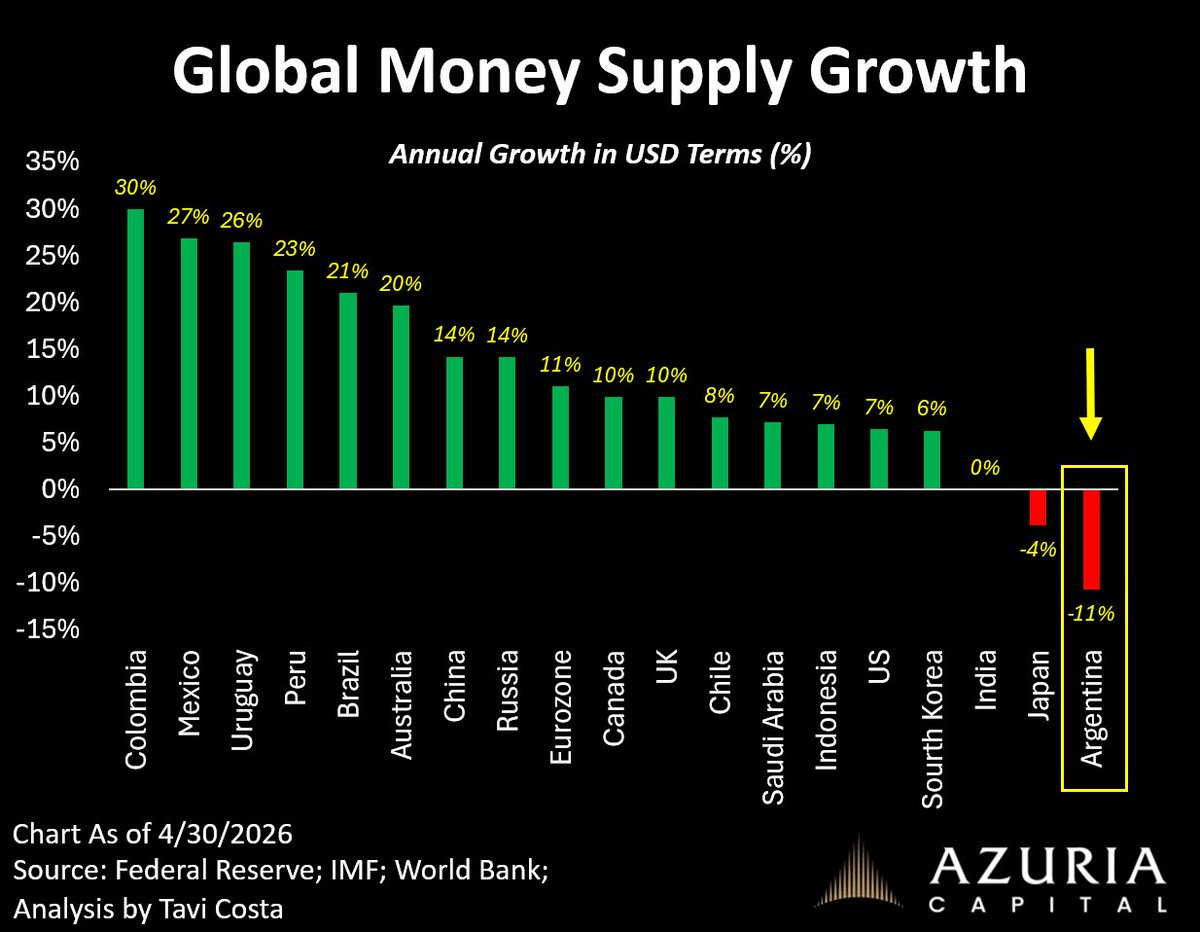
Argentina is the only country where money supply is contracting at a double-digit rate.
Meanwhile, the rest of the world continues to expand credit with little to no monetary discipline.
None of us own enough hard assets.
https://t.co/7n3N1S2a1W
Raw leafy greens are FAR more dangerous than raw milk.
Before you freak out, look at these numbers...
Raw leafy greens:
32 lbs per person per year leafy greens consumed by Americans (USDA).
90g/serving = 161 servings per year per person.
330 million Americans x 161 servings/year = 53B servings of leafy greens per year in the US.
2.3 million cases of foodborne illness from leafy greens (CDC data).
= 1 illness per 23,000 servings/year.
Raw Milk:
14.4 million raw milk drinkers in US (4.4% of US population).
3.3 million "frequent/regular" raw milk consumers.
3.3 m x 52 servings/year (1 per week avg) = 171.6 million servings (lowball).
120-300 cases foodborne illness from raw milk (CDC data).
= 1 illness per 572,000 servings raw milk.
This means that eating raw leafy greens is 25x more dangerous than raw milk on an illness/serving basis.
Should raw leafy greens be illegal? No, but we need to be honest about the relative risks here.
Why drink raw milk in the first place?
There are multiple studies that show raw milk (vs pasteurized) is associated with lower rates of asthma, eczema, and allergies (PMIDs: 31770653, 22146591, 34472138, 30813365).
Raw milk also increases lactobacillus populations in the gut ( PMID 32438623), is associated with improved lung function into adulthood (PMC5758444).
Does raw milk carry a risk of illness? Yes, as do ALL raw foods - raw leafy greens, raw fish, and other raw vegetables.
Sourcing for raw milk is critical if you choose to drink it. And no, drinking raw milk does not make you conservative, this has nothing to do with your politics.
This is about honest consideration of a (incorrectly) vilified food that humans have consumed for thousands of years.
Cold exposure doesn't just build mental toughness. It physically remodels your immune system.
Studies show that regular cold water immersion increases natural killer cell count, elevates white blood cell activity, and reduces inflammatory cytokines.
People who take cold showers get sick less often and recover faster when they do.
Start with 30 seconds at the end of your shower. Build to 3 minutes over 4 weeks.
The discomfort fades. The adaptation is permanent. Your immune system will be stronger every single week you stay consistent.
The Holocene - the current geological and climatological epoch - is now dated to have begun 11,600 years ago. That date marks the transition out of the last ice age and into the relatively stable climatic period humanity has inhabited ever since. Randall places that date alongside something Plato wrote in his dialogues Critias and Timaeus - that according to the sacred registers of Egypt, the catastrophe he was describing happened 9,000 years before his own time. Plato was writing approximately 2,600 years ago. Nine thousand years before that places the event at approximately 11,600 years ago.
The convergence is not approximate. It is precise. Randall notes that Plato's account extends the geographic reach of the catastrophe beyond the Mid-Atlantic - the sacred registers describe effects on the eastern side of the Mediterranean as well, suggesting a global scale event rather than a localized subsidence. The geological record of the Holocene boundary and the Egyptian sacred records transmitted through Solon and Plato are describing the same moment from different vantage points - one preserved in sediment and ice cores, the other preserved in the temple archives of a civilization that was apparently close enough to the event to have recorded it in detail and careful enough to have preserved that record for nine millennia.
RANDALL AT QUEST FOR ANCIENT CIVILIZATIONS
Get your exclusive ticket in the Randall Carlson dedicated seating section at Quest for Ancient Civilizations in Sedona, May 1-3, 2026: https://t.co/Y8Ny9RIs0G
I am not a military analyst. I'm a financial analyst focused on macroeconomic risk.
That different lens might explain why I see something most military strategists and investors are missing.
---
The New Rules of Warfare—And Why We Can't Opt Out
For nearly a century, warfare belonged to whoever controlled the biggest defense budget. Aircraft carriers. Stealth bombers. Multibillion-dollar weapons systems.
That model is changing in ways many aren't appreciating.
Ukraine and Iran are showing the West what 21st-century conflict actually looks like: decentralized, highly iterative, fast-changing, unmanned, and cheap. Neither the US nor Russia—beginning in 2022—appears prepared.
We might now have no choice but to show we can fight and win such a war.
The Ukraine Approach
Faced with a small defense budget, a much smaller population, and a vastly outnumbered army, Ukraine had to get creative. They couldn't match Russia's industrial capacity or spending. So they abandoned that playbook entirely.
They developed an entirely new way to fight, highly decentralized, iterative, and most importantly, cheap.
They also created Brave1—a completely new way to conduct war.
Frontline commanders log into an iPad and bypass central command entirely. They spend digital points to purchase equipment directly from hundreds of (Ukrainian) manufacturers. When they encounter a new threat, they message the manufacturer directly and work with the engineers to find a solution, even if that means they visit to the front. The result is hardware or software upgrades that once took months now take days.
Here's the crucial part: hundreds of manufacturers compete fiercely for these dollars by offering the best possible product as fast as possible. This isn't centralized procurement. It's a market. Competition drives innovation at scale. Weapons evolve as the enemy evolves in real time.
Units are also awarded points for confirmed kills, uploaded from drone video—a powerfully eloquent way to grade effectiveness.
But the real innovation might be how they decentralized manufacturing itself. Instead of building weapons in massive, centralized factories that make perfect targets for Russian bombing, Ukraine distributed production across hundreds of small manufacturers—workshops, machine shops, garages, and yes, kitchens. Each produces components or complete systems. This approach serves two purposes: speed and survival.
You can bomb a tank factory. You destroy production for months. You cannot bomb ten thousand kitchens. If one workshop gets hit, ninety-nine others keep producing. The network regenerates faster than Russia can destroy it. This is why the manufacturing process includes actual kitchens—it's not a metaphor. It's a strategy.
The Metric That Defines a New Era
The result is staggering: at least 70% of battlefield casualties now come from drones. This is the first time in over a century that the primary cause of combat death is neither a bullet nor an artillery shell. Since World War I, industrial warfare meant industrial killing. Ukraine has broken that equation entirely.
As a result, Russia is now controlling less territory than at any point since 2022 and going backward. In March, Ukraine made gains while Russia recorded no gains for the first time in two and a half years, and Drone-led offensives recaptured 470 square kilometers while paralyzing 40% of Russian oil exports.
Ukraine has lowered the "cost per kill" to less than $1,000 per casualty—a 99.98% reduction from the millions of dollars that were common in the post-9/11 wars. This isn't an incremental improvement. This is a complete inversion of modern military economics.
Yet the Western defense establishment is not learning from this.
Rheinmetall CEO Armin Papperger mocked Ukraine's entire approach. In The Atlantic, he called Ukrainian manufacturers "housewives with 3D printers," dismissing their work as "playing with Legos." They are not studying this revolution. They are mocking it.
And the "housewives with 3D printers" are beating the Russian army!
Ukraine Is Now in the Middle East
The US Military and Gulf states face an eerily similar problem. Iran's Shahed drones threaten shipping in the Strait of Hormuz—a chokepoint that funnels 21% of global oil. They cannot fend off Iran by firing a $4 million Patriot missiles at $20,000 drones.
They need what Ukraine has discovered: a decentralized, rapidly adaptive defense network that doesn't require centralized industrial capacity.
That's why Ukraine just signed historic 10-year defense deals with Saudi Arabia, Qatar, and the UAE.
Over 220 Ukrainian specialists are now on the front lines of the Persian Gulf—exporting not just weapons, but a completely new doctrine of how to fight.
The precedent is set. The model works. Everyone is watching.
Mosaic
On April 1st, Trump threatened to bomb Iran "back to the stone ages" if they don't reopen the Strait within weeks.
It's the classic 20th-century playbook: overwhelming offense force, massive bombardment, industrial-scale destruction.
The problem? That playbook doesn't work against distributed, cheap, rapid-iteration systems—especially when your enemy is organized under a mosaic structure.
Iran's "Mosaic Defense" doctrine is a decentralized command system where authority and capability are distributed across multiple geographic and organizational nodes.
Each region operates semi-autonomously with overlapping chains of command and pre-planned contingencies. It's designed so that when you destroy the center, the edges keep fighting. You cannot decapitate a system with no head. You cannot out-bomb your way to victory when your enemy is not centralized; this was the solution for 20th-century industrial warfare.
Defense Wins Championships
21st-century asymmetrical threats require defensive shields, not aggressive offenses. Ukraine has built exactly that: rapid-iteration defenses, decentralized manufacturing, commanders empowered to buy solutions in real time and rewarded for success.
That same defensive model may hold the key to opening the Strait of Hormuz. Not through massive offense, but through the ability to adapt and defend quickly.
Why We're Stuck
Whether you viewed this as a war of choice or not, it has now become a war to keep global trade open. And that makes it inescapable.
This is precisely why the US cannot declare victory and walk away from the Strait of Hormuz— or TACO.
Every adversary on the planet will interpret American withdrawal as confirmation that cheap asymmetric systems work against powerful centralized platforms.
And these adversaries might have sent us a message last month. In mid-March 2026, an unauthorized drone swarm penetrated Barksdale Air Force Base in Louisiana, home to the U.S. Air Force's Global Strike Command.
The fact that this happened not overseas but in the United States, and that these tests occurred just weeks ago, underscores how close this threat is now.
They didn't attack. They announced their presence. Every adversary watching learned that cheap drone networks can reach into the US.
The Global Supply Chain Risk
If the US abandons the Gulf while Iran holds the Strait contested, markets will price this as validation that cheap systems can hold global trade hostage. The current market disruptions will become permanent.
Supply chains will have to pivot from "just-in-time" efficiency back to "just-in-case" redundancy. Inflation returns as safety costs money. Trade routes diversify away from vulnerable chokepoints. The global friction tax becomes permanent.
The Unavoidable Truth
Once you prove that cheap, asymmetric systems can hold global trade hostage, that knowledge spreads globally and irreversibly. Every adversary learns the same lesson: you don't need a $2 trillion Navy—you need $20 million in drones and the will to use them.
Withdrawing while the Strait remains contested would permanently validate this model. Supply chains shift to "just-in-case" redundancy. Insurance costs rise. The friction tax becomes structural—baked into every global transaction for decades.
The cost of staying is measured in months. The cost of leaving is measured in decades of economic drag.
We cannot leave unfinished business.
The cryptic announcement that Iran will allow tankers to pass through the Strait of Hormuz if their cargo is paid in Yuan has many problems. Unless there are more details offered, view it as propaganda and not a workable idea.
---
If you're interested in why, some thoughts...
No operational mechanics were explained
How exactly does Iran verify what currency a cargo was paid in before granting passage? Oil trades involve a chain of counterparties — producers, traders, refiners, end buyers — often with multiple legs of financing and settlement. There's no manifest line that says "paid in yuan." Is Iran proposing to inspect banking records at the Strait? Demand SWIFT confirmations from Chinese banks?
This isn't a tariff booth, it's one of the world's most complex commodity markets. There is no operational framework described because there likely isn't one.
The Saudis tried exactly this in 2022, and quietly killed it
When Saudi Arabia floated yuan-denominated oil sales to China, it generated huge headlines in 2022. It went nowhere.
Once you collect yuan, what do you do with it? China's bond market is partially closed to foreigners, capital controls limit repatriation, and yuan-denominated assets globally are a tiny fraction of what dollar assets offer.
Oil exporters need somewhere safe, liquid, and deep to park revenues. That somewhere is US Treasuries, not Chinese Yuan-denominated bonds.
Chinese capital markets are not deep enough
The US Treasury market trades $800B+ daily. That depth is why the dollar is the oil settlement currency, not politics, not the petrodollar agreement, but pure market structure.
If every barrel transiting Hormuz (roughly 15-20 million barrels/day pre-war) suddenly needed yuan to purchase, the demand shock on a managed, partially-closed currency would be enormous. China's capital markets cannot absorb that recycling flow.
A surging yuan could actually hurt China
Massive forced yuan buying would likely send the currency soaring, and that's the last thing Beijing wants.
China is already battling deflation. Its export sector is under tariff pressure from the US. A sharply stronger yuan erodes export competitiveness.
China has spent years carefully managing a gradual appreciation of the Yuan for strategic reasons. A shock appreciation forced by an Iranian is not in Beijing's interest.
There's no indication Beijing has endorsed or agreed to this plan.
Further, China has carefully avoided being drawn into the military conflict. Suddenly becoming the financial clearinghouse for the Hormuz passage, with all the secondary sanctions that come with it, is exactly what Chinese banks want to avoid.
China buys Iranian oil through shadow-fleet intermediaries specifically to avoid formal yuan-settlement mechanisms that would expose Chinese banks to US sanctions.
----
This reads like a trial balloon from Tehran, not a workable financial architecture. It suffers from the same structural reasons that killed the Saudi yuan-oil experiment in 2022, with the added complications of US sanctions and the absence of Chinese buy-in.
The dollar's dominance in oil markets is a function of capital market depth and convertibility, not something a Strait closure can unilaterally rewrite.
Mold Detox Smoothie Recipe:
Ingredients:
- 1 cup organic cilantro (natural binder for mold + metals)
- ½ cucumber, peeled (hydrating + kidney support)
- ½ lemon, peeled (liver support + glutathione production)
- 1 scoop grass-fed beef collagen (amino acid support for detox pathways)
- 1 tbsp chia seeds (fiber to bind and flush toxins)
- 1 tbsp MCT oil (fuel for brain + bile production)
- ½ green apple (low glycemic antioxidant source)
- 8 oz filtered water or hydrogen water
- Optional: 1 drop chlorophyll or ¼ tsp spirulina
Blend until smooth and drink first thing in the morning on an empty stomach.
Which Mark Carney was right:
A. Pre-election Carney who said “the biggest security threat to Canada is China”
Or
B. Post-election Carney who signs a “strategic partnership” with Beijing for a “new world order”?
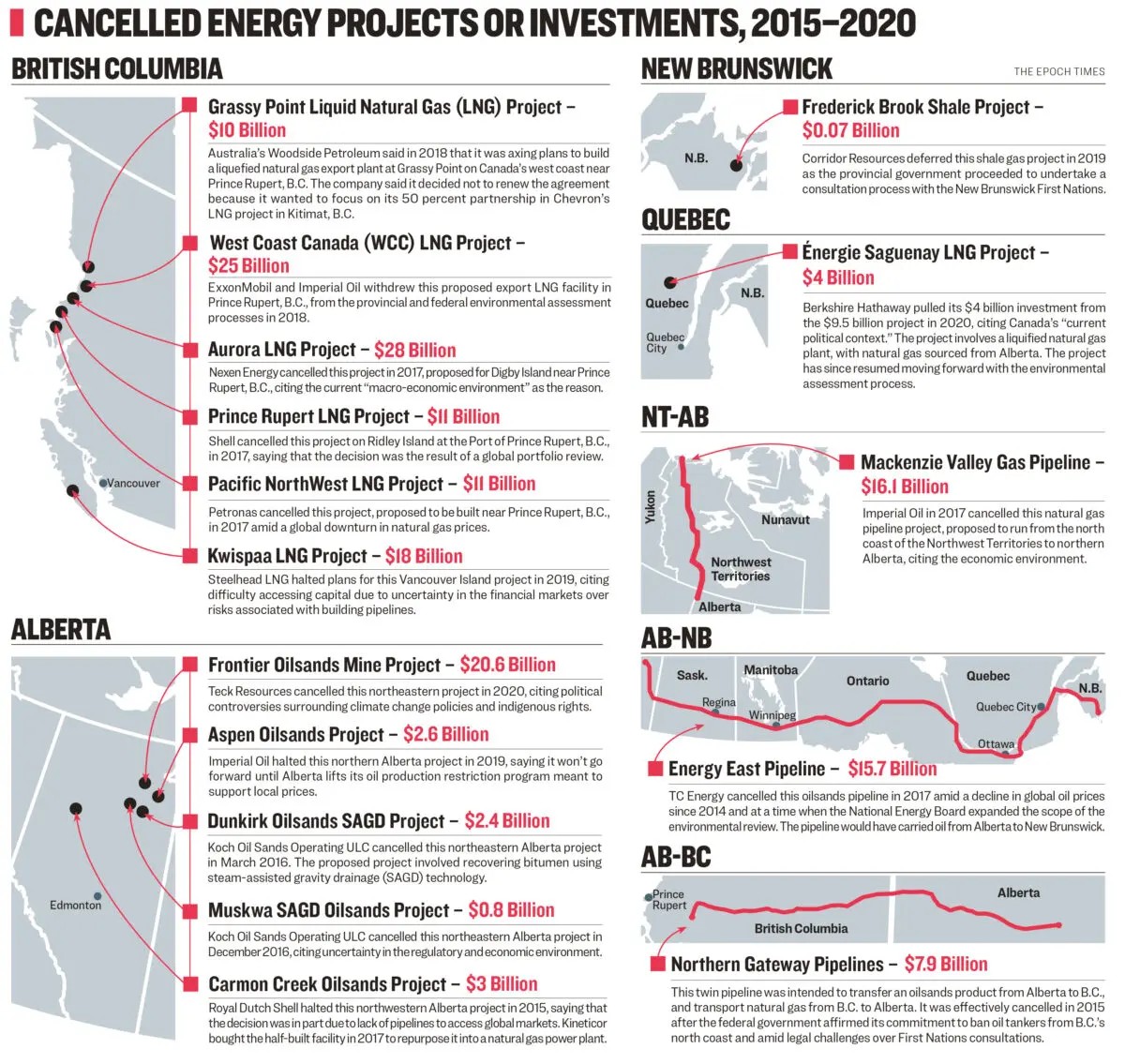
Liberal anti-energy laws prevented over $176 billion worth of oil & gas projects.
It's forced Canada to sell 90% of our largest export to the U.S. at massive discounts.
Get government out of the way & shovels in the ground. Boost paycheques, buying power and economic sovereignty.
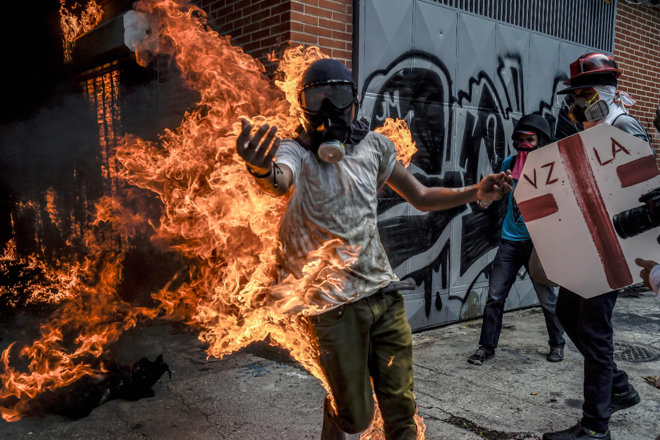
#1 É um erro tratar a operação dos Estados Unidos como uma violação da soberania da Venezuela. Soberania pressupõe Estado legítimo, instituições sólidas e respeito à vontade popular. Nada disso existe há anos no regime de Nicolás Maduro; que jamais respeitou esses quesitos.
High‑protein diets do not harm your kidneys, even in people with impaired kidney function
A 2024 study of adults with and without chronic kidney disease found that higher protein intake wasn’t just safe...
It was associated with progressively lower mortality, up to ~33% lower risk at ~1.6 g/kg/day compared to the RDA
Even in the most extreme cases, such as very sick patients receiving high-dose IV protein directly into their veins, research finds no signal of kidney harm
For typical healthy adults who exercise and want to age well, the real danger isn’t eating “too much” protein, but eating too little, not training enough, and slowly losing muscle and resilience year after year