Bag: Full
Conviction: 100/100
FUD: Irrelevant
Key to Success: Discipline and Patience
The rotation will happen sooner than later. Just have some faith and patience
$QNT
🏦It's been about a week since $QNT x TCH news
The hype's died down a bit
So let's officially look at this with a CLEAR LENS
No hype, just pure facts.
First off, let's look at the scope of the partnership
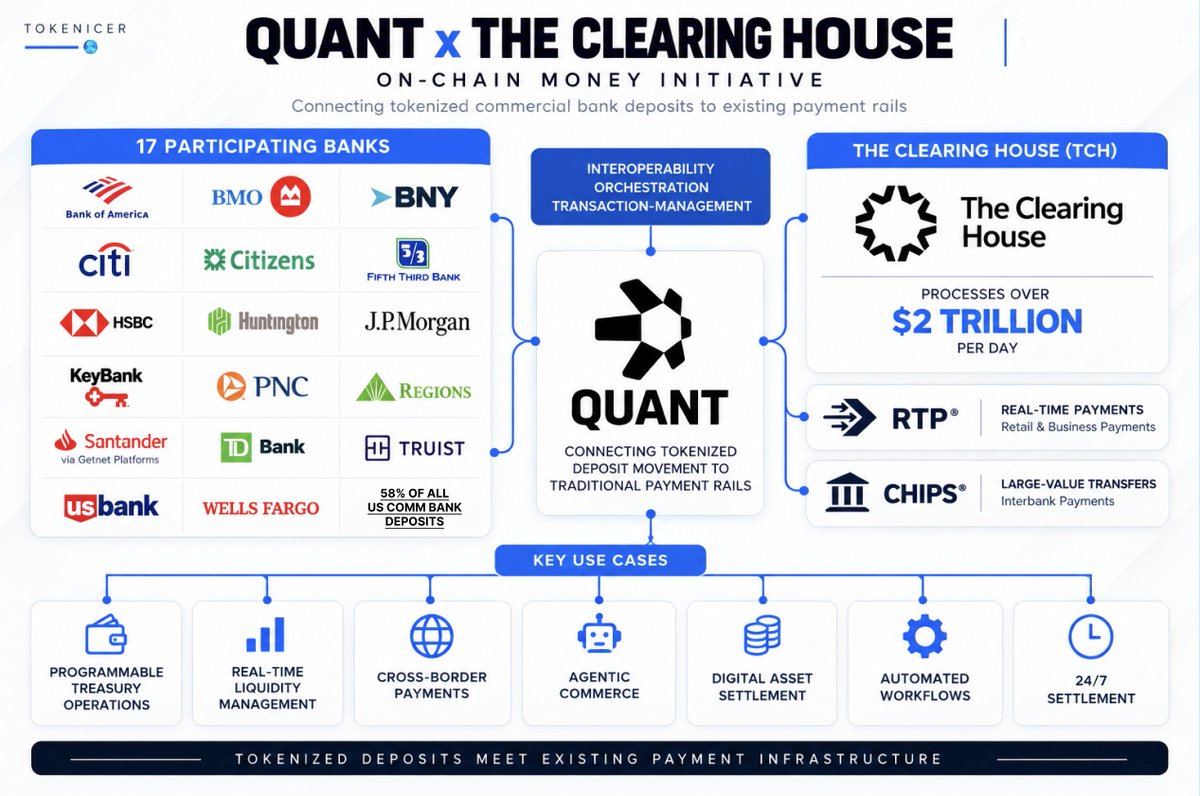
The Clearing House selected Quant for orchestration infrastructure in their On-Chain Money Initiative.
What's the On-Chain Money Initiative (OCMI)?
In short the OCMI is like the US version of UK GBTD.
Both have selected Overledger for orchestration.
The key difference here is that UK Finance, which organized the UK GBTD is a trade association.
They coordinated and organized all the moving parts for UK GBTD. They themselves don't run payments infrastructure of any sorts.
The Clearing House on the other hand...
Is the only private sector operator of both Real-Time Payments (RTP) & Clearing House Interbank Payments System (CHIPS).
So this time... It's not a trade group coordinating banks toward infrastructure someone else runs,
Rather, it's the infrastructure operator itself building the on-chain layer directly over the rails it already owns.
Now let's talk scale.
TCH itself processes over $2 TRILLION a day.
Seriously... Think about that for a second.
17 banks are in at launch.
Bank of America
BNY
Citibank
HSBC
JPMorgan
Wells Fargo
US Bank
And more
Together they represent about 58% of ALL US commercial bank deposits.
Quant's role specifically: interoperability, orchestration n transaction-management layer.
Same three-part job Overledger's been doing for GBTD.
Connecting tokenized deposit movement straight into RTP n CHIPS, the same rails already in production.
So on one end... We won't be seeing anything "new" that Quant is doing per se.
But on another end, the #1 private sector payments provider in the US is using Quant for something they've already proven they can execute at scale.
What does that actually unlock?
• Programmable treasury operations
• Real-time liquidity management
• Real-time 24/7 settlement
And Agentic Commerce sits right within there too.
Something that's been rapidly growing within institutional finance.
And we already know Quant is working with world leading IT provider Capgemini around this.
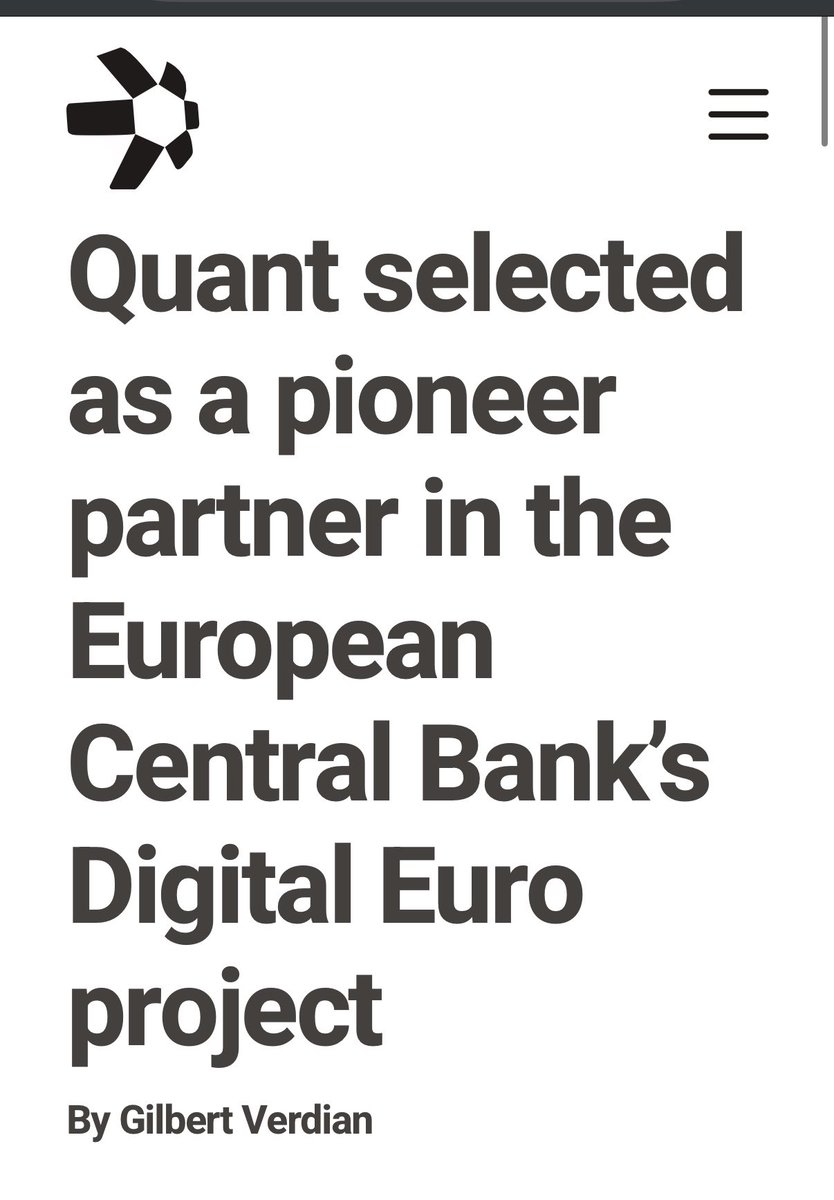
Gilbert Verdian called the selection
"A defining step in the global transition to programmable money."
Some pretty bold claims.
But look at who's saying it and what/who they're building it on top of.
Target launch is H1 2027.
–––––––––
UK Finance had already proved the model worked.
US just skipped that step and had the rail operator build it themselves.
2 different countries. 2 different bank groups.
Same Orchestration Layer deployed over both.
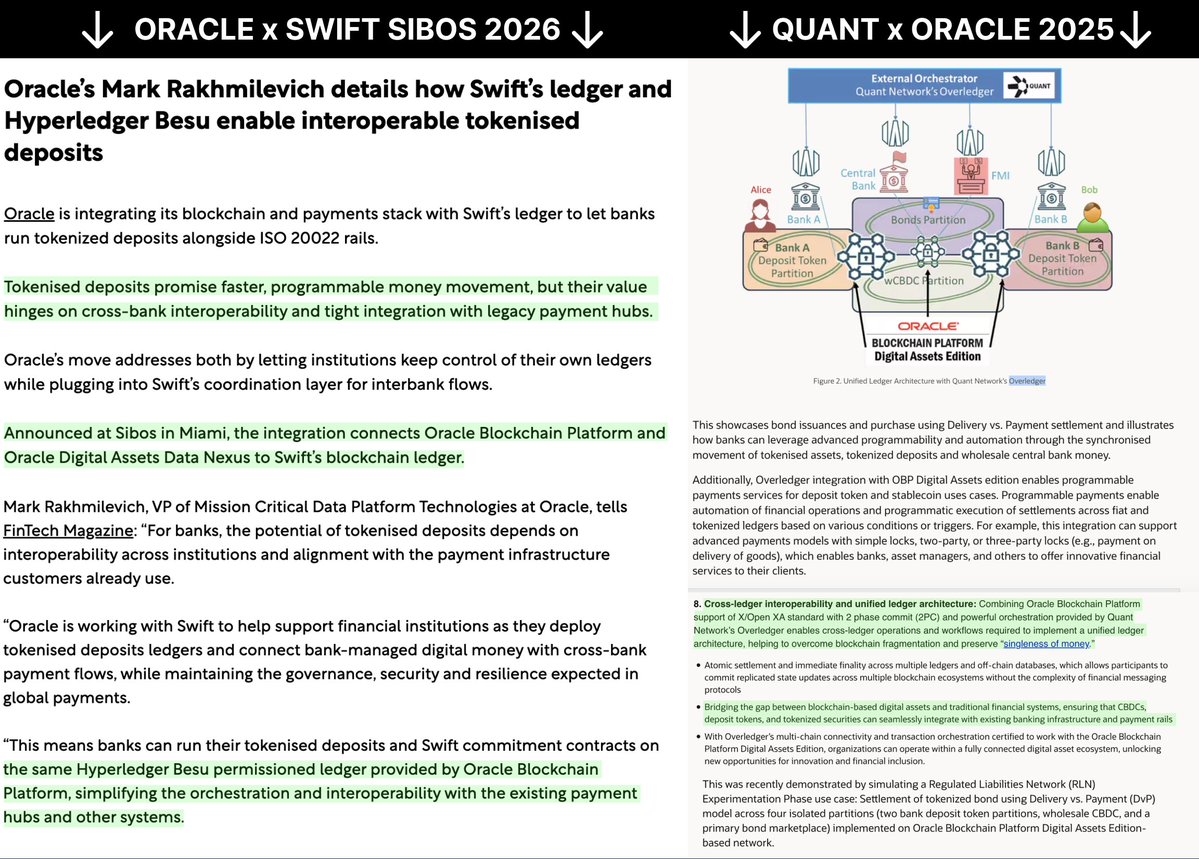
🌐More details on Oracle X SWIFT partner
The work of $QNT is clear as day here
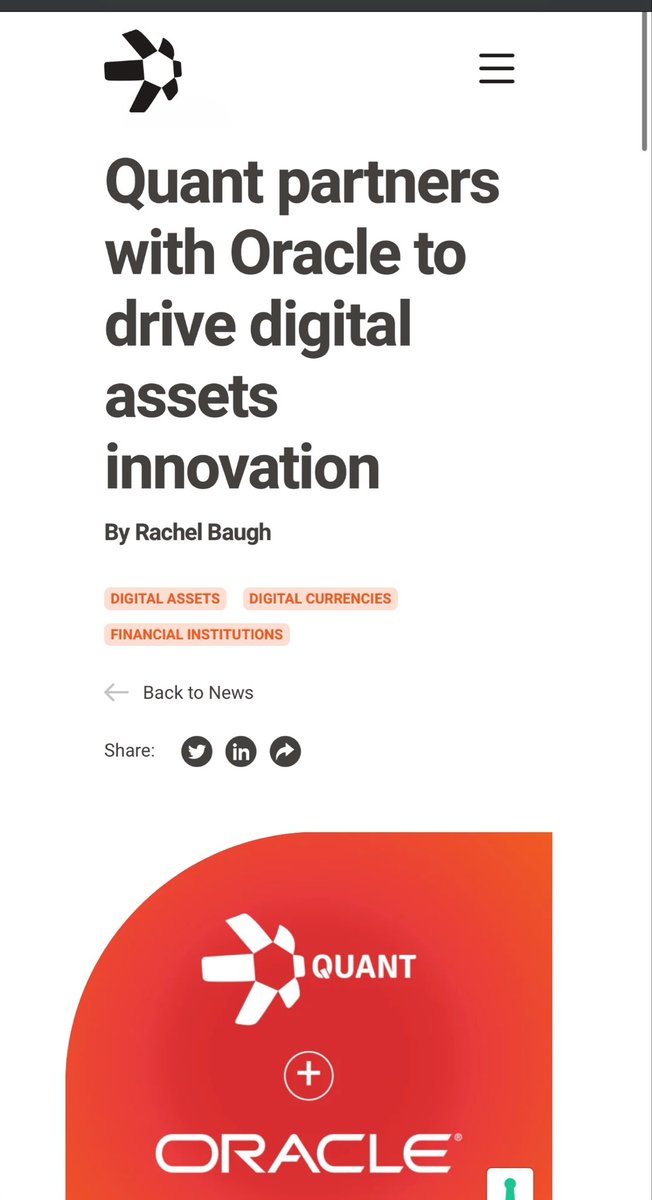
We already know Oracle's Blockchain offerings enabled by Overledger from their 2025 piece
The collab showcases EXACTLY that
✅Cross ledger/tech integration
✅Oracle Blockchain + Digital Asset
✅Orchestration & Interoperability
These are technologies and terms we've seen within Quant's wheelhouse over the past 2 years.
Oracle is a MASSIVE player in institutional finance and overall enterprise software.
Just because institutions move to DLT doesn't mean they're gonna abandon their legacy infrastructure.
And much of that legacy infrastructure sits within Oracle's offered infrastructure.
It simply made sense for them to use Overledger to plug all the existing Oracle tools into DLT banking.
And we see that exact verbiage in Oracle x SWIFT news
It's confirmed that Oracle Blockchain and Oracle Digital Assets will be used in the partnership.
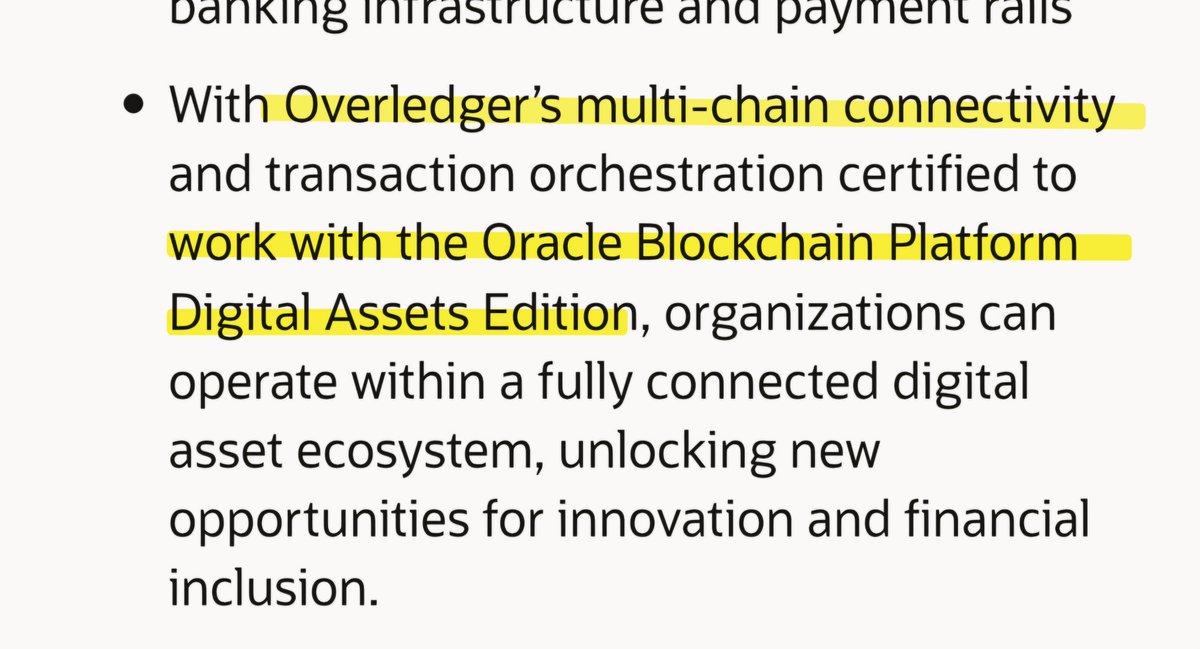
And a year back we got confirmation that both those infrastructures will work thru Overledger.
And with the mention of things like Oracle Digital Asset Nexus & ISO20022 rails...?
It certainly sounds a lot like what QuantNet offers👀
–––––––––
The momentum has begun & it's gonna be hard to stop
• The Clearing House
• Capgemini
• Oracle
• SWIFT
All clear pieces of institutional financial foundations
This is no longer a coincidence
🧿💥 $QNT LIVE is now up and running.
24/7 price, on-chain transfers, whale alerts, derivatives data and QNT news, all in one live dashboard.
Built to track the market, not hype it.
Let me know what you think! 💪
https://t.co/lFIikXZzQp
$QNT has no competitors.
The others tackling interoperability haven’t built on the right foundation.
They need to catch up with 20 years of architectural design, 10 years of development and implemented at the top level institutions.
Just take a look at the FA of QNT 🏛️
Besides bagging the largest US 🇺🇸banking network, here’s what Quant accomplished just last year⬇️⬇️
And there’s much unknown
None of these networks are live yet, but they will launching in the coming years✅
We’re in the pre-game phase…🤝
You have to be a special kind of stupid to think $QNT whales and OGs are selling here.
We waited 8 years just to sell before staking, mainnet opening up to retail, the first Trillion in tokenized deposit volume, before US banks go live in H1 2027 with their first txs.
$QNT gets lumped in with every other interoperability token.
I think that's a mistake, and the reason goes back to how the internet itself was designed.
Quant has been designed to be "Internet-Scale".
But what does that mean?
🔥Seems $QNT x Capegemini is OFFICIAL
In July we saw them drop on a report on tokenized deposits
The past few days at SIBOS expanded that
• Capegemini Tokenized Deposit report cites Gilbert
• Agentic AI treasury demo at SIBOS
But why is this so huge for Quant?
Take a look at Capegemini's client/partner list
• European Central Bank
• BNP Paribas
• ING Group
• Microsoft
• NVIDIA
• Oracle
• IBM
• SAP
And there's MUCH more to that list.
The two have likely been working in silence for quite a while now.
You don't just bring a random demo to SIBOS without first extensively building and testing
And when we look across the current payments landscape today, there's two key trends.
Tokenized Deposits & Agentic Payments
EXACTLY what Quant & Capegemini are building around
🚨Today’s Oracle announcement may be one of the biggest $QNT breadcrumbs yet.🚨
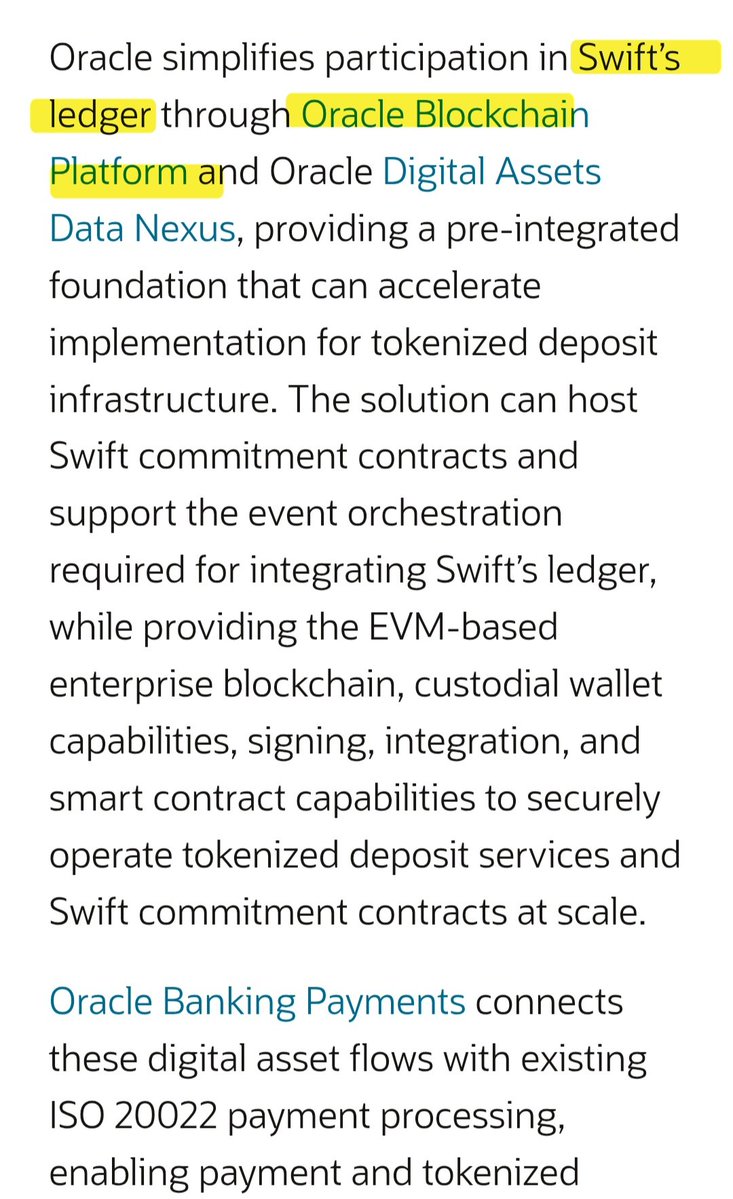
Oracle says Blockchain Platform + Digital Assets Data Nexus connect institutions into SWIFT LEDGER, host Swift commitment contracts, orchestrate the workflow, and bridge those flows into ISO 20022
Separately, Oracle has already certified Quant Overledger for its Digital Assets Edition as a cross-ledger interoperability/orchestration layer.
Every connection and flow is there.
The only missing receipt: confirmation that Overledger is actually invoked in the Swift Ledger runtime path. (NDA?) Once that domino falls... Holy hell 🚀
https://t.co/lRcoZZCD82
Quant just published a 25-page institutional blueprint.
The paper comes as tokenized commercial bank money moves from pilot programs into live infrastructure across the UK, U.S., Canada and Europe.
Quant highlights four major initiatives:
• Great British Tokenised Deposit in the UK, where 7 banks have completed live customer transactions on shared infrastructure built by Quant
• The Clearing House’s On-Chain Money Initiative in the U.S., with Quant selected for interoperability, orchestration and transaction management and launch to participating institutions targeted for H1 2027
• A joint tokenized deposit initiative involving Canada’s 6 largest banks
• Germany’s Commercial Bank Money Token initiative, now in pilot.
The central argument is that putting deposits on a ledger is only the beginning.
A ledger can record that money moved.
It does not inherently tell a bank:
• Why it moved
• Which obligation it satisfied
• Who authorized it
• What conditions had to be met
• What external systems it depended on
• When the obligation was actually complete
• What happens if part of the transaction fails
Quant calls this concept ‘economic intent.’
The paper separates institutional infrastructure into six responsibilities:
• Economic intent
• Institutional control
• Programmability
• Orchestration
• Money and posting model
• Execution and settlement
The first four sit above the ledger.
The final two relate to the underlying money and settlement infrastructure.
One example in the paper makes the distinction:
A customer asks a bank to pay a supplier £5 million after delivery is confirmed, with two approvals before a deadline.
To the customer, that is one obligation.
The infrastructure can generate 6 separate ledger entries, including a reservation, release, transfer, fee and status events.
The point:
Ledger activity measures the plumbing.
The bank still has to preserve the economic meaning of the transaction.
The paper also rejects the idea that one network will replace the existing financial system.
Instead, Quant describes a future where:
• Swift
• RTGS systems
• Domestic payment networks
• Tokenized deposit networks
• Asset platforms
• Public and private ledgers
all coexist.
A connection to one does not automatically provide access, settlement eligibility or common legal treatment across the others.
That makes orchestration a major part of the problem.
A single financial instruction may need to cross multiple networks with different operating hours, settlement models and points of finality.
Capital markets are where this becomes especially important.
Quant says tokenized assets have advanced faster than the cash used to settle them.
A bond can move on a ledger in seconds while the corresponding cash leg still settles through conventional infrastructure.
The proposed model is programmable delivery-versus-payment (DvP):
• Asset eligibility checked
• Cash availability confirmed
• Authority verified
• Both legs reserved
• Both execute together, or neither proceeds
The same framework extends to FX payment-versus-payment, repo and collateral.
Quant and Murex are already demonstrating this architecture.
At Sibos, the companies showed a USD repo against a tokenized U.S. Treasury, with the cash leg in tokenized deposits and the transaction operated through Murex MX.3.
One scenario completed through next-day recall.
Another was deliberately rejected mid-execution and rolled back with no change to the ledger, account or inventory state.
Finality remained with the designated settlement rail.
The UK project is also moving into capital markets.
Participating banks plan to issue 3 digital bonds in Q1 2027, traded and settled using tokenized deposits.
The bigger signal in Quant’s paper is that institutional tokenization is moving beyond the question of:
“Which blockchain will financial institutions use?”
The harder question is becoming:
How do banks coordinate money, securities, approvals, compliance and settlement across multiple systems without losing control of the transaction?
Quant’s thesis is that the ledger is only one layer.
The increasingly important infrastructure may be the stack sitting above it.
@FusionLayer25 | @quantnetwork | @gverdian
ethereum:0x4a220e6096b25eadb88358cb44068a3248254675
Gilbert Verdian, CEO of Quant Network, is literally the architect of the new on-chain global financial system.
ethereum:0x4a220e6096b25eadb88358cb44068a3248254675 @gverdian