Today is Navy Day! First celebrated on 27 October 1922, the observance brought ships, aircraft, and sailors into communities across the country to connect Americans with their Navy. The date honored Theodore Roosevelt’s birthday and his advocacy for American sea power.
But how did Navy Day begin—and who was really behind it? Historian Ryan Wadle explores the little-known partnership between Navy leaders and the Navy League that launched the nationwide celebration.
Read “First Rate Ideas: The Hidden History of Navy Day”: https://t.co/BGmWwmz2pQ
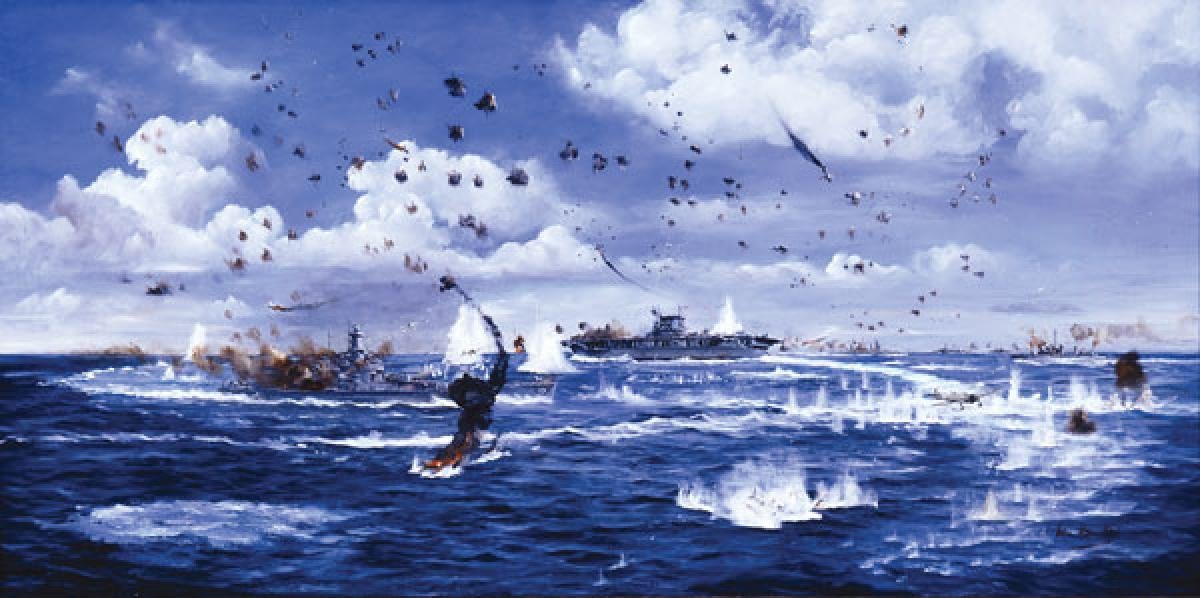
Oct 26, 1942. Japan wins the battle and sinks an American carrier. And it may have cost them the war in the air.
By October 1942, the fight for Guadalcanal had been raging for nearly three months. Japan planned one big push. The army would storm Henderson Field, and the navy's carriers would come south to finish off the American fleet.
Admiral Halsey had just taken over in the South Pacific. His order to his commanders was simple: attack, repeat, attack.
He sent his only two carriers north of the Santa Cruz Islands. USS Hornet, the ship that had launched the Doolittle Raid. And USS Enterprise. Against them, Japan had four carriers.
On the morning of Oct 26, both sides found each other almost at the same time. Strike groups passed each other in the air on their way to their targets.
American dive bombers smashed the flight deck of the Japanese carrier Shokaku and hit the light carrier Zuiho, knocking both out of the fight.
But Japanese planes found Hornet.
Bombs tore into her. A damaged Japanese dive bomber deliberately crashed into her. Then torpedoes hit her engine rooms, and she went dead in the water.
Enterprise, hidden for a while by a rain squall, was hit too, but survived. The destroyer USS Porter was torpedoed while picking up a downed aircrew and had to be scuttled.
The crew of Hornet fought for hours to save her. A cruiser tried to tow her. More Japanese planes came and hit her again. Finally she was abandoned.
American destroyers were ordered to sink her. They fired torpedoes and hundreds of shells into her, and she still wouldn't go down. That night, Japanese destroyers arrived and finished her off.
On paper, it was a Japanese victory. Enterprise was now the only working American carrier in the Pacific. Her crew reportedly put up a sign: Enterprise vs Japan.
But Japan lost 99 planes. Even worse, they lost more veteran aircrew at Santa Cruz than at Coral Sea, Midway, or Eastern Solomons. Pilots who had trained for years and couldn't be replaced.
The Japanese carriers had won. And they never fully recovered from it.
Oct 24, 1944. A single Japanese bomb sinks an American aircraft carrier. And the ship that came to save her pays an even heavier price.
That morning, while American planes were hammering Musashi, Japanese aircraft went after Halsey's carriers.
Most were shot down. One got through.
A lone Japanese dive bomber dropped a single bomb onto the light carrier USS Princeton. It punched through her flight deck and exploded in the hangar, right among aircraft loaded with fuel and torpedoes.
Fire tore through the ship. Her sprinkler system failed. Explosions rocked her. Destroyers came alongside and took off hundreds of crew.
The cruiser USS Birmingham pulled right up next to the burning carrier, her crew pouring water onto Princeton's fires. For hours, they fought to save her. Hundreds of Birmingham's sailors were out on deck, manning hoses, helping with towlines.
At 3:23 p.m., Princeton's bomb storage blew up.
The explosion ripped off a huge section of the carrier's stern and swept across Birmingham's crowded decks like a giant shotgun blast of steel.
On Princeton, 108 men were killed. On Birmingham, which had come to help, 241 men died and 412 were wounded. Her decks were covered in dead and dying men.
Princeton couldn't be saved. American torpedoes sank her that evening. She was the only fast carrier of her class lost in the war.
Birmingham survived and limped home for repairs. Her crew never forgot the day they tried to save a sister ship and were nearly destroyed with her.