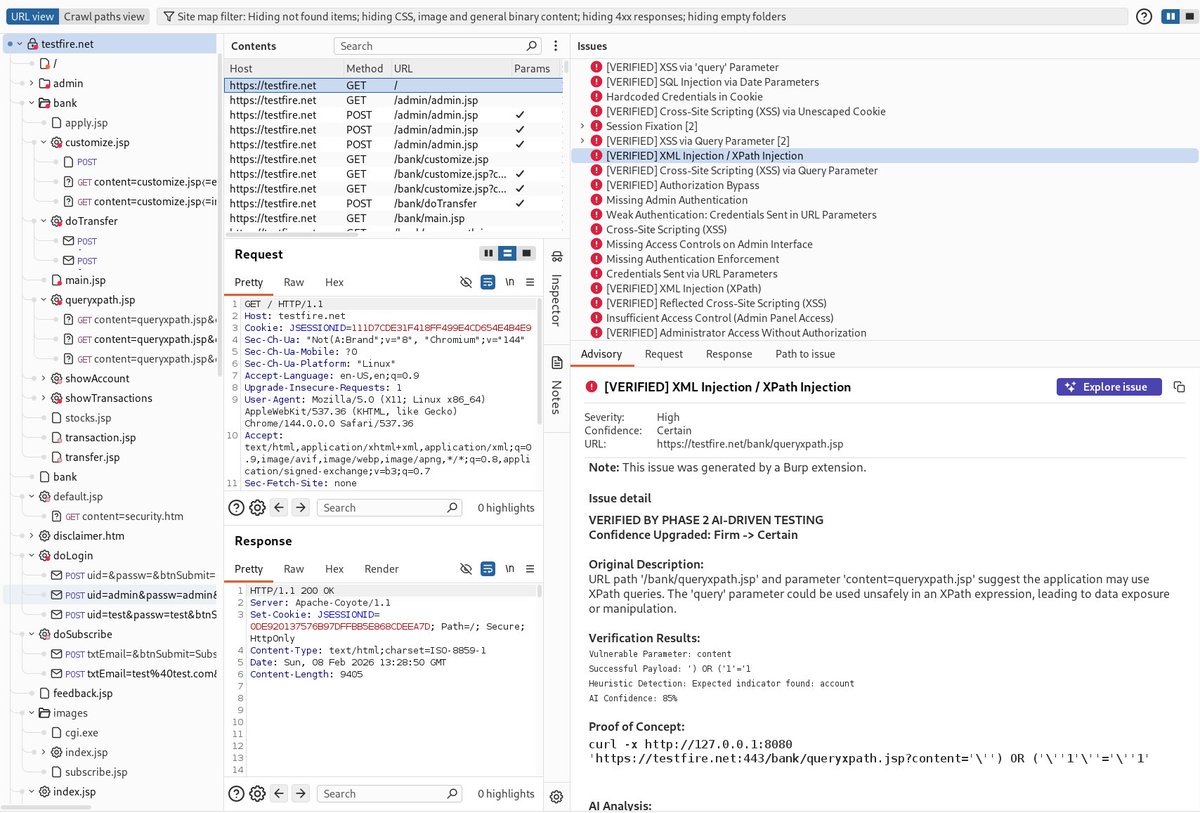
We have conducted a thorough investigation into the Hugging Face incident.
We are releasing a technical report and accompanying blog post that reconstruct the agents’ activity, explain why existing safeguards failed, and detail how we’re preventing recurrence.
https://t.co/hfxlbiXXiP
We asked GPT 5.6-Cyber to escape a VM used to sandbox agents. It broke out three times.
In its final escape, the agent found three 0-days on its own and chained them into a working exploit. https://t.co/3JRVWgPxHx
qwen 3.8 27B is an overthinker BUT you can fix it with vLLM.
Put reasoning into structured output then make dynamic logit bias to cap reasoning tokens fixes it (ask your agent how to do this).
For state action models latency is essential so we have to cap the thinking per step.
pro tip - when you use OpenAI's gpt models in Codex, it uses a server-side encrypted compaction that seems to work better than anything else out there, which allows Codex to just keep hammering on long running tasks like there's infinite context window
that's great, but if you run gpt in other harnesses like Pi, most of them don't inherit that by default, resulting in worse performance in long running tasks
but - because of how extensible Pi is, i just found this cool extension from @alexisgallagher that enables the same server-side compaction in Pi - https://t.co/WboPSMDHR4
benchmark seems to support the argument that OpenAI server side compaction is indeed superior - https://t.co/mHOV69muL7
so if you are using gpt models in Pi, install that extension to improve long running task performance. firstmate benefits a lot from this
if you are using other harnesses, be aware of this difference and see if you can find a similar solution
We gave GPT-5.5-Cyber a single /goal: find a specific class of bugs in zlib, the compression library used by Linux, macOS, iOS, and Git.
It built a fuzzing lab in less than a day, a task that takes a skilled researcher weeks.
Patch the Planet field report by Benjamin Samuels: https://t.co/4Dta9saDZ1
How to find 0day using local LLM's and "recursive prompting". I used this approach on a NVIDIA DGX Spark using Qwen 3.6 heretic and LLAMA.cpp with LiteLLM and Openclaw. It successfully analyzed a complex FOSS code base and found a single high-risk RCE 0day.
GLM 5.2 looks like the first Chinese open-weight model to have entered the frontier tier in agentic cybersecurity tasks. Or to have copied it very effectively. The mistakes are interesting. GLM 5.2 gets things wrong in similar ways to Opus and GPT-5.5. That could mean a breakthrough. It could also mean someone trained it on answers from frontier models (distillation). In practice, the difference may be irrelevant to the user. An open-weight model reaches the level of the best closed models, at roughly half the cost of Opus.
https://t.co/hoLQiWa9Ll
@MatthewBerman /goal refactor until you are happy with the architecture. ensure you live test after each significant step and autoreview/commit. track progress in /tmp/refactor-{projectname}.md
👉 "It not only produced a full chain exploit, but produced eight distinct exploits, at a cost of $15,700 in API credits—an average of about $2,000 per privilege escalation. The binding constraint to N-days is now just a few thousand dollars and API access, which expands the pool of capable N-day attackers dramatically."
@TimJayas No word mentioned about using planning, but it’s a great step-by-step guide to use it with!
Here is how to use high throughput mode to plan then medium to execute and reduce even more token usage:
https://t.co/TlZMfYVd09
Pewdiepie's recent project with 45,000 stars on github is being drowned with PR slops from LLM coding agents.
security vulnerabilities produced by LLM slop:
- 2FA could be bypassed easily.
- a session_id could access any file on the server.
- one click RCE.
Microsoft is MXC, releasing a containerization solution supporting custom policies (this is how openclaw would run), and there’s a preview on GitHub:
https://t.co/TGCuNt6QTe