🚨: China's putting data centers on the ocean floor. The ocean itself becomes the cooling system, reducing the energy and water demands traditional data centers require
#CHP 'ye
geçici #yönetici olarak atanan
#KemalKılıçdaroğlu 'na
#sanatçı "Onur Akın" da küsdü.
#Kayyum ,
#tedbir kararının kaldırılmasını
#talep edebilir.
Kurultay talebi en kısa zamanda gerçekleşirse;
Onur Akın,
kararını yeniden değerlendirebilir.
https://t.co/VrBWSMbtt7
Physics Chaos Like You’ve NEVER Seen It! Get ready to have your mind blown by one of the most beautiful displays of pure chaos in physics.This stunning simulation showcases Spring Pendulum Chaos — a mind-bending system where a double pendulum is attached to a sliding mass held between two horizontal springs. What happens next is pure mathematical magic: unpredictable, wildly sensitive motion that never repeats.Using the Lagrangian formulation, the simulation reveals the hidden machinery behind the madness — the mass matrix, Coriolis forces, stiffness matrices, and evolving generalized coordinates all working together to create endlessly complex, hypnotic https://t.co/auGOagDRzg tiny change in starting conditions and the whole dance transforms completely. That’s the signature of true chaos: beautiful, unpredictable, and infinitely fascinating.Whether you’re a physics student, math lover, or just someone who appreciates the raw elegance of the universe… this one will hook you.The math behind the madness has never looked this mesmerizing. Who else could watch this for hours? Drop a if chaos just became your new favorite kind of beauty!
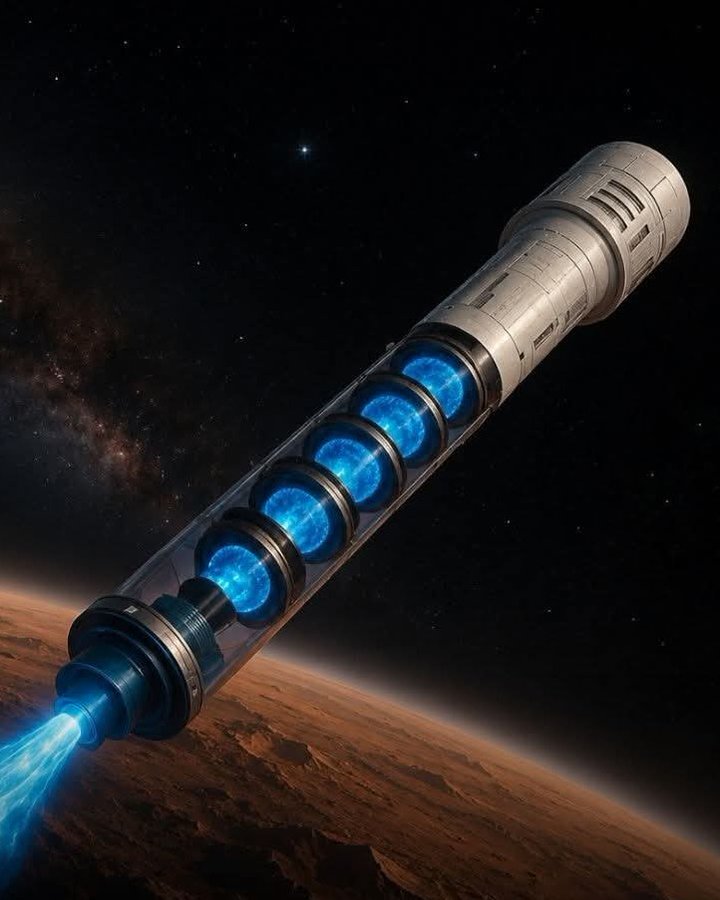
Nuclear Fusion: The Engine That Could Get Us to Mars in Weeks Imagine slashing the journey to Mars from a grueling 6–9 months one way down to just a few weeks.That’s the tantalizing promise of nuclear fusion propulsion — a technology that could revolutionize human spaceflight and make the Red Planet feel like a neighboring city instead of a distant world.From 500 Days to 30–90 DaysTheoretical studies and mission concept papers show that advanced fusion-powered spacecraft could reduce a full round-trip mission to Mars from roughly 500 days (using today’s chemical rockets) to as little as 30 to 90 days under optimistic but plausible engineering scenarios.Instead of burning chemical propellants in short, powerful bursts, a fusion drive would harness the same energy source that powers the Sun: controlled nuclear fusion. By smashing light atomic nuclei together, it releases enormous energy and generates exhaust velocities far beyond anything chemical rockets can achieve.Why Fusion Changes EverythingThe real game-changer is continuous thrust. A fusion spacecraft could accelerate for weeks or months, then flip and decelerate — creating a fast, efficient trajectory instead of the long, coasting Hohmann transfer orbits we use today.Because propulsion efficiency grows non-linearly with exhaust velocity, even modest improvements in energy density deliver massive reductions in travel time. In other words, fusion doesn’t just make things faster — it makes the impossible feel almost within reach.The Road AheadOf course, challenges remain huge. We still need:Stable net-energy-gain fusion reactions
Compact, lightweight reactors suitable for space
Advanced radiation shielding to protect the crew
Concepts like those studied by NASA and research teams draw inspiration from Earth-based experiments such as ITER, but scaled and optimized for propulsion rather than stationary power generation.If we succeed, fusion propulsion could become one of the few realistic pathways for crewed missions across the Solar System on human timescales — turning months-long voyages into routine trips and opening the door to the rest of the planets.The age of fusion-powered exploration may still be a decade or two away… but when it arrives, Mars will suddenly feel a lot closer.
🚨 PHYSICISTS JUST CONFIRMED “NEGATIVE TIME” IS REAL IN A MIND-BENDING QUANTUM EXPERIMENT.
Light can exit a cloud of atoms before it even enters.
In a new experiment, researchers fired photons through a dense cloud of ultra-cold atoms and measured something that shouldn’t be possible in classical physics.
Some photons appeared to spend a negative amount of time inside the cloud effectively leaving before they had fully arrived.
Why this matters:
• This isn’t time travel it’s a quantum effect involving how light interacts with matter at the deepest level
• It comes from “weak measurements” that let scientists observe the system without fully disturbing it
• The atoms themselves “report” spending negative time in an excited state
• It challenges our everyday intuition about cause and effect in quantum systems
The deeper implication is enormous:
We are seeing the strange, non-intuitive nature of quantum mechanics play out in real experiments.
Time at the quantum scale doesn’t always behave like the arrow we experience in daily life. Effects can appear to precede causes in measurable ways without breaking relativity or causality.
This is one of the clearest experimental windows yet into how reality works at its most fundamental level.
What do you think does “negative time” change how you see reality, or is it just another quantum quirk we’ll eventually get used to?
Follow for more frontier physics and reality-bending discoveries.
⚡Scientists Just Measured the Speed of Quantum Magic 🤯
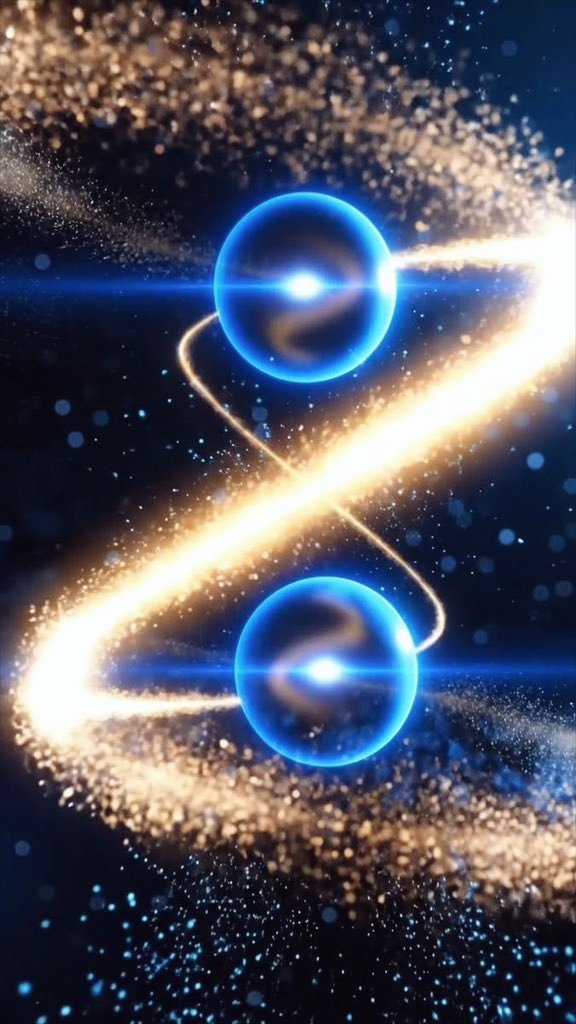
For a long time, scientists believed quantum entanglement happens instantly — with no time at all. But now, they have discovered something shocking: it actually takes a tiny bit of time. A time so small it is hard to imagine — called an attosecond.
Inside an atom, a strong laser hits and knocks one tiny particle, called an electron, out of the atom. Another electron stays inside. But instead of becoming separate, the two become strangely connected. Whatever happens to one also affects the other, even if they are far apart. It’s like having two coins that always show the same side when you flip them.
The strange part is this: the electron that flies away doesn’t know exactly when it left. It is in a blurry state between moments. And that tiny time difference is linked to the energy of the electron left behind. Scientists found this delay is only about 232 attoseconds — a number so small it is almost impossible to feel.
This proves that quantum entanglement is not magic. It is a real process that happens over a very short time — and now we can measure it.
This matters because future technology like super-fast computers and unbreakable messages depend on entanglement. By learning how it starts, scientists can one day learn how to control it.
Even in the smallest moments, the universe is doing something incredible. ✨️
🚨 The Terrifying Theory That Explains Why Aliens Never Contact Us 👽
Look up at the night sky for a moment. Billions of stars shine across the universe. Around many of those stars, there are planets — some possibly similar to Earth.
With numbers this huge, scientists believe intelligent life should exist somewhere out there.
So the question becomes deeply mysterious: Why is the universe so silent?
This puzzle is known as the ****. If alien civilizations are common, we should have seen signals, spacecraft, or some evidence by now.
But we haven’t.
One chilling explanation is called the ****.
According to this idea, the universe is like a vast, dark forest at night.
In that forest, every civilization is like a hunter moving quietly between the trees. No one knows who else might be out there. Some hunters may be peaceful… but others might be dangerous and far more powerful.
In such a place, making noise could be deadly.
If you shout in a dark forest, something might hear you.
And you have no way of knowing whether what hears you is friendly… or a predator.
The Dark Forest theory suggests that advanced civilizations may choose to stay completely silent to survive. Broadcasting your location across the universe could be like lighting a bright beacon in the darkness — announcing exactly where you are.
A more advanced civilization might detect that signal and decide it is safer to eliminate you before you become a threat.
After all, in a universe where survival is uncertain, the safest strategy might be simple: destroy potential rivals before they grow stronger.
This possibility creates a haunting image of the cosmos.
Somewhere out there, intelligent civilizations may exist — hiding, listening, and watching the darkness carefully.
They may have detected signals from other worlds long ago… and quietly chosen to remain silent.
And here is the unsettling part.
For decades, humans have been sending radio signals into space. Our television broadcasts, radar systems, and scientific transmissions have been leaking into the cosmos since the early 20th century.
From far away, Earth might look like a glowing signal in the dark forest.
So the next time you gaze up at the stars, remember this strange possibility.
The universe may not be silent because no one is there.
It may be silent because everyone is hiding.
Molla Nasreddin Dergisi 20260427 223121 0000 : MEHMET KARABAĞLI : Free Download, Borrow, and Streaming : Internet Archive https://t.co/aoWv9LUjvm @internetarchive
A virus that kills cancer has stopped pancreatic tumors in three people.
Currently, the 5 year survival rate for pancreatic cancer is just 13%. This could change everything.
An experimental, cancer-killing virus has halted advanced pancreatic tumors in three clinical trial patients, despite researchers administering just one-tenth of the targeted therapeutic dose.
In an unexpected medical breakthrough, an early-stage clinical trial designed solely to evaluate the safety of an experimental oncolytic virus ended up halting the growth and spread of advanced pancreatic tumors in three patients. Led by Dr. Masato Yamamoto at the University of Minnesota, the trial administered just one-tenth of the targeted, eventual dose. Despite this microscopic amount, the modified virus successfully targeted the patients' tumors, raising hopes for a powerful new weapon against one of the deadliest forms of cancer.
The treatment works by utilizing a genetically modified virus that selectively infiltrates and multiplies inside cancer cells, causing them to burst while sparing healthy surrounding tissues. While these early-stage results are incredibly encouraging, experts urge caution, noting that the trial was extremely small and that larger-scale, multi-phase clinical evaluations are still required to confirm how reliably the treatment works in a broader population.
source: New Scientist. (2026, May 29). Pancreatic cancer halted by virus injection in three patients.
🚨 BREAKING NEWS:
SCIENTISTS DISCOVERED A 392-YEAR-OLD SHARK STILL SWIMMING IN THE ARCTIC OCEAN.
This Greenland shark was born around 1634 the same era as the first European settlers in North America.
It has been gliding through the freezing Arctic depths for nearly four centuries.
Why this matters:
• Greenland sharks are the longest-living vertebrates on Earth
• They grow extremely slowly only about 1 cm per year
• They reach sexual maturity at around 150 years old
• This one was radiocarbon-dated using the proteins in its eye lens (which never degrade)
The deeper implication is staggering:
While humans are racing to understand aging and longevity, this shark has been quietly living through the entire modern era from the invention of the telescope to the first Mars landings without ever surfacing.
It has seen more history than almost any other animal alive today.
What does it feel like to know a creature born in the 1600s is still swimming in our oceans right now?
Follow for more frontier biology and mind-bending discoveries.