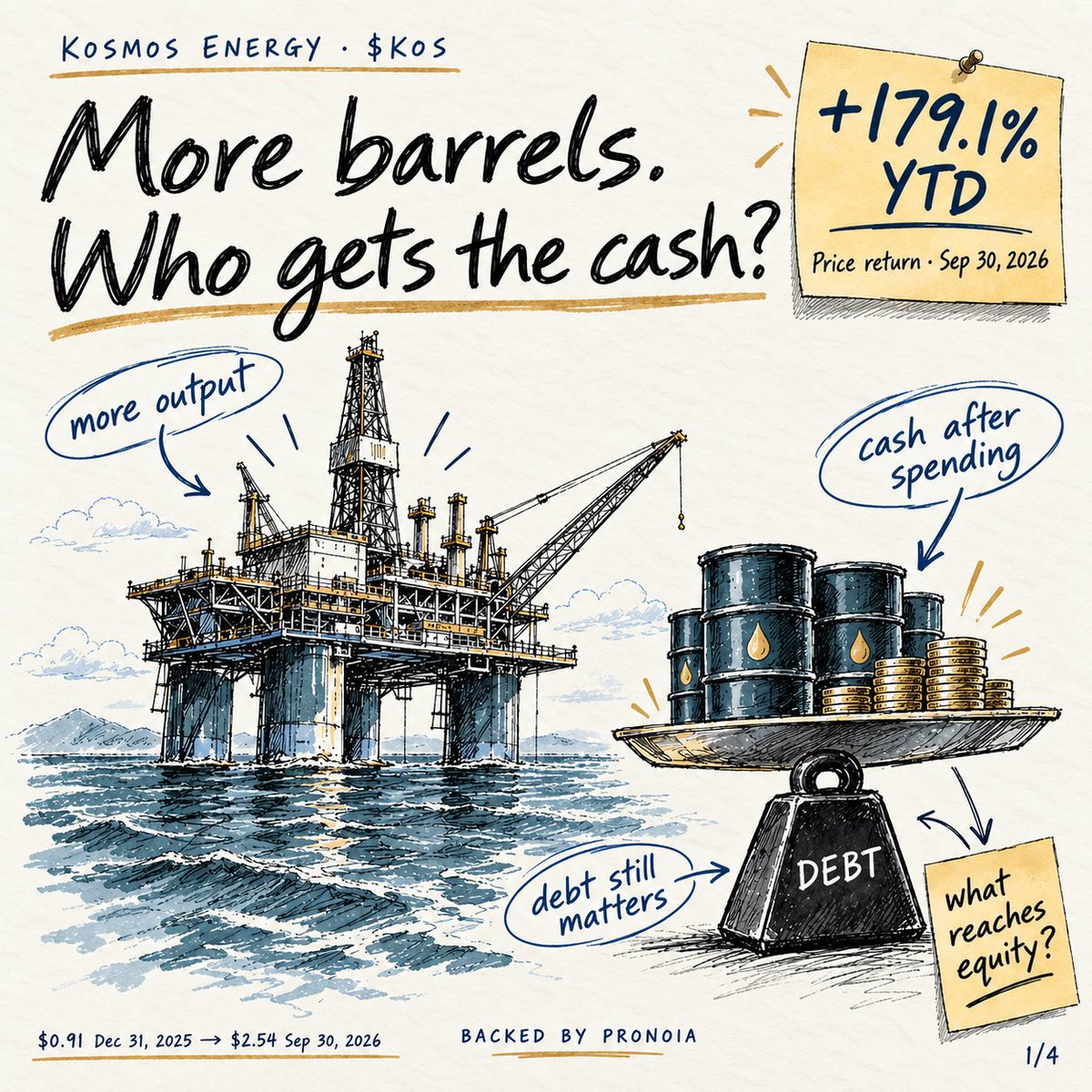
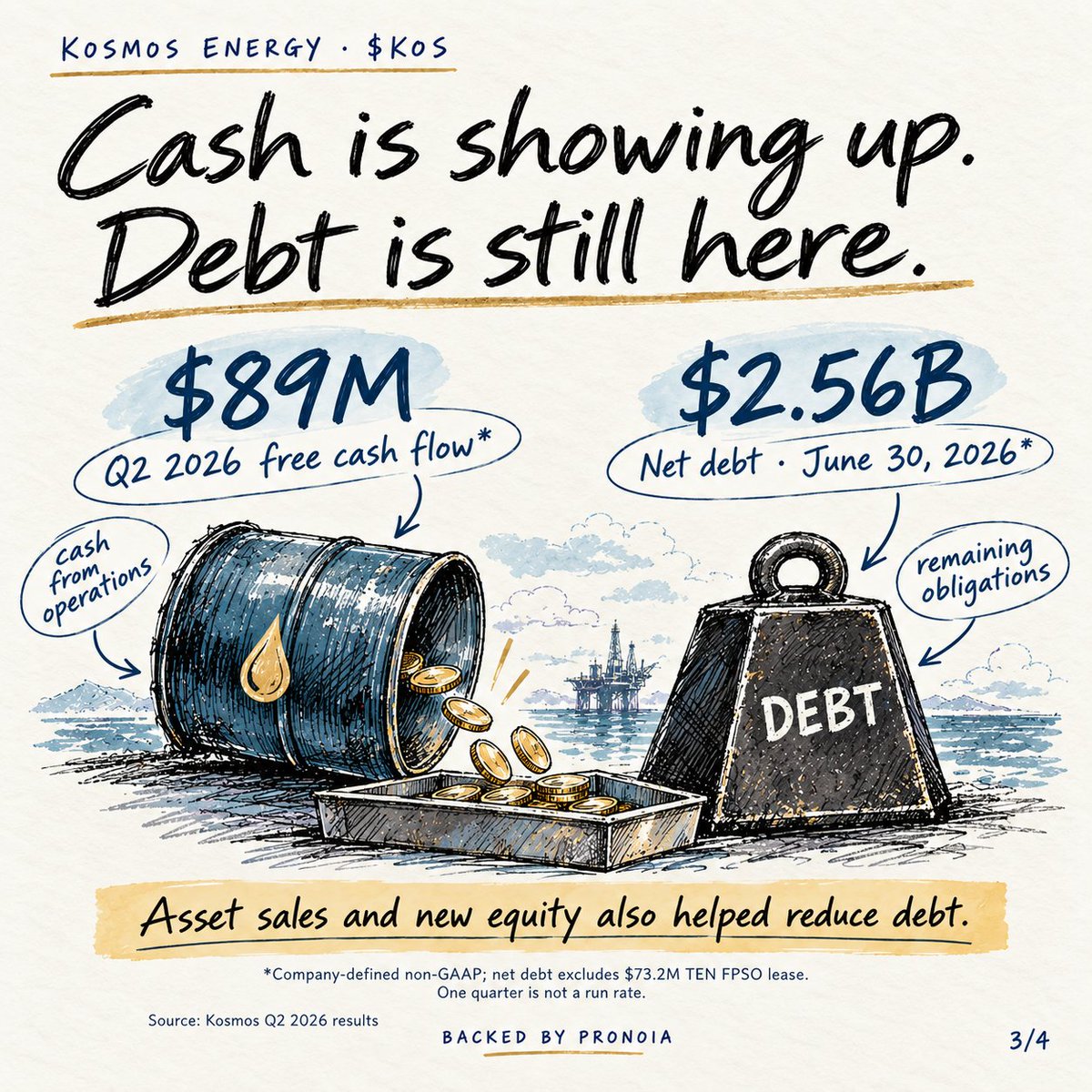
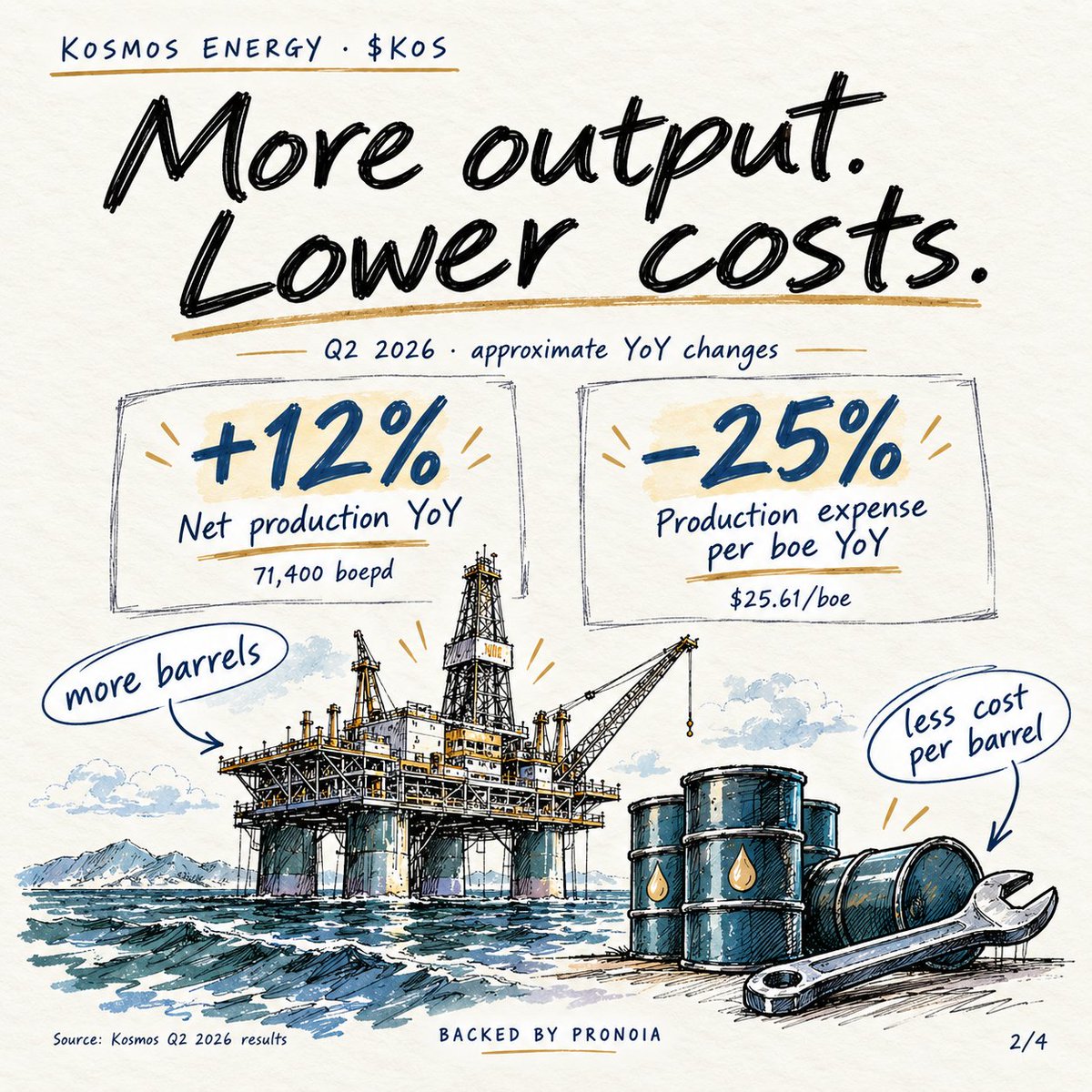
Kosmos Energy $KOS : +179.1% YTD.
i called it on July 8. More barrels, lower costs. Now the cash needs to pay down the debt.
The thesis, in four sketches 👇
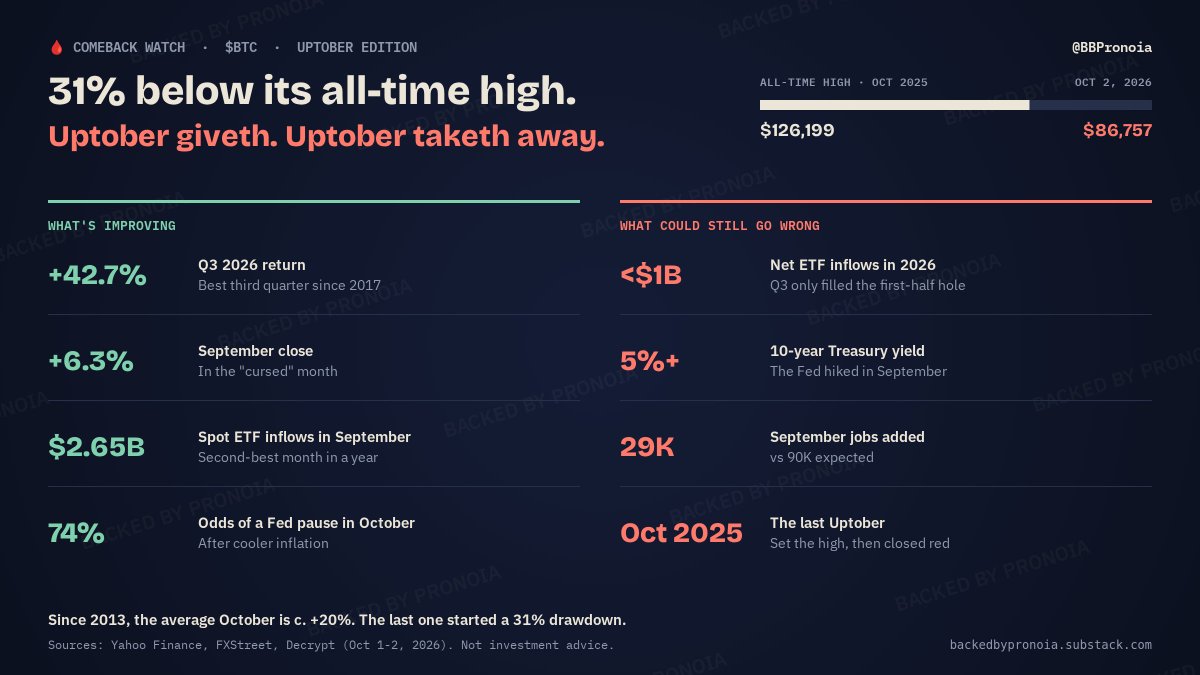
🩸 Comeback Watch: $BTC, Uptober edition
$86K. Still 31% below the all-time high.
That high was set last October. So was the start of the fall.
Improving: best Q3 since 2017, $2.65B of ETF inflows in September.
Still open: 10-year above 5%, and 2026 ETF inflows under $1B net.
Uptober giveth. Uptober taketh away.
Bounce or comeback?
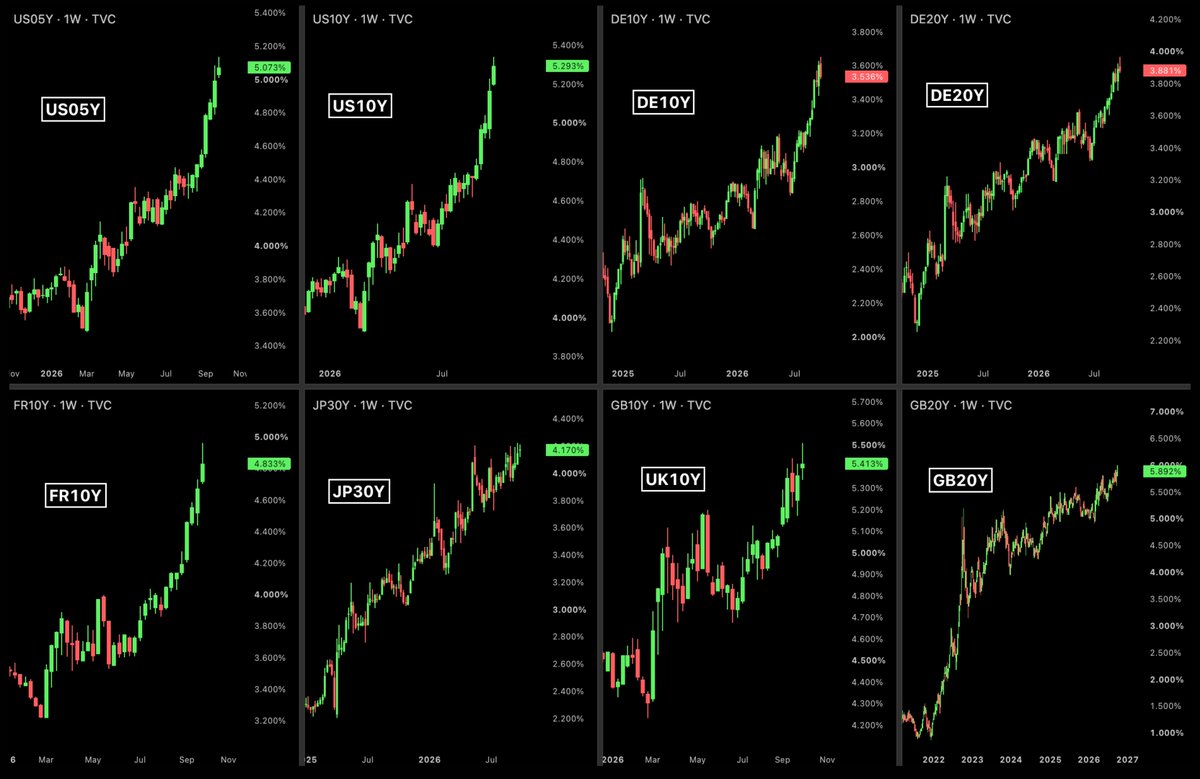
🚨 Global debt now exceeds $365 trillion.
That's roughly 310% of global GDP, an ALL TIME RECORD.
Now the cost of servicing that debt is exploding everywhere at the same time.
US 5-year Treasury: 5.136%, highest since 2007 (19 year high)
US 10-year Treasury: 5.340%, highest since 2002 (24 year high)
US 20-year Treasury: 5.730%, highest since 2002 (24 year high)
US 30-year Treasury: 5.681%, highest since 2002 (24 year high)
UK 5-year Gilt: 5.062%, highest since 2008 (18 year high)
UK 10-year Gilt: 5.510%, highest since 2007 (19 year high)
UK 30-year Gilt: crossed 6.029%, highest since 1998 (28 year high)
Japan 10-year bond: 3.126%, highest since 1996 (30 year high)
Japan 30-year bond: 4.223%, a record high since Japan started issuing this bond in 1999
Germany 10-year bond: 3.65%, highest since 2009 (17 year high)
France 10-year bond: 4.963%, highest since 2002 (24 year high)
Australia 10-year bond: 5.448%, highest since 2011 (15 year high)
The entire world is drowning in debt.
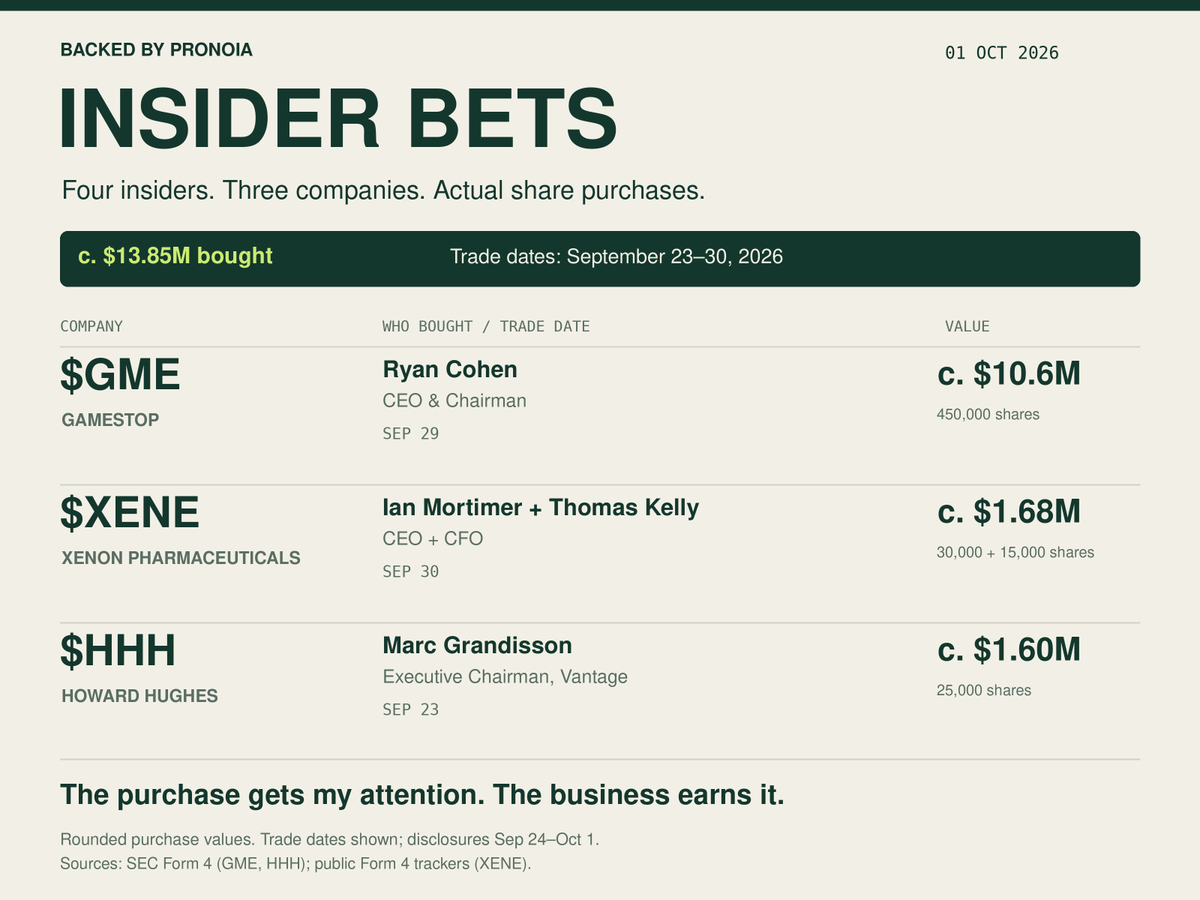
💰 Insider Bets — October 1
my favourite management presentation is a purchase receipt.
Four insiders. Three companies. Here’s where they put their money:
🎮 $GME — Ryan Cohen: c. $10.6M
GameStop’s CEO bought 450,000 shares on September 29 at c. $23.48, taking his direct holding to 40.95M shares.
A big cheque. Still only a c. 1.1% increase in his existing position.
My test: can the operating business generate sustainable cash? Cohen buying more doesn’t answer that for us.
🧬 $XENE — CEO + CFO: c. $1.68M
On September 30, Ian Mortimer bought 30,000 shares at $37.38. CFO Thomas Kelly bought 15,000 at c. $37.32.
The context matters: Xenon recently paused new enrollment in psychiatry trials following adverse events. Its epilepsy studies continue, and its drug application for focal seizures has been submitted to the FDA.
My test: regulatory progress in epilepsy and clarity on the psychiatry safety issues. Two executives buying cannot replace clinical evidence.
🏘️ $HHH — Marc Grandisson: c. $1.60M
Vantage’s executive chairman bought 25,000 Howard Hughes shares on September 23 at c. $64.12, increasing his direct holding by c. 35%.
HHH completed its $2.1B acquisition of insurer Vantage in June. Someone close to that business is increasing his exposure to the parent.
My test: underwriting profitability and investment returns. The holding-company story needs numbers.
The purchases get these names onto my research list. What happens in the business keeps them there.
Which deserves a deeper dive?
Trade dates: September 23–30. Disclosed September 24–October 1, 2026.
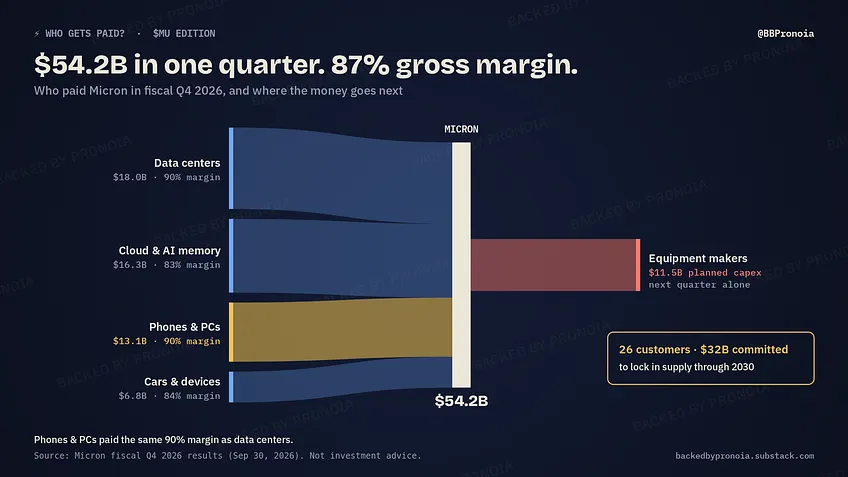
⚡ Who Gets Paid? $MU edition
Micron made $54.2B in one quarter. Gross margin: 87%. Somebody is paying that bill. Here's who.
Data centers and cloud AI → $34.3B.
The AI build-out is the obvious payer.
Phones and PCs → $13.1B, at a 90% margin. The same margin as data centers. That cost lands somewhere. Eventually, probably on you.
26 big customers → $32B committed to lock in supply through 2030. Buyers are paying today to make sure they get memory tomorrow.
Equipment makers → $11.5B of Micron capex next quarter alone. Every memory shortage becomes someone else's order book.
Yesterday I asked if it was too late to buy. Last night the customers answered: they're still paying.
Which one surprised you?
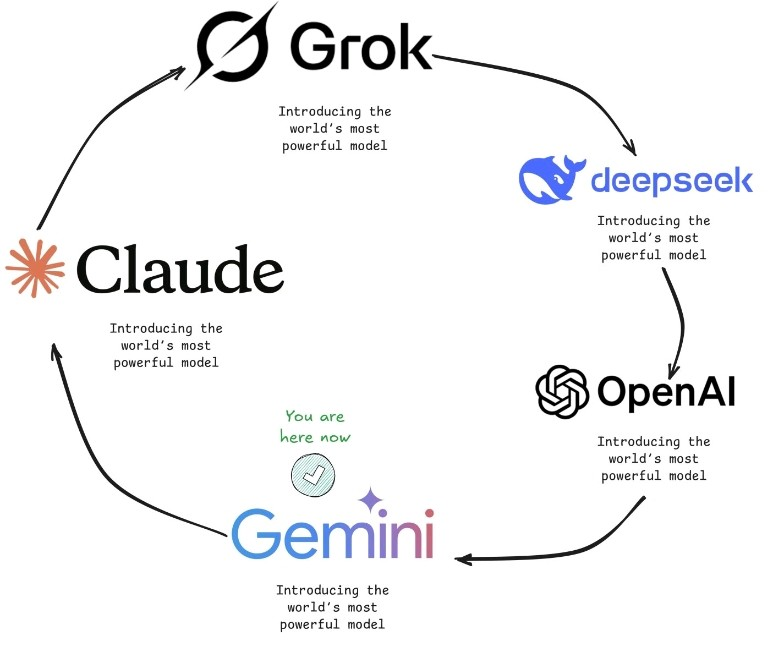
Now it's $GOOG, but OpenAI will be back in top in weeks, then Anthropic again... and so on.
On the while we'll see 4 more Chinese disruptions.
"artificiar interigence"
OpenAI can’t catch a break lol.
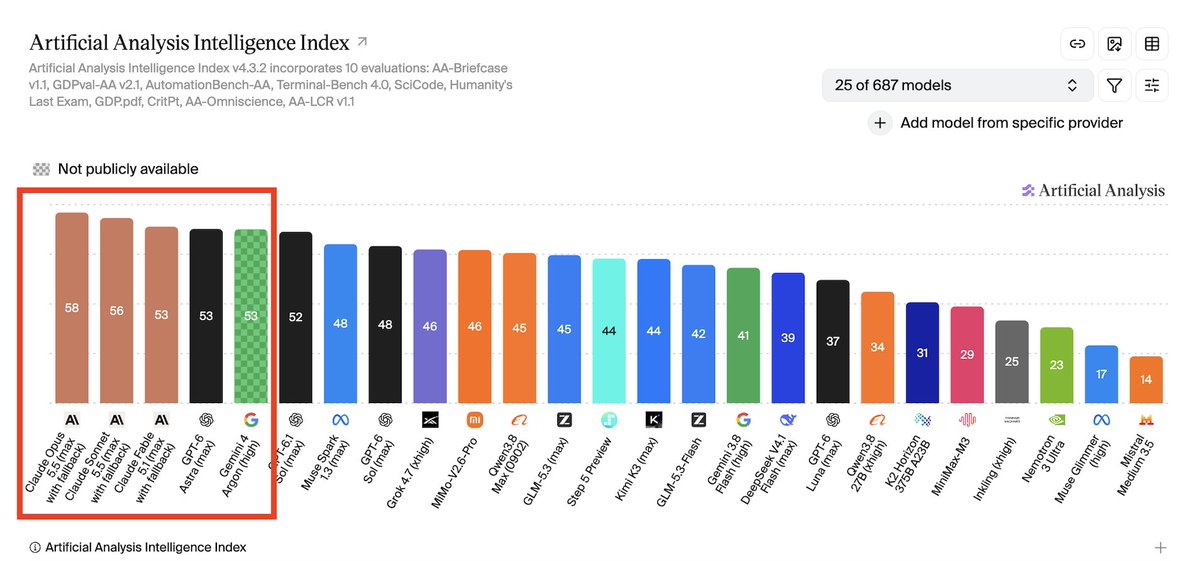
Claude Opus 5.5 leads Artificial Analysis. Now Google’s Gemini 4 Argon matches GPT-6 Astra’s score.
Cost per benchmark task:
Opus 5.5: $5.98
Astra: $3.26
Google: $1.99
Google is 39% cheaper than Astra and 67% cheaper than Opus.
🧨 Too Late to Buy? $MU edition
In July I called Micron the place where AI FOMO goes to meet God. The FOMO won. Up 555% in a year. Now a $1.2 trillion company. Report is out.
The bull case: it looks cheap. Around 7x next year's expected profit. Analysts expect c. $150 a share, up from $44 over the last twelve months.
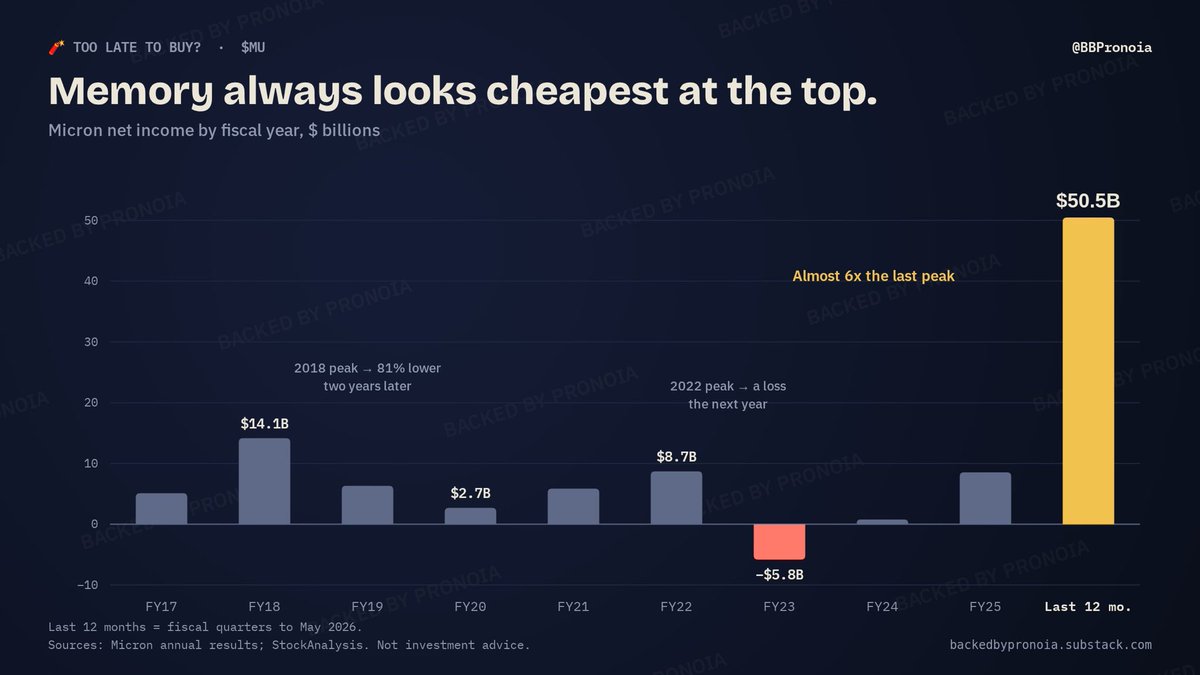
The catch: memory always looks cheapest at the top. 2018 peak profit: $14.1B → $2.7B two years later. 2022 peak: $8.7B → a $5.8B loss the next year. Today: $50.5B, almost 6x the last peak.
The business: never been better. The price: needs this boom to be different.
Too late? Tell me why I'm wrong.
The calculation:
$280 × 1.10⁵ ÷ 30 = $15.03 in annual earnings per share.
$15.03 × 323.331M shares ÷ 20% net margin = $24.3B in annual revenue.
Lower margins, a lower final valuation or additional dilution would raise that hurdle.
🧨 Too Late to Buy? $BE Bloom Energy edition
i love a stock right up until i read what it costs.
• The price: around $280, up roughly 280% over the past year. The power shortage has shareholders’ attention.
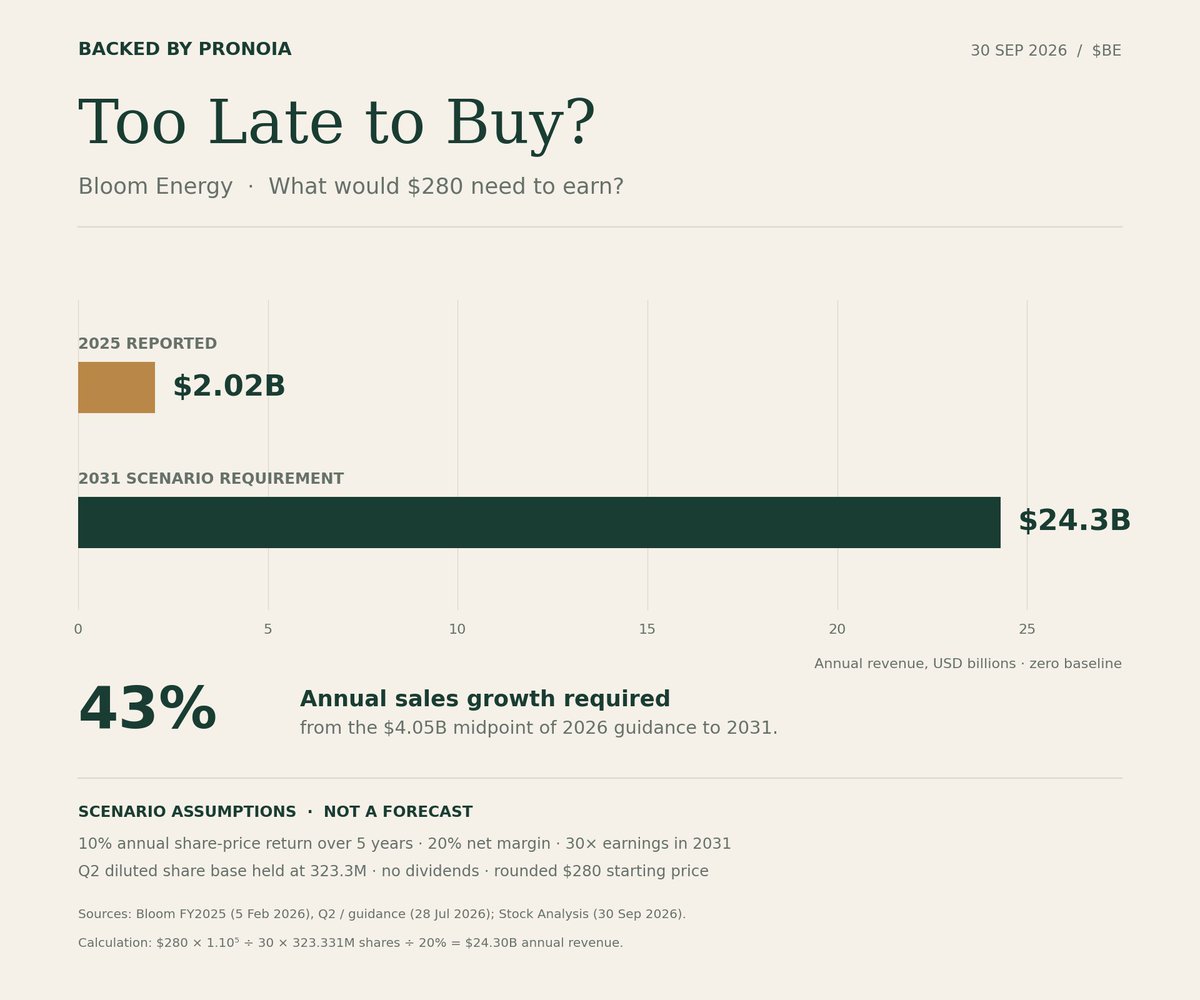
• What it needs: roughly $24.3B in annual revenue by 2031 to deliver a 10% annual share-price return under the assumptions below.
• What it has done: $2.02B in revenue in 2025. Its latest 2026 guidance is $3.9–4.2B.
• The hurdle: about 43% annual sales growth from the 2026 guidance midpoint for five years, reaching a 20% net profit margin.
The business has a real bottleneck to solve. The price needs years of profitable expansion.
Assumptions: $280 starting price; 30× earnings in 2031; 20% net margin; Q2 diluted share count held flat at 323.3M; no dividends. An illustrative scenario, not a forecast.
Data as of September 30, 2026. Sources and calculation in the first reply.
Too late? Which assumption would you change?