“…language models do not replace linguistic theories, but they do tell us things about language, and they do force us to rethink certain approaches.”
— Richard Futrell & Kyle Mahowald
https://t.co/xL5OnhPR8Q
“Knowledge incubated within the peer group can act as a cultural safety net, called upon when adult knowledge is insufficient.”
— Sheina Lew-Levy & Dorsa Amir
https://t.co/XKXVBSOLf6
“Do we need both a mentalistic and an institutional stance?”
“The institutional stance” by Julian Jara-Ettinger & Yarrow Dunham (@yarrowdunham). Full BBS treatment, with commentaries and authors’ response:
https://t.co/iCrApLadLT
“Indeed, specifically social tinkering may be uniquely human.”
“Social tinkering: The social foundations of cultural complexity” by @NickJChater & @MH_Christiansen. Full BBS treatment, with commentaries and authors’ response:
https://t.co/W60LNrJFcm
Does egalitarianism require equality?
“Egalitarianism is not equality: Moving from outcome to process in the study of human political organisation” by Stibbard-Hawkes & von Rueden. Full BBS treatment, with commentaries and authors’ response:
https://t.co/gjQcrf4Rz3
“This raises the question: what can we learn by including metabolism when we model cognition?”
“Metabolic considerations for cognitive modeling” by Philipp Haueis & David Colaço. Full BBS treatment, with commentaries and authors’ response:
https://t.co/lMvgMpJgA0
Eric Schwitzgebel @eschwitz on biological naturalism, and how artificial systems (beyond current AI) might come to instantiate 'biological' properties relevant for consciousness. Eric provided an excellent commentary on my recent @BBSJournal piece, and this blog post expands usefully on it: https://t.co/IuD8EgPsFj
In new @BBSJournal Commentary, @chris_percy argues that metabolic costs may explain why brains favour specialised systems – from neural circuits & glia through to possible (& more speculative) analogue field mechanisms inspiring R&D in advanced computers. https://t.co/FtFXgoDglf
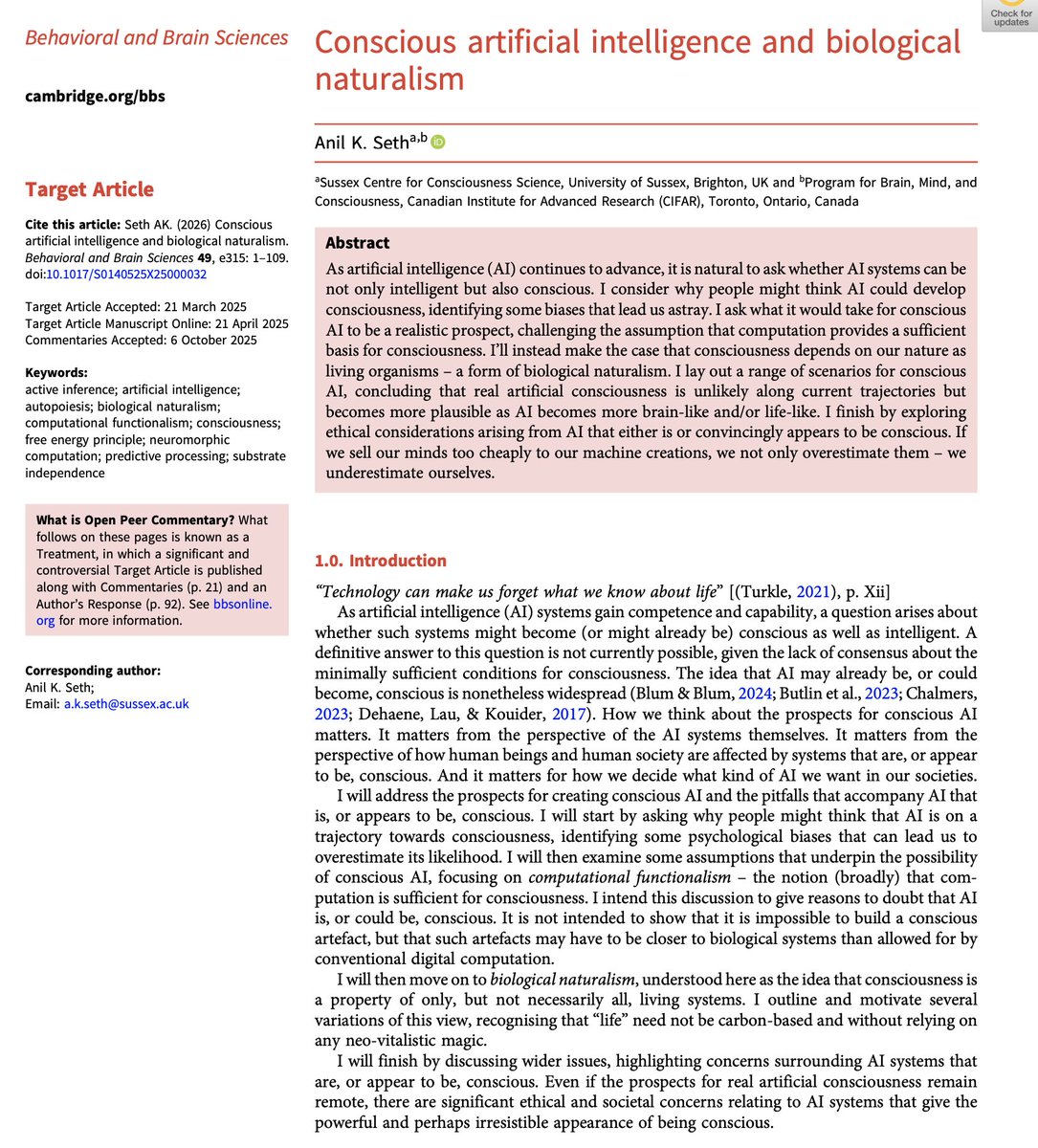
🎇 Good news! 🎇 The kind people at @BBSJournal have made the new collection on "Conscious AI and biological naturalism" completely #OpenAccess for a limited period. This include the target article, all 50 commentaries (many of which disagree with me), and my response. Go to the link and click 'save pdf': https://t.co/6ZFzHrUsUR
For easier ways into the debate, try my @NoemaMag essay on "The Mythology of Conscious AI" (winner of the 2025 @berggruenInst Essay Prize), and this 2026 main-stage @TEDTalks:
https://t.co/LmSiQnT9Wh
https://t.co/vDvw82ookk
In case useful, here's a (temporarily) #OpenAccess @BBSJournal@BBSJournal collection on 'conscious AI and biological naturalism', with a target article, 50 peer commentaries, and my author response. Hopefully a decent representation of where the substantive debate is at: https://t.co/oo6dm8m3Lm
In case useful, here's a (temporarily) #OpenAccess @BBSJournalrnal collection on 'conscious AI and biological naturalism', with a target article, 50 peer commentaries, and my author response. Hopefully a decent representation of where the substantive debate is at: https://t.co/oo6dm8m3Lm
Hi @michaelshermer - thanks for posting the essay 🙏🏽 To clarify, my arguments against computational functionalism (substrate-independent computations being sufficient for consciousness) do not depend on biological necessity. So, indeed, I am not suggesting a theist (or a vitalist, or a carbon chauvinist) argument. The longer version is in @BBSJournal - target article, 50 (!) commentaries, and my response: https://t.co/6ZFzHrV0Kp
We have a perfectly adequate working definition of consciousness, sufficient to distinguish it from intelligence and other forms of cognition. I'm sorry the discussion hasn't been helpful to you, though I agree that neuroscience is often insufficiently incorporated.
Can I suggest the below @BBSJournal collection. Even if you don't agree with my position, there are plenty of different perspectives - drawing on neuroscience - in the (50) commentaries: https://t.co/6ZFzHrUsUR
The "time" argument, developed here by @MiTiBennett via @Noahpinion, is one among many arguments against computational functionalism. The UCLA neuroscientist Dean Buonomano has persuasively made a similar case (https://t.co/E4M62ROSVH).
FWIW my @bigthink article and part of my @BBSJournal author response also follow this line: for standard Turing computation only sequence matters, but for neurophysiology and for consciousness the continuity of physical time matter too. Brains (& conscious experiences) are not just embodied and embedded, they are also *entimed*.
See https://t.co/8KvtjL0WL9) and https://t.co/q1E5gCil3l - snippet attached 👇🏽
"I can tell you this, though: Every single person who thinks that machines cannot be conscious, is making an argument that humans are special. Everything they say just boils down to blah blah blah, "nooo, we're special." From there it's just rationalization."
This is very far from the truth. There are many (IMO compelling) arguments against (silicon, digital) machine consciousness that in no way depend on human exceptionalism, or even on carbon chauvinism.
To get a good sense of the current debate in academia, have a look at this just-out @BBSJournal paper, along with 50 commentaries (from all perspective), and my response. You'll see a much richer debate than you describe. https://t.co/bQVmlAXLa0
Thanks for your advice. I've been working on these issues for ~25 years, but I'm always open to learning more. See this recent @BBSJournal collection for a summary of where I stand now (with 50 peer commentaries, all from smart people with relevant experience): https://t.co/pzszCvMSgB
Anil Seth's essay on biological naturalism (in opposition to the possibility of AI consciousness) is an interesting counterpoint, which of course drew lots of commentary and disagreement. A large collection of responses is now available with the article: https://t.co/YJu5TRhIqY
Thanks @davetroy - appreciated 🙏🏽. FWIW the key entry points in my work are (in order of accessibility) my TED talk (https://t.co/FQLrSbssgo), my @NoemaMag essay (https://t.co/OWd3FVz9LU), and - just out - this @BBSJournal collection (https://t.co/QNZ1RVBWP9)
Hi @clairlemon. I've been thinking about the possibility of 'conscious AI' since 2009 (https://t.co/VCtZaYIrXJ). I am a vocal skeptic, but I don't think it helps to characterise those who think AI might be conscious as 'insane'. Polarisation is dangerous, and the question of 'AI consciousness' is scientific, not political. There are good arguments on both side. IMO the sceptical arguments are far stronger, but others disagree & I respect and engage with their views.
For a representative take on the state of the debate in academia, see this just-published @BBSJournal collection, which has my target article, 50 peer commentaries, and my response. https://t.co/pzszCvMSgB