My new book is out: The Making of the Middle East: The Myth and Reality of Political Power.
Growing out of my notes taken over roughly two decades of reading on the region it is a basic account of the making of the Middle East.
Here is the link: https://t.co/3c6m9nRLB0
Orta Doğu'nun perde arkası!
İsrail-Birleşik Arap Emirlikleri 'dostluğunun' sebepleri neler?
Siyaset bilimci Dr. Birol Başkan @BBaskanNotes ile konuştuk.
Abone olmayı unutmayın!
https://t.co/NNetPAE9bX
Today at 20:30 Ankara time, I will join @hediyelevent to discuss UAE-Israel relations: how they began, where they stand today, and where they may be heading.
Orta Doğu'nun perde arkası!
İsrail-Birleşik Arap Emirlikleri 'dostluğunun' kökleri!
Siyaset Bilimci Dr. Birol Başkan @BBaskanNotes ile konuşuyoruz.
⏰20.30'da
Abone olmayı unutmayın!
https://t.co/jGKi7mlTW2
America cannot align Turkey, Syria, and Iraq toward shared prosperity if these countries, and their peoples, are not willing to move in that direction themselves.
America can assist regional cooperation. It cannot manufacture it.
I can see why this tweet caused discomfort in Turkey. It puts Turkey in the same file with two Arab states. Ussama Makdisi once spoke of Ottoman Orientalism. The ambassador should have studied his lesson well: Modern Turkey is the principal inheritor of the Ottoman Empire. +
In the tradition of those who have long studied the Levant and Anatolia — Iraq, Syria, and Turkey remain the strategic fulcrum upon which any enduring Middle East stability must pivot. Balancing these three nations requires a single, consistent point of American contact and leverage — transcending tribal, religious, or sectarian differences. This vital mission, embraced by President Trump, seeks to aid the region in aligning itself toward shared prosperity by weaving its disparate threads into one coherent tapestry of order and mutual interest.
In any case, I think the Turkish reaction is hypersensitive.
My objection is elsewhere. The ambassador says America seeks to “aid the region in aligning itself toward shared prosperity.”
That is the fantasy.
Then We Are All Intellectual Idiots
Mark Manson's Piece titled "Intellectuals are F*cking Idiots" is disappointing for it turns a serious methodological problem into a cheap insult.
cont'd: https://t.co/Ak1o9kLA1j
I lived in Qatar for almost ten years, and I do not remember seeing Qatari men publicly show affection toward their female relatives.
What Sheikh Temim shows is human. And very glad to see.
It was born from historical fear. Jews in Turkey had seen what had happened to Armenians and Greeks. They knew, or at least feared, that their turn could come too. Kayadez was therefore not just silence. It was survival performed under the shadow of catastrophe.
This article left a bitter taste.
Turkish Jews passed through a lot: the 1934 Thrace pogrom, 20 Kura forced labor, the Varlık Vergisi, Aşkale, wartime fear, and the shadow of the Holocaust. Yet their main public newspaper often could not even name what was happening.
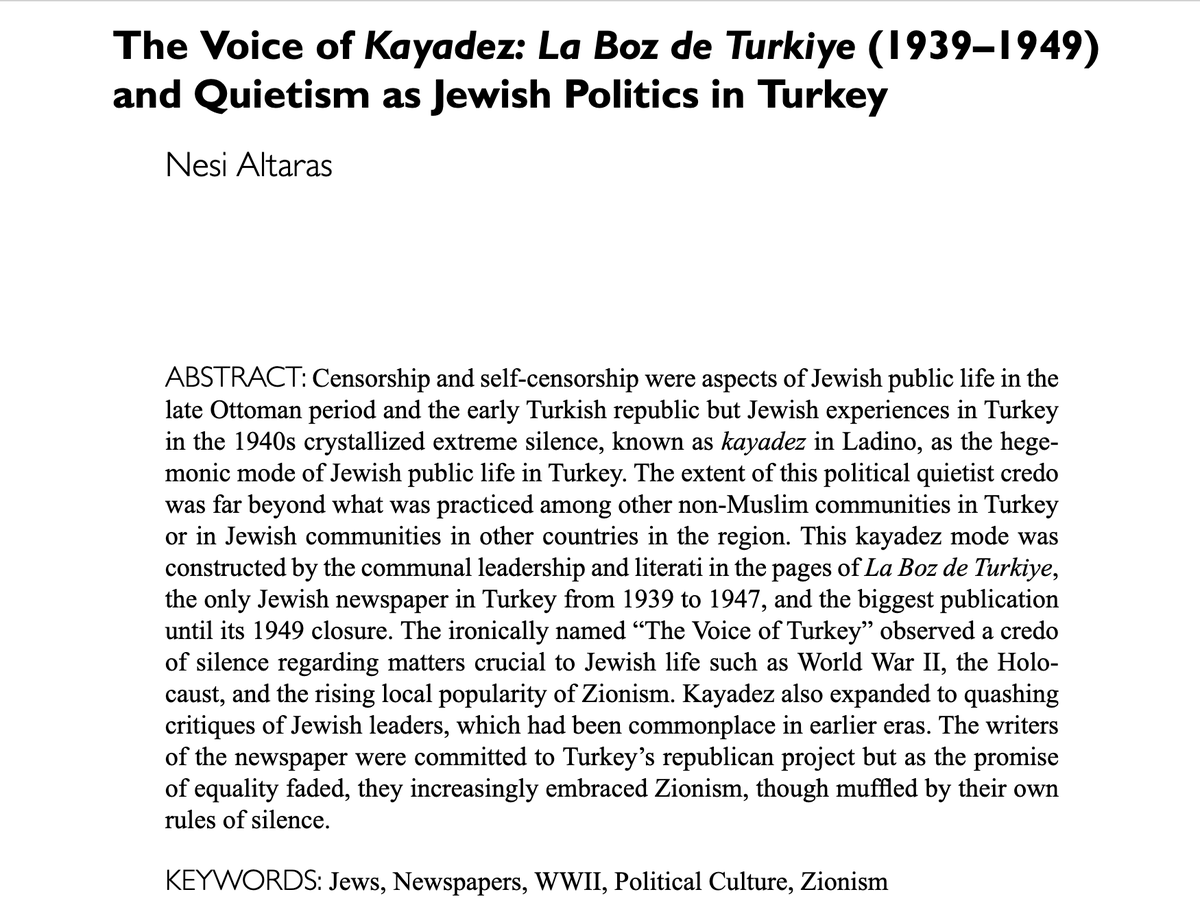
My new paper on the crystallization of kayadez, Jewish political quetism, is out! I read through the 10 year run of La Boz de Türkiye, the only (later main) Jewish newspaper in Turkey 1939-1949.
Scroll this the thread for a summary of main arguments and the link!
Instead they had to appear loyal. Grateful. Content.
That is the cruelty of kayadez: being forced to suppress the very language through which suffering could become public. The most painful part is that this silence was not born only from censorship.
Özgür Özel’s Newsweek Article Is Scandalous
First, it is bad political strategy. In Turkey, appealing to Europe is never a good move given it activates one of the oldest accusations: that the opposition is complaining about the country abroad...
Cont'd: https://t.co/vsHPKZBbs3
Politics is Not a Virtue-Contest
I recall a scene from the Korean historical drama My Dearest. The Crown Prince of Joseon speaks to a man named Lee Jang-hyun, played by Namkoong Min. Jang-hyun is a trader and a wanderer.
Cont'd: https://t.co/yrVT0cRUos
The revealing phrase was Kılıçdaroğlu’s: “tıpış tıpış gidip oy kullanacaksınız.”
That was how the CHP leadership saw its voter base. More importantly, it was also how much of that voter base behaved.
I mostly agree with this piece on the CHP. But, the problem is not just the CHP leadership.
The party has been like this for decades because a large part of its secular middle-class base never truly demanded anything else. +
After nearly a quarter century of AKP dominance, Turkey’s main opposition party, the CHP, remains unable to name its program, organize its social base, or break with the political culture that has made it so easy to defeat. https://t.co/dY9OXmifp4
It is not that the party can/could not become a power capable of challenging AKP dominance. It is that it has never wanted to be.
And the party’s voter base has never pushed the leadership toward any meaningful change in that direction. +
The author also makes a sensible call to Özel: do not accept Kılıçdaroğlu’s nostalgic moral fight; move away from “we are morally right but defeated” rhetoric toward a future-oriented politics of action, desire, and victory.
One of the best political analyses I have so far read on Kılıçdaroğlu came from a psychologist.
Based on Kılıçdaroğlu’s bayram interview she claims that he is (1) obsessive in his reliance on law, (2) narcissistic in his moralized humility, +
Kılıçdaroğlu’nun iktidarının medyasına verdiği bayramlaşma röportajını bayramın ilk günü aile ziyaretleri nedeni ile parça parça seyredebilmiştim. Bugün tamamını izledim ve bir psikopolitik söylem analizi hak ettiğini düşündüm. Çünkü izlediğim bir bayramlaşma değildi, bir dizi psikolojik savunma mekanizmaları sıralamasıydı. Ve şunu da söyleyeyim Kılıçdaroğlu'nu sandığım kadar kuvvetli görmedim. Hazırlıksız, savunmacı ve şaşkın göründü bana.
Söylemi ise üç hattan ilerliyordu… devamı aşağıdaki yazıda:
(3) oedipal in his claim to guard party tradition against rebellious successors, and (4) melancholic in his call to return to a lost moral origin rather than build a future.
Islam Divided: The Culture Behind the Sunni–Shiite Split
Reflection on S. H. M. Jafri’s The Origins and Early Development of Shi‘a Islam.
See: https://t.co/eTZJyBP4Ml