This podcast with @bcmassey (hosted by @jeffma & @RufusPeabody) is a masterclass for those interested in the NFL draft and human judgement.
- Base Rates vs. Judgement: "Every one of these prescriptions—trade back, pick high-value positions, go with the big board consensus—it’s basically: don't exercise expert judgment about player evaluation. It’s like, 'Defer expertise in the interest of more picks.' It’s hard to do because it flies in the face of guys who spent their lives getting better at evaluating individuals. Each one of those prescriptions says, 'Don't bet on individuals. Just play the base rates.'"
- Base Rates vs. Judgement: "If you look at every two-for-one trade you could have made to come down out of a position in the first round... between 60% and 70% of the time, you are more likely to do better on that stat if you take two lower picks instead of one. You can overcome a 60% base rate if you are 65% diagnostic that a player is better, but you have to have a track record that justifies that kind of confidence."
- The Rarity of Skill: "There are individuals who actually can pick stocks better than the market. It’s just that they’re very rare. General managers who are very sure of themselves think they can discriminate like that. But the question is: what’s the track record? Are you keeping score?"
- AI vs. Analytics: "AI has better branding than analytics and data science used to, and it’s got a better user interface for the world. People are listening to models more because they're in the guise of 'AI' instead of a geeky guy with a spreadsheet."
https://t.co/TDOPpb1FfW
If you're one of the 7, we've got a good one for you this week. Fresh off a trip to Pittsburgh, NFL Draft analytics OG @bcmassey joins to discuss whether scouts matter, can anyone provide alpha differing from consensus, positional value, & more.
https://t.co/7sziL4mvar
Ezra Klein: "Having AI summarize a book or paper for me is a disaster.
It has no idea what I really wanted to know and wouldn't have made the connections I would've made. I'm interested in the thing I will see that other people wouldn't have seen, and I think AI typically sees what everybody else would see.
I'm not saying that AI can't be useful, but I'm pretty against shortcuts.
And obviously, you have to limit the amount of work you're doing. You can't read literally everything. But in some ways, I think it's more dangerous to think you've read something that you haven't than to not read it at all.
I think the time you spend with things is pretty important."
@ezraklein
@smartfootball Yeah but he's supposed to be smarter/better than just expressing feelings as fact. And painting with such a broad brush. I won't defend owners but personnel folks seem to me some of the hardest working, most committed folks in the building (/on the road).
Terrific from @tylercowen: "If by any chance you are wondering how to make yourself smarter, learn how to appreciate almost everybody, and keep on cultivating that skill."
I highly recommend this fantastic, big picture listen from @WMoneyball@bcmassey@38Godfrey, on college football and the changing power structures.
Great blend of narrative & analytics on topics such as the transfer portal, and SEC strength (or lack thereof).
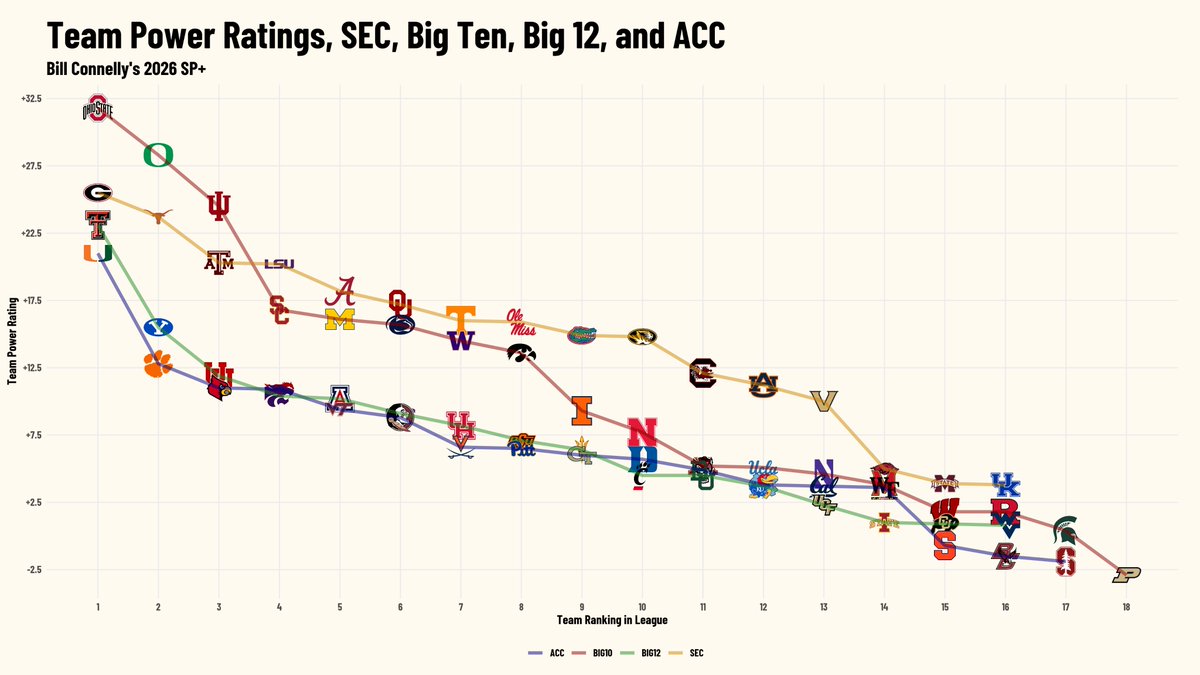
@BradPowers7 I know comparing across eras ("super team era" vs not) can be hard, but in terms of how dominant were they relative to the FBS level in the given year, here's where the models put them compared to others in the last 10 years.
"first-person (vs. third-person) narrative perspective causes people to construe information more concretely (vs. abstractly), … construe others’ actions more concretely (vs. abstractly) when those actions are written from the first-person (vs. third-person) narrative perspective. … people prefer concrete (vs. abstract) summary descriptions of short narrative stories that are written from the first-person (vs. third-person) narrative perspective. … people were more motivated to donate blood when first-person (vs. third-person) donation testimonials were paired with concrete (vs. abstract) arguments for donating. … First-person (vs. third-person) narratives increase identification with characters" https://t.co/JUYp7l1bVU
all the AI talent shuffling lately reminds me of NFL draft economics:
“trading up” is usually -EV.
you overpay for marginal improvements & overrate your own evaluation skills. Wonder how much of that dynamic applies here
Got a little primer yesterday on sports as an asset class from Goldman's Dave Dase - packed a lot into 20 minutes. Fun bunch of work in his world. Full show here:
https://t.co/dhawHwDRDu
Ahead of his keynote at the Wharton Sports Business Summit, Dave Dase of Goldman Sachs joined @WMoneyball to discuss sports as an asset class—from financing teams to fan engagement.
Hear more Friday!
https://t.co/F8aqorV3i9