I'm noticing that a lot of the people angry about Ted Chiang's Atlantic piece have jobs like Head of Ideation at the AI Consciousness Institute for AI Consciousness. Always worth noting who has a professional stake in a position being right or wrong.
"If you look back over the last few months,you’ll see a carefully plotted and heavily narrativized ascent built atop the corny and mostly untrue idea that #Anthropic is made of sterner moral stuff than its rivals"
@bcmerchant on #Anthropic & #TheVatican:
https://t.co/uC9Q90IY3H
So the Trump administration's tactic on data centers is to say that the thousands of people—citizens, farmers, homeowners, etc—protesting them, from Oklahoma to Maine to Texas, are doing so because they are all part of a "foreign influence campaign"
Got it, that should play well
DATA CENTER DOOMERS: Secretary Burgum reported that the intelligence community has traced much of the opposition to data centers to foreign influence campaigns aimed at slowing American technological progress. The strategy appears to be working.
this is the most regressive piece of tech “journalism” i have seen in quite some time
claiming that karen hao’s book is what started the backlash against datacenters…. how did someone approve posting this???
"At least make sure to get your facts right." Immediately blames anger at data centers on *Karen Hao* lmfao
This is the Washington Post? This whole feed is just embarrassing, half-baked wannabe rightwing influencer vibes. Really sad what's happened over there
People in AI like to claim AI doesn’t compete with the authors of the work it is trained on, making training on people’s work more likely to be fair use.
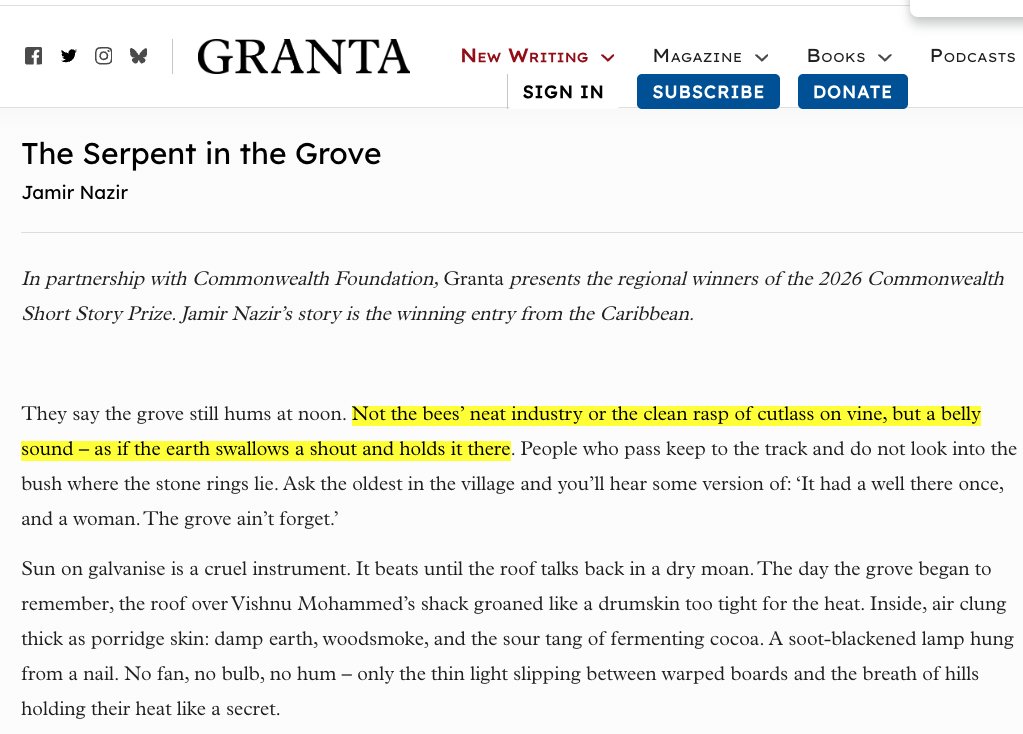
If this short story prize went to an AI story - as seems likely - that position gets even harder to argue.
It's a major milestone for *something*, whether for AI itself, or for how AI-generated content has altered tastes in writing, or in a new era of overworked judges contending with volumes of competing levels of variously edited AI slop
Well, this is a first: a ChatGPT-generated story won a prestigious literary prize (The Commonwealth Prize).
"Not X, not Y, but Z" sentences everywhere, the "hums" trope, and plenty of other obvious markers of AI writing.
A major milestone for AI, at any rate...
@GrantaMag
Wrote about the college kids booing AI, and how, in a moment rife with economic precarity, affordability crises, and narrowing job prospects, AI has become the new avatar of American capitalism.
“I don’t think most people are formulating a new worldview in which AI is a boogeyman political project hatched by billionaires. I think they’re more likely to understand AI as an extension of an already inequitable system, and as an accelerant of that inequality.”
It's not uncommon at all for those selling a new automation technology to promise it will slash labor costs and destroy livelihoods.
The difference is the promise is usually made in corporate conference rooms, or more tacitly, as with Uber's promised arbitrage of labor laws.
AI being booed in commencement addresses seems pretty natural to me. It's really, really unusual for the people building and selling a new technology to promise that it will destroy people's livelihoods.
Whether you consider this to be "horrendous marketing," or "actually, a craven justification for VC investment" or "really, just honest communication" or "rationally over-emphasizing the probability of a long-tail catatrophic outcome" or whatever else, the point is ... it's very unusual.
I think today's 22yos should probably familiarize themselves with Claude and ChatGPT, but I don't entirely blame them for booing a technology whose architects have said, this will destroy your jobs.
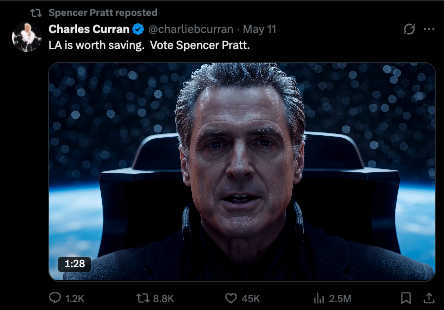
Bold move from @spencerpratt to position himself as the pro-AI slop candidate for mayor of a city where thousands of workers in its most famous industry are out of work and big tech is actively trying to help corporations like Disney automate more of them
@elaifresh@thecandykeynes A lot of economic data, including gold standard Bureau of Labor Statistics data, is self-reported and gathered through such surveys. I think that you assume 400 artists would be "vindictive pessimists" in a study with university researchers says more about your priors than theirs