CBSE’s May 2025 tender required answer sheets to be scanned with automatic robotic scanners, spines preserved, at a minimum of 300 DPI.
The tender re-issued in August quietly removed all of it. “Scanners” became generic. Resolution dropped to 200 DPI.
Now we know what that meant in practice. It has been exposed that COEMPT scanned the answer sheets using mobile phones.
The blurred copies, the missing pages, the unscanned books - they are not “errors.” They are the predictable outcome of a contract written to fit a vendor.
This is fraud. And every child whose marks were wrongly evaluated is a victim of it.
This morning, the Prime Minister had time to speak about mangoes. He has not had time to speak about 18.5 lakh children whose answer sheets were scanned with phones.
Dharmendra Pradhan ji still sits in office.
Modi ji’s silence is no longer indifference. It is complicity.
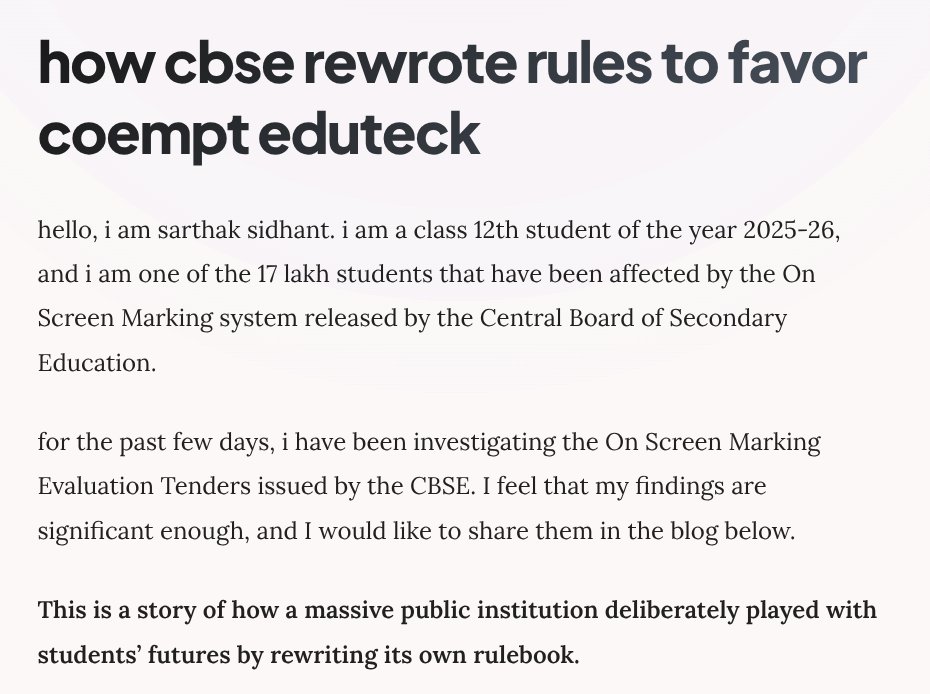
This is an unbelievable piece of work by Sarthak and something that requires amplification.
Let me explain what he found, in simple terms.
Sarthak is a Class 12 student from the 2025-26 batch, one of the 17 lakh students whose answer sheets went through CBSE's new On-Screen Marking system.
He spent days reading through CBSE's evaluation tenders, scraped all 576 tenders CBSE has issued, and tracked how the rules changed across three versions of the same tender.
The core finding is that the company that won the contract to scan and grade 17 lakh students' answer sheets is Coempt Eduteck.
Coempt used to be called Globarena Technologies. Globarena was the company behind the 2019 Telangana intermediate exam disaster, where software failures led to 3.8 lakh students getting wrong or missing marks, and 23 students died by suicide.
A government committee found systemic failure and negligence. Six months later, Globarena rebranded to Coempt Eduteck.
So a company with that track record won a contract to handle 17 lakh CBSE students. Sarthak's investigation is about how the rules were rewritten to let that happen.
The tender was issued three times.
> First tender, February 2025. It existed, then disappeared from the public GeM portal. Sarthak scraped all 576 CBSE tenders and this one was missing from the archive entirely.
> Second tender, May 2025. Four companies applied including TCS and Coempt. All four failed the technical evaluation. Cancelled.
> Third tender, August 2025. Coempt won. Between the second and third tender, a series of rule changes happened, and every single one made it easier for Coempt to qualify.
Here is what changed, one by one.
01. The old rules disqualified any company with a history of abandoning work, failing to complete contracts, or financial weakness. The new rules deleted this clause entirely. Coempt's Telangana history stopped being a barrier.
02. The old rules disqualified any company that was "blacklisted earlier." The new rules changed this to "currently blacklisted." Because Globarena rebranded after Telangana, removing the word "earlier" effectively erased their past.
03. The rules required Rs 50 crore average turnover over three years. Coempt's exact average came to Rs 50.86 crore. They cleared the bar by less than 1%. Earlier, a smaller company had asked CBSE to lower the bar to Rs 30 crore for fairer competition. CBSE refused. So the bar was kept high enough to block small players, but sat exactly low enough for Coempt to scrape through.
04. Software maturity is measured on the CMMI scale, 1 to 5. The old rules required Level 5. The new rules dropped it to Level 3. Coempt is a Level 3 company.
05. The cooling-off period for engaging retired CBSE officials was cut from two years to one. This makes it easier to use recently retired insiders to influence the process.
06. The old rules required experience with large projects of at least 5 lakh students each. The new rules removed the student count and counted cumulative answer-book volume across small projects instead. Coempt has many small fragmented university contracts. This helped Coempt and hurt TCS.
07. The old rules required bidders to own their own data centre and disaster recovery centre on Indian soil. The new rules allowed third-party MeitY-empanelled cloud hosting. Coempt runs on AWS and Azure. This helped Coempt and hurt TCS, which owns its own data centres. It also means student data is no longer on sovereign, Indian infrastructure.
08. The old rules required the bidder to own or control the complete source code of its software. The new rules deleted this. Coempt's platform runs on Microsoft's proprietary IIS, which they don't own.
09. A last-minute corrigendum, issued right before bid submission, removed CBSE's own power to blacklist the firm if its software failed catastrophically. So even a Telangana-scale failure couldn't get Coempt banned from future government tenders.
10. The penalty structure shifted from punishing mistakes to punishing delays. The old rules fined the vendor for wrong scanning, merged pages, and unscanned books. The new rules dropped those and instead levied Rs 50,000 per day for delays. This incentivises rushed scanning over accurate scanning.
11. The old rules had a hard accuracy threshold, error rate not to exceed 0.5%. The new rules removed this number entirely.
12. The old rules specified proper book and robotics scanners. The new rules just say "sufficient scanners." The definition was vague enough that, as Sarthak notes, the scanning could be done with a phone on a stand.
13. On the security side, the contract required a VAPT (vulnerability and penetration test) certified by CERT-In before go-live, and a restricted beta phase before launch. The system clearly wasn't restricted, because the other researcher, Nisarga, was able to access it and find vulnerabilities four days before go-live. So the mandatory security audit appears to have been bypassed.
These are more than a dozen rule changes, all between the failed tender and the winning tender, all pushing in the same direction, all benefiting the one company with the worst track record in the field.
The security holes Nisarga found last week now have an explanation. The system was built by a vendor that was specifically allowed to skip the security certification, the source code ownership, the data sovereignty, and the quality thresholds the original rules demanded.
Following things need to happen immediately;
1. An immediate CAG audit of the tender process.
2. A parliamentary debate on the topic.
3. An independent investigation into
> Why the first tender vanished?
> Why the disqualification clauses were deleted?
> Why the turnover bar was held exactly where it was?
> Why the security level was dropped?
> Why the blacklisting power was removed at the last moment?
Sarthak, this is genuinely exceptional investigative work. Far better than most journalists with full resources ever manage. Take a bow. :)
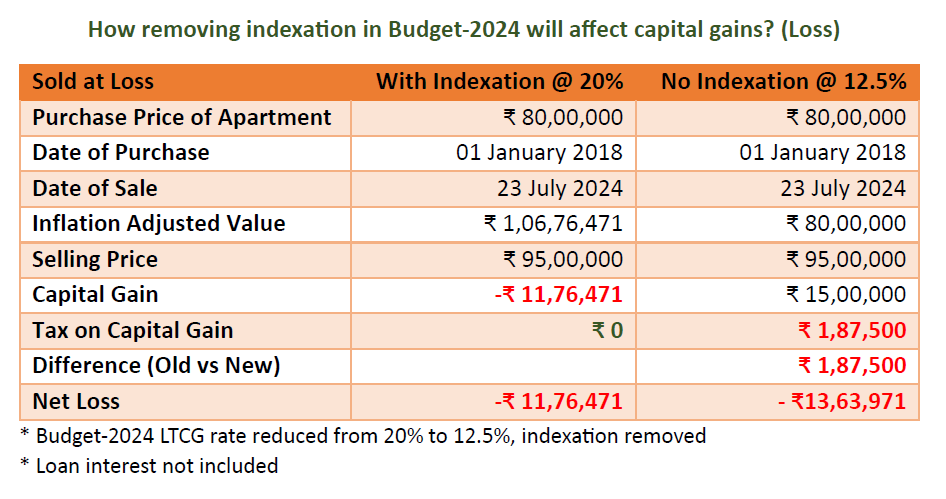
In the previous case, you at least made a profit to pay the capital gains. Now, let's take a scenario where you bought an apartment in January 2018 for ₹80 lakhs and sold it today for ₹95 lakhs due to a personal emergency.
This is where it gets tough. If indexation was applicable, you actually made a loss of ₹11.76 lakhs and would have paid 'Zero' LTCG tax.
But with the new method, @nsitharaman will add salt to your wound. She will take ₹1.87 lakhs from you as LTCG. Your net loss becomes ₹13.63 lakhs. Again you might spent many many lakhs more in loan interest alone.
Removing indexation defeats the whole purpose of LTCG. This affects everyone and will push more people to undervalue their transactions, increasing the use of black money.
This makes real estate investments less attractive and could drive our construction sector into a even bigger crisis. (2/3)
@RailMinIndia@IRCTCofficial Train no .12291 from YPR to MAS is delayed by more than 3hours without any notification, can you provide details on why the delay? This is poor service which needs to be fixed. Many passengers were waiting for the train with kids and babies.
"Electoral bond scam is not just the biggest scam in India but the biggest scam in the world. After electoral bond corruption became public, now the fight is not between two alliances but between the BJP and the people of India."
-Parakala Prabhakar, economist & FinMin Nirmala Sitharaman's husband
@Flipkart@flipkartsupport Ordered laptop which I don't usually prefer because of trust issues, yet again you guys proved it right, promised delivery date is July 17 and it's out for delivery for a couple of days now. What's the guarantee I'll get the genuine product, look fishy
https://t.co/aXyEtR7FIw @CMOTamilnadu@Udhaystalin request to take a look at this pathetic situation in TN,as a tax payer i would like see if any action taken on the department who leads to this situation #TamilNadu
@tcookin stay away from this travel operator, they take partial payments and increase the rates quoting dollar increase, where nothing is increased. It's purely a scam, even after paying the full amount, asking for extra stating flight price increased. Don't have any process.
@PMOIndia@nitin_gadkari@narendramodi Sir our plight of hundreds of Renault Duster owners is lying at the mercy of @RenaultIndia. They have sold a permanently defective car to us and not providing any solution to the problem. Our appeal to the MORTH,
Dear Hdfc, I applied for a credit card almost a month back, The status is still in progress ref no. 22D21058713180VY. @HDFC_Bank Never expected this delay from a private bank.
@RenaultIndia@renaultgroup@RenaultIndia injector reliability is still in question .no clarity on why it's failing often..fix it before posting anything on social media about safety