In today’s op-ed, “Trump-Xi and the Limits of U.S. Power,” I argue that U.S.-China relations are likely to be defined neither by a full-scale Cold War nor by a genuine strategic partnership, but by an unstable coexistence. Competition will continue over advanced technology, military modernization, and regional influence, especially in Taiwan and the Indo-Pacific even as initiatives such as the Quad and AUKUS appeared less cohesive during Donald Trump’s second presidency. President Xi has summed this up as “constructive strategic stability.”
https://t.co/pagkX4eKcc
In today’s op-ed, “Trump-Xi and the Limits of U.S. Power,” I argue that U.S.-China relations are likely to be defined neither by a full-scale Cold War nor by a genuine strategic partnership, but by an unstable coexistence. Competition will continue over advanced technology, military modernization, and regional influence, especially in Taiwan and the Indo-Pacific even as initiatives such as the Quad and AUKUS appeared less cohesive during Donald Trump’s second presidency. President Xi has summed this up as “constructive strategic stability.”
https://t.co/pagkX4eKcc
President Xi clearly had the upper hand in his meeting with President Trump. Prof BR Deepak @BDeepak110 tells me on The @SundayGuardian podcast.
https://t.co/jUQ5YjX04q
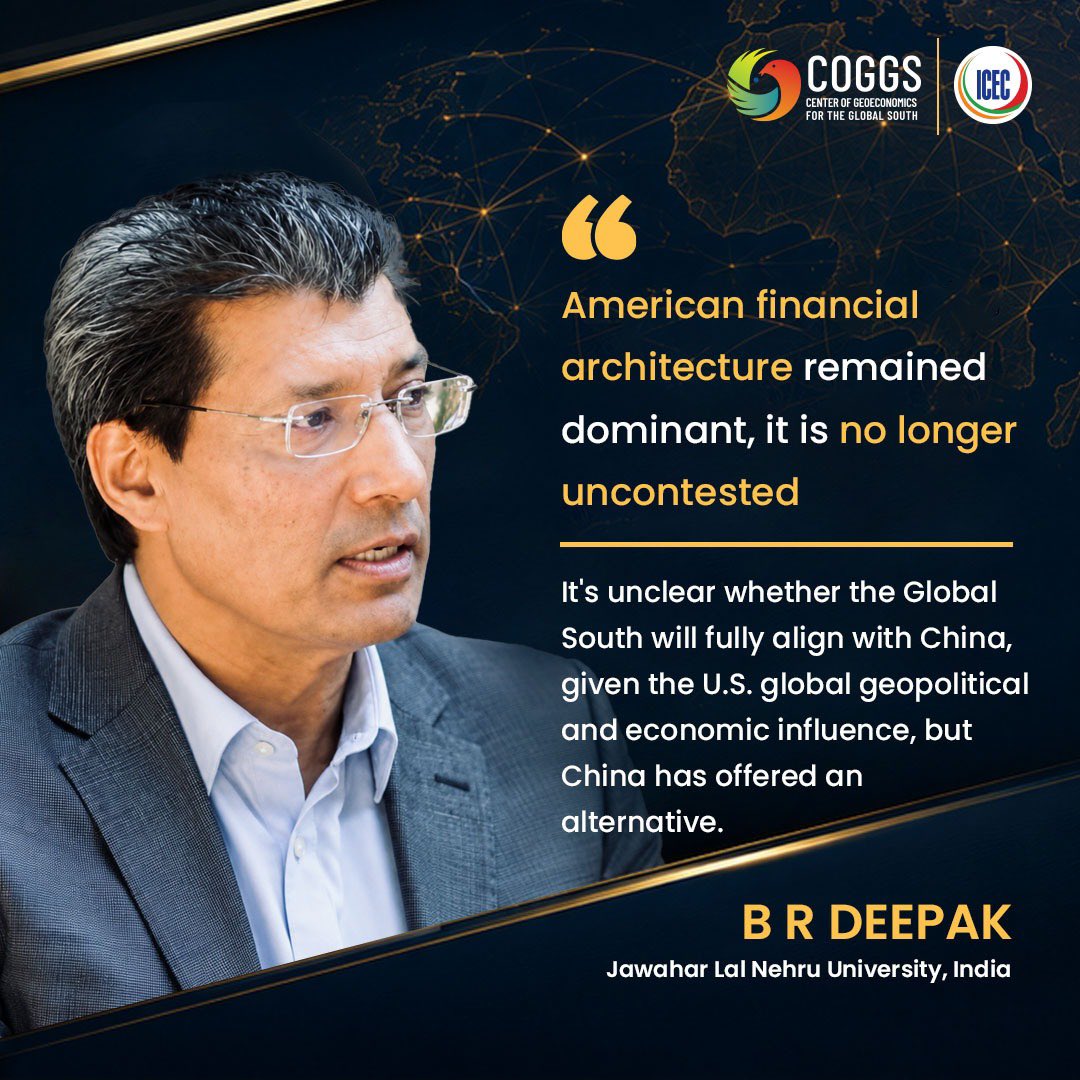
In today’s op-ed, I argue that China is contemplating exit strategies from the dollar tollgate on the assumption that financial orders are closely tied to transitions in hegemonic power. The financial architecture of Pax Britannica declined as British imperial power weakened during the twentieth century, eventually giving way to the Pax Americana system centred on Wall Street and the petrodollar. The emerging question today is whether the current era signals the beginning of a gradual transition toward a Sino-centric financial order — a potential “Pax Sinica.”
https://t.co/7oz42xOrLQ
In today’s op-ed, I argue that China is contemplating exit strategies from the dollar tollgate on the assumption that financial orders are closely tied to transitions in hegemonic power. The financial architecture of Pax Britannica declined as British imperial power weakened during the twentieth century, eventually giving way to the Pax Americana system centred on Wall Street and the petrodollar. The emerging question today is whether the current era signals the beginning of a gradual transition toward a Sino-centric financial order — a potential “Pax Sinica.”
https://t.co/7oz42xOrLQ
In this op-ed, I outline eight lessons the PLA and other analysts draw from the US-Israel–Iran war and examine China’s strategic posture. I argue that Beijing has adopted calibrated restraint and strategic opportunism—avoiding direct involvement while letting other powers bear the costs of confrontation and preserving its own flexibility. https://t.co/AxKDz05Pcn
In this op-ed, I outline eight lessons the PLA and other analysts draw from the US-Israel–Iran war and examine China’s strategic posture. I argue that Beijing has adopted calibrated restraint and strategic opportunism—avoiding direct involvement while letting other powers bear the costs of confrontation and preserving its own flexibility. https://t.co/AxKDz05Pcn
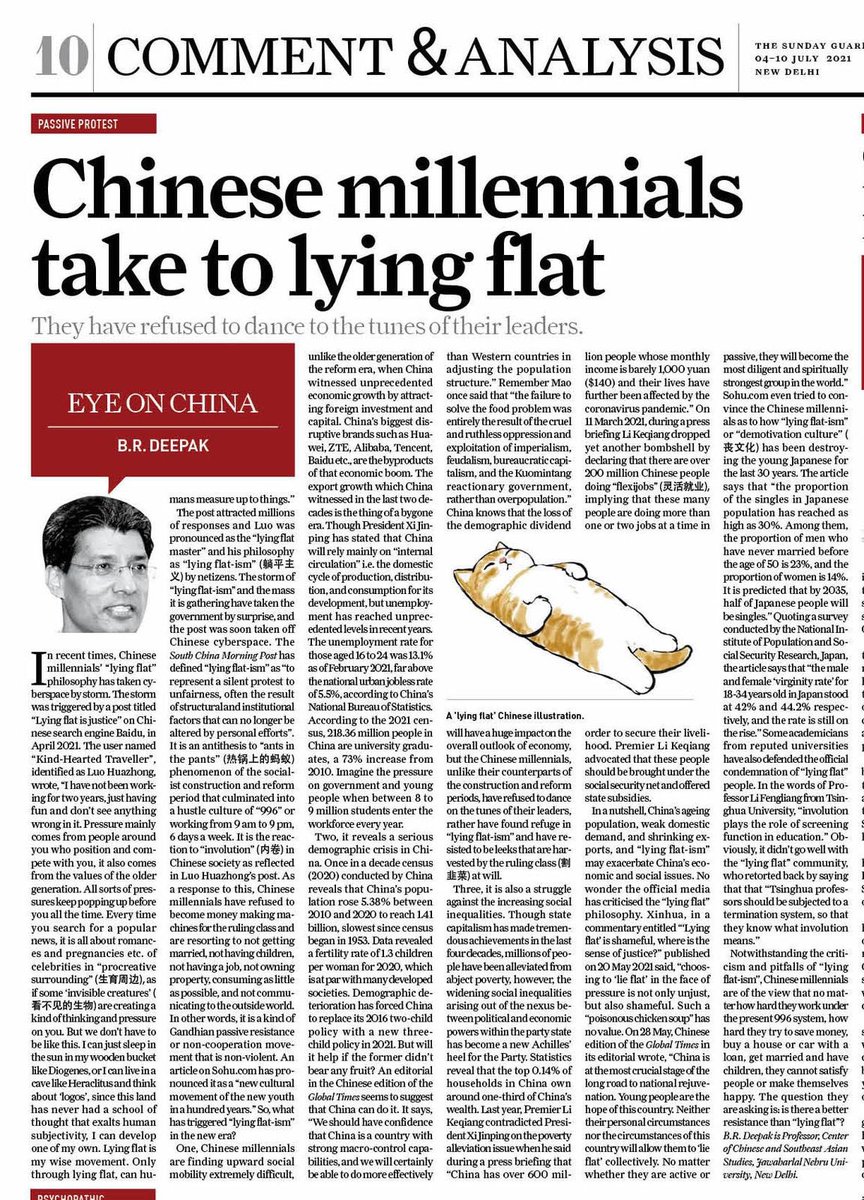
Three days ago, China’s Ministry of Public Security stated that “Numerous cases show that anti-China hostile forces, while waving the banner of ‘lying flat,’ are actively working to erode the thinking of Chinese youth.” The Ministry also called upon young people, emphasizing that they “need not force themselves into the false binary choice of ‘involution or lying flat.’ Instead, they should seek opportunities based on their own realities and steadily accomplish each task at their own pace.” Given this background sharing an article I wrote in 2021!
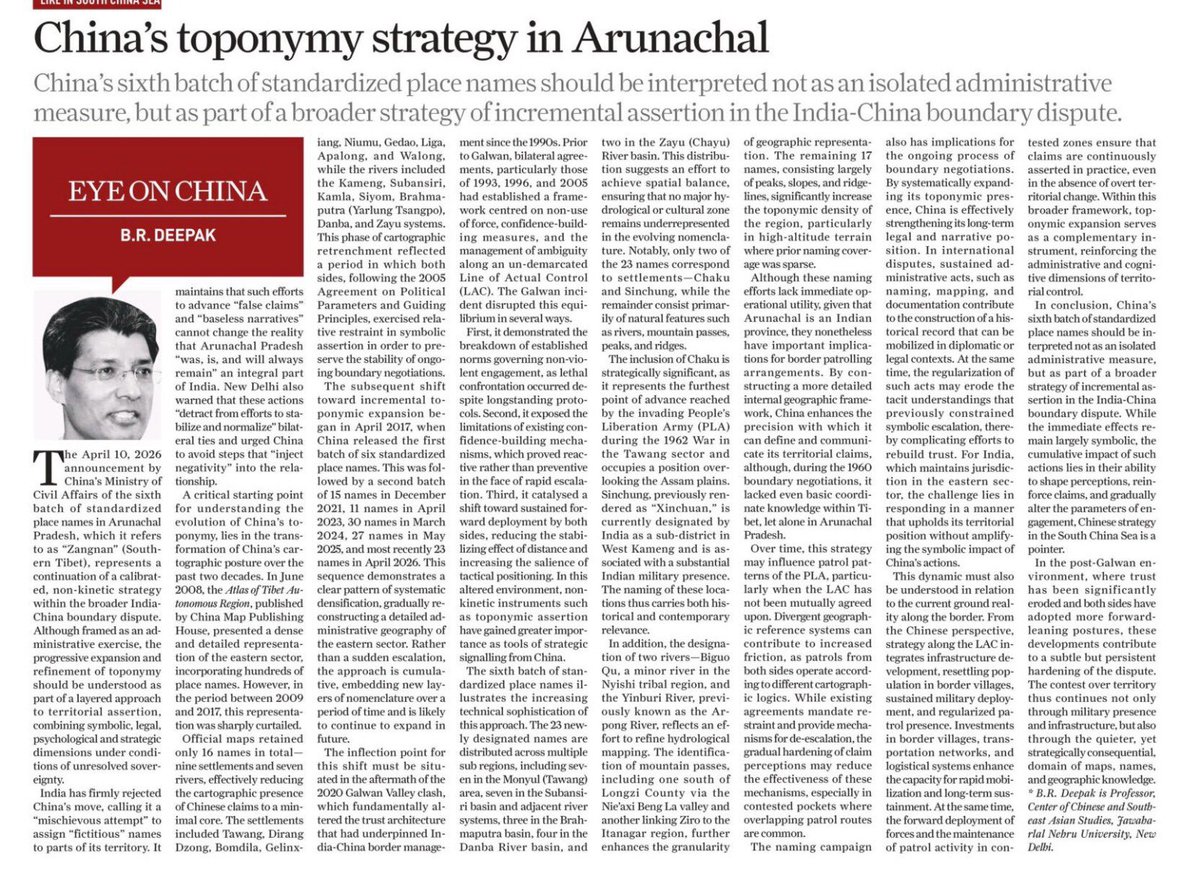
In today's op-ed I argue that after Galwan, India–China border management shifted as trust and confidence-building frameworks eroded, exposing agreement limits and prompting sustained forward deployments. In this context, China’s expanded toponymic assertions, evident in its sixth batch of standardised place names, enhance territorial signalling, cartographic precision, and legal positioning. Though largely symbolic, these measures may intensify patrol friction, complicate negotiations, and gradually harden competing claims along the unsettled Line of Actual Control.
https://t.co/IAOetqlOdy
@Siamii_Guite Very much so, this is in sync with the strategy. For example, Tibet word no where appears in the discourse, it is Zangnan now, and on the long run people will forget Tibet the way they have forgotten Eastern Turkistan and call it by Chinese name Xinjiang
In today's op-ed I argue that after Galwan, India–China border management shifted as trust and confidence-building frameworks eroded, exposing agreement limits and prompting sustained forward deployments. In this context, China’s expanded toponymic assertions, evident in its sixth batch of standardised place names, enhance territorial signalling, cartographic precision, and legal positioning. Though largely symbolic, these measures may intensify patrol friction, complicate negotiations, and gradually harden competing claims along the unsettled Line of Actual Control.
https://t.co/IAOetqlOdy
@veer_krishnaa Build capacities, leverages and above all your economic prowess to start with, which unfortunately we have not been able to build. As a result, our trade deficit with China is way larger to our defence budget.
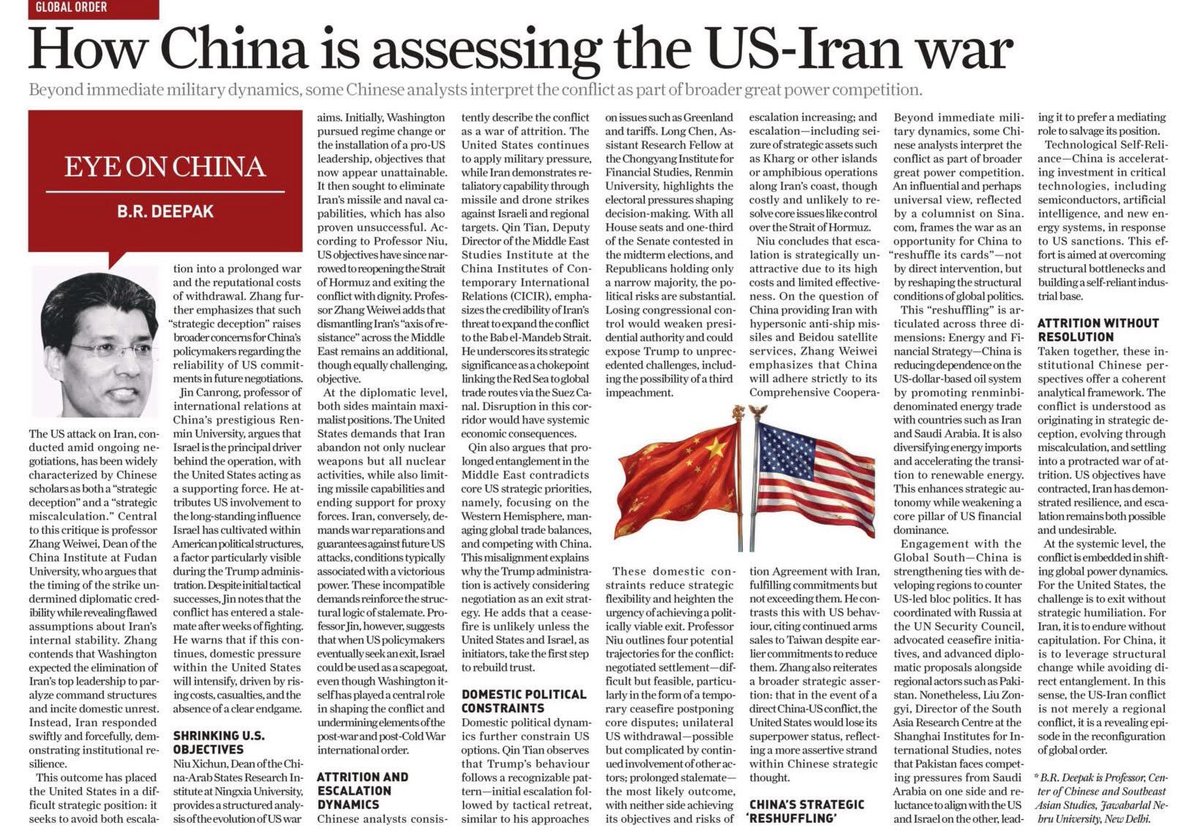
In today’s op-ed, I examine how Chinese academia perceives the US–Iran conflict. Beyond the immediate military objectives of the United States, Iran, and Israel, many analysts situate the conflict within broader shifts in global power dynamics. For the United States, the central challenge is to disengage without incurring strategic humiliation. For Iran, it is to endure without capitulating. For China, the task is to capitalize on structural changes while avoiding direct entanglement. In this sense, the US–Iran conflict is not merely a regional confrontation, but a revealing episode in the ongoing reconfiguration of the global order.
https://t.co/KqthKXcfAo
In today’s op-ed, I examine how Chinese academia perceives the US–Iran conflict. Beyond the immediate military objectives of the United States, Iran, and Israel, many analysts situate the conflict within broader shifts in global power dynamics. For the United States, the central challenge is to disengage without incurring strategic humiliation. For Iran, it is to endure without capitulating. For China, the task is to capitalize on structural changes while avoiding direct entanglement. In this sense, the US–Iran conflict is not merely a regional confrontation, but a revealing episode in the ongoing reconfiguration of the global order.
https://t.co/KqthKXcfAo
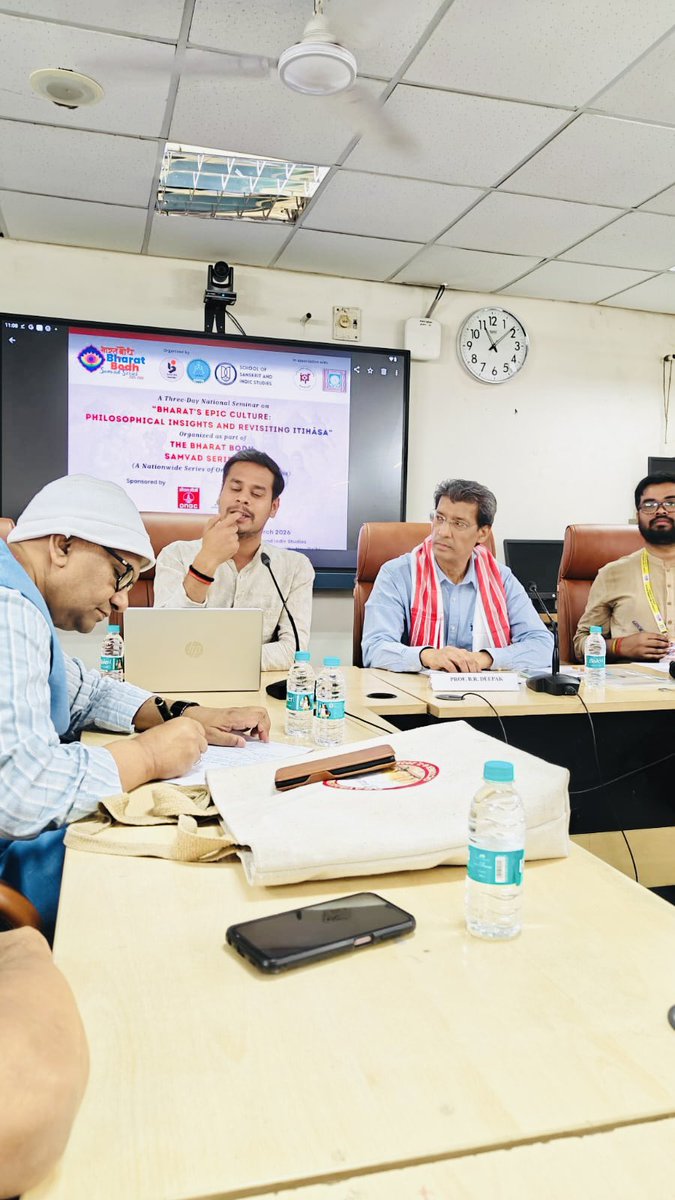
Today, had the privilege of presiding over a session of a three-day seminar on “Bharat’s Epic Culture: Philosophical Insights and Revisiting Itihasa”, organized by the Special Centre for Sanskrit and Indic Studies, JNU. Engaging presentations were delivered by Dagyung Jung, Irfan Ahmed, and Sanjiv Mishra. I also shared my reflections on the dissemination of the Indian epics, particularly in the context of historical communication routes linking India with East and Southeast Asia. Photo courtesy Irfan Ahmed