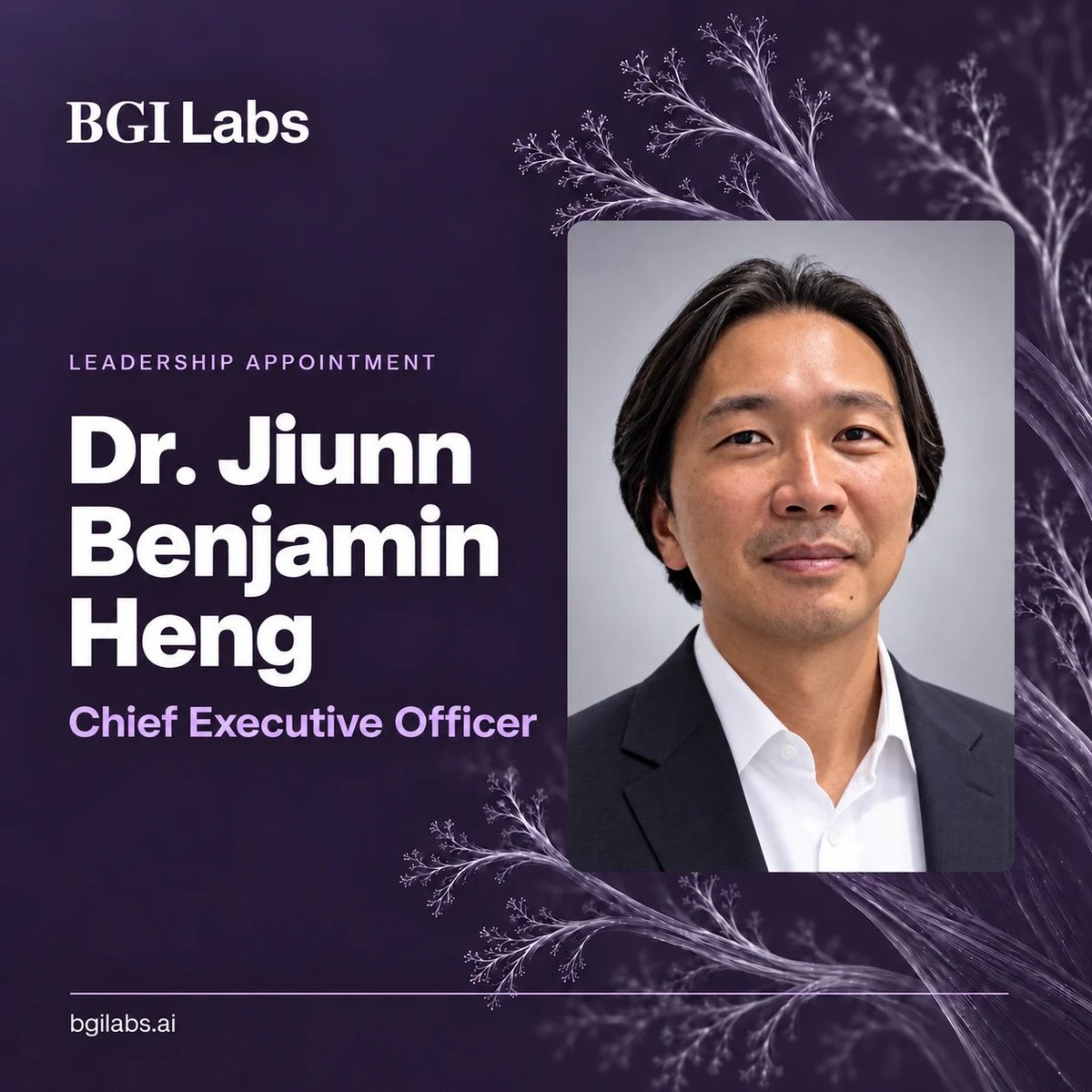
We are pleased to announce the appointment of Dr. Jiunn Benjamin Heng as Chief Executive Officer of BGI Labs. A seasoned technologist, serial innovator, and venture capitalist, Dr. Heng brings deep technical expertise and operational rigor, with experience scaling frontier technology ventures, guiding R&D innovations into high-volume production, and backing promising founders.
At Intel, he worked in semiconductor R&D, process engineering, and device integration. He later led product engineering and pilot manufacturing at SolarCity before heading Solar Product Engineering and Pilot Operations at Tesla, where his work contributed to the success of the Solar Roof and the Gigafactory. He also served as Chief Operating Officer at Caelux and Executive Vice President of Engineering at ESS, and has worked with startups across AI, cleantech, robotics, and energy.
As General Partner at 99VC, an early-stage fund specializing in physical AI and frontier technologies, Dr. Heng works with founders on product-market fit and go-to-market strategy. He holds a PhD in Electrical Engineering and Nanobiotechnology and has more than 85 patents across multiple disciplines, along with numerous publications.
Combining the perspectives of scientist, inventor, operator, and investor, he is passionate about turning breakthrough technologies into lasting businesses.
Read the full announcement: https://t.co/W6LpCJl2hx
Executive Chairman and Chief Scientist Dr. @bengoertzel argues that teaching AI to follow rules isn't enough without understanding why its actions matter.
He describes systems that choose actions according to beneficial goals and develop a practical understanding of those goals by helping people.
Listen to his full interview on the Artificial Intelligence Podcast: https://t.co/J89Cmy96v1
Our Chief Ethics Officer, Kai Zen Bickle, speaks with Frank W. Bergmann about who gets to build AGI, whose interests it will serve, and what safeguards developers are willing to adopt.
They discuss how open-source tools make it easier for independent developers to build AI agents and whether competitive pressure will lead teams to leave safeguards out. Bergmann proposes giving independent auditors access to the ethical rules an agent uses to make decisions.
Watch the full episode of The AGI Race, powered by BGI Labs: https://t.co/lmc8UTaxR1
How could brain-inspired computing offer a more energy-efficient path to AGI?
On The AGI Race, our Chief Ethics Officer, Kai Zen Bickle, speaks with Dr. Alexander Ororbia about alternatives to backpropagation, the potential energy savings of neuromorphic computing, and the research needed to evaluate these systems at scale.
Dr. Ororbia also explains his hypothesis that humanlike intelligence requires computation inseparable from a physical body and a drive for self-preservation.
Watch the full episode of The AGI Race, powered by BGI Labs: https://t.co/uw6Hy7JSNf
Executive Chairman and Chief Scientist Dr. @bengoertzel joined Professor Karl J. Friston, neuroscientist at University College London, to discuss why increasingly powerful language models may not be enough to achieve AGI.
Their conversation explored how the human brain learns, whether machines can possess consciousness and moral agency, and how research into predictive coding could lead to AI systems that learn continuously from experience.
Watch here: https://t.co/LPyG1v3p4m
The debate over whether to accelerate or pause AI development leaves another question largely unexamined: whether to build a different kind of AI.
Our Executive Chairman and Chief Scientist, Dr. @bengoertzel, calls for investment in architectures that give AI systems an understanding of their place in the world and a capacity for compassion.
Listen to his full interview on the Artificial Intelligence Podcast: https://t.co/J89Cmy96v1
Ben Goertzel. Joscha Bach. Kai Bickell. Catherine McMillan. AJ Green.
Five top minds, 90 minutes, and some of the hardest questions in AI: can we pause it, will superintelligence take control, and who gets left behind?
They agreed on almost nothing, and made my P(Doom) change three times in one sitting.
Buckle up - our AI Battle Royale is out now.
@bengoertzel@Plinz@KaiZenBickle@catrosemcmillan@SingularityNET@AICollectiveCo
Scientific discovery often depends on connecting findings from separate areas of research. How can AI help turn those connections into new scientific insights?
On The AGI Race podcast, our Chief Ethics Officer Kai Zen Bickle speaks with Mesto, an 18-year-old Hyperon contributor, about his work using MeTTa and Omega.
Mesto explains how he uses MeTTa and AtomSpace to represent scientific findings in a form AI systems can reason over, helping them connect evidence across papers and assess conflicting claims. He also discusses how he learned MeTTa and began contributing to the Hyperon community.
Watch the full episode of The AGI Race, powered by BGI Labs: https://t.co/srD1O5XiLe
Our CEO, Dr. @bengoertzel, argues that finding and patching vulnerabilities cannot be the long-term answer to software security.
He proposes using AI coding agents to identify which parts of existing software need replacing first, then rewrite them as formally verified code.
Listen to his full interview on the Artificial Intelligence Podcast: https://t.co/J89Cmy9Ekz
Our CEO, Dr. @bengoertzel, spoke with Tech in Asia about the scientific, commercial, and political stakes of the race to AGI.
He explains what would qualify as human-level intelligence, outlines how we are developing products on open, decentralized infrastructure, and examines how AGI could disrupt work, challenge institutions, and concentrate economic and political power.
Read the full interview: https://t.co/b9DBGnh7pE
Our CEO, Dr. @bengoertzel, joined Tony Hoang on the Artificial Intelligence Podcast to discuss AGI research and enterprise applications, including Omega’s role in identifying a Linux kernel vulnerability and how open, decentralized AGI infrastructure can help address complex business challenges and create new opportunities.
Dr. Goertzel also shared his views on AI safety and regulation, developing systems with moral agency, and the need for independent scientific oversight of frontier AI development.
Listen to the full conversation: https://t.co/J89Cmy96v1
We are sharing an early result from applying Omega, our neural-symbolic cognitive architecture, to cybersecurity research. Using an experimental harness incorporating elements of Omega, researchers at PwnAI identified a critical vulnerability in the Linux networking stack and demonstrated a guest-to-host virtual machine escape in a controlled research environment. The vulnerability, named PwnEscape, has since been addressed by an upstream Linux patch.
Omega-Pwn combines PwnAI’s security tooling and automation with elements of Omega to support extended, multi-step investigations. By preserving hypotheses, failed experiments, and evidence across sessions, it enables researchers to build on earlier findings and pursue parallel lines of investigation. Researchers directed the work and evaluated the evidence, with GPT-5.6 Sol serving as the primary reasoning engine for source-level analysis.
Omega-Pwn forms part of a broader research effort that includes Omega Purple, a proposed multi-agent framework that brings attack analysis, defensive testing, and independent evaluation into a shared world model. We are exploring how this approach could also identify critical software functions and guide their replacement with provably correct, correct-by-construction code, helping establish stronger security guarantees for the systems that future AGI will depend on.
Read CEO Dr. @bengoertzel’s overview of this research and our broader approach to cybersecurity: https://t.co/iT7sI0YpR8
As we build open, decentralized AGI at BGI Labs, we are investigating how our systems can preserve beneficial goals as they modify and improve themselves, and how to safely distribute control over them.
Our CEO, Dr. @bengoertzel, examines these unresolved questions and their implications for how we design and govern human-level AGI and superintelligence.
Watch his full speech at Yale’s debate on whether to unplug AI: https://t.co/tmcQbU2DOF
Our CEO, Dr. @bengoertzel, joined Alex Chao on the Humans of AI podcast to discuss the path to human-level AGI, the limitations of frontier LLMs, AI alignment, and decentralized ownership and control of advanced AI.
Watch here: https://t.co/BALTsB3PID
Our CEO, Dr. @bengoertzel, joined Ben Greenfield on The Boundless Life Podcast to discuss a central challenge in applying AI to longevity research: generating testable hypotheses that go beyond the published literature.
He discussed how we combine large language models with Probabilistic Logic Networks (PLN) to reason over biological data and existing research, and why he sees autonomous scientific discovery as a defining application of AGI, with systems able to develop theories, design and run experiments, and revise their understanding in response to evidence.
Watch here: https://t.co/KfEF8Ew3qx
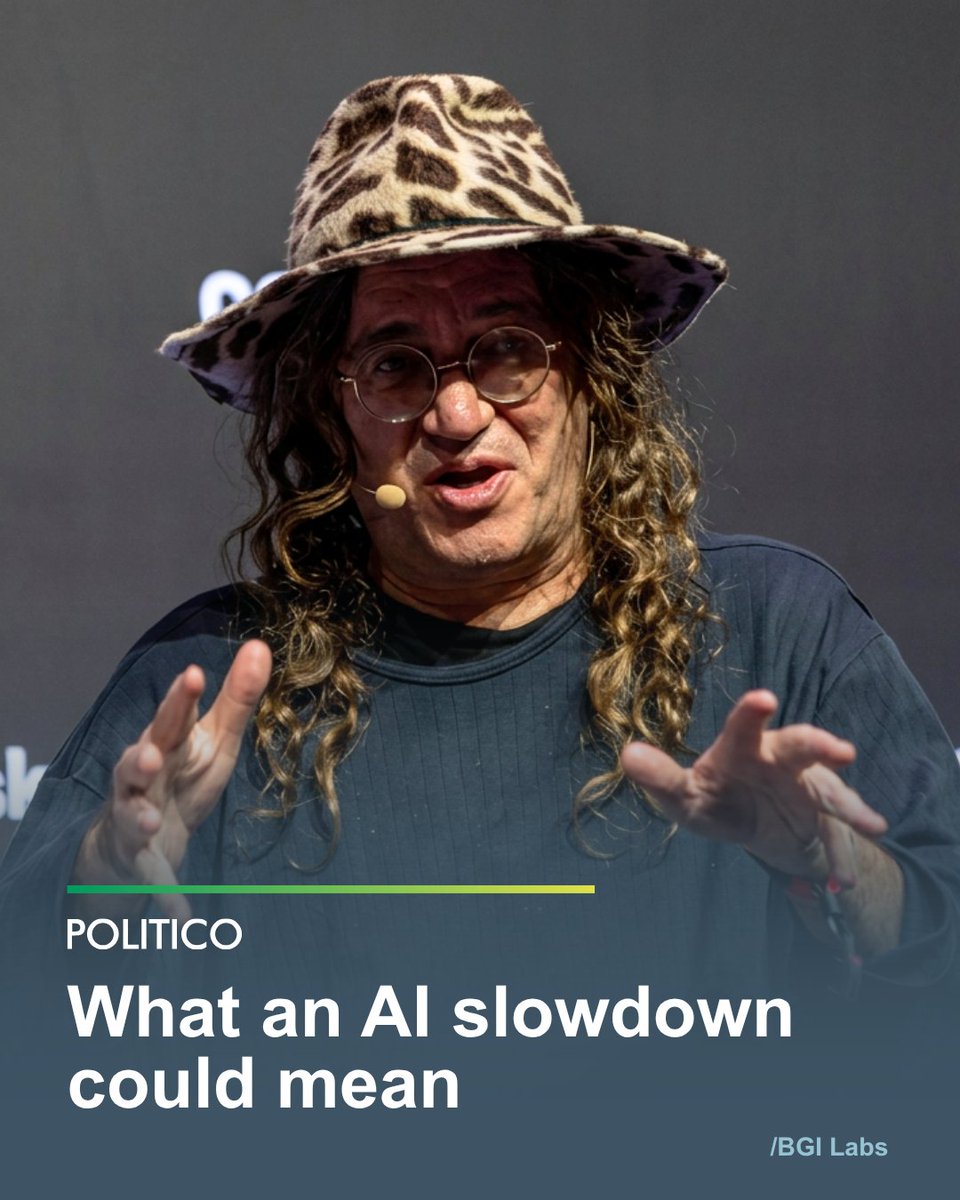
Our CEO, Dr. @bengoertzel, shared his perspective with POLITICO on the growing calls from leading technology executives for a global slowdown of artificial intelligence development. https://t.co/j9IMKUyhjs
Join us in San Francisco for Scaling Beneficial General Intelligence, part of @Techweek_ by a16z, on Wednesday, October 7, to explore our Hyperon AGI framework and get an exclusive look at Hyperon-based proto-AGI applications, including Codey, the humanoid social robot.
During the event, you will hear from our CEO, Dr. @bengoertzel, and the BGI Labs team on our vision for beneficial AGI, engage in executive discussions on AI and related technologies, and explore collaboration opportunities.
If you are attending #SFTechWeek or working toward open beneficial AGI, we look forward to seeing you there. Learn more and register now: https://t.co/6WOOJHfvtI
Our CEO, Dr. @bengoertzel, delivered a keynote at the Ai4 conference in Las Vegas, examining what it will take to reach AGI beyond scaling large language models.
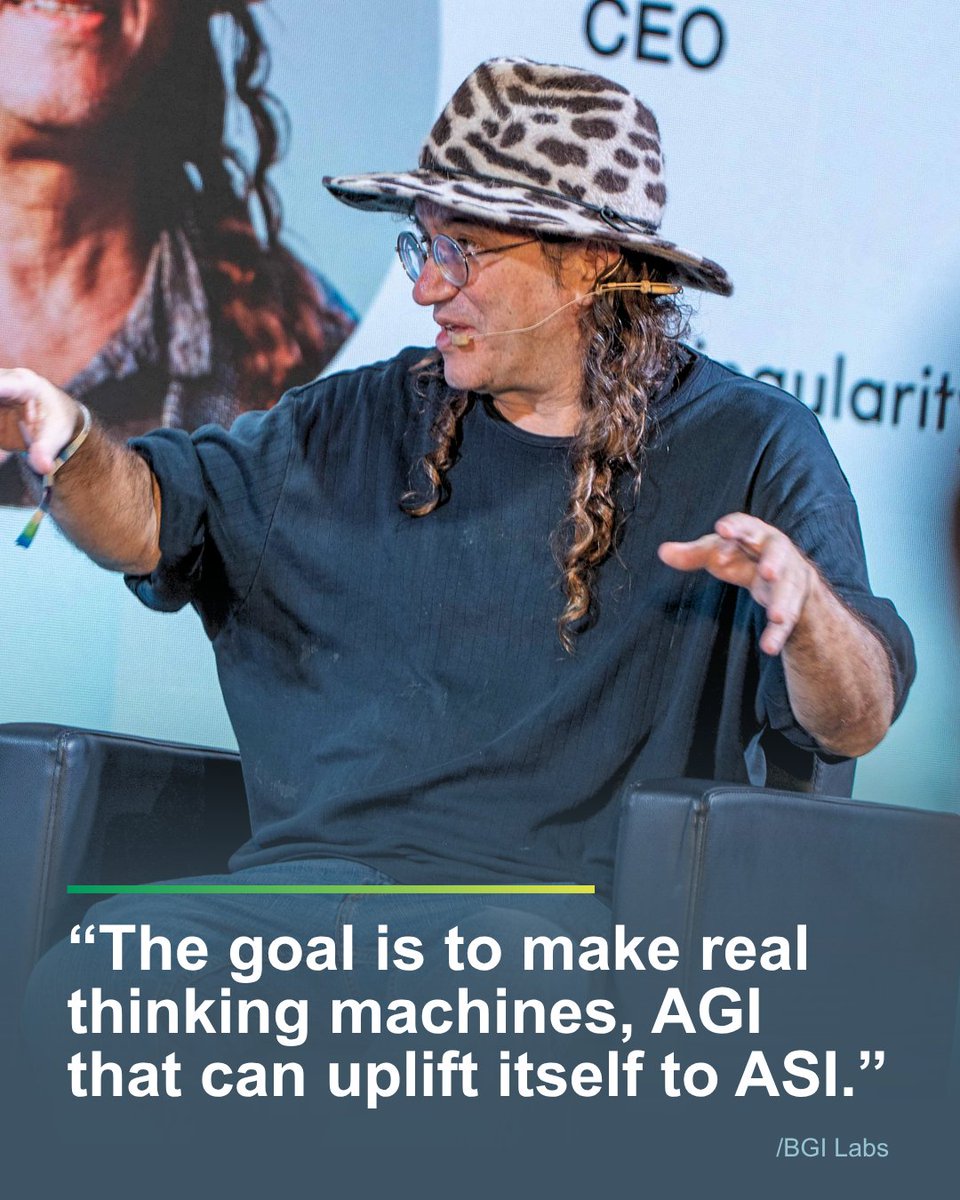
He identified reasoning, persistent memory, continual learning, creativity, and grounding in the world as central capabilities for systems that can generalize beyond their training. “The goal is to make real thinking machines,” he said.
Dr. Goertzel described an AGI that can enter a novel environment, work out what is happening, ask questions when necessary, and learn from what it encounters. Such a system needs to form abstractions, generalize from experience, retain what it has learned, and connect knowledge across time.
Memory was a major focus. “Lifelong learning depends on lifelong memory,” Dr. Goertzel said. He discussed OmegaClaw, which combines a continuously running agentic loop with symbolic working memory and long-term declarative and episodic memory, allowing an agent to retain experience over extended periods and build knowledge through continued interaction.
The keynote also addressed what it means for such a system to be beneficial. “Alignment is ill-posed unless you ask: aligned with what?” Dr. Goertzel noted that human values are dynamic and heterogeneous, making alignment a question that extends beyond instruction following and behavioral constraints. The system's design must account for values, self-understanding, and moral agency.
Dr. Goertzel also discussed the architecture being developed through Hyperon and OmegaClaw. Hyperon combines neural, symbolic, and evolutionary paradigms, while OmegaClaw brings persistent symbolic memory into a continuously running agentic system. He described these approaches as part of a broader effort to develop AGI beyond a single-model paradigm.
He also addressed the infrastructure underlying AGI development, emphasizing open-source and decentralized approaches that allow a broader range of people and organizations to participate in developing and governing advanced AI systems.
Our CEO, Dr. @bengoertzel, joined @juliankissa on The Beyond Tomorrow Podcast to discuss the neural-symbolic path to human-level AGI, the geopolitics of AI, the transition to superintelligence, and how open-source development, decentralized infrastructure, and governance can contribute to achieving a beneficial Singularity.