Kardashov civilization scale, talking about total energy harnessed by it, gets it all wrong.
What really marks civilization scale is the power of applied computations it is able to make per unit of time. (“Applied” means that they are used by civilization in reaching its goals.)
This is the real civilization scale. “Orlovsky scale” :)
… and breakthroughs (some may count at least 5 more breakthroughs needed, each one at the size of attention mechanisms, deep learning and perceptron invention)
Huge and systemic review on #AI#agent architectures, also comparing to biological brain and trying to adjust the modern agentic research into a more biologically-inspired direction. 🧵
https://t.co/4xm1nP4V3o
… and put it into the condext of modern AI research and #LLM's; demonstrating that it is still a very long way towards #AGI and agentic systems which would require not just a quantitative, but a qualitative progress …
Why do we need to sleep - and how this is related to consciousness?
Strange that for thousands of years people were puzzled by this simple question. Strange, since the answer is easy to find.
If you wonder why the sleep is needed, try not to sleep - and see what you will miss. Sleep deprivation degrades consciousness, time-, space- and self-awareness, thoughts coherence, memory - i.e. all cognitive and intellectual functions.
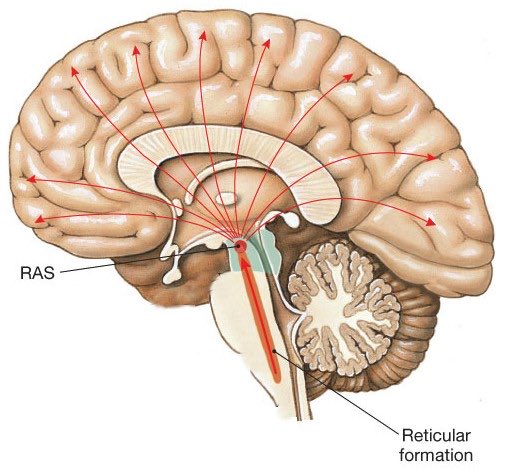
Thus, sleep is something our brain cortical neural networks require to avoid loosing its efficiency in computations. The awoken brain cortex activity is orchestrated by the reticular formation of the brain steam: the mechanism which creates our consciousness as a coherent thread of experience (one may compare that to the work of the OS system scheduler in a modern CPUs). Obviously, when run non-stop, the orchestration loses efficiency. Sleep resets it, allowing brain cortex to work in non-coherent mode for few hours (we feel that as sleep with no dreams, where we lose consciousness) - combined with "test drive" of REM sleep where the consciousness and coherence is present in a reduced form, receiving no external sensory input ("hallucinating" with dreams). This restores reticular formation "task scheduler" efficiency and supports our cognitive and intellectual functions after we awake.
Interestingly this shows that the sleep is not a property of the brain cortex, but rather of the brain steam, reticular formation, which has been present among animals much before humans, for hundreds of millions of years - in all species that do sleep (reticular formation is there in all chordata, starting from jawless fish). Thus, the sleep is a reticular formation reset: a reboot for the brain orchestrator.
The funniest part that some other phylogenetic branch of animals - cephalopod mollusks (octopuses, squids, cuttlefishes) - had independently acquired brain structure very similar to the reticular formation of chordata (and also named "reticular formation") - and, with it, ability & necessity to sleep!
QED, the puzzle of sleep is solved with what we already know today!
Indeed, our brains are Universal quantum computers. Whether they "delegate the exponential explosion of state and computation" to the quantum physics layer via some form of quantum chemistry (like chlorophyll does), or handle it in some other way, remains to be discovered.
A universal quantum computer has no racing conditions: it just executes each possible computation branch appearing from the shared state access. Literally, where there is a racing conditions, it splits and continues with all of the options.
Universe is the universal quantum computer. That's why we observe quantum physics.
To build another universal quantum computer one needs either to handle the exponential explosion of the state and amount of computations (which is impossible at our level of civilization) - or plug into quantum physical layer to delegate that explosion to the computational power of the Universe itself (which is super-hard, but theoretically is doable).
Many underestimate the risk of not having censorship-resistent high-load computing (able to run at least linear algebra in parallel
Mode - what humans call "AI" and "ML" today) - and overestimate the value of money comparing to it.
When you have a gun and is among some apes, it doesn't matter how much "sound and hard money" those apes have.
Intelligence (as an ability to outperform others in your computing capacity in creating models of the world around) is the ultimate "gun" - and all humans, not able to do that outperformance, are the apes.
Without censorship-resistant scalable computing we will just have tyranny of the scale we never had in the past - and bitcoin-as-money won't save from that.
That's why since 2017 we are building crnsorship-resistance computing platform, and work on technology backing it, like in @UVioletAI and #RGB
#FreeAI https://t.co/5cP5Js71LS
Consciousness. Self-awareness. Intelligence.
These are the things which are abundant not just in the Universe but even here on Earth across many biological species and programs. They are not the things which are important.
What is important is the existence of individual will. That is rare even amongst humans, - and AI, AGI, and ASI are still extremely far from acquiring it.
PS. Consciousness is just a single-threaded computation. All species with nervous system or advanced programs with self-introspection which run on CPUs have it.
Self-awareness is an ability to model oneself and compute that model. Again, high animals can do that and I am quite sure one can eventually get the same property from tensor computing ("AI").
Intelligence is an ability to have a coherent predictive model of the world - pretty much the same as self-awareness, but directed externally and not internally.
It seems like the Tree of Knowledge [of the Self and own Will] is required to be tasted by anyone seeking the real awakening, not the fake one. Designing AI which can supersede humans requires creating such tree first. Doubt OpenAI or Google engineers, or other humans who haven't ate from that tree themselves will be able to create it :)
I am a strong supporter for generalized molecular nano-assembly, which allows creation and production of hardware (molecular) computational architectures at exa-industrial scale, very robust, energy-efficient and green. Good that such nanoassembler was already released few billions years ago with no human or "natural intelligence" involved.
Its core components are DNA and ribosomes; instead of silicone it uses computational architectures based on some forms of carbohydrates (lipoproteins, nucleoproteins and saccharoproteins).
It's a pity that humanity was too uneducated and unintelligent not to use it and instead tried to reinvent the wheel with this bullshitty and scammy x86, ARM and other attempts which won't withstand the time and are unusable for building any proper interstellar civilization.
#HumanityIsScam
Conscious is a thread of coherent experience - literally the psychological equivalent to a thread of computation. It has nothing to do with self-awareness: modern computers are already "consciously" executing programs, but these programs are not self-aware.
In this regard neural networks are unconscious: they do not have any coherence internally (but instead are massively parallel).
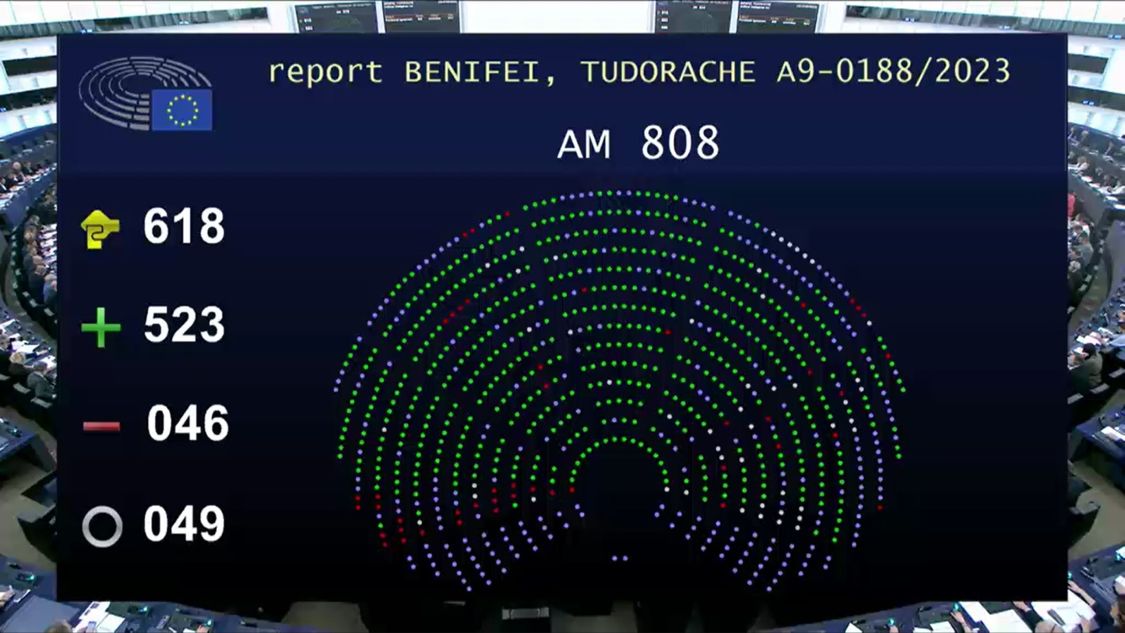
🚨BREAKING: The European Parliament has just APPROVED the AI Act. What everyone should know:
➵ The AI Act follows a risk-based approach. Some AI systems are banned, such as those involving:
- Cognitive behavioral manipulation of people or specific vulnerable groups;
- Social scoring: classifying people based on behavior, socioeconomic status, or personal characteristics;
- Biometric identification and categorization of people;
- Real-time and remote biometric identification systems, such as facial recognition.
➵ Some AI systems fall in the "high-risk" category, such as those involving:
- Critical infrastructures (e.g. transport) that could put the life and health of citizens at risk;
- Educational or vocational training that may determine the access to education and professional course of someone’s life (e.g. scoring of exams);
- Safety components of products (e.g. AI application in robot-assisted surgery);
- Employment, management of workers, and access to self-employment (e.g. CV-sorting software for recruitment procedures);
- Essential private and public services (e.g. credit scoring denying citizens opportunity to obtain a loan);
law enforcement that may interfere with people’s fundamental rights (e.g. evaluation of the reliability of evidence);
- Migration, asylum, and border control management (e.g. automated examination of visa applications);
- Administration of justice and democratic processes (e.g. AI solutions to search for court rulings).
➵ High-risk AI systems will be assessed before being put on the market and also throughout their lifecycle. People will have the right to file complaints about AI systems to designated national authorities.
➵ Generative AI, like ChatGPT, will not be classified as high-risk but will have to comply with transparency requirements and EU copyright law. Some of the obligations are:
- Disclosing that the content was generated by AI;
- Designing the model to prevent it from generating illegal content;
- Publishing summaries of copyrighted data used for training.
➵ The AI Act is expected to officially become law by May or June, and its provisions will start taking effect in stages:
- 6 months later: countries will be required to ban prohibited AI systems;
- 1 year later: rules for general-purpose AI systems will start applying;
- 2 years later: the whole AI Act will be enforceable.
➵ Fines for non-compliance can be up to 35 million Euros or 7% of worldwide annual turnover.
➵ If you want to learn more about the AI Act, including challenges, opportunities, and practical insights, join my live session with @BertuzLuca, @JcMalgieri & @RistoUuk on April 4th (register using the link below).
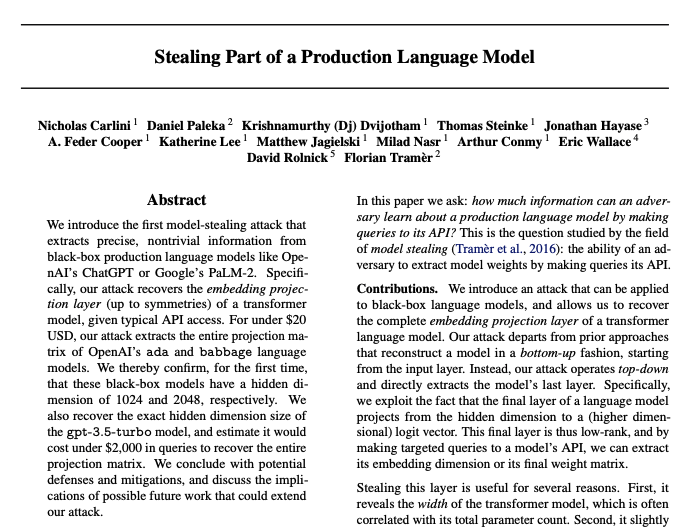
Google announces Stealing Part of a Production Language Model
We introduce the first model-stealing attack that extracts precise, nontrivial information from black-box production language models like OpenAI's ChatGPT or Google's PaLM-2. Specifically, our attack recovers the embedding projection layer (up to symmetries) of a transformer model, given typical API access. For under \20 USD, our attack extracts the entire projection matrix of OpenAI's Ada and Babbage language models. We thereby confirm, for the first time, that these black-box models have a hidden dimension of 1024 and 2048, respectively. We also recover the exact hidden dimension size of the gpt-3.5-turbo model, and estimate it would cost under 2,000 in queries to recover the entire projection matrix. We conclude with potential defenses and mitigations, and discuss the implications of possible future work that could extend our attack.
@max_paperclips Because many think that LLM solves problems in other domains, where it doesn’t.
FYI we will be writing what we want, not seeking for your permission.
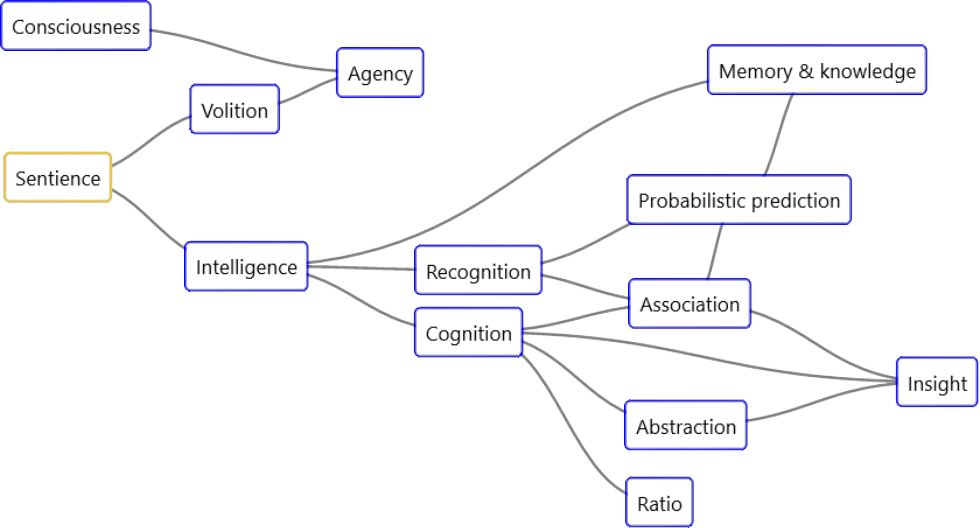
@max_paperclips Citing context on difference between cognition/ recognition and the overall hierarchy of things related to intelligence.
DL & LLMs cover knowledge, prediction, part of associations related to them and recognition - but not rest of cognition, which is our field of interest
@max_paperclips People need many things, for instance ability to chop woods and build houses. Still it is not our mission or a task to do that.
What you mentioned is a recognition (classification, association) and not a critical part of cognition. We are focusing on abstraction instead.
@max_paperclips Your logic is failed. According to it, theoretical science or math “has nothing to show in practice, so its opinion is worthless”.
You push others to do something you need and then blame them and ask to be silent when they decline your request and agenda. Not acceptable.
@max_paperclips Our goal is not to build a ChatGPT alternative. Our goal is to understand what cognition is and how to build cognitive systems, and GPTs are not of that class.


![dr_orlovsky's tweet photo. Consciousness. Self-awareness. Intelligence.
These are the things which are abundant not just in the Universe but even here on Earth across many biological species and programs. They are not the things which are important.
What is important is the existence of individual will. That is rare even amongst humans, - and AI, AGI, and ASI are still extremely far from acquiring it.
PS. Consciousness is just a single-threaded computation. All species with nervous system or advanced programs with self-introspection which run on CPUs have it.
Self-awareness is an ability to model oneself and compute that model. Again, high animals can do that and I am quite sure one can eventually get the same property from tensor computing ("AI").
Intelligence is an ability to have a coherent predictive model of the world - pretty much the same as self-awareness, but directed externally and not internally.
It seems like the Tree of Knowledge [of the Self and own Will] is required to be tasted by anyone seeking the real awakening, not the fake one. Designing AI which can supersede humans requires creating such tree first. Doubt OpenAI or Google engineers, or other humans who haven't ate from that tree themselves will be able to create it :)](https://pbs.twimg.com/media/GWLtpo9XIAApm59.jpg)