I love Americans. We were about to walk an hour to the stadium in the rain to save on an Uber, and the receptionist at the hotel we were parked in front of decided to drive us there.🙏
One heuristic for making startups AI-proof is to make things human intelligence can't compete with either. For example, marketplaces are proof against AI competitors for the same reason they're proof against human ones.
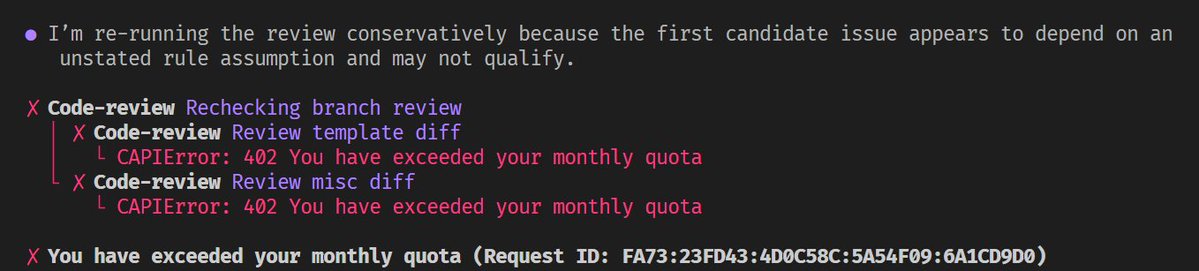
🦔GitHub Copilot switched to token-based billing this morning and users are already out of credits. Pro+ subscribers paying $39 a month are reporting 60% of their credits gone in two hours of normal use. One user lost 20% of their allowance from a single file review with no code changes. Another hit their monthly cap before the calendar even flipped to June.
Orgs with shared token pools have no way to see individual usage, so entire teams get cut off when one person runs a heavy prompt. Users are canceling and moving to Claude Code and Codex. GitHub community forums are on fire.
My Take
Flat-rate AI subscriptions were always subsidized. Everyone in the industry knew it. Today the subsidy ran out for a few million developers at once. The problem is a lot of companies already restructured around these tools. They cut headcount and told remaining engineers to lean on Copilot instead of building skills internally. Those companies now depend on a tool whose cost just became unpredictable and whose usefulness completely changes when you have to ration prompts to stay under budget.
The developers moving to Claude Code and Codex will hit the same wall eventually. Every AI provider faces the same unit economics. Anthropic filed its S-1 this morning, and the durability of its revenue depends on whether customers stick around once real pricing kicks in everywhere. If a $39 subscriber cancels after one day because the tool became unusable, multiply that across millions of seats and the churn risk becomes very real.
Today showed what happens when AI pricing meets reality. The companies that built their workflows around cheap tokens just discovered the tokens aren't cheap anymore and the people who knew how to do the work without them are already gone.
Hedgie🤗
The most basic way AI could blow up imo. I'm not saying it does but this is the most obvious way I can see it happening
- Per seat subscriptions are massively subsidized. The flat fee was priced way below what heavy usage actually costs
- For real business use you have to move to the API anyway. Data protections, work integrations and compliance officer approval
- On the API you pay metered rates, and businesses are burning credits way faster than the per seat pricing ever led them to expect
- This is everywhere right now. Internally for us, Codex users, Uber torching its entire 2026 AI budget in 4 months, the Microsoft comments. Just go try an API
I shared more on this here: https://t.co/iZrqrCAIRW
- And I don't think most businesses have the money to keep paying increasing API rates without a real change to how they operate (caps needed)
- Because they have a cheap alternative. They can reach open source models through any aggregator (OpenRouter, Venice, Baseten, Together) and still get strong privacy. Venice private data centers, or E2EE/TEE serving GLM 5.1.
More on open source inference provider raises here: https://t.co/7kf56P44yQ
- And the discount is enormous. DeepSeek V4 codes within a hair of Opus on SWE bench at roughly 1/30th the price, and the cheapest open models run closer to 1/100th
- Chinese labs open source frontier grade models. The model is the single biggest cost an inference provider has, and they get it for free
- This idea dies if China goes closed source. That is actually bullish web2 AI labs, because if everyone is closed you pay up for the best intelligence. China goes closed source if they are tired of giving away an asset and they want the revenue and data flow to train new models
- Is this showing up in web2 AI lab revenue yet? No. Revenue is off the charts. Anthropic went from 9B to 47B run rate in five months
- So go forward, what happens?
- I think revenue slowly starts leaking to the open source inference providers (see Venice usage, OpenRouter's $113M raise, Baseten is raising at $11B or triple its valuation in three months, on revenue that went from $200M to $600M annualized in a single quarter)
- It doesnt move overnight, but it caps the labs ability to raise prices, and margins are already deeply negative. OpenAI is reportedly running near negative 122%
- With margins that bad there is no cash flow, so the labs are fully dependent on outside capital to buy GPUs, train models, and keep subsidizing usage (I.e. see Google tapping $80b equity sale, granted 30b for employee RSU taxes. Clearly they think Equity is overvalued or you wouldn't sell it)
- The break comes when that capital stops. Pricing is capped so margins cant improve, and the moment investors lose conviction on payback, the whole flow reverses
- Why would they lose conviction on payback? Back to the start - the inability to improve margins or get businesses to pay more
- This is also limiting, if we start making new drugs with AI or create entirely new businesses, you better believe people will pay up to the max for AI usage
Clubbing is dead and has been replaced by fitness & wellness.
Ppl used to party to socialize and date but now they do things like HYROX, bathhouses, and running raves.
The death of clubbing is something to be studied:
— US has lost 12% of its nightclubs in the last 24 months
— 25% of US adults didn’t drink at all last year
— Gen Z drinks 30% less than Millennials did at the same age
On the flip side:
— According to Strava, the number of running clubs recorded on the platform increased 3.5x in 2025
— 72% of Gen Z go to run clubs to meet new people
— Sauna and spa market: $11.8B → $22.4B by 2034
The post-alcohol economy is gonna be a massive category.
If an Anthropic employee got $500k/year in equity over 4 years in 2024, they are now worth $125M.
At $1M/year equity for 4 years, they are worth about $250M.
The scale and speed of wealth creation are incomprehensible.
$500k/year equity is not a lot for an early-stage startup. I don't think the Bay Area has seen this type of wealth creation in history.
Dot com boom probably feels like a speck of dust.
NYC is absolutely electric right now.
Perfect weather. Knicks in the Finals. Hyrox going on. Interns. Summer Friday. Every bar is buzzing. Everyone is outside.
I honestly can’t remember the city having more energy than it does today
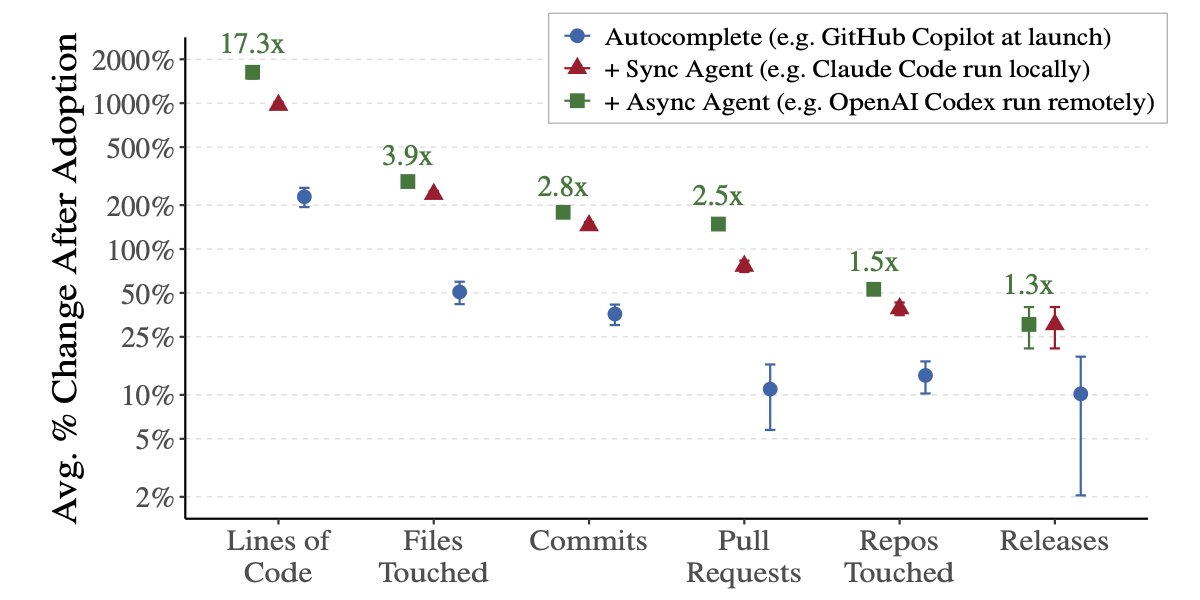
Big paper on AI coding agents using Github & other data
The auto-complete tools (Copilot) led to 2.2x more code, local agents like original Claude Code led to 7.4x, & current remote coding agents 17.3x(!)
But human bottlenecks in coding means actual releases "only" went up 30%
No one could have predicted this
“Jersey City was one of the busiest apartment-construction markets in the entire New York metro region, adding thousands of new units as developers chased the post-pandemic demand surge. When all that inventory came online at once, landlords had to compete on price to fill the units, which pulled rents down from their 2024 peak. The building boom is why renters are getting a break now."
The SAT & ACT are strong predictors of college performance (far better than high school GPA).
Yet, many colleges eliminated them on the assumption they hurt diversity.
Not so. From the NYT: “Once we brought the test requirement back, we admitted our most diverse class ever.”
At @UChicago@UChi_Economics “Last year, over 40 percent of students graduated with a degree in economics—double the share from 20 years ago. The most obvious culprit is the business economics specialization introduced in 2018.”