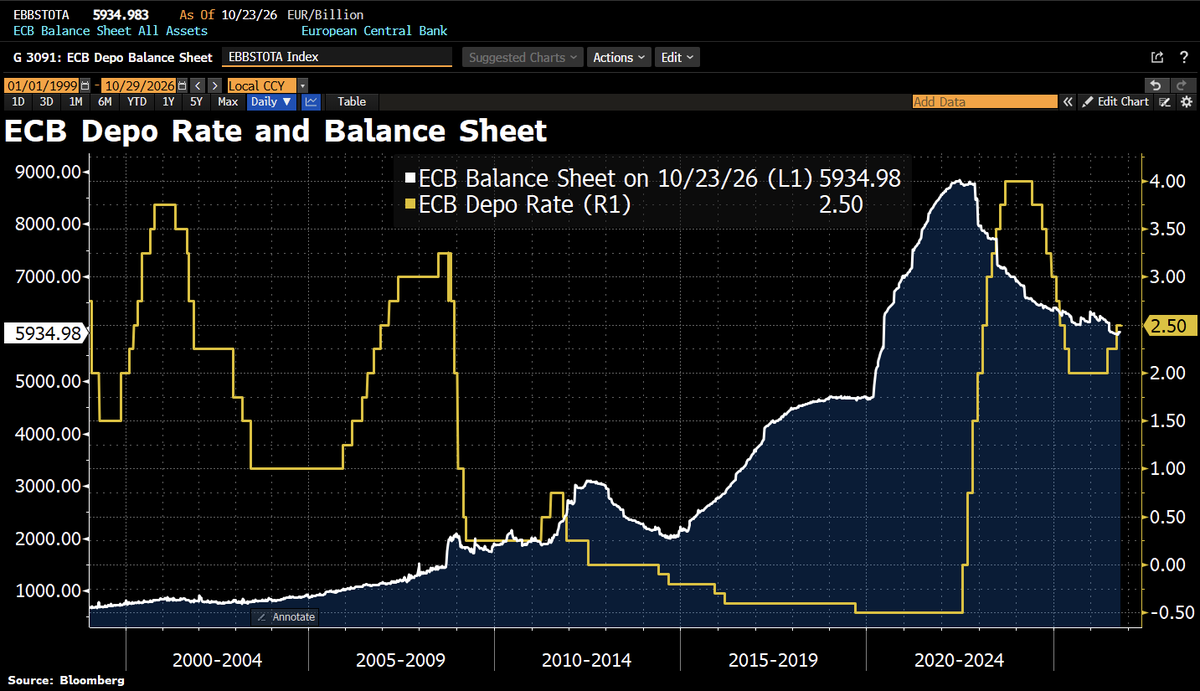
ECB holds rates steady at 2.50%, setting the stage for a possible final hike in December. The dovish message: little evidence that the energy shock is feeding into wages or underlying inflation, while rising bond yields are already doing some of the ECB’s tightening. Bloomberg Economics expects one last hike, then a stop. Meanwhile, the balance sheet has shrunk to €5.93tn.
SUMMARY OF FED CHAIR WARSH'S STATEMENT:
1. Fed to eliminate 1 interest rate-setting vote beginning in Fall 2027
2. Fed expects to hold just 6 policy-setting meetings in 2028, down from 8 currently
3. Overwhelming consensus is that the "monetary medicine is starting to work"
4. Warsh says he is "unwilling and unable" to call financial conditions tight
5. Warsh says that inflation remains elevated in the US
6. The Fed awaits more information in determining policy path
The Fed is now in "wait and see" mode.
Tienen que ver esta chulada de contrato que descubrimos en #Latinus… y quién lo firma! Presiento que no le va a gustar nada a la presidenta. #Loret en @latinus_us
Looking forward to joining @GBM_mx_ in Mexico City tomorrow for a discussion on investing, markets, and the global economy.
If you’d like to watch the conversation live, you can tune in here:
https://t.co/dv9LZTlLHy
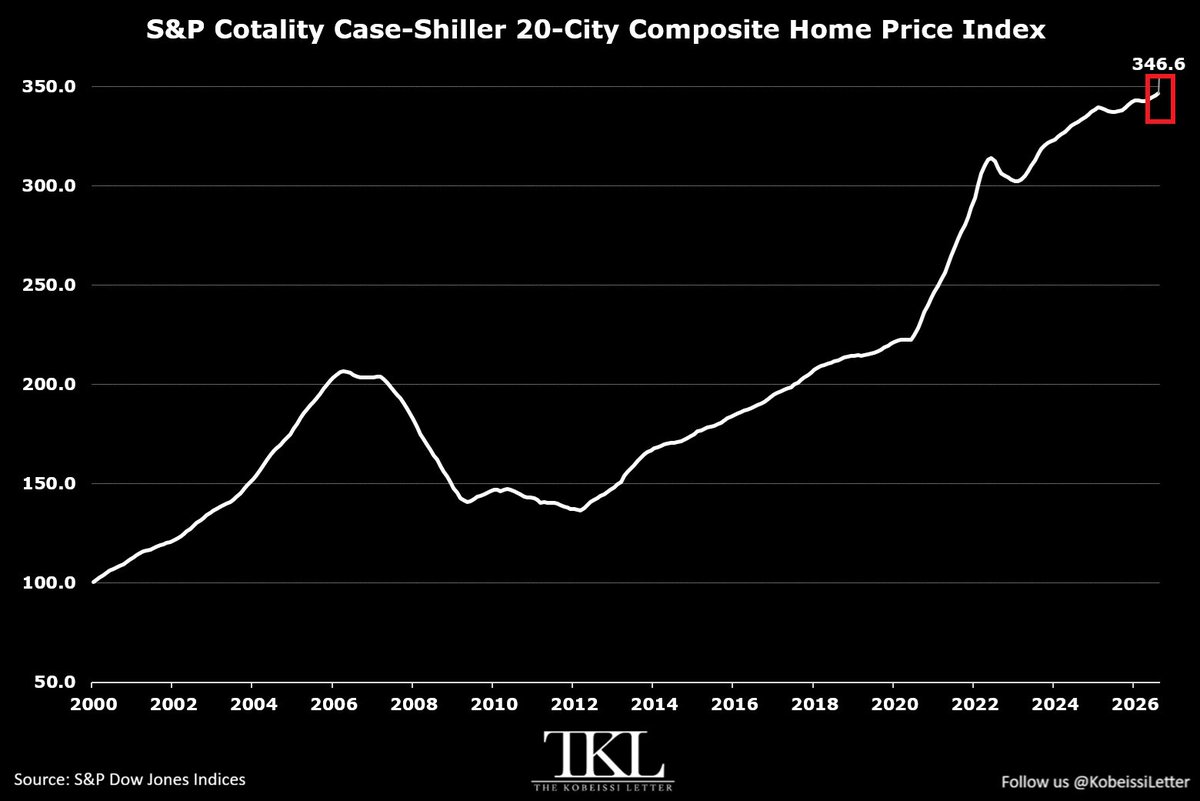
BREAKING: Home prices across America's 20 largest cities rose +0.3% MoM in August, marking their 5th consecutive monthly increase.
YoY, prices jumped +2.7%, bringing the 20-City Composite Home Price Index to a record 346.6 points.
Since the start of 2019, home prices have surged +56.5%.
Chicago led all metros in August for the 6th consecutive month, recording a +6.7% YoY increase.
New York and Cleveland followed, with YoY increases of +6.2% and +4.3%, respectively.
Housing affordability continues to deteriorate.
Brazil's 10Y Government Bond Yield is now pushing 16%!
That's a +300 basis point gain in a single day.
That would be like US mortgage rates going from 7% to 10% in a single day.
BREAKING: US households now own ~42% of the US equity market, their highest proportion since the late 1990s.
This proportion has risen +7 percentage points since 2020.
Foreign investors are the 2nd-largest owners, accounting for 18%, up from 16% in 2020.
Mutual funds rank 3rd, at 15%, down from 23% in 2020.
Meanwhile, ETF ownership has increased +3 percentage points over the last 6 years, to 10%, its highest on record.
By comparison, pension and retirement funds own 8% of the market, while hedge funds own just 1%.
Household demand for stocks is stronger than ever.
“China doesn’t have a Mexico. Europe doesn’t have a Mexico. We do.”
Texas billionaire Ross Perot Jr. says a fully integrated North America has the demographics and resources needed to compete globally, calling Mexico key to the region’s ability to “grow and prosper." He spoke at Bloomberg Invest Dallas https://t.co/8lsL5D7cMb
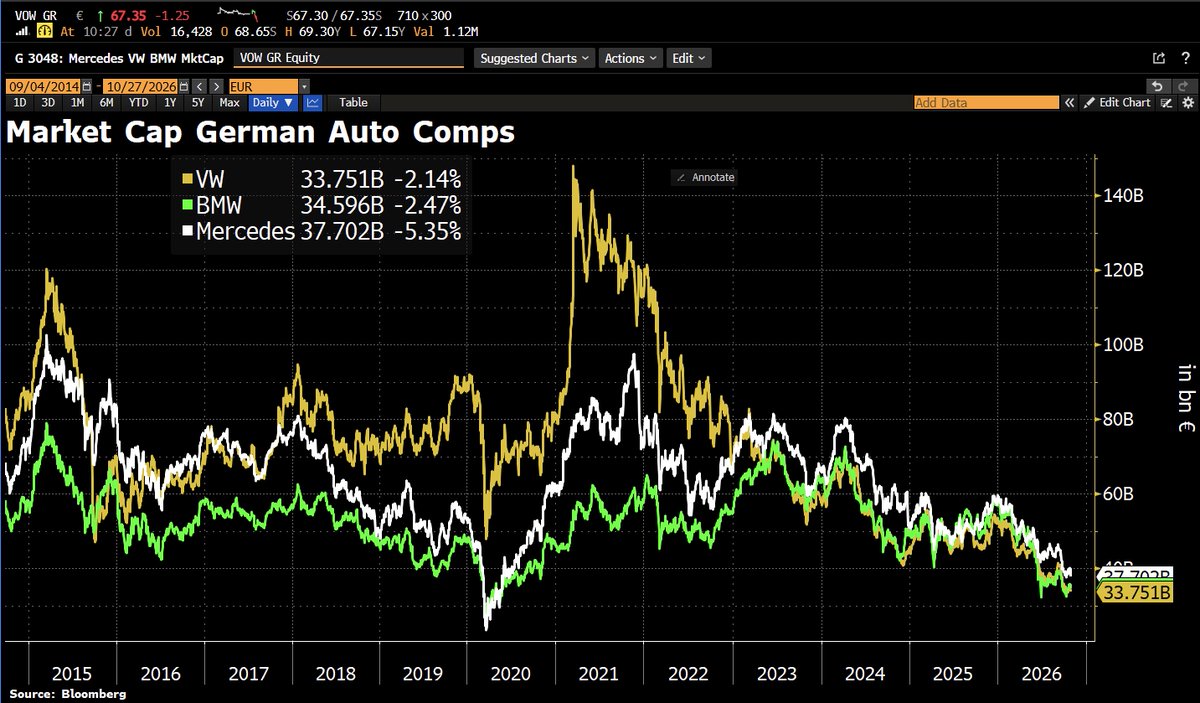
Good Morning from Germany, where Mercedes is also being hit hard by the China shock. It joins BMW & VW in cutting its outlook, now targeting a car margin of just 2–3%, vs up to 5% before. Shares tumble 5.4%, taking this year’s loss to more than a third. Germany’s Big Three are now worth just €106bn combined. Tesla alone is worth €1.4tn, more than 13 times as much. China, once their profit engine, has become a major liability.
BREAKING: Brazil's -19.8% stock market crash on Monday was one of the rarest market events in the last two decades, according to our analysis.
Brazil's EWZ ETF plunged -19.8% on October 26th, marking an 8.4 standard deviation move.
For context, the ETF's average daily move over the last 20 years has been just +0.04%, with a standard deviation of 2.36%.
Under a normal distribution, the probability of a decline this extreme is approximately 1 in 58 quadrillion.
In other words, this event should be virtually impossible under conventional statistical models.
What just happened in Brazil was *almost* impossible.
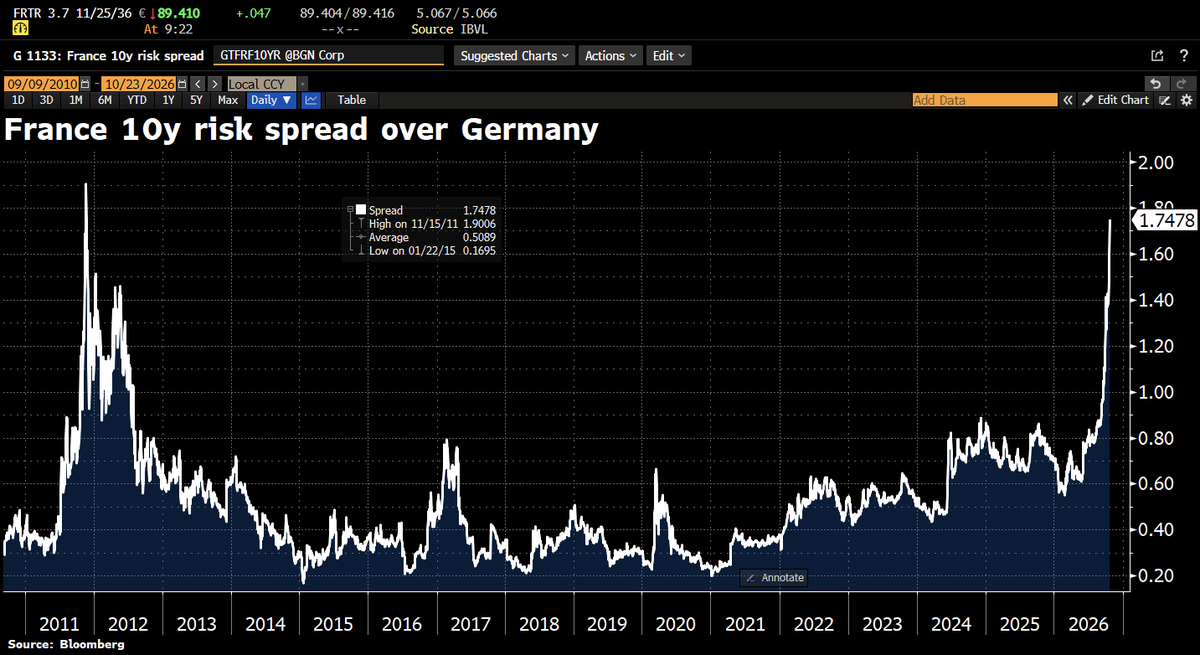
Bond markets are turning up the pressure on Paris as France’s risk premium keeps climbing. The 10y yield spread over Germany has widened further to 175bps, the highest since 2011. Just 15bps shy of its eurozone debt-crisis peak.
BREAKING: AI token spending grew just +0.2% MoM in September, the lowest monthly growth since November 2025.
This follows a +1.0% increase in August, marking two consecutive months of growth at or below +1.0%, the weakest streak in at least 18 months.
This comes as falling prices for the most advanced AI models, alongside improvements in efficiency and quality, drive down the average price per million tokens processed by these models.
Since July, overall AI token prices have declined -48%, to $0.65 per million tokens, the lowest since at least January 2026.
Lower costs could unlock the next wave of AI adoption.
The US affordability crisis is worsening:
Food prices have surged +34.5% since December 2019, now at their highest level on record.
Rent and grocery prices have risen +33.3% and +30.0%, respectively.
Furthermore, motor vehicle maintenance and repair prices have soared +55.2% over the same period.
Meanwhile, prices for services excluding rent, including medical care, transportation, education, communication, and recreation, have increased +29.2% since December 2019.
As a result, the Consumer Price Index (CPI) has risen +30.4%.
Basic necessities are becoming increasingly unaffordable in the US.
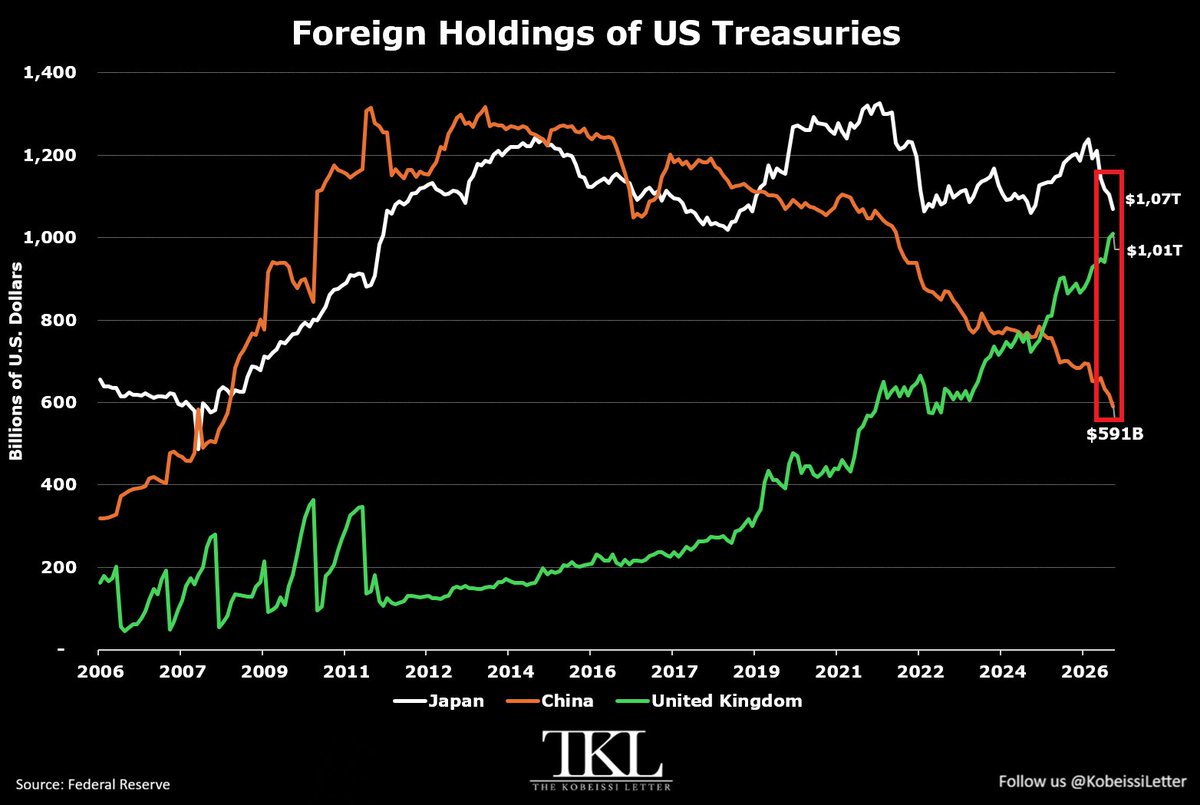
BREAKING: Foreign holdings of US Treasuries jumped +$83 billion in August, to $9.33 trillion, their 6th-highest total on record.
The surge was driven by Canada, which raised its holdings by +$38 billion, to $465 billion, its 4th-highest on record.
This was followed by Belgium, which increased its holdings by +$20 billion, to a record $491 billion.
The UK, the 2nd-largest holder, raised its holdings by +$11 billion, to a record $1.01 trillion.
Meanwhile, Japan, the largest foreign holder, cut its holdings by -$36 billion, to $1.07 trillion, its lowest since November 2024.
China, the 3rd-largest holder, reduced its holdings by -$27 billion, to $591 billion, its lowest level since August 2008.
Foreign holdings of US Treasuries are rising despite continued selling in Japan and China.
BREAKING: $750 billion has been added to the US stock market in the last 45 minutes as reports of a US-Iran proposal to end the war send WTI oil crashing to $96.
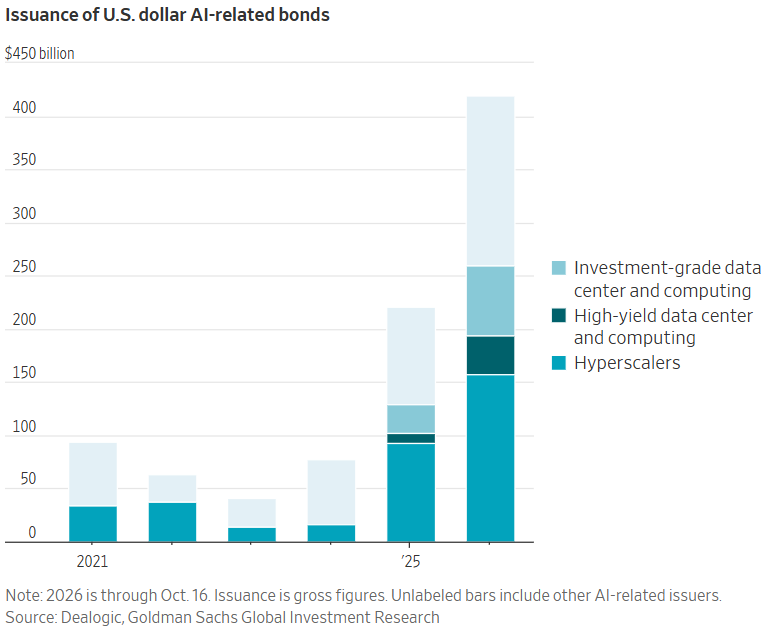
The AI boom is increasingly being built on borrowed money.
AI-related bond issuance has surged to $419 billion so far in 2026, 90% higher than all of 2025.
Every equity bubble inevitably becomes a credit bubble before it bursts.