♡ Open-source hackathons building the cutest multiverse! Code $BOHBOO, the BOHBOOverse, #GiftFAI, realms & more. Sending lots of hugs for hardworking devs! 🦌👻
VBH2 is almost here!
Due to personal constraints this will be the last Virtual BOHBOOverse Hackathon until September 2026 😳
Start organizing your team, we are excited to see what you build next!
https://t.co/nTvQorKTFp
📕New Guide for Organizers: Planning a university hackathon? You only need to answer these 14 quick questions.📝
We wrote the guide so you don't have to learn the hard way.
Read the full article 👉 https://t.co/ydw78RB9xq
Software Factory isn’t just for huge enterprises, although that is our bread and butter. It’s a powerful tool that is increasingly useful for talented and curious organizations of all sizes.
Please consider giving it a try.
I would like to offer to pay the salaries of TSA personnel during this funding impasse that is negatively affecting the lives of so many Americans at airports throughout the country
@shanaka86 Elon is pivoting the collapse threat…started when he bought Twitter.
We are no longer silenced 🤫 by the natural/historical forces of collapse.
When will the updated version of your book come out? Happy to help you write it.
Everyone is covering Terafab as a chip factory.
It is not a chip factory.
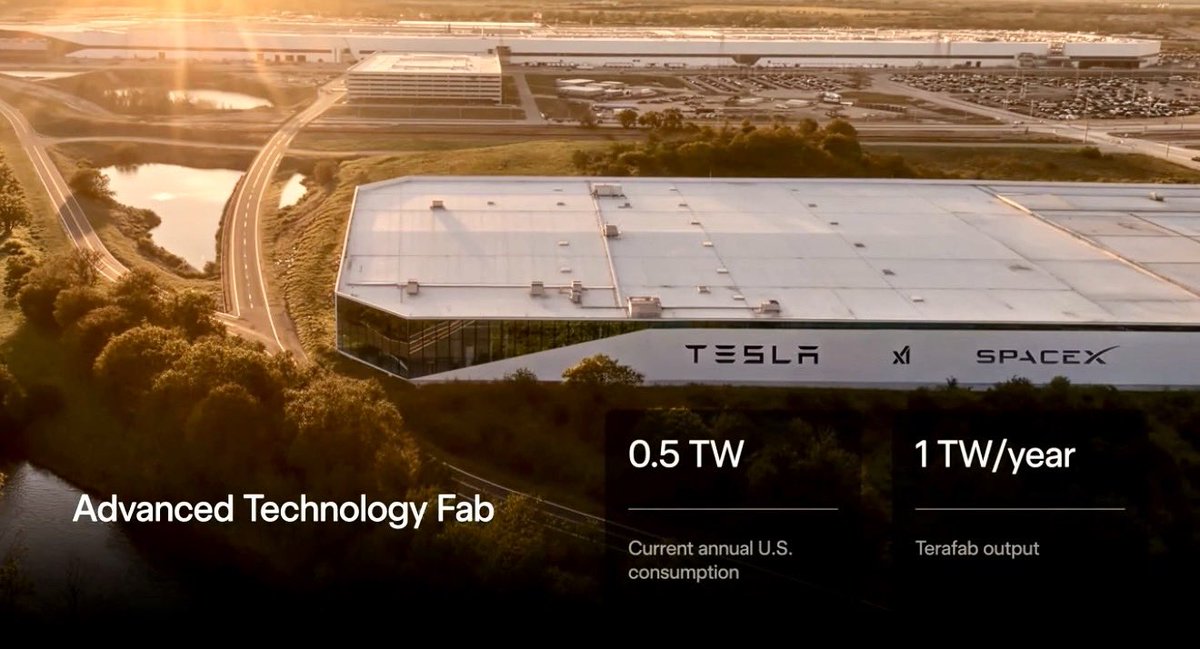
Last night in Austin, Elon unveiled a facility that makes masks, fabricates chips, and tests them inside a single building with a nine-month recursive improvement cadence. No such loop exists anywhere else on Earth. Then he told you 80% of the output goes to space. Then he showed you a 100-kilowatt AI satellite with solar panels and radiators, scaling to megawatt range. Then he said Optimus plus photovoltaics will be the first von Neumann probe, a machine capable of replicating itself from raw materials found in space.
Nobody connected the sequence.
Terafab produces 1 terawatt per year of compute. The entire United States consumes 0.5 terawatts of electricity. Musk is building a single factory whose output in AI silicon exceeds twice the power consumption of the country it sits in. And he is sending 80% of it off-planet because Earth literally cannot power what he is building.
Follow the mechanism. Terafab seeds the chips. Starship launches Optimus robots and solar arrays at 100 million tons per year. The robots mine lunar and asteroid regolith for silicon, iron, and nickel. They 3D-print more robots. They fabricate more solar panels. They assemble more AI satellites. Each satellite runs hotter-burning D3 chips designed specifically for vacuum, where free radiative cooling eliminates the thermal constraints that strangle every terrestrial data center on the planet. The nodes replicate. The replication is exponential.
This is a Dyson Swarm bootstrap hidden inside a semiconductor announcement.
The math is public. The Sun outputs 3.828 times 10 to the 26th watts. A 2022 paper in Physica Scripta calculated that 5.5 billion satellites at 290 kilograms each, robotically manufactured from Mars resources, capture enough solar energy to meet all of Earth’s power needs within 50 years. A 2025 paper in Solar Energy Materials calculated a partial swarm capturing 4% of solar output yields 15.6 yottawatts, roughly a billion times current human civilization’s total energy budget. Musk just announced the factory that builds the chips that go inside the satellites that replicate themselves forever.
92% of advanced logic chips are fabricated in Taiwan. One factory in Austin does not fix that. But one self-replicating system seeded by that factory, launched by the only company with reusable heavy-lift rockets, assembled by the only humanoid robot in mass production, and powered by the only star within reach, does not fix a supply chain. It obsoletes the concept of supply chains entirely.
The market priced this as a $20 billion capex story about semiconductor independence.
The actual announcement was the engineering blueprint for Kardashev Type II.
Humanity sits at 0.73 on the Kardashev scale. 18 terawatts. The distance between here and harnessing a star is not a technology gap. It is a recursion gap. And recursion is exactly what a single building in Austin that makes its own masks, builds its own chips, tests its own chips, and launches the output into orbit on its own rockets was designed to close.
Every civilization that makes it past this point never looks back.
Helium is the only element that escapes Earth’s atmosphere permanently. Once released, it rises through the troposphere, passes the stratosphere, and leaves the planet. It cannot be manufactured. It cannot be synthesised at industrial scale. It accumulates over billions of years in the same geological reservoirs as natural gas. And one third of the world’s supply just went offline because Iran hit the facility that extracts it.
Qatar produced roughly 63 million cubic metres of helium in 2025, accounting for 30 to 36 percent of global supply from a total of approximately 190 million cubic metres. QatarEnergy’s three large helium purification plants at Ras Laffan form the world’s biggest helium production base. When LNG production stopped after Iranian drone strikes on March 2 and the subsequent missile damage on March 19, helium extraction stopped automatically because helium is recovered during natural gas liquefaction. You cannot produce helium without producing LNG. The byproduct dies with the primary product.
Spot helium prices have roughly doubled since the crisis began. Industry consultants warn that prolonged disruption could push contract prices toward $2,000 per thousand cubic feet. A major industrial gas supplier has already begun assessing customers a helium surcharge. Phil Kornbluth, the most cited helium market consultant, stated the assessment directly: the world cannot compensate for the loss of a third of its helium supply.
South Korea imports 64.7 percent of its helium from Qatar. SK Hynix and Samsung operate high-volume fabs producing the DRAM and high-bandwidth memory that power every AI accelerator, every data centre GPU, and every cloud computing cluster on Earth. Helium cools silicon wafers during fabrication. It serves as a carrier gas in deposition and etching tools. It enables leak detection in vacuum systems. Modern extreme ultraviolet lithography requires helium-cooled environments for precise temperature control. Without helium, the fabrication process degrades or stops.
SK Hynix and Samsung hold two to three months of helium inventory. Two to three months is not a buffer. It is a countdown. If Ras Laffan remains offline beyond that window, South Korean memory production faces rationing. TSMC in Taiwan is somewhat more diversified but still uses Qatar-linked supply chains. The entire AI hardware supply chain, from HBM3E memory stacks to advanced logic chips, sits inside helium-dependent ecosystems.
Beyond semiconductors, helium cools the superconducting magnets in more than 14,000 MRI machines operating worldwide. It pressurises rocket fuel tanks and purges propulsion systems in aerospace. CERN’s Large Hadron Collider depends on helium cryogenic systems. There is no substitute for helium in any of these applications at industrial scale.
The United States and Qatar together account for more than 70 percent of global production. The US federal helium reserve and private suppliers offer partial relief, but global prices and spot availability are still governed by Qatar’s market share. Japan’s Iwatani has drawn on US reserves. Canada and the Rockies are seeing renewed investor interest. None of this replaces 63 million cubic metres in weeks.
The war hit uranium first. Then oil. Then nitrogen. Then water. Then plastic. Then medicine. Then sulfur. Now helium. Eight layers. Each one deeper. Each one closer to the infrastructure that sustains modern civilisation. The chip that processes your data, the magnet that scans your body, and the rocket that launches your satellite all depend on an atom that leaves the planet when you lose it.
https://t.co/iFmUcarGdV
As coding agents start compiling English into code, the definition of WHAT to build becomes the highest leverage work.
That means teams need to collaborate deeply on requirements.
Some people write specs as markdown in Git repositories. But that isn’t a collaborative environment. PMs aren’t living in IDEs or PRs.
Software Factory brings a Cursor-like agent experience into a multiplayer document editor.
If you’ve wondered why Google Docs never built a true, agent-driven editor: it’s extremely hard.
We just shipped one.
Try it here: https://t.co/fkfTXgcI8c
Just added more to my $BOHBOO bags today.
Projects with active devs and strong community energy always stand out to me, and this one is showing good signs early. Still building my position while it’s quiet.
Buy proof attached. Let’s see how far $BOHBOO can go. 🚀
@BOHBOOhacks
I mentioned this earlier but there are a lot of interesting consequences to autonomous driving. One of them is that insurance companies start to look more financially predictable...they charge lower premiums, but they also pay out less. This will flow through to reinsurers as well.
Case in point, Lemonade cutting premiums by 50% if you drive a Tesla with FSD. Important implications for all car insurers.
Just won VBHpro! 🏆🔥
Huge thanks to the organizers, judges, and the entire community for this epic opportunity to showcase my skills and go head-to-head with top talent. Grateful for the support, feedback, and vibes—let's keep building! 🚀 #VBHpro#Winner
GM everyone!!
VBH1.5 gifts have been sent out!
VBH1PRO winners have been decided and our winners are
EJ
@LumiiEth@RaidsOctavius
1st second and third respectively.
We are in fast motion and are moving on to VBH2 and we are looking to get as many people as possible in.