@aria_gerson Part of the issue with Vanderbilt's NC SOS is just bad luck. If you take VU's NC schedule (presumably scheduled 1-2 years in advance) and re-calculate NC SOS based on prior year opponent quality, it would be ranked ~85 in 2023, ~157 in 2024, and ~158 in 2025... vs 251 in 2026.
@cyd88 @RobertMara662 @TheUASignGirl I've seen a hundred tweets like that and they all have to exaggerate his age because 24 isn't that old by modern CFB standards.
@JabautTim@watchLiveMusic@Kim_Jong_Ilness @CFBRep Tennessee has already lost one game. Vanderbilt has not. If we assume 10-2 gets you in and 9-3 does not, then Tennessee can lose up to one more game, and Vanderbilt can lose up to two more games.
Super excited to share our paper “A genome-wide association study identifies an African-specific locus on chromosome 21q22.12 associated with Burkitt lymphoma risk and survival”. This work should encourage more studies to understand the genetic basis of BL https://t.co/3Srv13GMg9
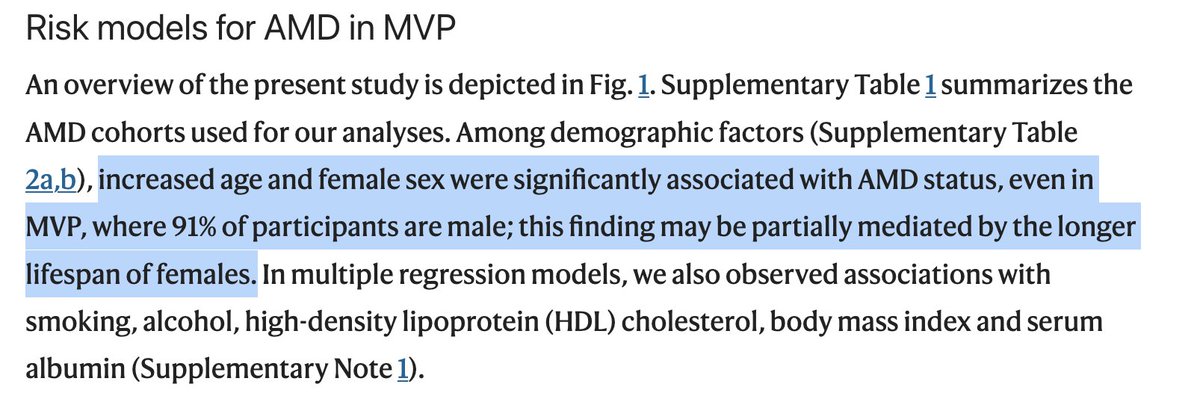
The past few days, I've been reading this absolutely beautiful and comprehensive work on the genetics of AMD. Will share more on the genetic results later. But one observational association that stood out for me is the increased prevalence of AMD in females than males (OR=1.2-1.4) even in a cohort like MVP, where 91% of the participants are males. The increased prevalence in females is thought to be simply due to that females longer than males (age is THE most important risk factor for AMD). Fascinating!
Gorman, Voloudakis, Igo Jr., et al. Nat Gen
https://t.co/jBJRoFEEkm
From @cwru: data analysis from #MillionVeteranProgram and 5 other cohorts show genetic risk for #AMD using #EHR. It helped uncover genes and pathways that boost AMD risk in one of the most diverse samples ever analyzed.
@NatureGenet: https://t.co/DaOjAANCKA
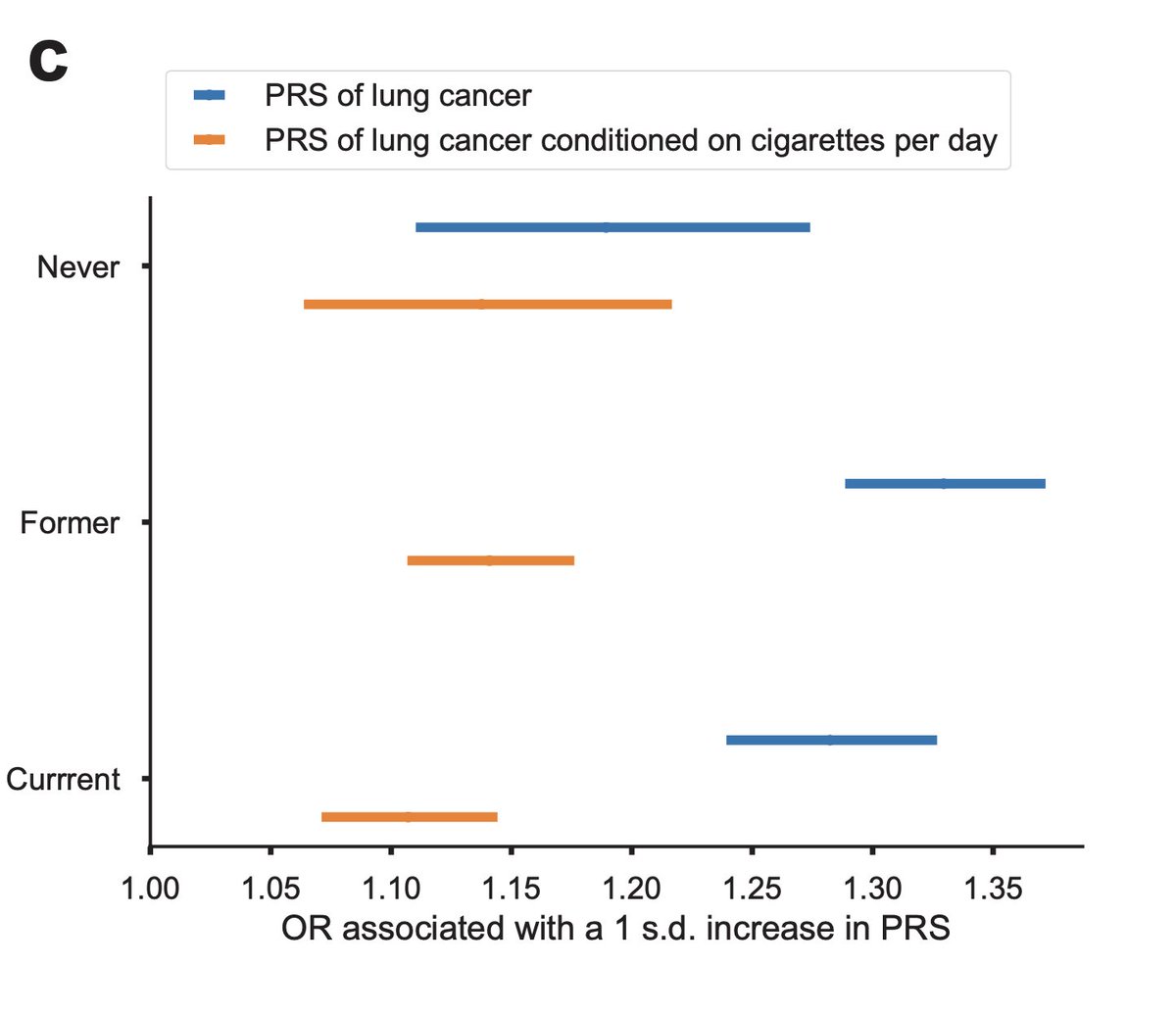
Love this plot showing the association of polygenic score of lung cancer with lung cancer. Once you condition on smoking, the effect size becomes similar across current, former and never-smokers.
Gormon et al. medRxiv
https://t.co/gaP5X4zrKJ
Beautiful human genetics discovery of a missense variant in VE-PTP (aka PTPRB) that increases the risk of central serous chorioretinopathy (CSC) and varicose veins, but decreases risk of glaucoma.
VE-PTP encodes vascular endothelial-protein tyrosine phosphatase (removes phosphate), which is a natural inhibitor of tyrosine kinase receptors (adds phosphate) in vascular endothelial cells.
There is a huge literature on the vascular receptor tyrosine kinases (aka angiopoietin receptors), namely TIE1 and TIE2, that bind to its ligands angiopoietin 1 and 2 and regulate angiogenesis (https://t.co/1UqeGwiy8W).
TIE2 (aka TEK) is specifically expressed in vascular endothelial cells. Researchers discovered VE-PTP in mice in 1999 by searching specifically for proteins with phosphatase activity that are bound to angiopoietin receptors in endothelial cells in the blood vessels of the brain (https://t.co/SvsQdyVICQ).
Both TIE2 and VE-PTP are essential for blood vessel formation and patterning during embryo development, and so complete loss is incompatible with life.
The earliest human genetic discoveries related to TIE2 were from the early 1990s. Linkage analysis of large families with venous malformations pointed to a region in chromosome 9p. Soon it became apparent that the causative mutation was a gain of function missense mutation (https://t.co/poHWvHGpDW).
TIE2's link with glaucoma come from early mouse studies that showed, if you delete either TIE2 or its both ligands (Angpt1 and 2) during the late embryonic development, you bypass embryonic lethality, but the mice still develop severe glaucoma due to abnormal development schlemm's canal required for aqueous humor drainage in the eye (https://t.co/jMjnVP2jcG) Later, human genetic confirmed this finding. Partial loss of TIE2 causes primary congenital glaucoma (https://t.co/1Ti41klcvh).
These discoveries formed the basis of development of VE-PTP inhibitors to activate TIE2 (as VE-PTP is a natural antagonist of TIE2) for the treatment of open angle glaucoma (https://t.co/mSXbQajzZk).
So far, no strong human genetic findings have surfaced for VE-PTP. Now, Rämö, Gorman, Weng, et al. report phenotypic consequences of a naturally occurring low-frequency missense variant that decreases VE-PTP function.
Fascinatingly, the phenotypic profile of partial loss of VE-PTP look inverse of the phenotypic profile of partial loss of TIE2.
- While TIE2 deficiency causes glaucoma, VE-PTP deficiency protects against glaucoma.
- While TIE2 over activation causes venous malformation, VE-PTP deficiency increases risk of varicose veins and serous chorioretinopathy (caused by increased fluid permeability of choroidal blood vessels resulting in fluid escaping to behind the retina and detachment).
Some interesting questions to answer:
Are varicose veins and chorioretinopathy are merely developmental consequences of VE-PTP deficiency ? Will post-natal deletion of VE-PTP recapitulate these phenotypes in mice? This is important to know to assess adverse effects of VE-PTP inhibitors.
Similar to how VE-PTP inhibition is explored to treat open angle glaucoma, will TIE2 inhibition help treat chorioretinopathy?
Rämö, Gorman, Weng, et al. medRxiv 2024
https://t.co/f34QghPDno
Great GWAS paper diving deep into the contributions of germline variants to kidney cancer in 29k cases and >800k controls. I particularly love the discovery of a VHL 3' UTR variant, seen in ~10% of African and ~0.01% of European ancestries, that increase the risk of clear cell renal cell carcinoma by 2.7 folds (P=1e-23)--a huge effect size for a common variant.
VHL (von Hippel-Lindau) is a tumor suppressor gene famous for its association with a range of manifestations: tumors and cyst in brain, retina, kidney, adrenal glands, pancreas etc. Renal cell carcinoma is the commonest manifestation. VHL is often chosen as an example to illustrate the concept of "one gene many syndromes". Loss of function variants typically cause renal cell carcinoma, missense variants cause pheochromocytoma. It's interesting to see a common UTR variant with such a large risk effect for renal cell carcinoma. The variant likely downregulates VHL strongly. It's a pity that the authors couldn't verify that because existing gene expression datasets are biased towards European ancestries.
Purdue, Dutta, Machiela, Gorman, et al. Nat Gen
@NCIChanock @mitchiela@Diptavo
https://t.co/grig4wyYnB
Love this plot showing the association of polygenic score of lung cancer with lung cancer. Once you condition on smoking, the effect size becomes similar across current, former and never-smokers.
Gormon et al. medRxiv
https://t.co/gaP5X4zrKJ
A multi-ancestry GWAS meta-analysis of Fuchs endothelial corneal dystrophy identifies eight novel loci, including low-frequency missense variants in laminin genes LAMA5 and LAMB1 and phenome-wide scans uncover pleiotropy with renal traits at TCF4:https://t.co/0IEKNO89Bc
@brgorman
GWAS of Fuchs corneal dystrophy in ~4k cases and >300k controls. Look at the impressive tower on chromosome 18 at the TCF4 locus. CTG intronic repeat expansion in TCF4 (encodes a transcription factor) is the strongest risk factor (OR>30) of late onset Fuchs. The disease mechanism is likely through a toxic gain of function. ASOs targeting TCF4 are likely under development for Fuchs (https://t.co/4UzXNjQ3ND).
Gorman, Francis et al. Comm Bio
https://t.co/0PoXsbH5zL
New manuscript about BCFtools/liftover, a tool that converts genetic variants between reference genome assemblies with better support for indels and multi-allelic variants: https://t.co/NGgzm52KfJ 1/8
📢NEW @AJHGNews
📰 Autoimmune alleles at the major histocompatibility locus modify #melanoma susceptibility
🧑🤝🧑@jvt_master et al.
👇
https://t.co/dhpZzc6DOj
New preprint!
10% of women lose one X chromosome in a fraction of leukocytes. What’s the cause/consequence?
We leveraged genetic data from 904,524 women and show germline variants predispose to mLOX and shape the magnitude of clonal expansion.
https://t.co/fjnA11Hu7x
@ellieanderphd @LeaMerone I think I recognize it! Critical Thinking by Moore & Parker, 6th Ed. (2001). It's been almost twenty years since I used that textbook. https://t.co/tNhg2bzbqy
With this first release I offer five different tools supporting the GWAS-VCF standard: +score to compute PGSs from VCFs, +munge to convert to GWAS-VCF, +metal to meta-analyze, +liftover to convert across genome builds, and +blupx to run cross ancestry BLUP
Happy to announce today a new suite of tools to help support the GWAS-VCF summary statistics standard developed by @matt_s_lyon and @marcora. Lack of file format standards is a major hindrance taking away time from more important tasks. Available at https://t.co/n93wS9Jnlv