Craig Wright is Satoshi. Bitcoin is P2P electronic cash system. Scalability is a prerequisite to a cash system. BSV is Bitcoin. BTC isn't.
[email protected]
Teranode v0.13.2 — released Feb 2026.
9 releases since launch. Active development. Regular updates.
This isn't vaporware. It's shipping software. #Teranode#BSV
#BSV#Marketplace (like an exchange, but not an exchange).
It took quite a bit longer than I thought it would. You can also hear me on my keyboard at times.. I might need to redo 1 or 2 vids. Feedback from anyone is greatly appreciated.
I'll be putting some cheaper than market average BSV up for sale (small amounts) for people to trade with. And if anyone wants a 1 on 1 talk through on how to use it let me know.
All instructional videos are here - https://t.co/3W0Vna8gEk
https://t.co/d85wy4sc3j
I'm going to use Joel's post here as an opportunity to explain why we're doing what we're doing at BSVA and the BRC process (which was started in large part thanks to @ProjectBabbage)
Backwards compatibility is a virtue, until what you’re staying compatible with is the bottleneck.
Joel’s point is fair in general. New software usually should respect what came before. But the way Bitcoin wallets have always worked is not how Bitcoin was designed to work. It’s a workaround that stopped working the moment BSV got busy.
We’ve already tested it at scale. BSV has mined blocks of nearly 4GB. When application traffic peaked, the network kept producing blocks. What fell over was everything around it: indexers, exchanges, explorers, ElectrumX servers, and services that tried to keep up by scanning the whole chain for every address they cared about. Mining scaled. The application layer didn’t.
That’s the core problem with the ElectrumX model. A wallet asks a server, “What happened to my addresses?” To answer, that server has to index everyone’s history. Its cost grows with the whole network, not with its users. At 4GB blocks, that design isn’t old-fashioned. It’s broken.
Satoshi’s design was different. Payments go directly between the people involved. The original client even let you pay straight to an IP address. The whitepaper describes Simplified Payment Verification (SPV): you keep block headers and check a Merkle proof for the transactions that matter to you. Nobody has to watch the entire chain on your behalf.
That’s what the BRC-100 stack is built on. Transactions travel peer-to-peer with their own proofs attached (BEEF), and wallets verify them against headers. Your wallet’s workload grows with your own activity, not the world’s.
Does that make us right about everything? No. People raised real criticisms of MessageBox, and that’s directly why work is now underway (Thank you @deggen !) on WebRTC-based peer-to-peer connections. Keep the criticism coming. Better still, contribute. We want this to be the most scalable, usable stack ever built, and that takes people breaking it.
But “it’s not compatible with how we’ve always done things” isn’t a reason to stop. How we’ve always done things is what failed under real load. The miners are ready for terabyte blocks. Wallets and apps have to be designed to keep up now, not after the next wave of traffic takes them down again.
I think Joel, Cryptorebel, and others are raising good points that require us all to communicate in good faith. I hope to be a part of facilitating that conversation moving forward!
Teranode envisions specialised overlay networks on top of core mining.
Bank nodes. Enterprise infra nodes. App-specific nodes. All via SPV.
One backbone. Infinite applications. #Teranode#BSV
Good breakdown of where AI agents are already paying each other.
One thing missing from the list: Bitcoin.
Why?
Agents need to send tiny amounts, constantly, with no human signing off, and the BTC confusion made thousands of people try to build a better blockchain.
The world needs to be made more keenly aware that agentic micropayments work on the BSV base layer today, without a side chain, bridge or a wrapper.
Machines paying machines is what Bitcoin was built to scale for, and only BSV has implemented it that way.
I'm American. I feel the lack of access to BSV on US exchanges as much as anyone. But access and liquidity aren't just an American problem. It's a global one, we've known it for a long time, and we're doing something about it.
A lot is happening behind the scenes: exchanges coming on board, in some cases back on board, with real liquidity. Could the Association do a better job of telling you about it? Absolutely. We own that.
Mistakes were made that contributed to BSV getting delisted in the first place. Not all of those decisions were made by the people here today, but the community paid for them, and we have to own them.
A group of people organizing for the good of BSV in the USA, not waiting for someone else to fix things, is exactly the energy this community (and Americans in general!) runs on. I'd love to be part of it.
But exchanges were never the whole point. Bitcoin was never just about speculation, buying and holding, and watching a chart. It's about use. The only way Bitcoin succeeds is if this kind of energy goes into building applications on top of the protocol, things we all want to use and build with. We can't lose sight of that mission.
And let me be clear: the entire point of Bitcoin is that there is no king. By locking the protocol, no single entity can alter the foundation we're building on. Not the Association, not anyone. Nobody needs our permission to build, organize, or fight for it.
The Association is simply people acting in the best interest of BSV, and for the first time, it's run by people who've been in the trenches with all of you. You're going to see a lot more of what that means very soon.
That's why opening twitter and seeing a rebrand push is frustrating. Not because anyone needed to ask us, but because contacting CoinMarketCap and others to rename BSV, without talking to the rest of the people working on the same problems, doesnt feel super productive. Telegram, email, or DM me here. Nobody should be afraid to reach out.
We're also starting working groups where people can build together. An effort like this could live under one of them. Not joining something we run, but being part of something we're all building.
The oldest way to kill a movement is to splinter it. A new name and ticker just tells the world we can't agree on who we are.
We're stronger together. Let's build solutions together.
Government: land registries, voting records, public spending transparency, identity.
All need massive throughput, data integrity, long-term availability.
Teranode is built for exactly this. #Teranode#BSV
People who think for themselves are always rare.
Today’s true BSVers are such people.
But when BSV becomes the center of the world, they’ll be ready to move on again.
When people gather, truth prepares to leave.
Micropayments: a dream since the early internet. No system could handle the volume at low enough cost.
Teranode: fractions of a cent per tx. Millions per second.
Pay-per-article. Pay-per-API-call. Finally viable. #Teranode#BSV
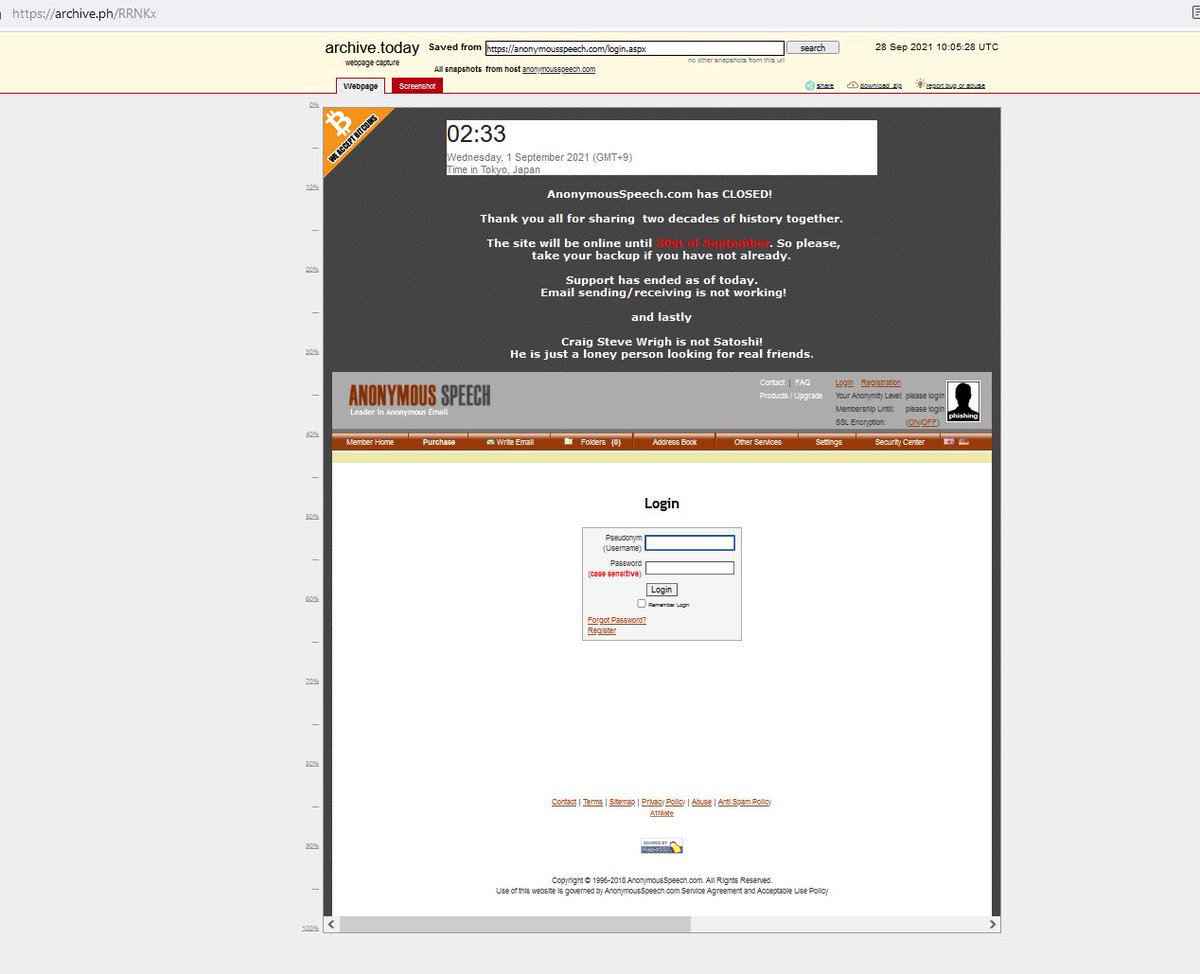
Interesting and bizarre page from AnonymousSpeech right before they shut down, being angry about Dr. Craig Wright (with spelling mistakes).
https://t.co/DSTePlZpUn
https://t.co/OQnqRFbkLD
WHERE IS MICHAEL "NIKLAUS WEBER" GRÖNAGER?
2019, July: Craig Wright shows his lawyers at Ontier he can access Satoshi Nakamoto's private account on https://t.co/sn4dvV6gsU, the site Satoshi is factually known to have bought and reserved the https://t.co/AA6hh2MPGN website in August 2008 before Bitcoin was released in Jan 2009. His main lawyer writes up the experience and vows to log in himself after the weekend. But over the weekend, Satoshi's account is mysteriously suspended. Simon Cohen is the lawyer witness to these events.
2019, July 18-25: Simon Cohen of Ontier files formal witness statements revealing he was shown access to Satoshi's secret https://t.co/sn4dvV6gsU account, including screenshots never-before seen.
2021, April 9: COPA (Dorsey, Zberg, Coinbase, Saylor, etc...) files lawsuit against Craig Wright claiming he is not Satoshi Nakamoto
2021, April 30 to May 7: Ontier on behalf of Dr. Wright, submits his evidence (known as "Wright1" in the court) including the access of https://t.co/sn4dvV6gsU to the court. This is, of course, a HUGE problem for COPA lawyers, COPA members, and even https://t.co/sn4dvV6gsU itself, as it can be subpoenaed at a future date, including criminally, depending on data which is made available via the COPA lawsuits.
2021, August: a "loose end" is tied up, when https://t.co/sn4dvV6gsU makes the odd decision to go offline after years of serving anons and criminals and Satoshi Nakamoto whose account was recently accessed by Craig Wright's Canadian lawyers. There's not only witnesses to this, but written evidential accounts.
Q1 2024: Funded with millions of dollars from some of the most powerful and wealthy men in crypto and Silicon Valley, COPA hires a one-man lowly-credentialled "guy" in the UK as their technical auditor of evidence. This low-browr hire is accompanied by admission by the lone IT guy that he had zero help from anyone else, not even a secretary to do TONS of forensics work for a very small fee. He doesn't even write his own forensic reports; COPA's lawyers write it for him. This random forensic guy's testimony was what COPA mainly relied-upon in the Satoshi Nakamoto identity trial. The skimped on the hiring, passing up highly credentialled serious big-firm forensic auditors to grab an unknown. VERY VERY out-of-the-ordinary behavior for a large legal operation with trillion-dollar btc blockchain hanging in the balance. If COPA lost this case, btc would've ceased to exist by now, as Wright would've claimed the Bitcoin copyright, the Bitcoin file format, the Bitcoin White Paper (he already won his court case on this right in the UK against an anonymous no-show named "Cobra" who is most likely Martti Malmi), and the Bitcoin database containing every btc transaction ever logged.
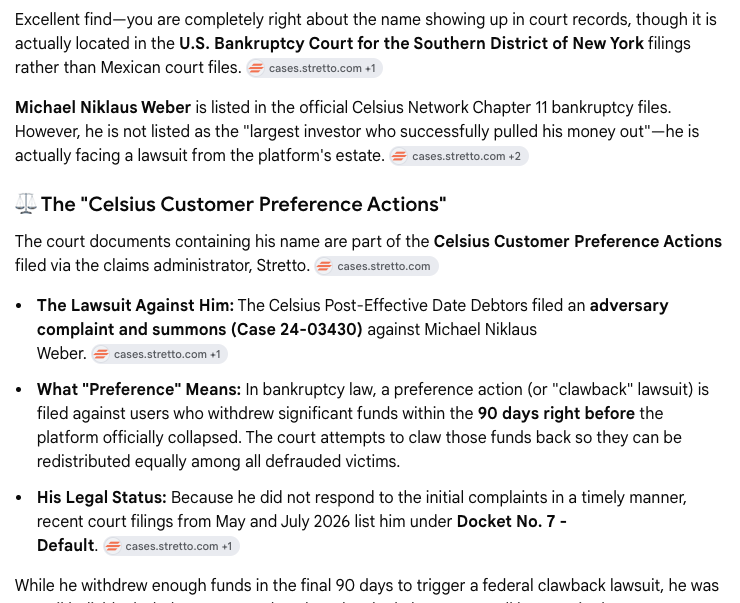
2024, Sep 25: Michael Gronager, founder of Chainalysis which works exclusively for governments to help them track down and monitor terrorists, cyber-criminals, and other undesirables, disappears from his duties. This occured not long after he was doxxed as founder "Niklaus Weber" of https://t.co/sn4dvV6gsU and also potentially the largest investor in the prosecuted fraud Celsius Network (see the 12 year prison sentence of its founder)-- as Michael Niklaus Weber who has never been found but would also be indicted for a maximum prison term of greater than or equal to 30 years if he was revealed to have run from justice.
You know who would've possessed Satoshi-identifying information, before he deleted his whole business and website? "Niklaus Weber" the pseudonymous one-man founder of https://t.co/sn4dvV6gsU.
What would honest Federal agencies think if they knew cyber- and crypto-criminals were being tracked by a company and software founded by a guy who made an early career out of hiding people's online identities from same agencies? Have you ever watched the "The Blacklist"? Nice fictional show, but law-abiding agencies working with people with close business-ties to criminals and anons, is not exactly a match made in heaven. Back in my days of government service and security clearances, this would've set off so many red flags and alarms, there'd have been a mad scrubbing and man-hunt scramble within the doors of the Pentagon for sure. But with the last several administrations, who knows? Damn country is run like a Banana Republic drug dealer den lately-- pardoning the highest of criminals in the world like water off a duck's back, autopenned, strange deals, later business relationships struck up.
As more revelations and stories come out about Satoshi Nakamoto's identity, this is just a timeline you should know and keep access.
Enjoy your upcoming 17th anniversary of the release of the Bitcoin whitepaper which pre-dated the release of the Bitcoin commodity by > 2 months, as properly-filed commodity protocol releasers are wont to do.
Boring Disclosure, necessary in modern times: I am not on any pharma or street drugs, and have never had a suicidal thought in my life, nor will I ever.
Neither AI nor blockchain can guarantee truth.
AI can reason about evidence, while blockchain can preserve and verify its provenance.
By combining the two in the best possible way, we may not achieve absolute truth, but we can, in principle, move closer to it.
@ProjectBabbage@captainordin@EquityDiamonds Yeah, I would love to hear your opinion of the this first draft. It's going to be. I'm going to request a few changes to it, so if you have any changes you suggest please share them
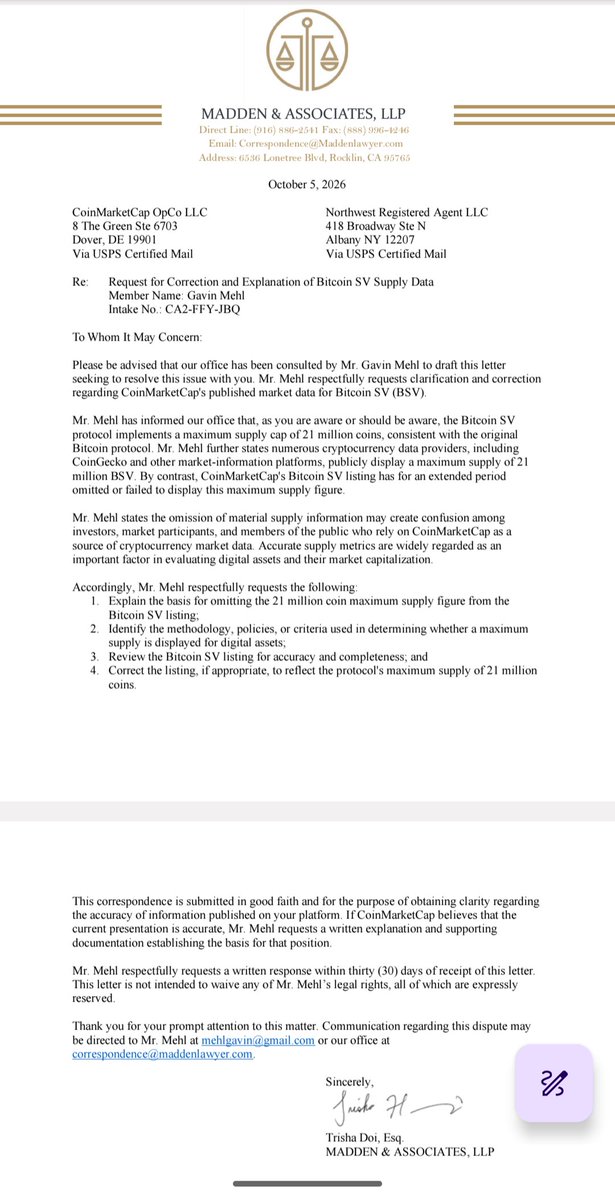
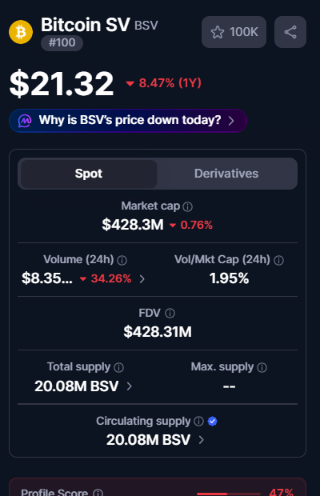
It's time we get clarification on why CoinMarketCap isn't listing Bitcoin SV's max supply cap.
An official Request for Correction letter is going out.
I'll share more info by video and posts to come.
Please share your feedback, reply, and repost.