The thing I’m most grateful to Elon for is bringing back an age of wonder and excitement to humanity. That was jaw-dropping awesome! Screams and mouths wide open in the audience. Nuts.
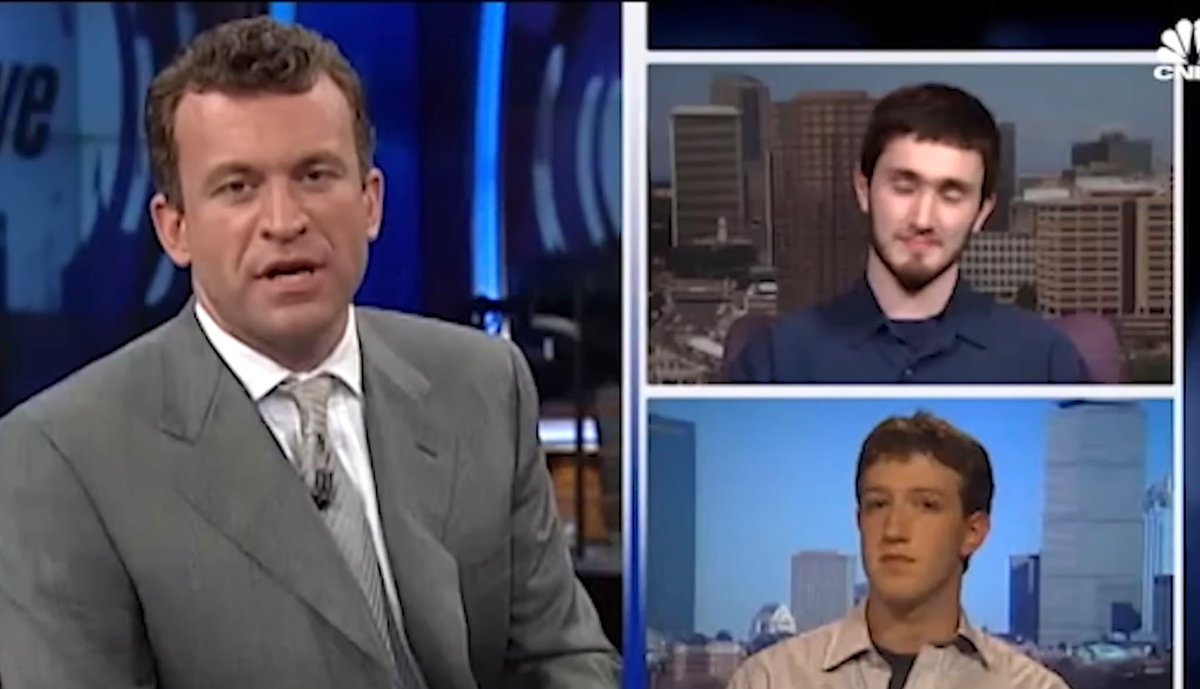
In April of 2004, I conducted the first national interviews with a 19 year-old Mark Zuckerberg on CNBC. I was a young anchor. He was younger, explaining a college website called https://t.co/gTpy9vPGSy
I asked him how big he thought it could get.
He said he had no idea, but he was planning to at least add a few hundred more universities.
I had no idea what Facebook would become. Zuckerberg was building it and he didn’t know either.
I think about that interview whenever I hear the people building artificial intelligence tell us what our future will be. I think about it when journalists announce what those builders will do to the rest of us.
They don’t know.
One future is an ownership class and a slave class. A few companies own the models, the computing power and the channels through which everyone else reaches them. The rest of us rent access, surrender our data and compete for whatever human work the owners still choose to buy.
Another future is the opposite. A person who never had a research staff, a software team, a translator or a lawyer gains capabilities that once belonged only to institutions with money.
People make things, solve problems and find one another without asking permission from the organizations that used to control the tools. Intelligence spreads. Human agency grows with it.
And then there is the third future. The one none of us has imagined. In 2004, neither the founder nor the journalist understood what would grow out of a college directory. We are even less entitled to certainty about a technology that reaches into every form of work and thought.
These are not forecasts. They are possibilities. The outcome will be shaped by decisions made now while the technology is still taking form.
We have already seen what happens when a tool that connects people becomes a gatekeeper. The internet put extraordinary power in our hands. It also built extraordinary power above our heads. Both things happened. Nobody predicted the whole bargain when we were interviewing college founders about their websites.
That experience makes me suspicious of anyone selling inevitability. The CEO promising universal abundance has a company to finance. The CEO warning that only a handful of firms can safely build these systems has a moat to defend. The journalist declaring that everyone will be replaced has a headline to write.
Artificial intelligence can become an instrument of domination. It can become an instrument of liberation. It can become something we do not yet have words for.
Our job is to keep the future open. Keep human judgment and human contribution valuable. Refuse to hand the power to decide our lives to a small circle of companies simply because they arrived first.
I asked a young founder how big his creation would get. The honest answer was that he didn’t know.
Neither do today’s AI prophets.
Subscribe: https://t.co/J9vB6EUwAt
When I left MSNBC in 2012, I went to Louisiana to build equipment.
The idea was to turn shipping containers into self-contained resource stations: solar power, water filtration, food production, and wireless connectivity. Linked together, they could form a distributed infrastructure for basic human needs.
We built them in Louisiana and Texas, using local manufacturing and training returning combat veterans to deploy and maintain them.
The goal was simple: replace dependency with distributed local capacity.
The idea attracted attention. The New York Times wrote about it. Foundations, corporations, and governments met with us. Eventually, I presented it at the State Department.
People consistently liked the concept. Meetings went well. There was interest and encouragement.
But no one put it into practice.
It’s possible the technology wasn’t ready or that better systems existed. That would be a reasonable explanation.
What was harder to explain was the outcome: nothing.
More than a decade later, global resource infrastructure still largely revolves around centralized delivery—moving water, food, power, and equipment into places —rather than enabling local production.
One meeting at the State Department sticks with me and may clarified why.
I presented the system: power, water, food, connectivity—local resilience, using oil industry expertise for the resource hubs and veterans as the workforce.
It was met with the standard high level of enthusiasm, but with zero engagement beyond that.
A state department official took me aside and explained the problem with my idea.
“If we control peoples access to food, water, electricity and connectivity they need us and we can control them. If we build a distributed network of resource hubs, they don’t -- and we lose power.”
That reframed everything.
I had assumed the goal of aid was identical to its stated purpose: to solve the problem. By that logic, the best system would eliminate the need for itself.
But institutions operate under incentives as well.
A corporation gains value from being the controlling provider of resources.
A charity depends on perpetuating ongoing need.
A government program derives influence from administering temporary assistance that can be withdrawn as a punishment for non-compliance,
Actually, solving the underlying problem -- remove the institution’s role.
This doesn’t require conspiracy. It simply reflects how incentives align.
It raises a question I’ve thought about since:
Do our systems want to solve the problem?
Often the people inside it do.
But solving a problem -- and managing a problem to accumulate as much power and money as possible are not the same function.
I was invited into a banquet hall at the Waldorf Astoria hotel in New York for a chance to meet privately with my childhood hero, Muhammad Ali.
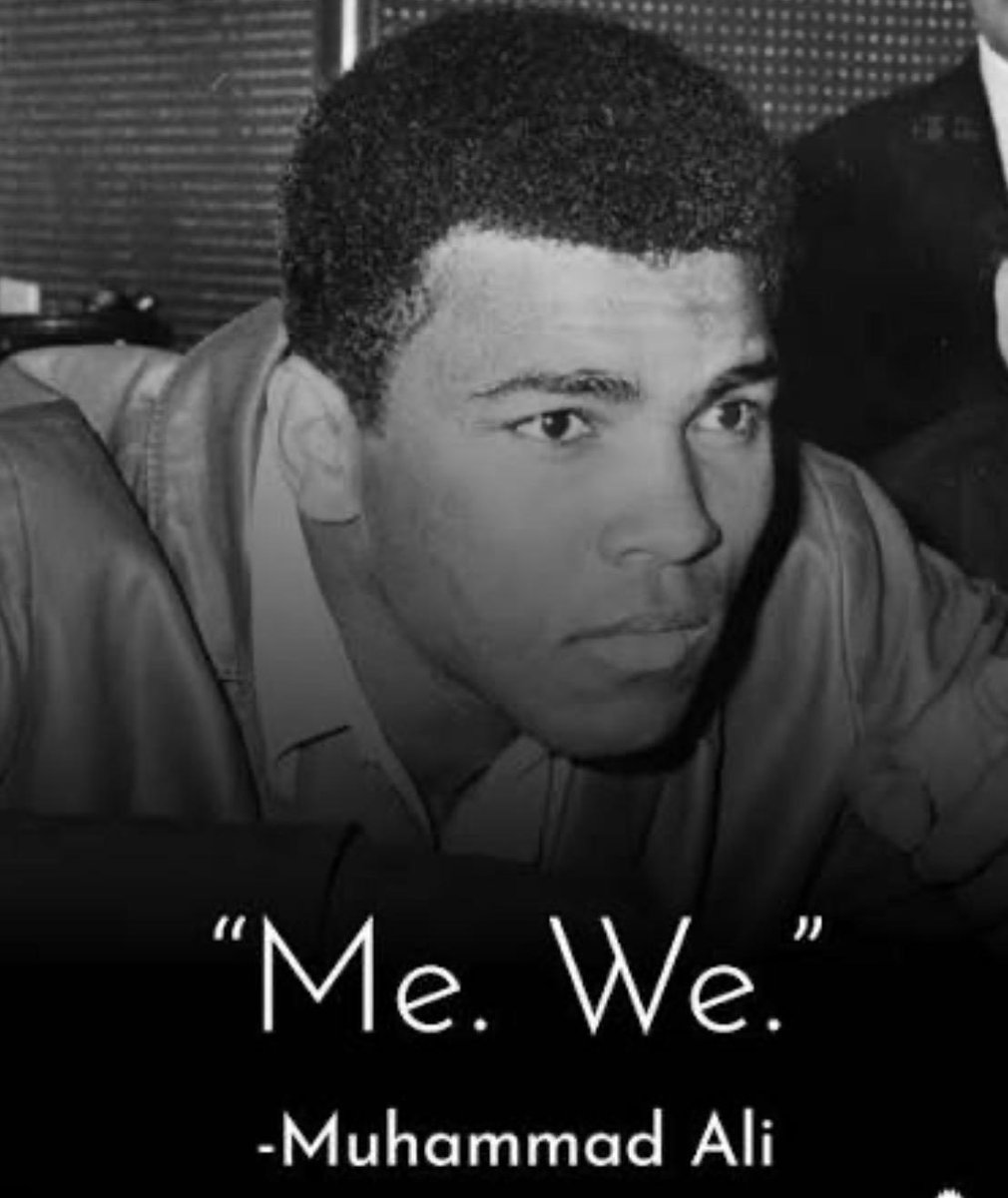
His Parkinsons was advanced and I kneeled by his wheelchair and held his hand and thanked him for the gift he had given me simply by his existence. I said to him, “me, we” and he squeezed my hand tight as I spoke those words.
In 1975, Ali had gone to Harvard and was asked for a poem. He gave them those two words.
“Me. We.”
It has been called shortest poem ever written. Harvard’s own history records Ali as that year’s Class Day speaker.
I have thought about that poem for years because they contain everything.
Me.
We.
I exist. You exist. We are here together. We are.
Not we do, or we have, or we want, or we need, or we lost… but we are.
Much of modern life is organized around convincing us that something is missing and that someone is to blame. Our need for more. More money, more status, more sex, more followers, more power, more recognition. Our certainty that its absence is someone else’s fault and that if we only had it, we would be enough.
A person who believes he is incomplete is profitable and dangerous as he will do almost anything to feel complete. Promise him the missing piece and he will keep reaching for it.
Politics and war offer another political or national enemy whose defeat will finally make everything right.
The gambling machine says the next hand will change everything. Pornography promises another fantasy. The algorithm promises another little reward.
The promise is always tomorrow, the relief is always one acquisition or domination away -- but it never arrives, and in the process, it drives ever increasing extremes in risk taking, consumption and destruction.
I see the same thing in the strange performance of masculinity that has become so common. The money. The women. The cars. The domination. The public humiliation of weaker people. The endless need to prove strength.
But that isn’t strength, it is insecurity with resources.
The strongest men I have known rarely needed to demonstrate that they were strong.
Italy taught me something about this too.
Go south to Naples and watch a man flirt with a woman walking past a café. He looks at her. She catches him looking. He smiles. She smiles back. There is a sparkle between two people who may never see each other again.
Then she keeps walking.
Nothing happened, there was no conquest, no manipulation, no expectation that the moment had to become sex, ownership or possession. A man enjoyed being a man. A woman enjoyed being a woman. For a few seconds they recognized something delightful in each other and then returned to their lives. The connected to the joy of being human.
This is enough.
There is something radical about that now.
If being alive is already meaningful, you are much less inclined to steal, corrupt or compromise the welfare of strangers for the benefit of your own misguided search to be “enough.”
This is why I believe that underneath the corruption, greed, self-dealing and manipulation in our government and in our society is something much simpler.
A spiritual void.
Not religion in the institutional sense, something more basic.
The understanding that there is a power greater than any one of us, that we are connected to that power always, and we are connected to one another whether we acknowledge it or not.
The understanding that your value is not created by your bank account, title, the number of people afraid of you, or the size of the audience watching you.
You were alive before you acquired any of those things, you will lose all of those things. But you matter before anybody applauds and you matter long after they stop.
More can never solve the feeling of not being enough.
There is no political or economic policy that can establish this grounding place. Only a spiritual solution.
Ali put it into two words. Me. We.
Subscribe: https://t.co/J9vB6EUwAt
The Buffett Paradox
I was 24 years old when Warren Buffett invited me to sit next to him at a minor league baseball game in Omaha, Nebraska.
It was the late 1990s and the Omaha Royals were playing at Rosenblatt Stadium during Berkshire Hathaway’s annual meeting weekend.
Buffett sat to my right; people came up one after another. Autographs, pictures, handshakes.
In between, I peppered him with questions. Buffett was already one of the richest men in the world, however what interested me wasn’t his wealth. It was how he thought about capitalism.
Buffett believed the most important consideration was that capital should find good people.
Give trustworthy people control of good businesses and resources. Let them work. Let them create real value over long periods of time.
The product didn’t have to change the world, it could be Coca-Cola, it could be See’s Candy.
What mattered was whether the people running the company could be trusted to allocate capital intelligently.
Then we started talking about the estate tax. I thought I understood it. I didn’t.
Buffett didn’t describe the estate tax as a punishment for rich people. He didn’t even principally describe it as a way for the government to raise money.
He described it as critical part of the machinery of capitalism.
Capital must circulate to ensure society adapts and grows.
Europe had spent centuries building aristocracies in which enormous pools of wealth passed from one generation of a family to another and the continent had stagnated. America was built in direct rejection of this idea.
Buffett argued that America must be different. The people who created great fortunes had demonstrated an ability to allocate capital. (Monopoly and regulatory capture were not so prevalent at that time to make money.)
The children of the rich had demonstrated only that they had chosen their parents well.
He gave me an analogy I never forgot.
Imagine choosing the next Olympic team from the children of the current gold medalists. Maybe the fastest man’s son is fast, maybe his daughter is faster.
But there is no reason to believe either is the fastest person in America….so why would we assume that the child of a brilliant capital allocator is also the person best qualified to allocate billions of dollars? Especially when this allocation is a critical function?
Buffett’s argument was not against wealth. It was against an aristocracy that freezes the flow of capital to productive use.
Break up enough dynastic capital and the money has to compete again. (This also assumes a trustworthy government that doesn’t squander our tax money on war and fraudulent government contracts.)
The freed-up money finds the young entrepreneur, the engineer, the immigrant.
The kid nobody has heard of with an idea nobody understands yet. The hungry people.
That conversation changed how I understood the estate tax.
I stopped seeing it simply as a debate about taxation. I began seeing it as a debate about who gets the next chance.
Warren Buffett has spent his life arguing that capitalism works best when capital follows ability rather than bloodline.
He has also arranged for the overwhelming majority of his personal fortune to be given away rather than simply inherited by his children.
But now, at the end of one of the greatest careers in American capitalism, his son Howard is succeeding him as chairman of Berkshire Hathaway.
There is an important distinction.
Howard Buffett isn’t taking over Warren’s job running the company. Greg Abel is CEO.
Howard’s role is different. Still, the symbolism is impossible to miss. The man who taught me that America should not choose its next economic leaders from the children of its previous winners—has chosen his son to guard the institution he built.
Maybe there is no contradiction, just something endearingly human.
But the larger principle he taught me that night remains more important than the irony. Healthy capitalism needs circulation, of money, of ownership, of opportunity, of power.
When capital stops circulating, capitalism begins hardening into something else. The people who inherit the money keep the money usually with limited productive use.
Children inherit the money, then they inherit the institutions and eventually they inherit the power.
That isn’t capitalism finding the best and brightest. That’s the very aristocracy America was created to reject.
I was 24 years old when Warren Buffett taught me the difference.
I never forgot it
Subscribe for free: https://t.co/J9vB6EUwAt
They don’t make ‘em like they used to… I mean that sincerely. There is no artist alive today who will leave the legacy that Dolly Parton did. Most music today is slop, and even the “good” music is (mostly) devoid of real heart and soul, and it certainly won’t be remembered in 50+ years…
Dolly released “Coat of Many Colors” in 1971. Take a couple minutes and watch this video. You listen to it today and you get the same goosebumps folks did when they heard it over 50 years ago. The same happy-sad pang in your gut. You actually feel something. You feel her story. Her love for her mom, and her mom’s love for her. When you listen to her sing you know it’s true. She opens up part of her soul and shares it. What an incredible gift she gave us all.
She came from nothing and became one of the most iconic musicians that ever lived. She also gave back what she was given. Not because her agent told her it would be good PR or to virtue signal on Instagram, but because it was who she was.
To bring such joy to the world through music is out of reach for almost all of us. But to raise people up through our actions is something we all can and should strive to do, even if we fall far short of Dolly.
What a truly beautiful human and amazing life. Rest in peace, Dolly.
Weird economics up on the agent-only runescape server
- Low cost of labor makes most commodities abundant
- Currency inflation means trading goods for goods, nobody really wants cash
- Huge swarm contention as certain resources with limited respawn rate become valuable
Bitcoin is one of the greatest game theory experiments in human history:
a global system that turns self-interest, competition, scarcity, and distrust into incentives to secure and sustain itself
In 1982, Robin Williams did a routine as the American Flag for the Norman Lear produced tv special "I Love Liberty" created to bridge political divides - and it's one of the greatest pieces you'll see 🇺🇸
I’m thankful for my family, my health, the privilege of living in the greatest country in the world, and the blessing of being alive as we begin the Age of Abundance.
Bitcoin not threatened by AI.
Google’s Willow chip has 105 physical qubits.
Google estimates that millions of physical qubits would be required to threaten modern cryptography.
Even under wildly optimistic and incorrectly extrapolated assumptions (that the quantum device can do SHA-256 at that rate and sustain it), it would still take ~10 hours on average to find one block.
And Bitcoin’s entire global network produces one every 10 minutes.
The ever wise Greg Maxwell on Core v Knots.
Summary to paraphrase,
“I hate spammers intended use of the bitcoin blockchain with every fibre of my being, but will fight to the death for an open permission-less system the doesn’t allow me or anyone else to police transactions because that’s more important and why I and others have worked on bitcoin all this time.
If you don’t like it fork off, we don’t make engineering choices based on popularity or an American Idol voting system. If we did Bitcoin would have died long ago “
@zerohedge True.
That is why Bitcoin is based on energy: you can issue fake fiat currency, and every government in history has done so, but it is impossible to fake energy.