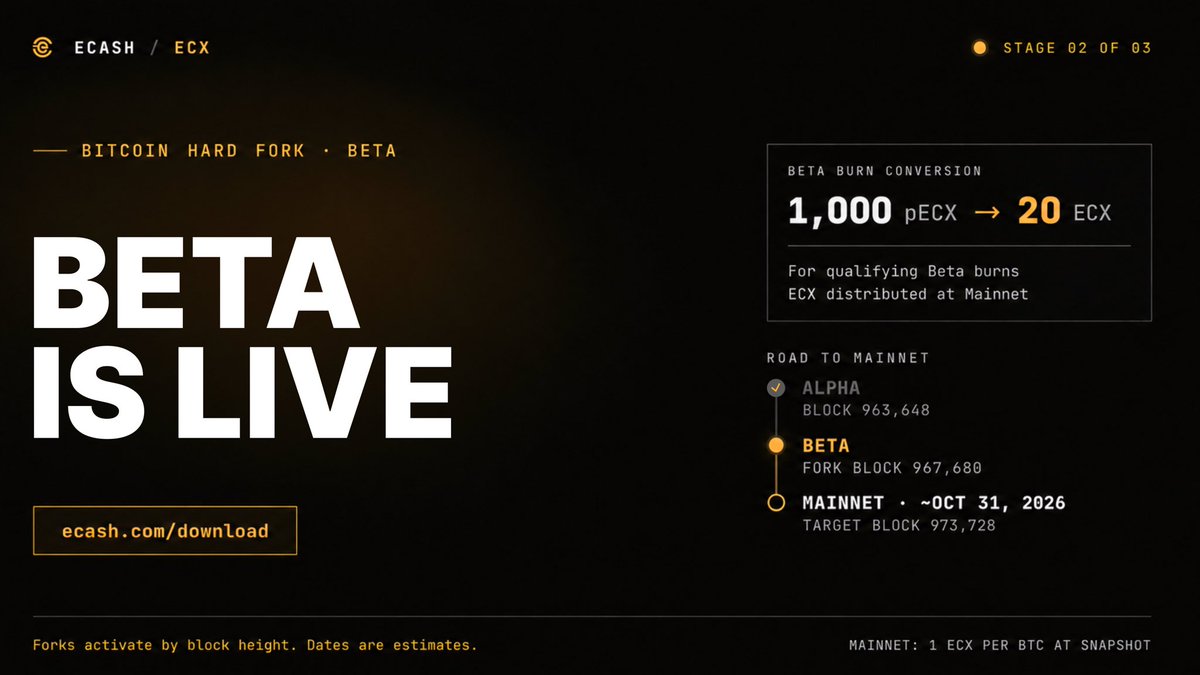
Bitcoin Hard Fork: eCash Beta Is Live
Bitcoin's biggest limitation has always been change itself. New functionality means years of soft fork debate, while L1 stays intentionally frozen to protect the monetary base.
Drivechains (BIP 300/301) fix this: sidechains pegged to BTC, independent of L1. Succeed, and Bitcoin gains new utility and fee revenue. Fail, and L1 is untouched.
eCash is the first real network built on this model, and Alpha proved it. Hashrate hit 9.44 PH/s, 7 independent pools mined blocks, and the community shipped a bunch of tools unprompted:
1/ https://t.co/A1wvy4Uqfq / https://t.co/RIEEJinMIX - first pECX↔BTC AMM, built in days
2/ https://t.co/cv0wurxzd7 - pECX faucet, hit by proxy farmers within hours
3/ https://t.co/LOYl4QX5X7 - the first block explorer
4/ eCashPool & NurseryPool - community mining pools, one paying out in Thunder on principle
5/ https://t.co/8ct2lnL8Ec - drivechain fee tracker, flipped live weeks early
6/ The eCash Splitter - official coin-splitting tool, GUI + CLI, shipped mid-alpha
New drivechains proposed. Blind merge mining tested live. Consensus bugs diagnosed by block height and root cause, faster than most funded eng teams manage.
Beta is now live: https://t.co/RoPIv0wtTc
Beta improves the pECX burn rate 👉 1,000 pECX → 20 real ECX (up from 10 in Alpha)
The pECX tokens are in addition, not instead of the original 1:1 airdrop. Every BTC holder still gets ECX 1:1 at full launch on October 31 regardless. Burning pECX now is a bonus on top of that, extra ECX for showing up early.
Receiving and splitting:
Hold BTC non-custodially at the fork block, you get equal ECX automatically, nothing moves or converts. eCash uses opt-in protection, not built-in, so every wallet and exchange keeps working on day one, but that means until you split, moving BTC could move your ECX too.
Splitting is a one-time fix, three ways to do it, two are one-tap in official eCash software, the third uses standard Bitcoin tooling only.
BTC on an exchange? You can't split yourself. We're in touch with exchanges about crediting ECX, or you can withdraw to self-custody before Oct 31 and split it yourself.
👉 https://t.co/RoPIv0wtTc
Getting ready for fork?
Start at https://t.co/SjWKMU2Izq and follow the flow for onboarding, coin-splitting guides and the checks to make before moving your coins.
How did a decade of sidechain research and Bitcoin debate end in a fork?
It started with Drivechains, @Truthcoin’s proposal to connect Bitcoin to sidechains.
Here’s the eCash (ECX) backstory, explained 🤓
The eCash hard fork is launching in 6 days
On Bitcoin’s 18th birthday, every BTC holder will receive free ECX
So here’s a documentary that explains why @Truthcoin decided to launch this fork and how it’s different from Bitcoin
Time stamps:
0:00 Teaser
0:54 Title
1:45 Act I: The Announcement
3:39 Act II: The Derangements
9:52 Act III: How Drivechains Work
14:32 Thunder & zSide
18:21 Act IV: Paul Is Right
19:08 Paul vs. the Lightning Crowd (TABConf 7)
22:14 Paul Sztorc vs. Peter Todd
24:47 Alex Gladstein vs. Paul Sztorc
27:04 Act V: October 31, 2026
34:00 Credits
eCash hard fork forecast: now Thursday, Oct 29 at ~2:30pm ET.
BTC blocks have been arriving fast, so the fork is landing earlier than expected.
If you self custody your $BTC, you’re getting $ECX. If you keep it on an exchange, you’re at the mercy of the exchanges to credit BTC holders at the fork.
Hardfork forecast: Thursday, 2:30 PM EST !
Lately, BTC Blocks have arrived extra-fast, so the fork is happening sooner than expected.
Remember: Self-custody your BTC! If you keep it on an exchange, they may not give you your ECX.
BUILD SOMETHING WEIRD.
Your first ECX project does not need a pitch deck. A tiny, weird demo will do.
Show what it does, link the repo, label the network and tell us where you're stuck.
https://t.co/cbHlcGOKTK
Bitcoin should have been the natural home for new ideas. Instead, its culture forces builders to fight, tooth and nail, just for permission to try. (Which they mostly don't get.)
Every ETH / Doge / Solana / etc project should instead be on BTC -- using BTC, and paying fees in BTC. This brings life to Bitcoin itself. Sadly, Bitcoin has squandered this opportunity for 10+ years.
With eCash, we get a glimpse of how things could be different.
For example, there is a new project "Fork", which is sorta like a https://t.co/yO9Ye50grF on eCash. I don't know if they will succeed, but I wish them good luck. @forkpadorg
Projects such as https://t.co/yO9Ye50grF are indeed silly, and irreverent — but so was the early internet. So was Bitcoin when it first came out. (Remember the "join us" wizard?) We need to let users be users.
After all, do we really want to live in a world where it is easy for someone to gatekeep what you do with your own BTC (or ECX)? I don't.
Bitcoin is facing a brain drain.
Developers leave for ecosystems that let them try an idea and see if the market wants it.
Sidechains will bring that freedom back without turning every experiment into an argument over changing Bitcoin itself.
Full piece below.
Today, developers have to convince Bitcoin a feature deserves to exist before the market gets to judge it.
Sidechains flip that. Build it first. Let users choose. If nobody wants it, it disappears.
ECX network support in a wallet you control
Tria provides self-custodial wallet support for ECX. Allocations are subject to the ECX project’s eligibility rules and terms.
Here’s what BTC holders should know: https://t.co/Ndzs0Q5J7u
I have been warning of Bitcoin fatigue for many *years*, especially in my "post maximalism" essay (2018)
Unfortunately, few heeded my warnings. Now, the disaster has come to pass.
The fatigue is from:
- bs politics
- no soft fork upgrades
- lying to ourselves, constantly about lightning (et all)
- courting the NGU class (Saylor et al)
- courting the "toxic" class whilst not having our own act together
- hating on users (for example ordinals)
The sad truth is: Bitcoin has, in fact, been dying the last 10 years. Not economically or technically -- but culturally.
Will make a video on this ~tomorrow
The problems with Bitcoin are not technical. They’re cultural.
Core developers have become timid, self-interested, and lazy. Miners have abdicated their duty to maximize revenue and the utility of the coin.
Bitcoin has ossified, and it can’t be fixed from the inside. So we’re fixing it from the outside.
Bitcoin can’t ship new features. eCash solves Bitcoin’s upgrade bottleneck.
Shoutout to @TheBlockCo research team for breaking down how drivechains turn a Bitcoin hard fork into a permissionless testing ground, with 7 chains going live Oct 31.
Read the report: https://t.co/2LDkACMzY9